Reference
How beadwork is built
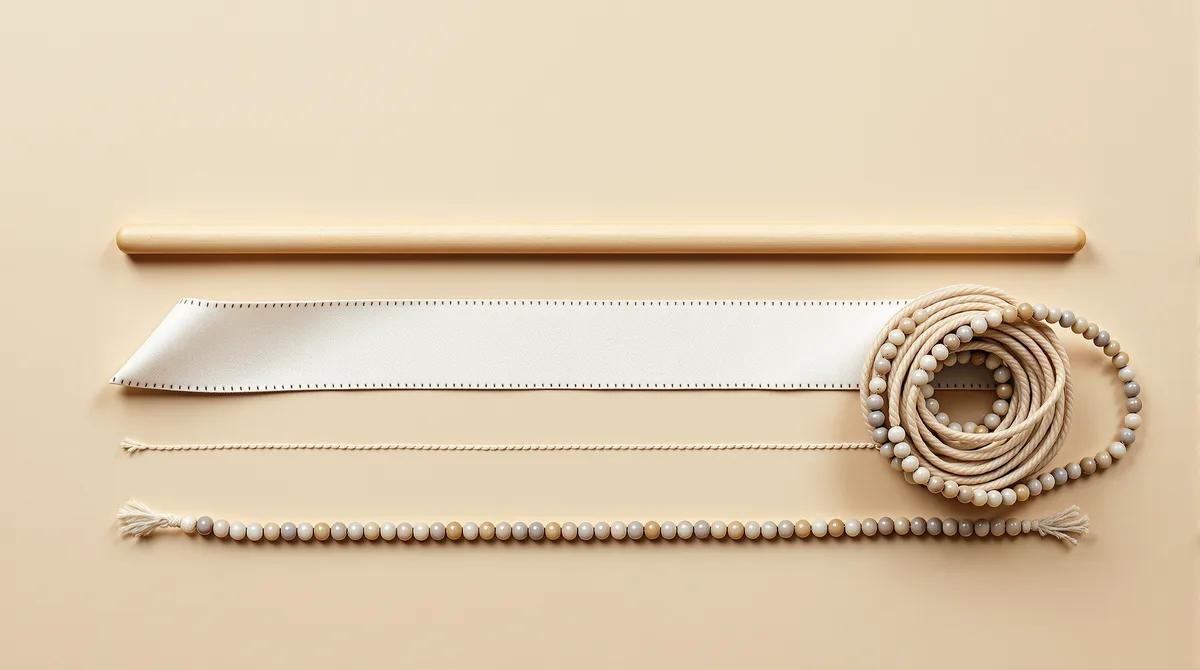
Five craft families — strung, embroidered, wire-wrapped, knotted and wrapped fibre — and what each one is good for.
Specs and sizes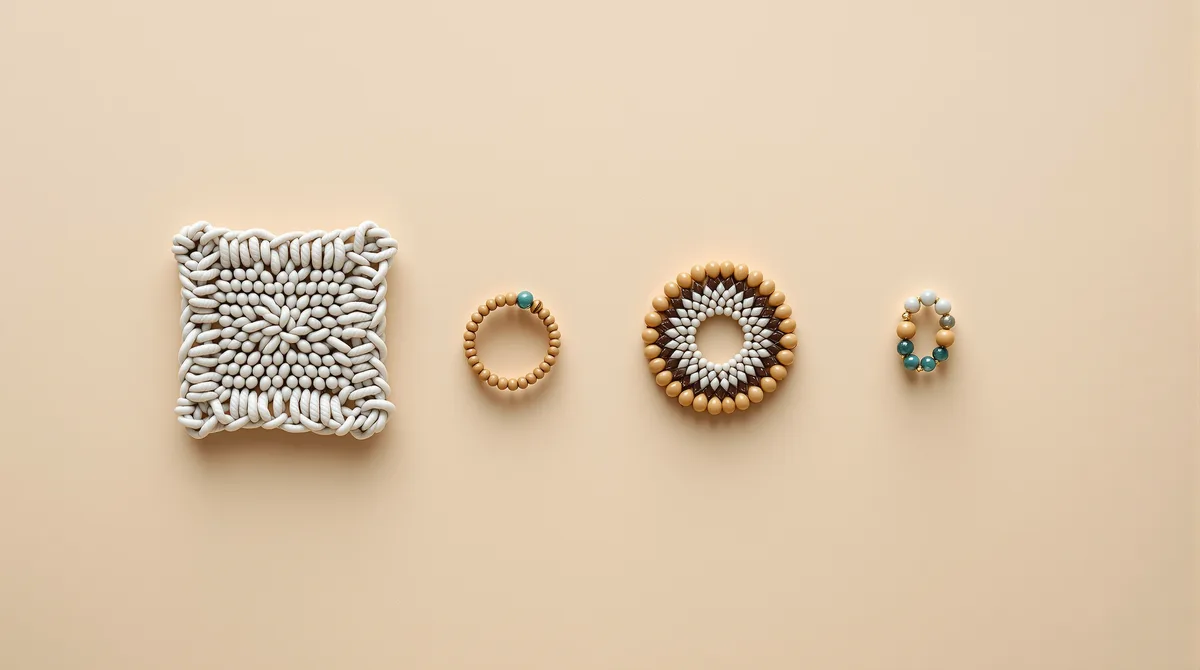
Manufacturing · Zardozi
Zardozi is a named metal-thread embroidery tradition of the Indian subcontinent. The bead-and-thread version of it is the technique behind almost every flat beaded object we make — coasters, cushions, ornaments, purses.
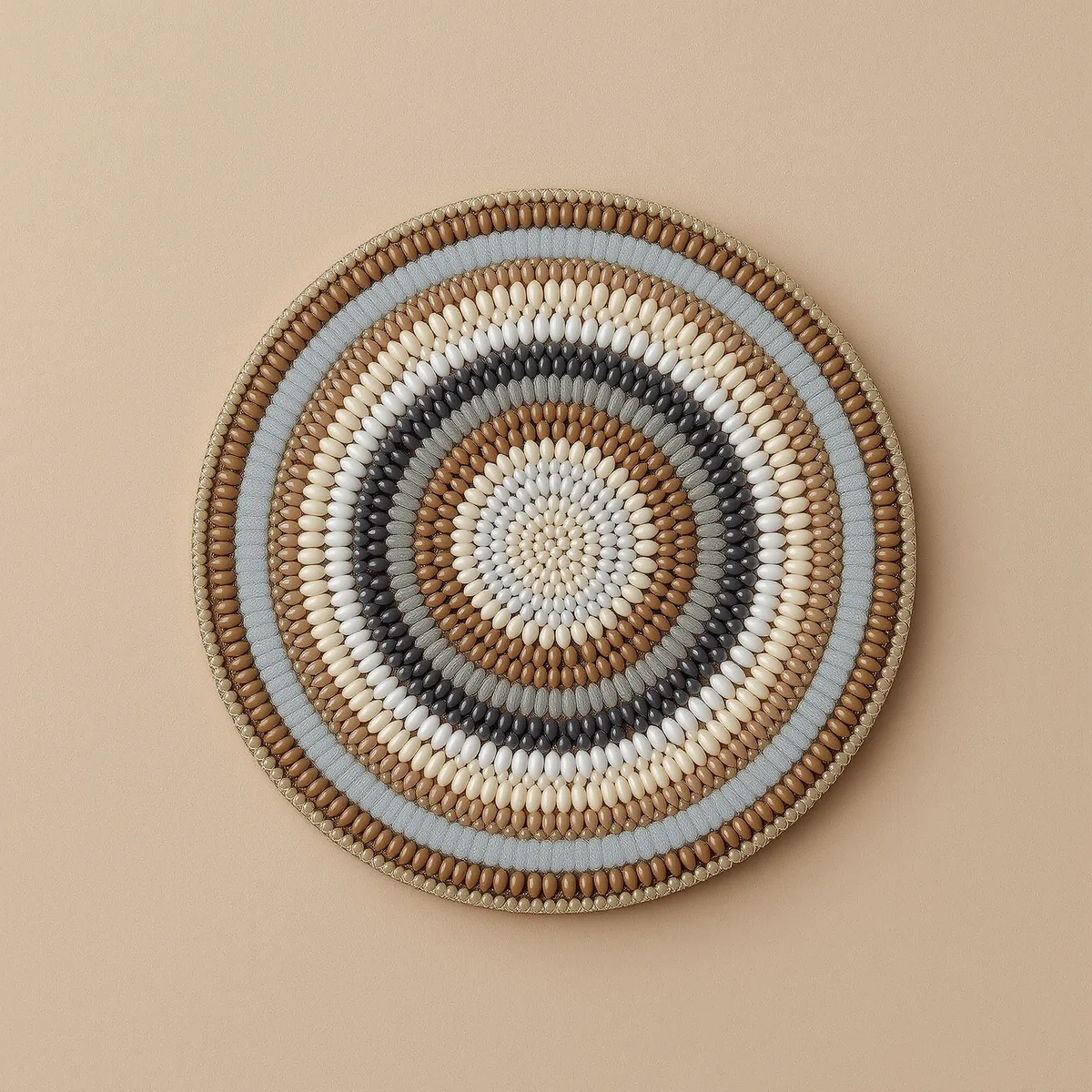
Four small beadwork samples laid out in a row: a knotted macramé square, two wire-wrapped beaded collars and a disc of couched bead embroidery.
Zardozi is a metal-thread embroidery tradition of the Indian subcontinent, in which motifs are couched onto a stretched ground rather than stitched through it. The bead-and-thread version substitutes glass seed and bugle beads for some of the metal, and it is the technique behind our flat beaded objects: coasters, cushions, ornaments, purses and appliqué.
Zardozi is a metal-thread embroidery tradition of the Indian subcontinent, long associated with court and ceremonial textiles. Its defining characteristic is couching: the decorative material is laid on the surface of a stretched ground and held down by a separate fine thread, rather than being pulled in and out through the cloth. That is why zardozi can carry heavy metal wire, coils, sequins and beads, none of which could survive being drawn through a weave.
It is a living craft with a long history and many regional hands. What we run is the bead-and-thread version of it: glass seed and bugle beads couched with metallic thread. We do not claim the tradition. We work in it.
This family runs across coasters, cushions, appliqué patches, brooches, ornaments and purse panels, and the construction is the same throughout. A bead map is drawn so every bead position is fixed. The ground — stiffened fabric or felt, or a woven face cloth for a cushion — is prepared and held taut. Beads are laid in sequence and couched down, the thread crossing between beads at every stitch. The piece is then finished: felt-backed with a turned edge for a coaster, made up into a cover for a cushion, mounted for an appliqué patch.
Pictures. That is the whole reason it exists in a beaded décor range.
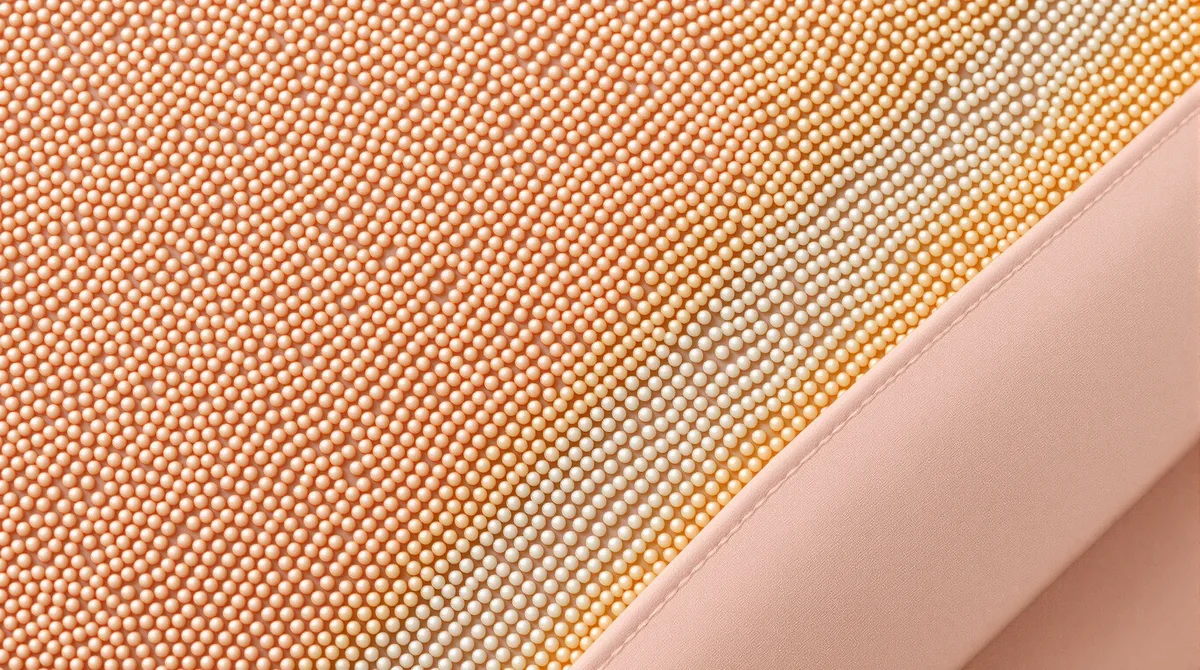
Glass seed beads at one to three millimetres behave like pixels: enough of them laid side by side stop reading as beads and start reading as an image. A letter, a face, a leaf with tonal shading — none of that is available to strung work, where gravity dictates a line, or to wire-wrapped work, where the armature dictates a shape. Couching is the only technique in the family with no structural opinion about where a bead goes.
The second thing it does is dimension. A couched floral can stand nine to twelve millimetres proud of its ground, built up in layers, which is a sculptural effect no flat stitch achieves.
Glass seed beads and bugle beads carry the work. Metallic thread and zari sit in the same stitch, as they do in the parent tradition. Sequins, flat-backed cabochons and small rhinestone settings are all couched the same way, and crochet appliqué or a knotted element can be laid onto the same ground where a design calls for mixed craft.
On the ground: stiffened cotton or felt for anything that must lie flat and hold a dimensional motif; woven poly-cotton or velvet for a cushion face. The ground is the specification buyers most often leave out and the one that decides whether the piece behaves.
| Specification | Value |
|---|---|
| Craft family | Bead and thread embroidery, zardozi tradition |
| Forms in the family | Coasters, cushions, appliqué patches, brooches, ornaments, purse panels |
| Core materials | Glass seed and bugle beads, metallic thread |
| Ground | Stiffened fabric or felt; woven face cloth for cushions |
| Coasters | 10–11 cm diameter, felt-backed with a turned edge |
| Dimensional florals | 9–12 cm |
| Other forms | Appliqué patches, brooches, ornaments, purse panels |
| Bead working size | About 1–3 mm for seed beads |
| Colour matching | To a colour reference or a physical chip, confirmed on the sample |
| Sampling | 16–20 days from an agreed brief, quoted separately |
| Production | 40–60 days after sample approval |
The size ranges in the catalogue are not arbitrary: they are the sizes at which a seed-bead motif reads properly. Below about nine centimetres a dimensional floral loses the layering that makes it worth building. Above about twelve, the same motif needs more beads than its visual gain justifies, and the answer is a larger bead or a looser fill rather than more of the same.
The ground and its stiffening. The bead material and bead size. The motif, as artwork or a reference image. The infill density. The finished dimensions. The edge treatment and the backing. The colours, with references or physical chips for beads and ground. Then packing, quantity per colourway, and the port or warehouse.
Where an accent bead sits on a field, say whether the field is dyed to match it. That one line removes the most common sampling disagreement in couched work.
Beads are matched to a colour reference or a physical chip and confirmed on the sample rather than on a screen. Ground and beads are approved together, because a bead and a ground at similar tonal value cancel each other out at two paces even when both colours are individually correct.
Dye-lot shift in surface-dyed seed beads is a batch property rather than a fault, and on couched work it shows differently from strung work: a field of thousands of beads averages the variation out, while a single couched motif can show it as a patch.
A brief with the motif, the ground, the size and the colours. A rough cost sheet before anything is made, so look can be traded against price while it is still free to change. The bead map next, which is the document everything else is held to. Then the sample, usually 16 to 20 days from an agreed brief, photographed for approval before it ships.
Beaded décor runs 40 to 60 days after sample approval. Sampling is quoted separately. Where a design mixes couched beadwork with knotted or crocheted elements, the bohemian lead time of 60 to 90 days governs, because the slowest craft on the piece sets the date.
Flat and face-protected, to your carton, label and inner-packing specification. Dimensional work is the exception: a floral standing proud of its ground cannot be stacked, so the packing method is settled at design stage rather than at the end. A boxed set — four coasters, or an ornament set — is the format this technique merchandises best in, and the box is part of the specification rather than an afterthought.
Bead security first, with a pull check across the field. Then the motif against the bead map, bead by bead where the drawing is tight. Then colour against the approved sample, the edge and backing for finish, and the reverse for exposed thread ends. First-article and lot inspection, kitting and export packing run through our own quality and packing house, and published issue rates across the group run at a fraction of a percent.
Bead count first, and on couched work bead count is a function of density more than of size. Then bead size: a slightly larger bead covers the same area with far fewer units and far fewer stitches, and at arm's length nobody can see the difference. Then motif complexity, because a tight drawing is slow at the needle regardless of how many beads it uses.
The reliable lever is de-densifying the infill: keep the outline tight, open the fill. It is the change that most often brings a couched piece to target with the drawing intact.
Home and lifestyle retailers buying under their own label, where boxed couched sets carry a high perceived value for their cost. Gift and seasonal programmes, which is where ornaments and appliqué belong. Boutique design retailers and museum shops, where the named tradition is part of the story. And corporate gifting, where a monogram is exactly the kind of image only seed beads can draw.
Good to know
Yes. Beads are matched to a colour reference or a physical chip and confirmed on the sample. In couched work the ground is matched too, and where a field carries a larger accent the field is dyed to match the accent so the accent reads as the subject.
Within limits, and the limit is the bead. Seed beads are about one to three millimetres, so a motif can only carry as much detail as that unit size allows at the finished dimension. Shrinking a motif means simplifying it rather than scaling it, and a redrawn bead map is the way to do that.
Beaded décor runs 40 to 60 days after sample approval, and that is the figure for couched work. Sampling usually takes 16 to 20 days from an agreed brief and is quoted separately.
Flat, with the beaded face protected so the field is never pressed against another piece, and to the carton, label and inner-packing specification you give us. Dimensional florals need a packing decision at design stage, because a motif standing nine to twelve millimetres proud of the ground cannot be stacked like a flat panel.
Glass seed and bugle beads are drawn and hand-strung in our own Firozabad glass works. The couching is done in our own beadwork studios, which work in zardozi and in faux capiz. Inspection, kitting and export packing run through our own Greater Noida house.
No. Minimums are set per design and confirmed per quote. A couched piece is priced by bead count and stitch hours, and two pieces at the same finished size can differ several times over in both, so one range-wide number would mislead a buyer.
No. There is no retail stock programme for beaded décor. Every couched piece is made to order against a sample you have approved.
Keep exploring
Reference
Five craft families — strung, embroidered, wire-wrapped, knotted and wrapped fibre — and what each one is good for.
Specs and sizesManufacturing
The face cloth, the couched bead field, de-densified infills and the closure — and what actually keeps beads attached on an object people lean on.
See the detailGlossary
The words a bead tech pack uses, defined one term to a page so a specification can cite them.
See the detailHub
The full beaded range — curtains, portals, valances, tabletop, cushions, textiles and beads — from a leading manufacturer that makes the bead as well as the piece.
Compare the optionsManufacturing
Bead-embroidered glass coasters on stiffened felt, or moulded acrylic sets in translucent and opaque — construction, sizes and what moves the cost.
See the detailCraft topic
Beaded flat, then made up: why the seam allowance has to stay bead-free, why the lining carries the load, and the hardware decisions that go with it.
See the detail
Start a conversation
Send a reference, a colour chip or a sketch. Minimums are set per design and confirmed per quote; sampling is quoted separately and usually runs 16 to 20 days from an agreed brief.