Manufacturing
Beaded backdrops
Repeatable backdrop panels, rigging that survives a van, fast reorder of one colourway, and real set-up times.
Compare the options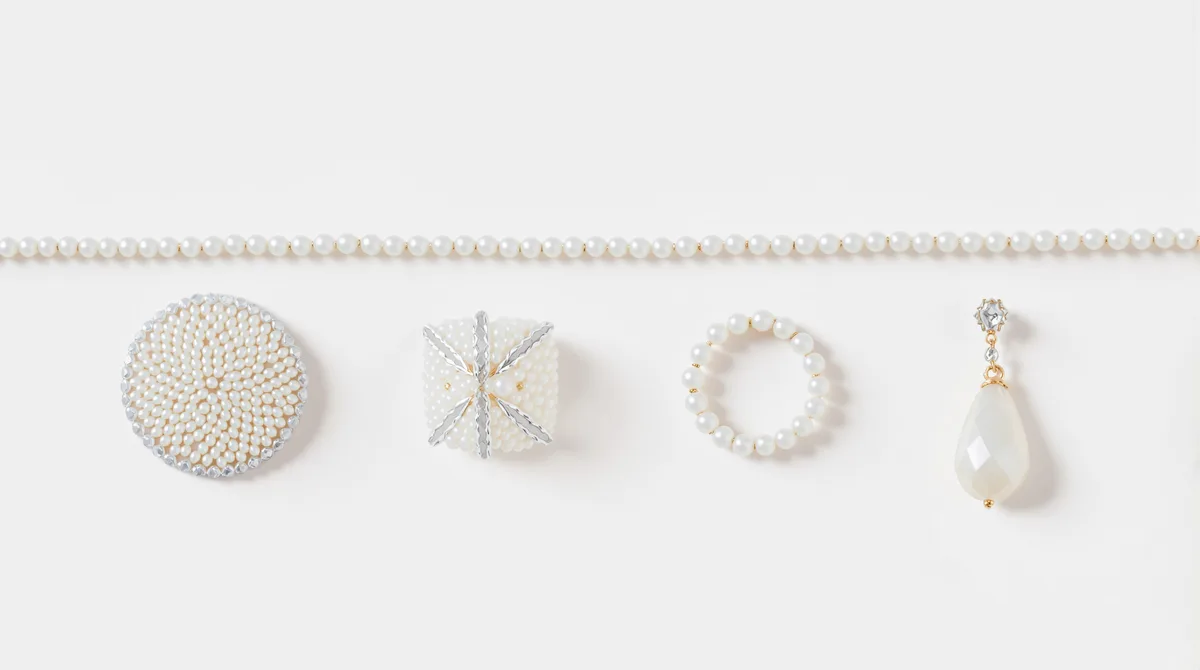
Craft topic
A wedding asks for three different objects at once: something architectural, something linear and something tiny. They share a palette and nothing else, and the three lead times behind them are what actually decides whether the brief is possible.
Pale beadwork laid out in a row beneath a strand of round pearl beads: a disc of couched bead embroidery, a folded beaded square, a small beaded ring and a faceted crystal drop.
Wedding beadwork covers three scales. A backdrop is large-format strung or linked-disc work up to about 90 by 200 cm. An aisle or arch run is trim and fringe quoted by length. A favour is an ornament or charm a few centimetres across. All are beaded décor at 40 to 60 days after sample approval, and knotted work at 60 to 90.

Almost always three objects, described as one.
Something architectural: a backdrop behind a top table, a ceremony arch, a photo wall, a mandap element. Something linear: an aisle run, an arch edge, a chair-back trim, a table-edge fringe. And something tiny: a favour, a place marker, a napkin charm, a gift topper.
A brief that asks for "beaded wedding décor" is asking for all three. They share a palette and nothing else — not the construction, not the bench, not the inspection, and not the lead time.
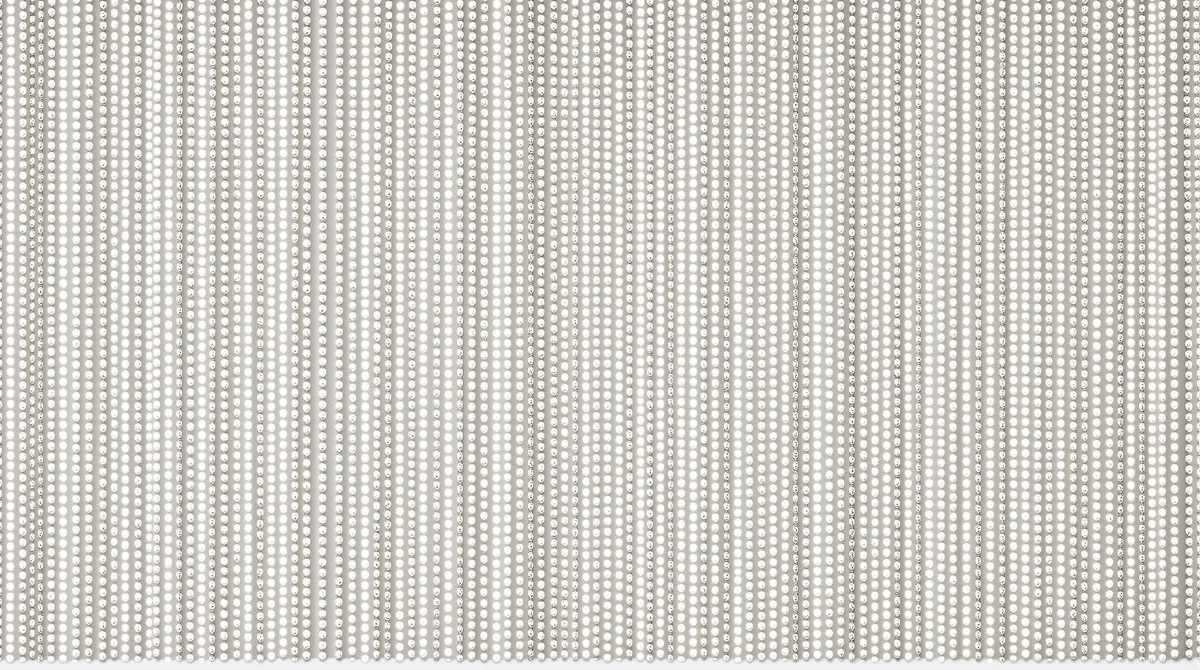
The backdrop is large-format strung work: strands hand-strung on cord to a count sheet and gathered on a header. At the top end it is linked-disc construction — faux capiz discs linked one below the next into columns hung side by side — which gives a far denser surface and is the route to a genuine backdrop-scale piece at around 90 by 200 cm.
The run is trim: repeated bead drops on a header tape, quoted by length rather than by piece, built to a fixed repeat.
The favour is a small object: a couched covered form, or beads wire-wrapped over a shaped brass armature, at roughly 5 to 10 cm.
Our published figures are the whole answer. Beaded décor runs 40 to 60 days after sample approval. Bohemian and knotted work runs 60 to 90, which matters the moment a brief includes macramé — and wedding briefs very often do.
Sampling runs 16 to 20 days from an agreed brief and is quoted separately. Where a design needs a new moulded or cast shape, tooling sits in front of all of it.
The practical difference between the three scales is less about days and more about what consumes them. A backdrop's date is set by its sample cycle, because it is one complex piece. A run's date is set by its repeat approval, because a repeat error compounds. A favour's date is set by capacity, because five hundred small couched objects is a lot of stitch hours even though each one is simple.
Because a wedding does not move, and almost nothing else in this trade is like that. A retail range that lands two weeks late lands two weeks late. A wedding piece that lands two weeks late does not land.
So a wedding schedule is built backwards from the event with genuine slack, not from the brief forwards with optimism. Count: production at 40 to 60 days, or 60 to 90 if anything is knotted; sampling at 16 to 20 days before that; colour approval and the client's own approval cycle before that; freight, customs and local delivery after. Then add contingency, because the contingency is the only part that can absorb a problem.
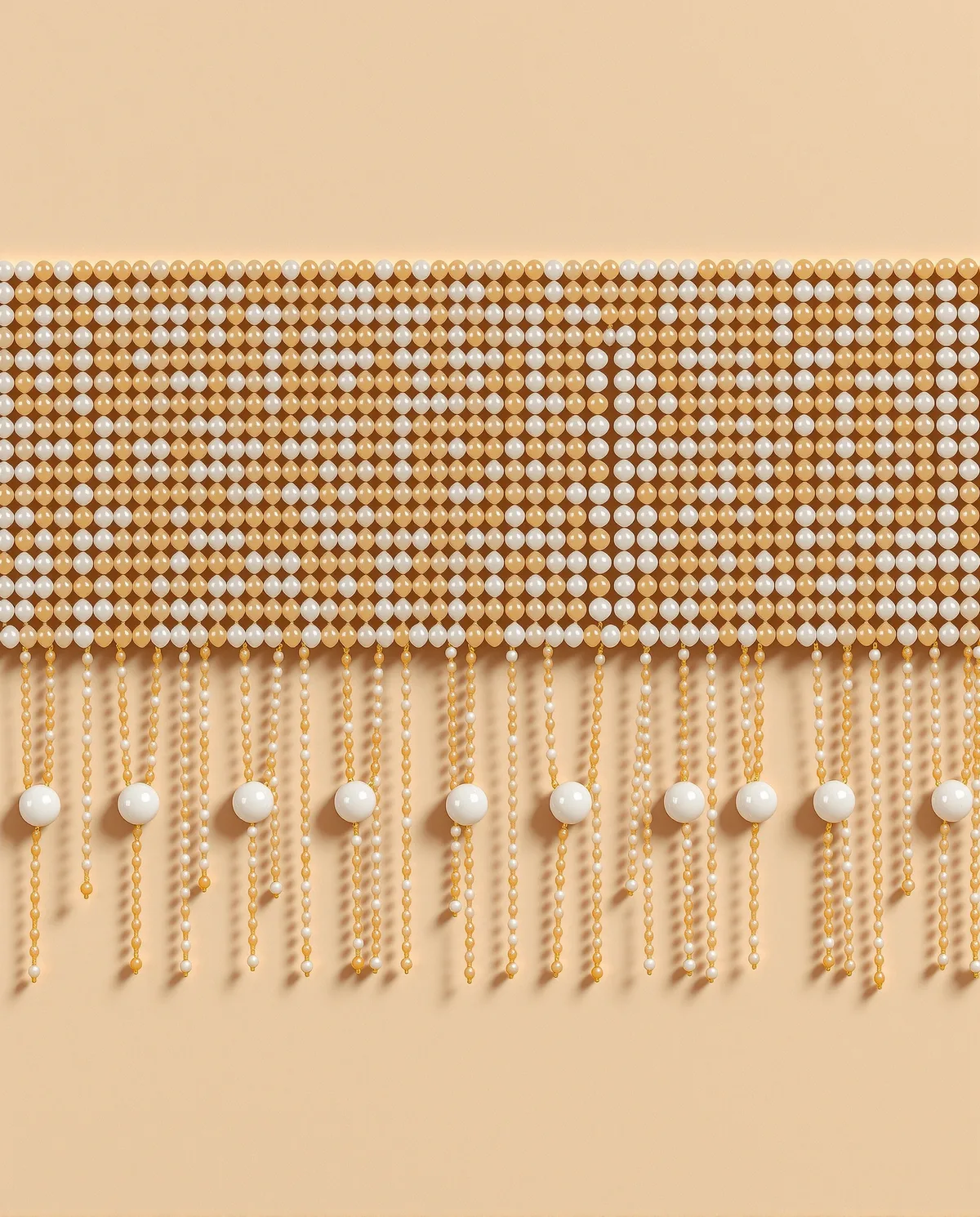
Weight and a rigging answer.
A door curtain hangs in a frame and is parted by hand. A backdrop hangs in open air, in a room full of people, usually near a door or an air conditioning outlet, and it will move all evening unless the hem carries weight. The fix is a heavier terminal bead or a larger bead size through the bottom third of each strand, specified at the brief rather than discovered at the venue.
The rigging is the other half. A dense glass or linked-disc panel at backdrop scale is a serious load, and it has to hang from a frame, a truss or a fixing rated for its real weight. We supply no hanging hardware, so the rigging has to be owned by whoever is installing it.
Because the length comes from the venue, not from the design. An aisle, an arch and a table edge are all dimensions nobody knows until the site is confirmed, so the sensible unit is a running metre.
That makes the repeat the governing dimension. If the repeat does not divide into the run length, every join shows a broken pattern — and at a wedding the joins are exactly where a photographer stands. Set the repeat against the consumed length before designing the drop.
Consistency at volume. One favour is a short job. Three hundred favours are judged as a set by a guest who sees six of them on one table, and the worst one in that six sets the impression.
That is an inspection problem rather than a craft problem. A favour programme should be checked as sets rather than as pieces, which is also how boxed sets of ornaments and coasters are checked, and it is the single thing that separates a good small-object run from a variable one.
A wedding programme starts from the constructions below rather than from a catalogue page.
Every construction on this page is one we build elsewhere: large-format hand-strung portals and curtains at around 90 by 200 cm, linked-disc hangings up to 90 by 200, beaded valances, fringe and drops, and small couched and wire-wrapped objects. Large beaded wall panels were installed at a US casino resort, which is the nearest thing in our record to event-scale work.
Mostly event and styling companies, who buy hire stock and consumables rather than ranges, plus a large volume of low-cost imported favours and backdrops. The bespoke end is project work for designers and venues, and it is where the construction and rigging questions on this page actually get asked.
Because the useful content is the three-scale analysis and the backwards calendar rather than a mood board. An event buyer who takes the hem-weight point, the repeat-divides-into-the-run point and the fixed-date arithmetic from this page will specify better from anyone.
Good to know
Bridal décor, event décor, wedding styling and mandap décor all overlap. In the trade the useful split is by how a piece is acquired: a hire item, a bulk consumable like a favour, and a bespoke statement piece. Those three are commissioned on completely different terms even when they are the same beadwork.
On a backdrop, weight at the hem and a header that will take the load — that is what stops it swinging all evening. On an aisle run, repeat accuracy across several repeats, not one. On a favour, consistency across the whole quantity, because a hundred favours are judged as a set and the worst one sets the impression.
A backdrop from a rigged frame, a truss or a ceiling fixing rated for its real weight, never from decorative hardware. An aisle or arch run is fixed along its header to a structure. Favours sit on a place setting or hang from a chair back. Rigging is the venue's responsibility and we supply no hanging hardware.
For hire stock, which is most of this market, the answer is handling rather than cleaning. Lift panels by the header, never by the strands; settle them after hanging; and store them in loosely tied bundles rather than loose, because an event panel is packed and unpacked repeatedly and tangling is what shortens its working life.
For each scale, a different brief. A backdrop needs width, drop, pitch, hem weight and a rigging statement. An aisle run needs a repeat, a header and a total length. A favour needs a motif, a size, a quantity and a pack. The constructions are documented across our portal, valance, wall hanging and trim work; the wedding range is not.
Every construction on this page is one we already build in another programme — large-format strung panels, linked-disc hangings up to 90 by 200 cm, trim and fringe, and small couched and wire-wrapped objects. A wedding programme is those constructions to a new brief: available to develop rather than a range to order from.
At each scale, differently. A backdrop is hand-strung on cord and gathered on a header, or built as faux capiz discs linked into columns. A run is repeated bead drops on a header tape. A favour is a couched covered form or beads wire-wrapped over a shaped armature. The palette is the only thing all three share.
Keep exploring
Manufacturing
Repeatable backdrop panels, rigging that survives a van, fast reorder of one colourway, and real set-up times.
Compare the optionsSpecification
A backdrop that reads on camera, an aisle that survives being walked, rigging one person can hang, and a repair kit that travels in the case.
Specs and sizesIndex
Seventeen beaded objects documented from inside the craft — what each one is, how the tradition builds it, and what it would take to develop one.
View the rangeCraft topic
Pinned beads over a foam form, the kit era that made it, what collectors check, and the one thing we make that is genuinely adjacent to it.
Specs and sizesCraft topic
Four elements — form, ground, couched beads, hanging loop — at seven to eleven centimetres, and why the poles of a sphere are where ornaments fail.
Read the guideManufacturing
Bead count per metre, repeat length, cut tolerance, roll packing and dye-lot continuity — what changes when beadwork is priced as a running length.
Specs and sizes
Start a conversation
Send a reference, a colour chip or a sketch. Minimums are set per design and confirmed per quote; sampling is quoted separately and usually runs 16 to 20 days from an agreed brief.