Craft topic
Indian door hangings
The threshold hanging of Indian homes — its meaning, its materials from mango leaf to zari, and why it is not the same object as a door curtain.
Specs and sizes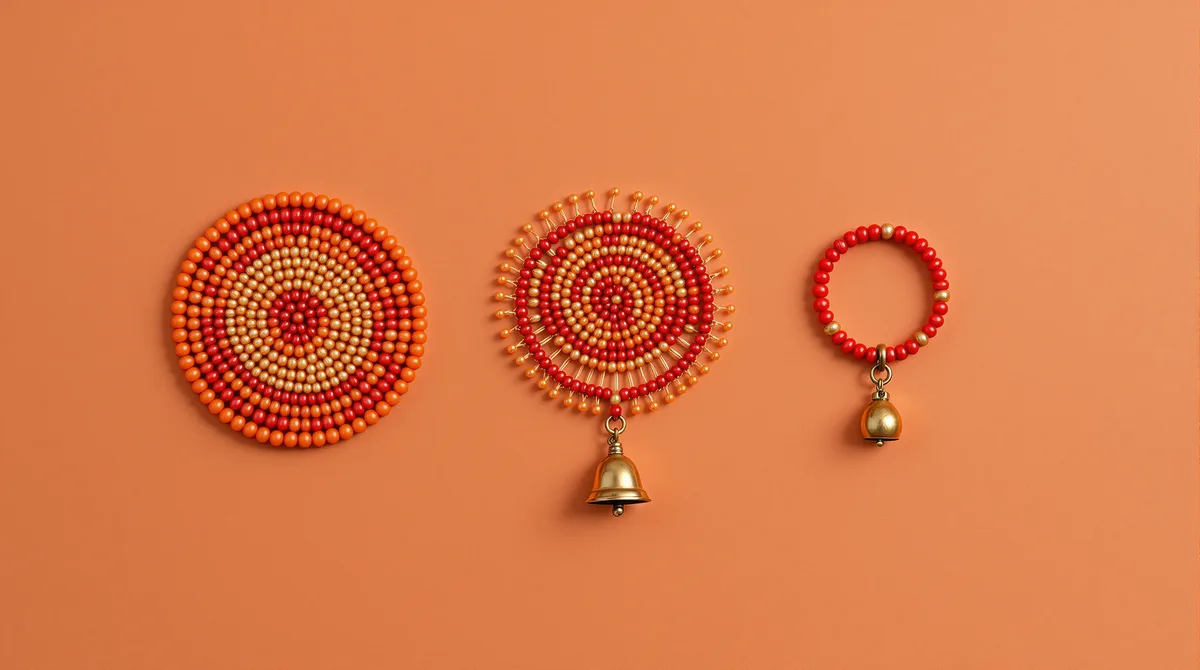
Craft topic
Diwali decoration is organised around two things: the threshold and the lamp. Almost every beaded form in the festival is one or the other, and the stitch behind most of it is the same couched work that built court textiles.
Festival beadwork in a row: two discs of couched bead embroidery worked in concentric rings of marigold and crimson seed beads, one hung with a small brass bell, beside a small…
Beaded Diwali décor is organised around the threshold and the lamp. The threshold forms are torans and bandarwals hung above a doorway; the lamp forms are diya and candle surrounds, lanterns and hanging lights. Most of the beadwork is couched bead and metallic-thread embroidery, often with mirror work set into it.
Diwali is the festival of lights, observed across India and the Indian diaspora over several days in the autumn. Houses are cleaned, thresholds are decorated, lamps are lit, and the decoration is not incidental to it — marking the doorway and placing the light are the observance.
That is why beaded Diwali décor is not a generic festive range. The forms are specific to two places in the house: above the door, and around the lamp.
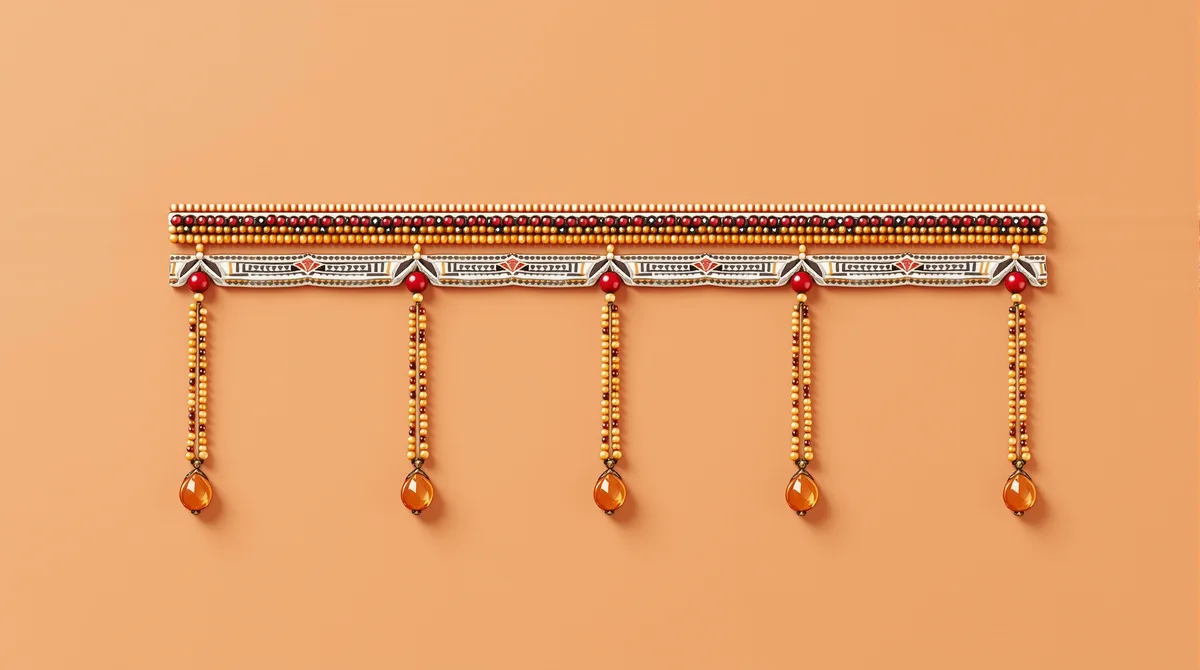
The toran, and its regional names bandarwal, bandhanwar and thoranam: a decorative hanging placed above the doorway, built as a horizontal band carrying a row of pendants below it. The classic festive version strings fresh mango leaves and marigold and is made on the day. The made version is a textile band with embroidered or beaded pendants.
Alongside it: beaded and mirror-work door panels, hanging bells, and strung garlands. All of them share the same structural logic and all of them hang above the opening. A toran is not parted and not walked through, which separates it completely from a beaded door curtain.
The diya, the small oil lamp, and everything arranged around it: beaded surrounds and rings on the surface beneath a lamp or a holder, beaded and mirror-work lanterns, hanging lights, and beaded mats and coasters under a cluster of lamps.
Here one rule governs everything and it is a material rule rather than a cultural one. Beadwork goes around a lamp, never against hot glass, and never where a flame can reach thread. Glass beads tolerate warmth; acrylic softens well below the temperature a glass holder reaches; thread and fabric grounds should be nowhere near a flame. Heat tolerance is confirmed on the sample, against the service temperature the piece will actually see.
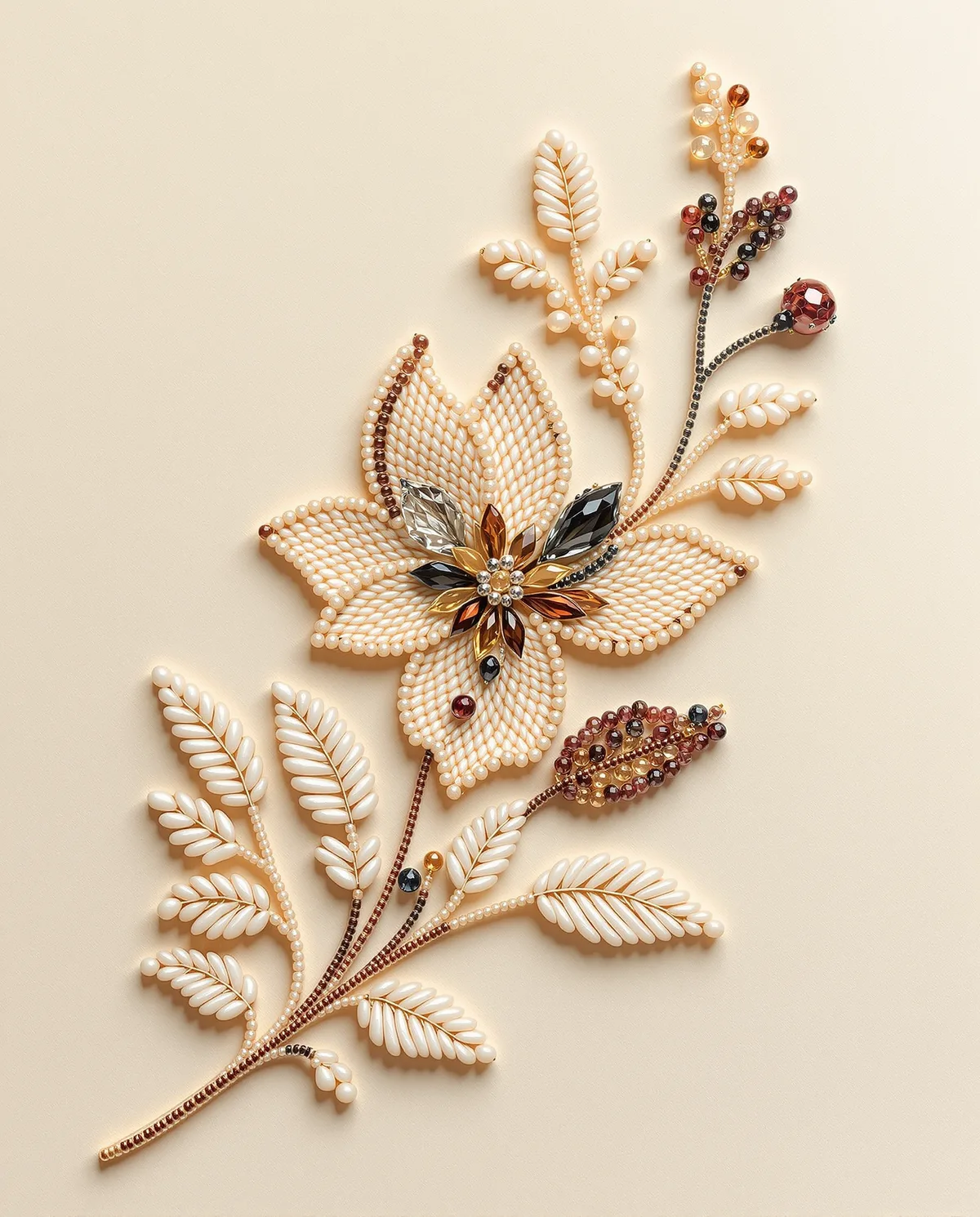
The stitch is couching: the decorative material is laid on the surface of a stretched ground and held down by a separate fine thread. That is the technique behind zardozi, the metal-thread embroidery tradition of the subcontinent, and it is why these pieces can carry heavy zari, coils, sequins and mirror — none of which could survive being pulled through a weave.
Materials: glass seed and bugle beads; zari and metallic thread; mirror, or shisha, set in a cradle of stitches; sequins; small metal bells; cotton and silk grounds, usually stiffened. The palette is saturated and warm, with gold doing structural work rather than accent work.
Because the pieces are seen by lamplight. A palette built for daylight goes flat under a warm, low, flickering light source, and a palette built for lamplight looks garish in a showroom.
That has two practical consequences. Gold and metallic thread are not decorative extras here; they are what keeps the piece readable when the only light in the room is at floor level. And colour approval on a festival piece should be done under warm light as well as under daylight, which is the same discipline we apply to approving a beaded lamp shade.
We do not make a Diwali range or torans today. Both are available to develop on the technique base above, and this page is written as craft rather than as a catalogue.
What is real is the stitch and the glass. Bead and metallic-thread embroidery in the zardozi tradition is a standing technique family in our own beadwork studios, documented at coasters of 10 to 11 cm, dimensional florals of 9 to 12 cm, appliqué patches and brooches. Glass seed and bugle beads are drawn and hand-strung in our own Firozabad glass works. We work in the technique, and a Diwali range is available to develop on it.
Position and purpose. Our strung work hangs in a doorway and is designed to be parted. A toran hangs above a doorway and is designed never to be touched. Our couched work makes coasters, cushion faces, purses and ornaments; a festival piece makes a band with pendants.
The nearest real adjacency is the stitch itself, and the second nearest is the beaded valance — which dresses the top of an opening and is still a different object from a threshold hanging in both construction and intent.
Overwhelmingly in India, at household and small-workshop scale, with a very large seasonal volume in machine-made versions. This is one of the few decorative categories largely made in the country where it is sold, which changes the commercial logic completely: the long export lead times that govern a Christmas range matter much less when the supply chain is domestic and the selling window is short.
For anyone importing, the familiar arithmetic applies: beaded décor runs 40 to 60 days after sample approval and sampling runs 16 to 20 days from an agreed brief, which puts an autumn delivery's brief in the early part of the year.
On a threshold hanging, the top band and the evenness of the pendant drops. On any mirror work, whether the mirrors are stitched or glued, because glue lifts and a lifted mirror edge is sharp. On metallic thread, colour hold — cheap coated zari greys within a season. Then the back, because a piece above a doorway is seen from below and often from both sides.
Because this is a living tradition with its own meaning and its own makers, and we are a manufacturer with no record in it. Describing the forms accurately is useful. Claiming them would be both false and discourteous, and the version costs us nothing worth having.
Good to know
Mostly by couching: bead, zari and mirror are laid on the surface of a stretched ground and held down by a separate fine thread, so heavy metal and glass can be carried where a drawn stitch could not. Threshold hangings are built as a band with pendants below it; lamp surrounds are wire-formed or stitched onto a stiffened ring.
The festival is Diwali or Deepavali. The threshold hanging is a toran, and bandarwal or bandhanwar across the Hindi-speaking regions. The oil lamp is a diya. Rangoli is the floor decoration and is not beadwork at all, though beaded and mirror rangoli mats are sold as a modern substitute for it.
On a threshold hanging, a top band that holds its line and pendants of genuinely equal drop. On any mirror work, mirrors held in a cradle of stitches rather than glued — a glued mirror lifts at the edge and the edge is sharp. On anything metallic, check the zari: good metallic thread holds its colour, cheap coated thread goes grey within a season.
The threshold forms above the door frame, spanning the full width of the opening, high enough that nobody brushes them in passing. The lamp forms on a surface or hanging from a hook. The one rule worth repeating is the heat rule: beadwork goes around a lamp, never against hot glass, and never where a flame can reach thread.
Dusted with a soft brush and spot-cleaned at most. Zari tarnishes in damp air, mirror settings loosen if the ground is soaked, and surface-dyed beads lose colour in water, so nothing in this family should be washed. Stored flat and out of light between seasons rather than folded, these pieces keep their condition from year to year.
The stitch is the real thing here. Bead and metallic-thread embroidery in the zardozi tradition is a standing technique family in our own studios — coasters at 10 to 11 cm, dimensional florals at 9 to 12 cm, appliqué patches and brooches — and glass beads are drawn in our own glass works. A Diwali programme, torans included, is available to develop on that technique base.
For a threshold hanging: a design, a band construction, a pendant set, a size range, a sample and a packing specification. For a lamp surround: a diameter, a heat instruction and a wire or ring specification. The crafts are present and documented. The products, the samples and the quality standards are not.
Keep exploring
Craft topic
The threshold hanging of Indian homes — its meaning, its materials from mango leaf to zari, and why it is not the same object as a door curtain.
Specs and sizesManufacturing
The couched bead-and-metal-thread technique behind the flat beaded objects: what it is, what it can depict, and the forms built with it.
Compare the optionsIndex
Seventeen beaded objects documented from inside the craft — what each one is, how the tradition builds it, and what it would take to develop one.
Read moreCraft topic
Beaded flat, then made up: why the seam allowance has to stay bead-free, why the lining carries the load, and the hardware decisions that go with it.
Read the guideCraft topic
The bead, the hole, the cord and the tassel — how a wood-bead garland is actually made, and what separates a good one from a cheap one.
See the detailCraft topic
Wire-wrapped and couched ring constructions, and the plain heat rule by material: the ring goes around a holder, never against hot glass.
Read the guide
Start a conversation
Send a reference, a colour chip or a sketch. Minimums are set per design and confirmed per quote; sampling is quoted separately and usually runs 16 to 20 days from an agreed brief.