Colour story
The Sterling Swan story
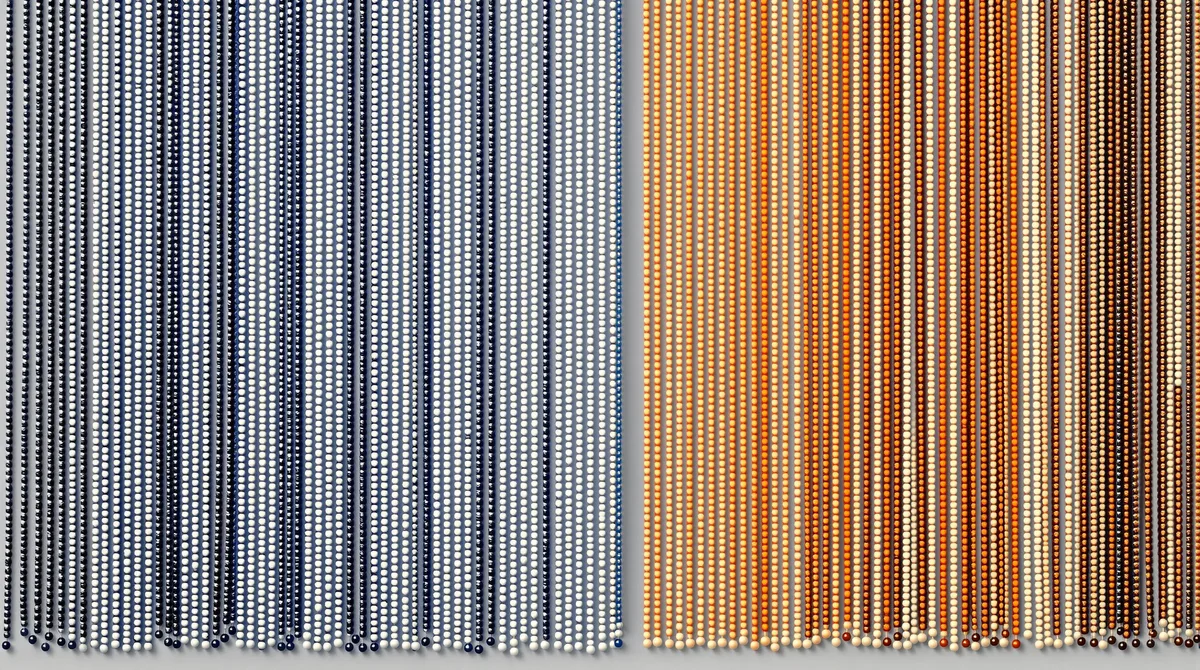
A pale, reflective palette drawn at 120 × 210 cm, where silver and clear glass read as light rather than as colour.
See the detail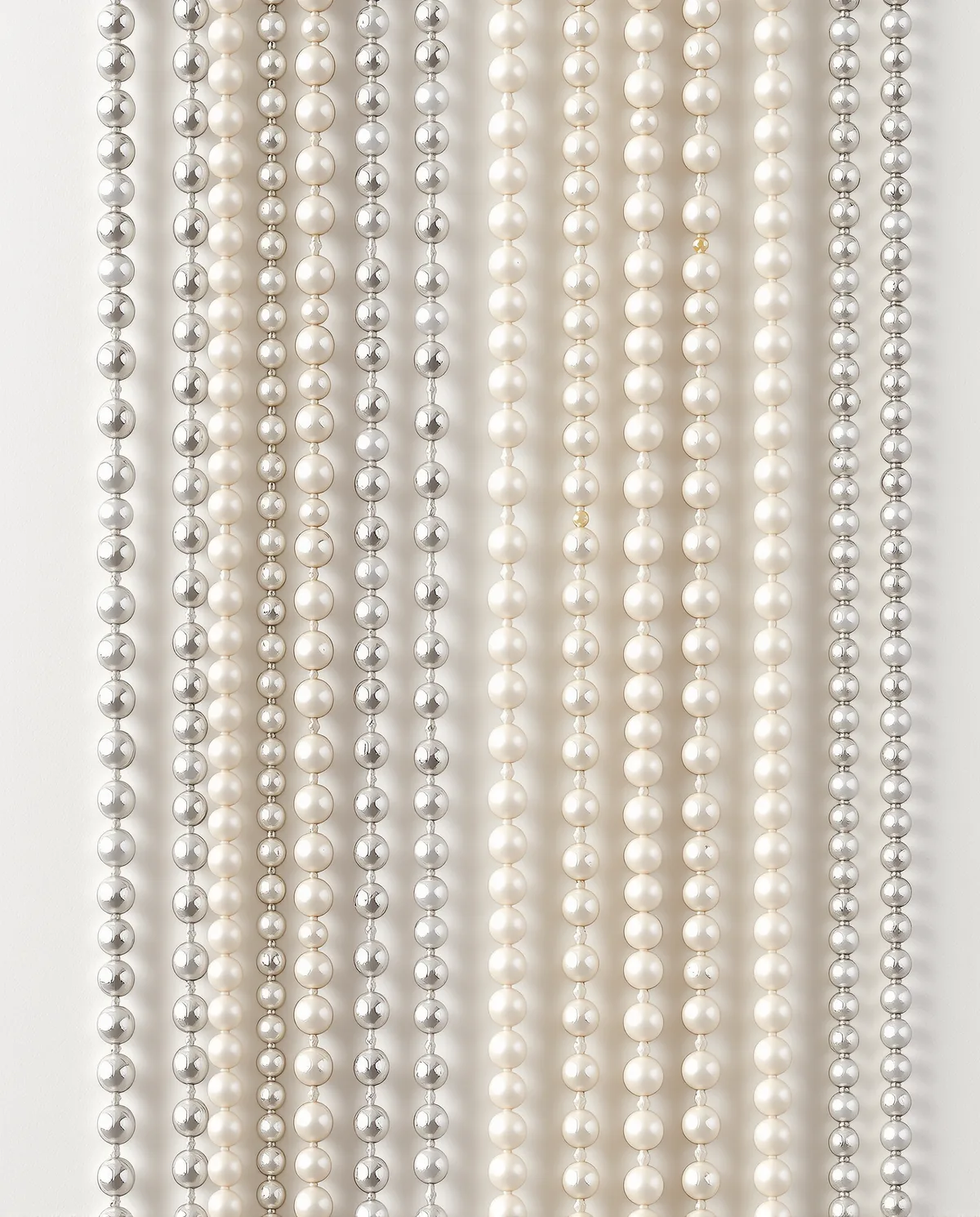
Design · Sterling Swan Backdrop Curtain
At 210 cm the design stops being about beads for a moment and becomes about the cord and the header that have to carry them.
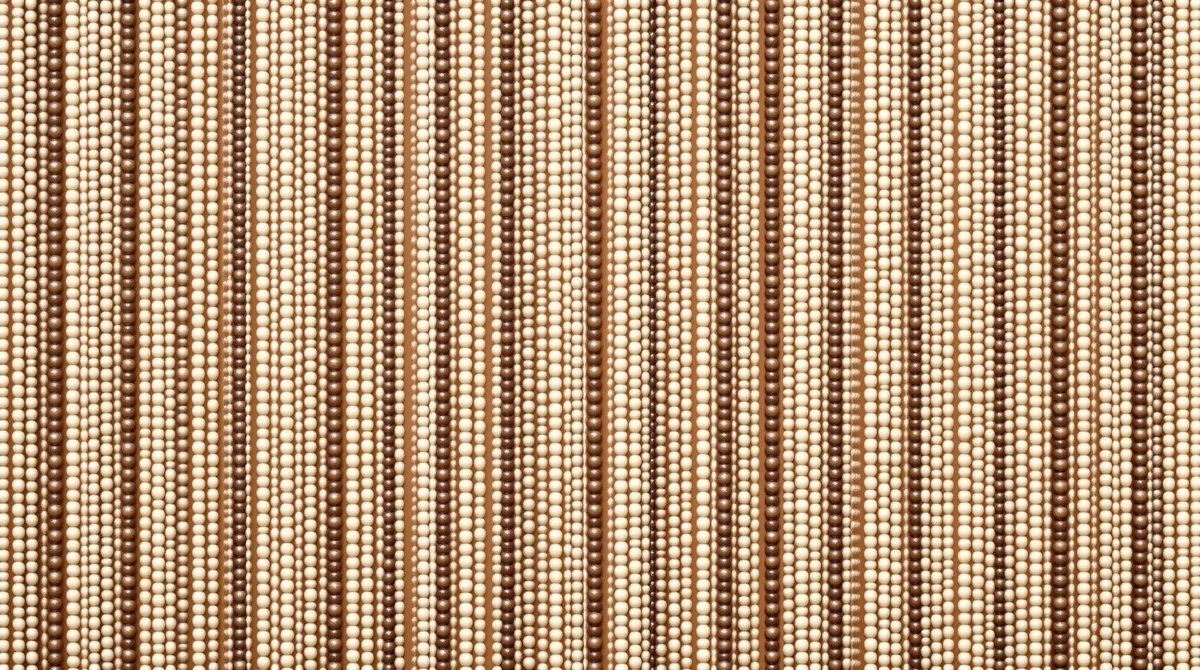
Six bead strands in the Sterling Swan palette, mirrored silver with pearl and chalk white, the mirrored beads throwing small hard glints.
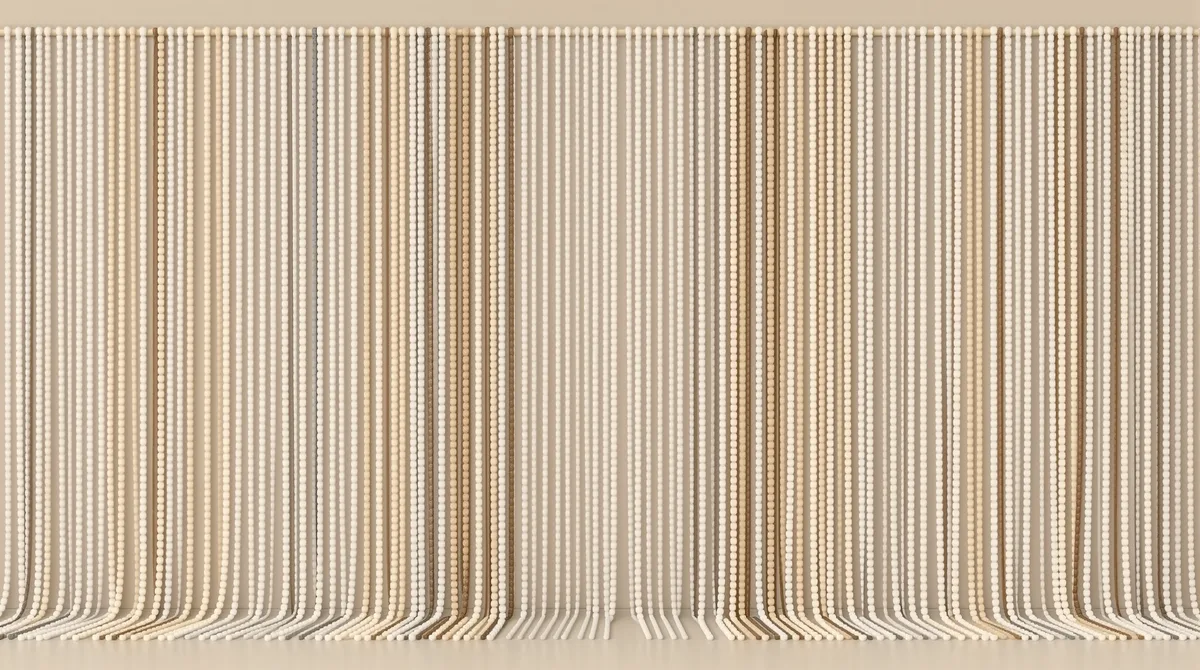
The Sterling Swan backdrop curtain is drawn at 120 × 210 cm, the largest format in the design library, in silver, clear and off-white faceted glass. At that drop the controlling questions are not aesthetic: cord gauge has to carry a 210 cm column of glass without stretching, and the header has to span 120 cm with that weight on it.
The Sterling Swan backdrop curtain is drawn at 120 × 210 cm in silver, clear and off-white faceted glass. It is the longest drop in the design library and one of the widest widths, and it was given that scale for a reason: a palette with almost no hue in it has nothing to say at small size.
The format is drawn for the 2027 library and the design is available to develop at that size, with the development questions unusually concrete.
Sixty strands across 120 cm at about a 2 cm pitch, following the library's own convention at that width. Each strand is a repeating sequence of faceted beads with plain clear rounds spacing them.
There is no mapped pattern and no scattered accent, which is the right call. In a palette with no colour contrast, a pattern would be invisible — there is nothing for it to be a pattern in.
At a 210 cm drop the sheet gains two entries. The stringing medium has to be specified for the load of a 210 cm column of glass rather than carried over from a 200 cm build. And the header rail section is checked against the panel weight at 120 cm of span. Freight cubing is the third, because a 210 cm strand does not fold.
| Specification | Value |
|---|---|
| Finished size | 120 × 210 cm |
| Strand count | 60 at about 2 cm pitch, on the library's 120 cm convention |
| Bead material | Cut and faceted glass with plain clear rounds for spacing |
| Material naming | Glass, not crystal — the term is corrected on every quote |
| Hem shape | Straight |
| Header | Turned wooden dowel or rail, section checked against finished weight |
| Cord | Gauge specified for a 210 cm column of glass |
| Intended use | Backdrop and room-height installations |
| Status | A design available to develop at the drawn size |
Carton length is the practical constraint: a 210 cm strand does not fold like a textile, and a glass strand bent into a shorter carton will knock against itself in transit.
So inner packing and carton dimensions on this design are agreed on the sample rather than assumed, and pieces per carton follow from the carton rather than from a target.
What it cannot show is the thing a 210 cm drop actually has to prove: how the piece behaves under its own weight after a week on a rail. Cord stretch, header deflection and strand settling are sample questions, not render questions, and this design has not answered them yet.
The pale reflective story, which holds this one design and no other in the published library. There is no short format, no wall piece and no portal drawn in the palette.
Faceted glass, almost entirely. A faceted bead returns a dozen small specular highlights where a round bead returns one, and with no hue contrast in the palette those highlights are the only visual event in the piece.
There is a naming point that comes up on every quote in this story. Buyers ask for a crystal beaded curtain; what is made and shipped is cut or faceted glass, and we describe it as glass. Calling it crystal implies a material we are not making.
Straight. Everything about this design is about accumulation — of highlights, of area, of drop — and a shaped hem subtracts from the bottom of the field where the accumulated effect is strongest.
This is the section that matters most on this page. No weight figure is published, and none should be inferred from a render; weight is established on the approved sample.
What can be said is where the engineering sits. A turned wooden dowel section that is correct at 90 cm will deflect at 120 cm under a dense glass panel, so span and load are checked together. And cord gauge has to be specified for a 210 cm column of glass rather than carried over from a 200 cm build — the extra 10 cm is more load on every strand, all the way up.
Recoloured easily and to large effect, because the clear ground gives any accent a free run. One tinted line changes the whole register: champagne reads warm, smoke reads architectural, pale blue reads cold.
Resized downwards with a caveat. Below about 150 cm the palette begins to read as white rather than silver, and a smaller version usually wants a graphite or smoke note added so the piece has a shadow to work against.
As a backdrop. Event and display companies, retail set-dressing, hospitality lobbies and photography. The drawn format is a backdrop format, not a doorway one, and that is how it should be specified.
It is the hardest design in the library to sell from a shelf, because it needs light behind it to do anything at all. Where it does work in-store is as a backdrop behind other product, which is a useful thing for a buyer to know before they order one to display flat.
Nothing yet, and that is worth saying plainly rather than borrowing a lesson from elsewhere. The nearest relevant experience is that large glass feature beads are annealed for strength and that colour and glass strength are linked — both established on a hand-made Venetian design — and both would need checking against whatever faceted bead line this design settles on.
Good to know
Cut and faceted glass, with plain clear rounds doing the spacing. The faceting is the mechanism rather than the ornament: a faceted bead returns many small highlights where a round returns one, and in a palette with no colour contrast those highlights are the only visual event.
Exclusivity is a commercial decision taken per programme rather than a property of the design. Name it in the brief and it is quoted alongside the piece.
It shows the format and the palette as drawn. What a drawing cannot show is the one thing a 210 cm drop has to prove: how the piece behaves under its own weight. That is a sample question.
Strands are kept in order and protected against knocking in transit, then packed to your carton, label and packaging specification. A 210 cm strand does not fold like a textile, so carton length and inner packing are agreed on the sample rather than assumed.
Yes. A sketch, photo or artwork with size, materials, colours and quantity becomes a colour-count sheet, with a rough cost sheet produced before any sample is made so the cost levers are visible early.
Yes, and a small change goes a long way. One tinted bead line in a clear field shifts the whole piece — champagne reads warm, smoke reads architectural, pale blue reads cold. Because the ground is clear, the accent has nothing to fight.
Yes, and down is easier than up. Below about 150 cm the palette starts reading as white rather than silver, so a smaller version usually wants a tinted or graphite note added to give it a shadow.
Keep exploring
Colour story
A pale, reflective palette drawn at 120 × 210 cm, where silver and clear glass read as light rather than as colour.
See the detailDesign
The full-length doorway designs, 90 × 200 to 120 × 210 cm, documented by strand count, hem shape and bead count.
Specs and sizesDesign
Thirty hand-strung strands of translucent acrylic at 90 × 200 cm on a stained header rail, recoloured season after season on one construction.
Compare the optionsDesign
A cream seed-bead base with amber accents and about 120 glass mushroom beads, scattered up to four a strand and never in a row.
Specs and sizesDesign
Dotted oval glass beads at 13 × 22 mm, scattered three or four to a strand on a seed-bead base dyed to match each dot.
Specs and sizesSpecification
Diameters, drill holes, cord selection, strand counts and format dimensions — the sheet to copy into a tech pack.
See the detail
Start a conversation
Send a reference, a colour chip or a sketch. Minimums are set per design and confirmed per quote; sampling is quoted separately and usually runs 16 to 20 days from an agreed brief.