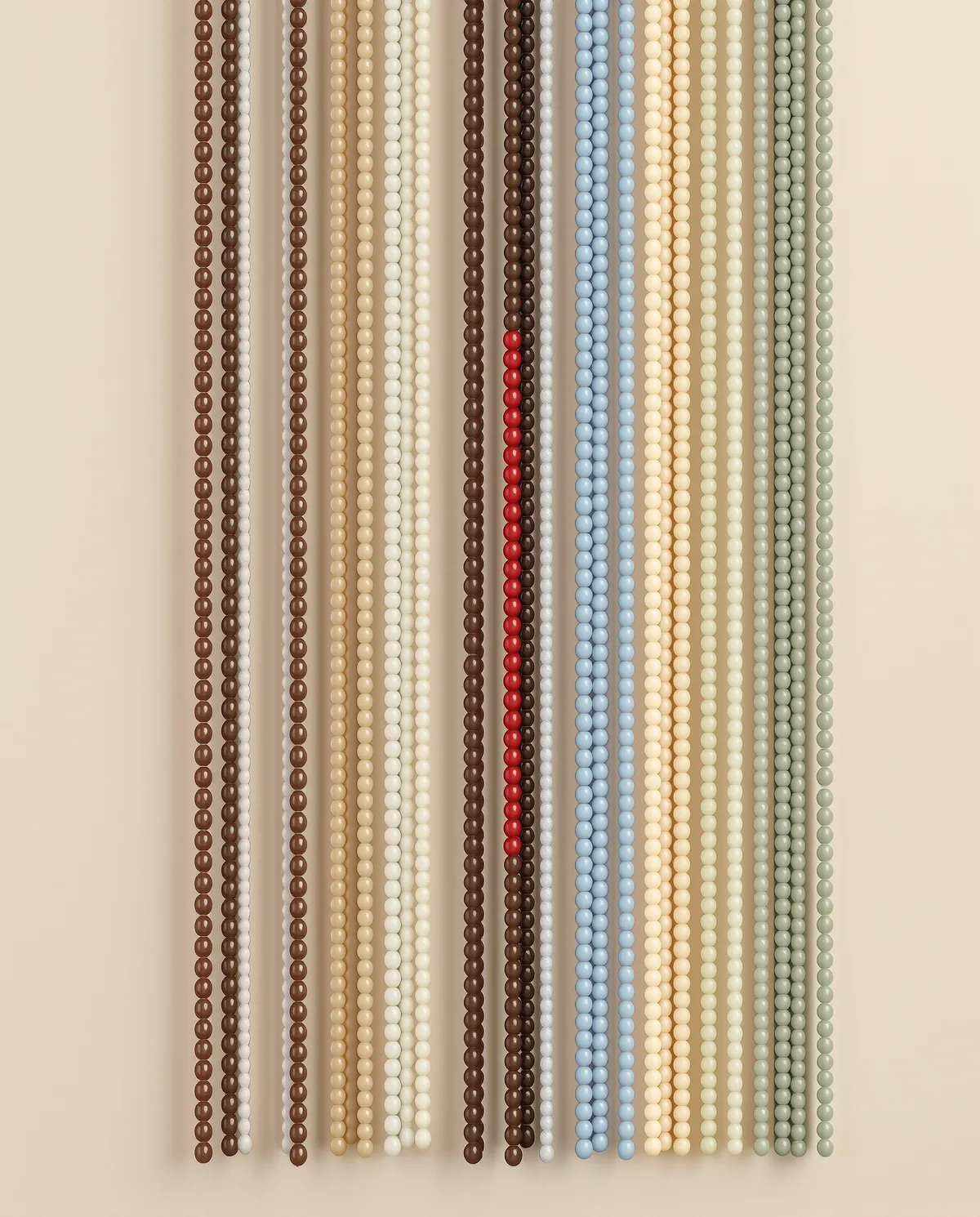
Colour story
Café Society
Espresso and cocoa, crema, dusty cornflower and pistachio, with one glossy cherry-red note doing the work of five.
How it is made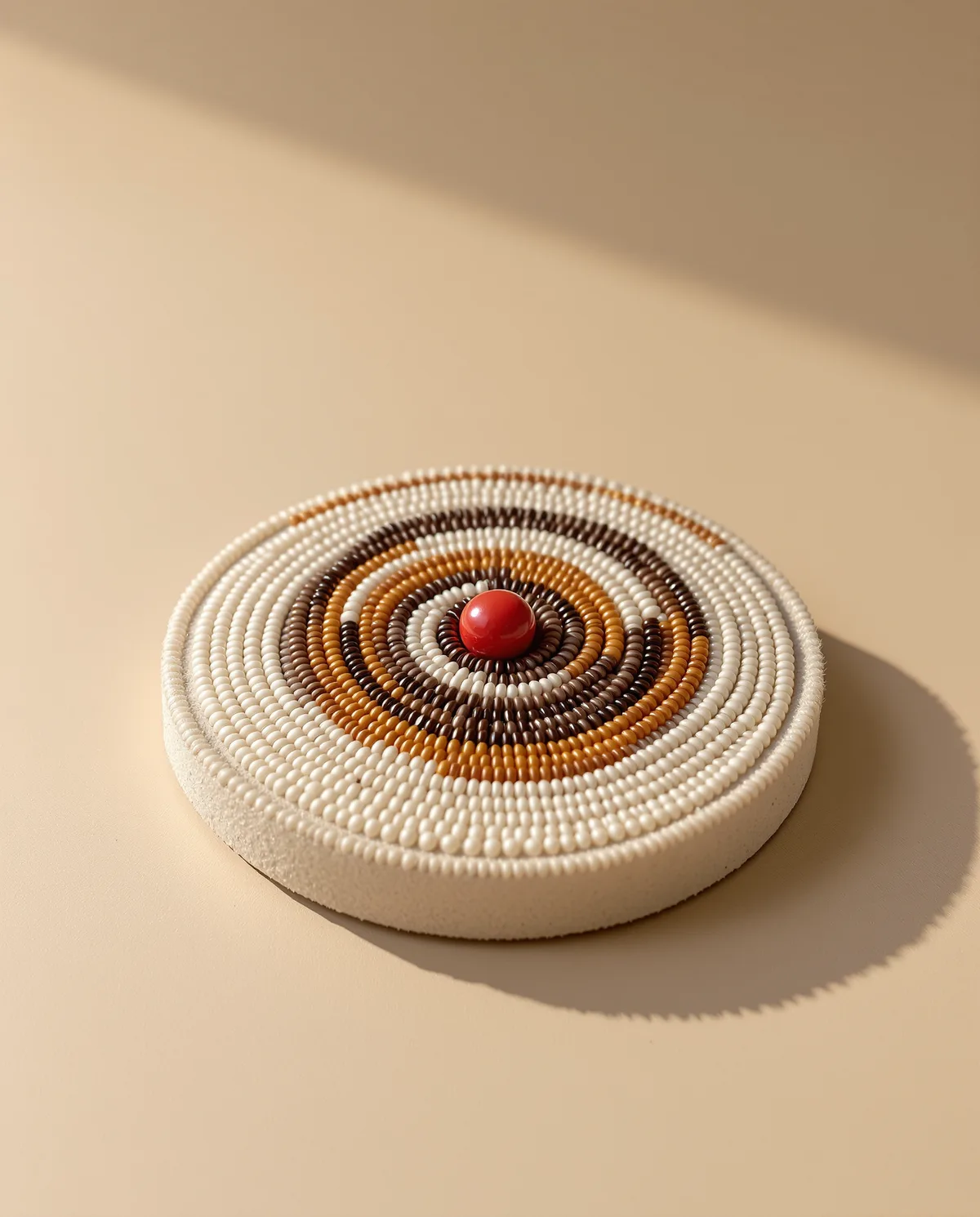
Design · Café Society Valance
Five colours on a 35 cm drop, four of them brown. Where the fifth one goes is the only decision that really matters.
A round beaded coaster, glass seed and bugle beads couched onto stiffened felt in concentric rings of espresso, crema and dusty cornflower.
The Café Society valance is the one beaded design in a collection that is otherwise tabletop. It places the collection's palette — espresso and cocoa brown, crema, dusty cornflower blue, pistachio and one glossy cherry red — on a valance at 120 × 30 to 40 cm, with the red used once per strand or less so it reads as a highlight rather than as a pattern.
The Café Society valance is the one beaded design in a collection that is otherwise tabletop. Collection 7 in the Design Studio is demitasse spoons, a layer cake server, pistachio spreaders and stirrers; this valance is where its palette crossed into beadwork.
It is drawn at the library's valance format — 120 × 30 to 40 cm, 56 to 60 strands, roughly 900 to 2,000 beads — and it is available to develop at that size.
A written sequence of five colours, dense. The strand count here is 56 to 60 across 120 cm, a strand pitch of about 2 cm, which is the library's convention at that width and is close spacing for a short piece. The bead count that follows from it runs roughly 900 to 2,000.
Five colours is at the limit of what a 35 cm strand can resolve. Below that number the piece reads as a palette; above it the sequence repeats too rarely down the drop and the eye reads a mixture. That is the single most useful constraint on this page for anyone adapting it.
Five bead lines is the figure that drives the bench time here rather than the bead count, which is low for the format. The strand count and pitch set the density, the carton sizes follow the 120 cm width, and the crema line is the one taken through sampling first because an off-white is the hardest colour to agree.
| Specification | Value |
|---|---|
| Finished size | 120 × 30 to 40 cm — the library's valance range |
| Strand count | 56 to 60 at about 2 cm pitch |
| Bead count | About 900 to 2,000 |
| Palette | Espresso, cocoa brown, crema, dusty cornflower blue, pistachio, glossy cherry red |
| Accent rule | One cherry-red bead per strand or fewer |
| Collection | Design Studio collection 7, announced October 2026 |
| Hem shape | Straight or lightly scalloped |
| Studio link | Confirmed collection slug — app.gemixx.com/?c=cafe-society |
| Status | A design available to develop at the drawn size |
A turned wooden dowel at 120 cm, made in our own Saharanpur wood factory, with its section checked against the span rather than against the load. If the browns are built in ceramic rather than glass the weight changes, because a glazed ceramic bead and a glass bead of the same size are not the same mass. That is a reason to settle the material before the fixing.
Recoloured freely, and in the Design Studio the design opens as your own copy to change — colours, finish and size. The collection link for this story is confirmed: app.gemixx.com/?c=cafe-society.
Resized with a palette caveat. Five colours work at 35 cm. On a 200 cm curtain the same five average into a mid-brown field from across a room, so a full-length version should be cut to three.
Café and small hospitality fronts, which is what the palette was named for, and retailers with a kitchen or dining range. Brown beadwork sells steadily and does not date, which is a quieter commercial argument than a statement palette but a more durable one.
It also suits a buyer who wants a beaded piece that will not fight an existing interior, which is a large part of the trade market and an underserved one in this category.
Not sampled, so the answer is that the lessons are borrowed. From the sea-glass valance: height is the cost lever that moves most on a short format, and a hem shape drawn as an outline has to be rewritten as strand lengths before it can be built.
From the palette itself: crema is the line to take through sampling first. An off-white is defined by what it is not, and it is the colour most likely to be described differently by two people looking at the same bead. Where it has to hit a buyer's own reference it is dyed to match, and production then runs 40 to 60 days after sample approval.
At 120 cm wide the carton is set by the width, so a valance ships long and flat rather than compact, and pieces per carton are agreed at quote stage.
It shows the palette at valance proportion, built from named beads so the design converts into a colour-count sheet.
The strand and bead counts follow the library's valance conventions, and are confirmed on the sample.
The Café Society story — espresso and cocoa brown, crema, dusty cornflower blue, pistachio and one glossy cherry red, with polished steel on the metal side. The notes for the collection give that palette in those words.
The story is the clearest case in the library of a palette looking for formats: the colour work is confirmed, and the beaded range behind it is this one short piece.
At valance proportion the browns stop being a ground and start being the subject, because there is not enough drop for them to recede. That is the argument for building them in ceramic on this format specifically, where a speckled glaze reads as texture at a metre rather than as a flat tone.
The cherry red is the one bead that really needs glass, because it needs gloss. And the specification for it is a count rather than a colour: one per strand or fewer. Four reds per strand turns a highlight into a pattern, and the brown palette stops being the subject — which is the commonest mistake made when this design is adapted.
Good to know
Glass across the palette, with ceramic a genuine alternative for the browns — a matte or speckled glaze from our own Khurja plant gives a cocoa surface glass cannot imitate. Only the cherry red really needs glass, because it needs gloss.
Exclusivity is a commercial decision taken per programme rather than a property of the design. Name it in the brief and it is quoted alongside the piece.
It shows the palette as drawn at valance proportion. The strand and bead counts follow the library's valance conventions, and are confirmed on the sample.
Strands are kept in order and protected against knocking in transit, then packed to your carton, label and packaging specification. At 120 cm wide the carton is set by the width, so a valance ships long and flat rather than compact.
Yes. A sketch, photo or artwork with size, materials, colours and quantity becomes a colour-count sheet. In the Design Studio this collection also opens as your own copy to recolour, and its collection link is confirmed.
Yes, and the structure transfers cleanly: four muted colours plus one saturated note. Change the hue family entirely and keep the four-to-one ratio and it still behaves like this design. Change the ratio and it does not.
Yes, with a palette caveat. Five colours work on a 35 cm drop. On a full-length 200 cm curtain the same five average into a mid-brown field from across a room, so a tall version should be cut to three colours.
Keep exploring
Colour story
Espresso and cocoa, crema, dusty cornflower and pistachio, with one glossy cherry-red note doing the work of five.
How it is madeManufacturing
Short strung panels at 120 × 35 cm and other formats, 56 to 60 strands, with scalloped, fan-arch, V-point and straight hems — and why height is the cost lever.
View the rangeDesign
Valances at 120 × 30 to 40 cm and café curtains at 76 × 76 cm, documented by hem shape, strand count and bead count.
View the rangeDesign
The deep blue story at valance drop — 120 × 30 to 40 cm, where the same palette runs a fraction of the doorway bead count.
See the detailDesign
A scalloped awning profile over a pastel scatter at the 120 cm width, so the short drop reads as deliberate.
See the detailDesign
Irregular frosted beads of 4 to 5 mm strung with seed beads into a scalloped arch, from a 24 in longest drop to a 10 in shortest.
See the detail
Start a conversation
Send a reference, a colour chip or a sketch. Minimums are set per design and confirmed per quote; sampling is quoted separately and usually runs 16 to 20 days from an agreed brief.