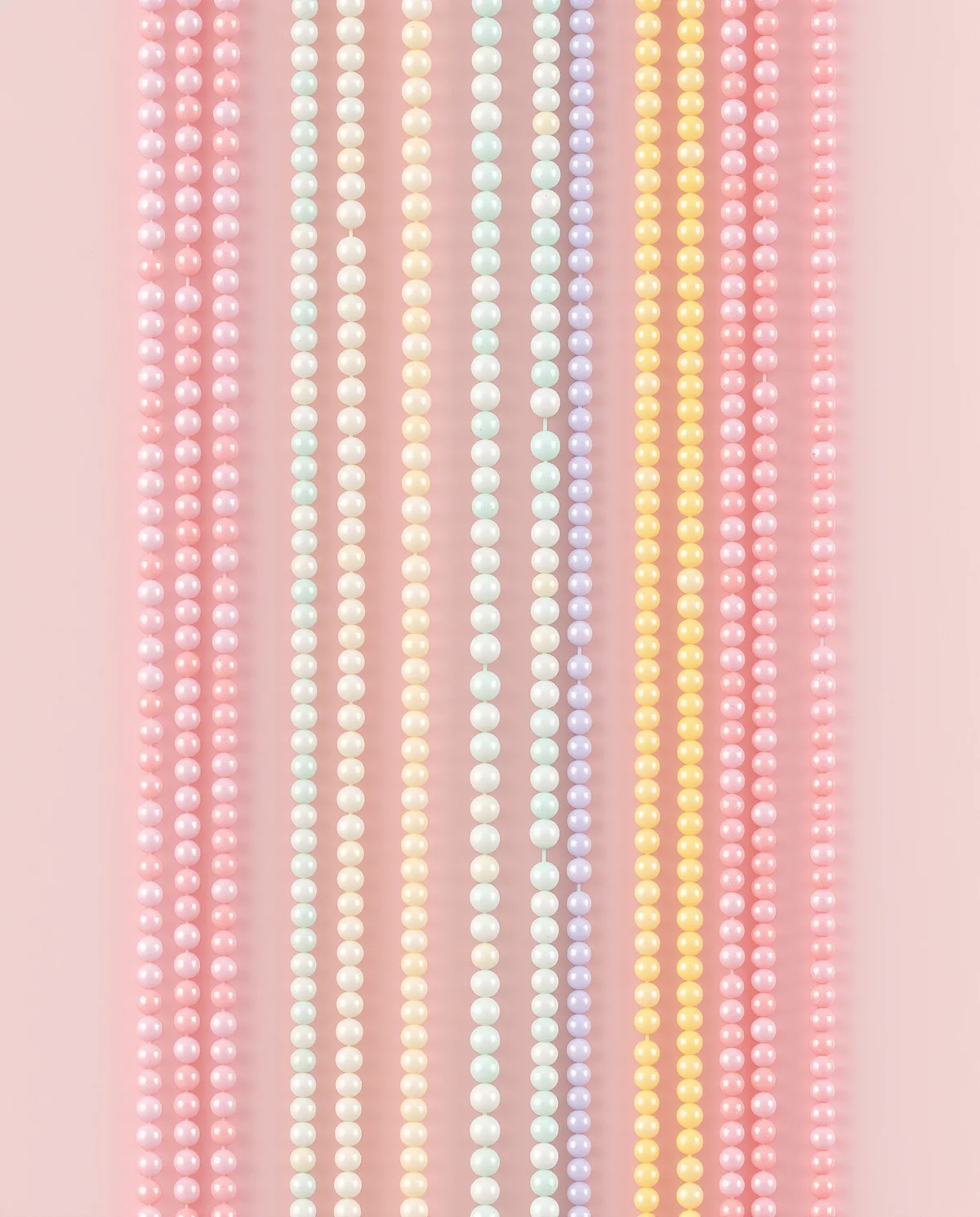
Colour story
Sorbet Parade palette
Scattered pastel accents across 60 strands at 120 × 180 cm, placed from a bead map rather than by chance.
Open the reference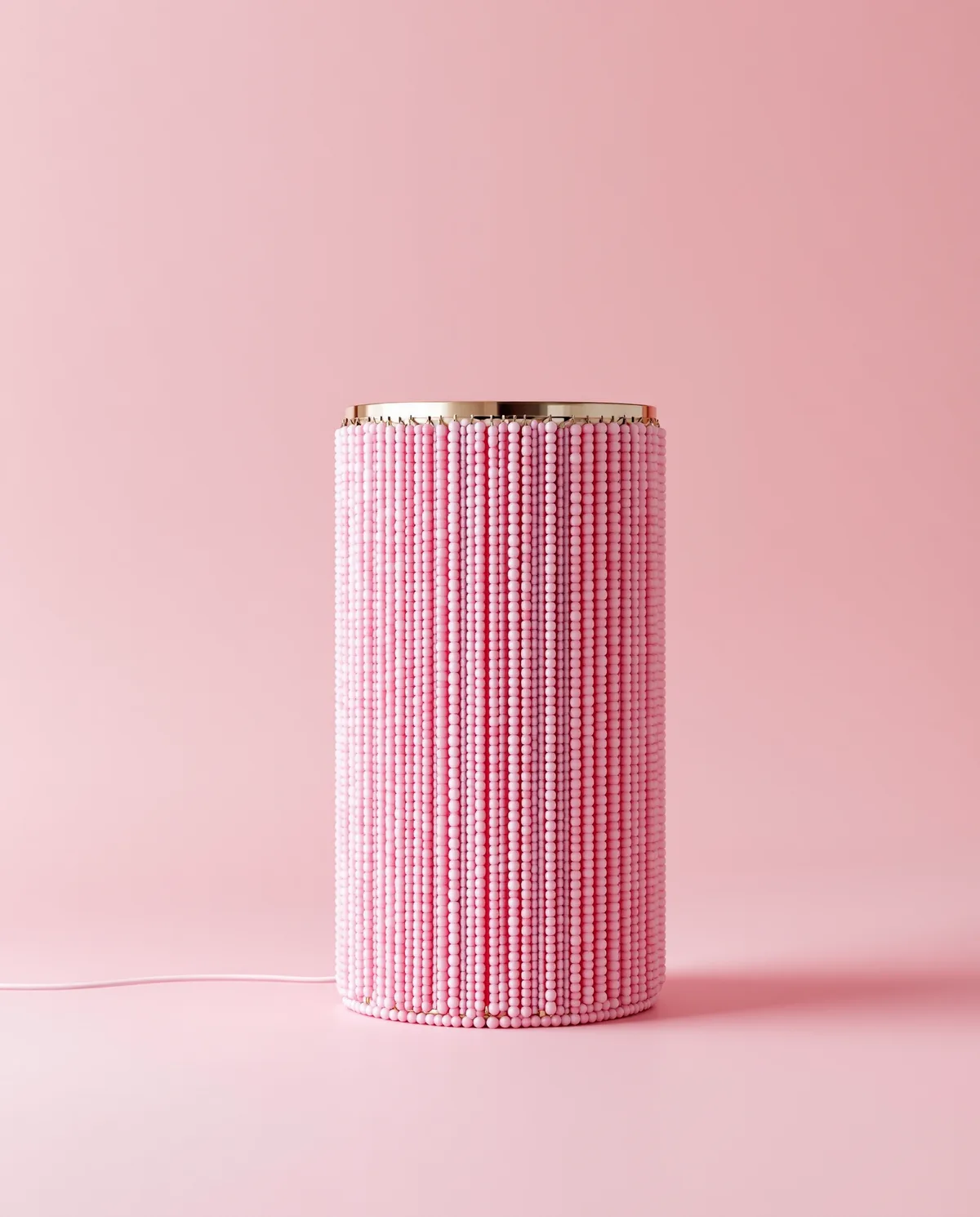
Design · Sorbet Parade Awning Valance
A pastel field on a short drop needs a shaped edge, or it reads as the top of a curtain somebody forgot to finish.
A beaded drum pendant shade in candy pink, lemon, mint and lilac, close-strung in vertical rows from a plain metal ring with a short beaded fringe below.
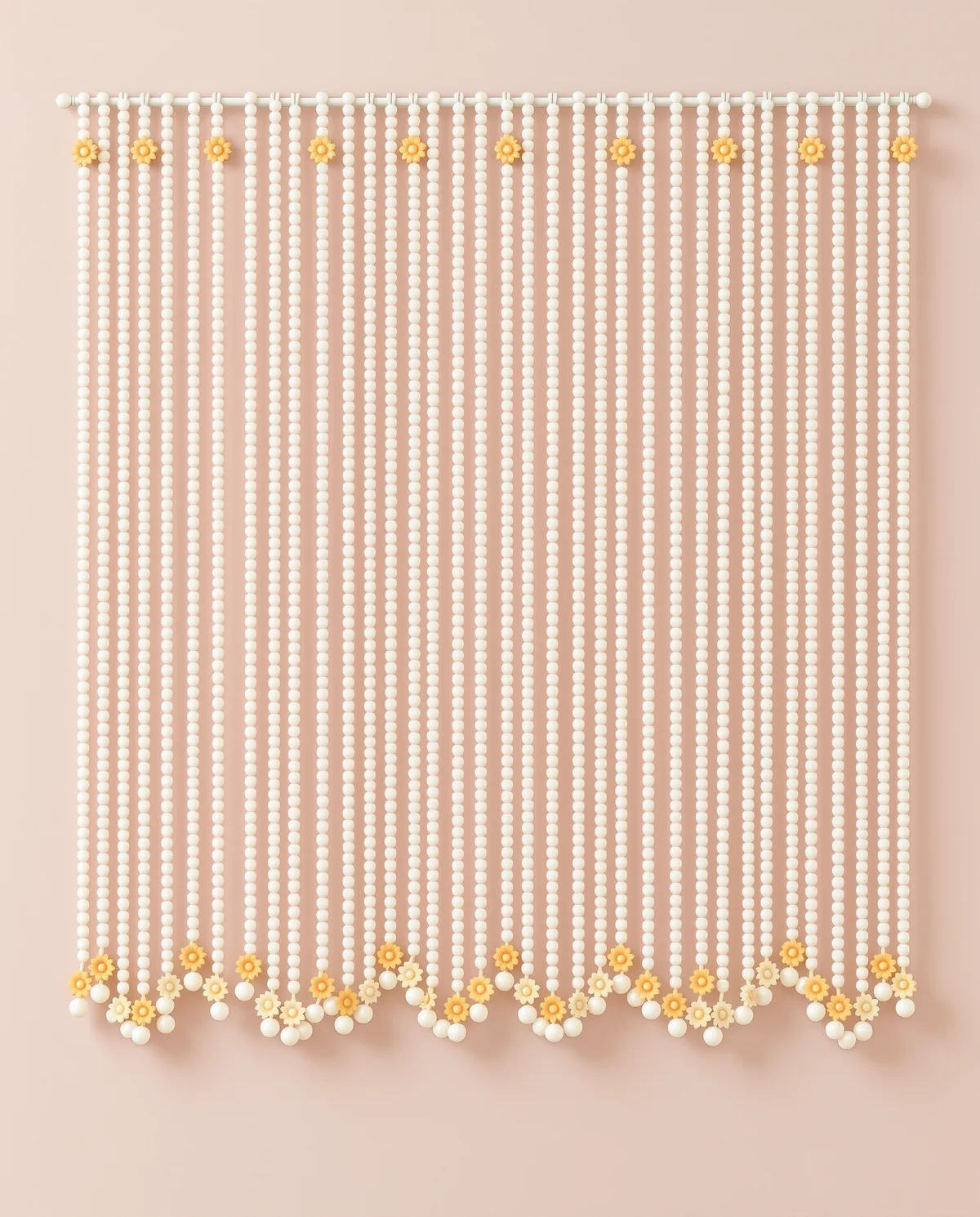
The Sorbet Parade awning valance runs a scalloped awning profile over a pastel scattered field, at the library's valance format of 120 × 30 to 40 cm and 56 to 60 strands. The profile is the point: a short pastel panel with a straight hem reads as unfinished, and a repeating scallop turns the same beads into a deliberate awning.
The Sorbet Parade awning valance runs a repeating scalloped profile over a pastel scattered field, at the library's valance format of 120 × 30 to 40 cm and 56 to 60 strands.
It is the short companion to the confetti curtain in the same story, and the two make a useful pair because they take opposite decisions about the hem: the curtain keeps its hem straight, this one does not.
A pale ground with larger pastel accents scattered over it, and a scalloped profile cut into the strand lengths.
The two interact in a way that has to be handled at specification stage. A scallop makes some strands much shorter than their neighbours, and a scatter is specified as a count per strand — three to four accents on a full-length strand is the figure production works to on a sampled dotted design. Apply a constant count across a scalloped profile and the short strands come out crowded while the long ones look sparse, so the count follows the length.
A repeating profile is cheaper to specify than a single curve. One scallop and a repeat count replace sixty individual strand lengths, and the first article is checked against the repeat. The scatter is a count per strand that follows the length, and the strand count sets the density across the 120 cm width.
| Specification | Value |
|---|---|
| Finished size | 120 × 30 to 40 cm — the library's valance range |
| Strand count | 56 to 60 at about 2 cm pitch |
| Bead count | About 900 to 2,000 |
| Hem shape | Repeating scalloped awning profile |
| Accent | Pastel beads scattered on a pale ground |
| Ground | Dyed to sit under the accent colours |
| Scatter rule | A count per strand, varied with strand length, plus an offset |
| Matched piece | A confetti curtain at 120 × 180 cm, 60 strands, straight hem |
| Status | A design available to develop at the drawn size |
As a repeating scallop: one curve repeated across the width, written out as strand lengths. That repetition is what makes it an awning rather than an arch.
It is also the one hem profile in the library that gets easier as the piece gets wider. A single arch across 120 cm needs 60 individually calculated drops; a scallop repeating every ten strands needs ten, repeated six times. Fewer numbers, fewer chances to be wrong, and a more forgiving first-article check.
A turned wooden dowel at 120 cm, made in our own Saharanpur wood factory. The load is close to even across the header, which is a quiet advantage of a repeating profile: an arch concentrates weight at the ends of the dowel, where a scallop repeat distributes it.
Recoloured with the ground following the accents — accents chosen first, ground dyed to them.
Resized well. Widening adds scallops rather than stretching them, which keeps the curve correct. Changing the depth is the harder move, because the scallop depth has to stay in proportion to the drop, and a scallop that is too deep on a shallow valance leaves its shortest strands barely longer than the header.
Retailers and own-label brands in kitchen, children's and gift ranges, and café and small hospitality fronts. A scalloped pastel awning is one of the most immediately appealing short pieces in the library and it reads from the street.
It is also the right piece to open a colour story with commercially, because a valance carries the full width and the full palette at a fraction of the curtain's bead count.
Not sampled, so the lessons are borrowed and they are good ones. From the sea-glass valance: a shaped hem drawn as an outline has to be rewritten as strand lengths before it is buildable, and it was corrected during sampling for exactly that reason. From the sampled dotted portal: dye the ground to the accents, and specify the scatter as a count plus an offset rather than as random.
What this design adds is the interaction rule — vary the accent count with the strand length — which is the thing a sample would be built to confirm.
On a profiled hem the strands are not interchangeable, so they are bundled in sequence and labelled.
At 120 cm wide the carton is set by the width, so a valance ships long and flat rather than compact.
The accent positions illustrate the rule. The map is written at specification stage against the chosen bead size.
The pastel confetti story, which also holds a confetti curtain at 120 × 180 cm on 60 strands with a straight hem. The story is defined by its mechanism — a scattered accent on a ground dyed to match — rather than by the particular pastels.
The accents are what a customer sees and the ground is what makes them work. Pressed glass is the usual accent route because a mould-made bead repeats its dimensions, which matters when accents are placed to a map.
Acrylic moulded and dyed to the colour is the lighter alternative and is unusually good at pastels, because the colour runs through the material rather than sitting on its surface — which on a pale colour is the difference between uniform and patchy.
Good to know
Yes, and a scallop repeat scales better than most profiles. Widen the piece and you add scallops rather than stretching them, which keeps the curve correct. Changing the depth is the harder change, because the scallop depth has to stay in proportion to the drop.
Pale glass seed beads as the ground with larger pastel accents over them. Pressed glass is the usual accent route because a mould-made bead repeats its dimensions, and acrylic moulded and dyed to the colour is the lighter alternative and is genuinely good at pastels.
Exclusivity is a commercial decision taken per programme rather than a property of the design. Name it in the brief and it is quoted alongside the piece.
It shows the profile and the character of the scatter as drawn. The accent positions illustrate the rule; the map itself is written at specification stage.
Strands are kept in order and protected against knocking in transit, then packed to your carton, label and packaging specification. On a profiled hem the strands are not interchangeable, so they are bundled in sequence and labelled.
Yes. A sketch, photo or artwork with size, materials, colours and quantity becomes a colour-count sheet. For a profiled valance, give the longest and the shortest drop and the number of scallops across the width.
Keep exploring
Colour story
Scattered pastel accents across 60 strands at 120 × 180 cm, placed from a bead map rather than by chance.
Open the referenceManufacturing
Short strung panels at 120 × 35 cm and other formats, 56 to 60 strands, with scalloped, fan-arch, V-point and straight hems — and why height is the cost lever.
Read the guideDesign
Valances at 120 × 30 to 40 cm and café curtains at 76 × 76 cm, documented by hem shape, strand count and bead count.
Open the referenceDesign
The deep blue story at valance drop — 120 × 30 to 40 cm, where the same palette runs a fraction of the doorway bead count.
View the rangeDesign
The espresso and crema palette at valance drop, with one cherry-red note placed for the light.
Read the guideDesign
A 76 × 76 cm square at about 1,800 beads, which is the clearest bead-count-against-format comparison in the library.
See the detail
Start a conversation
Send a reference, a colour chip or a sketch. Minimums are set per design and confirmed per quote; sampling is quoted separately and usually runs 16 to 20 days from an agreed brief.