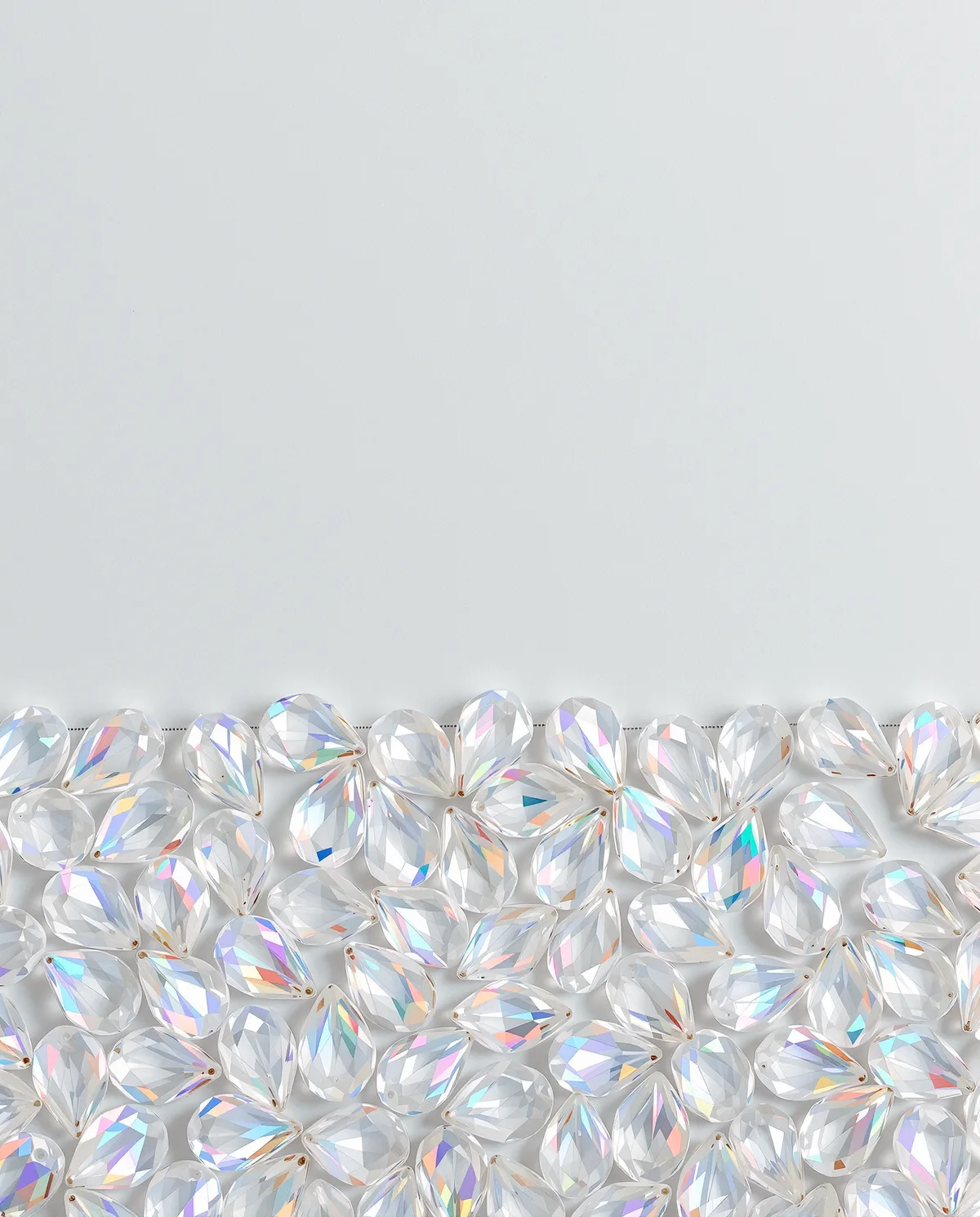
Material
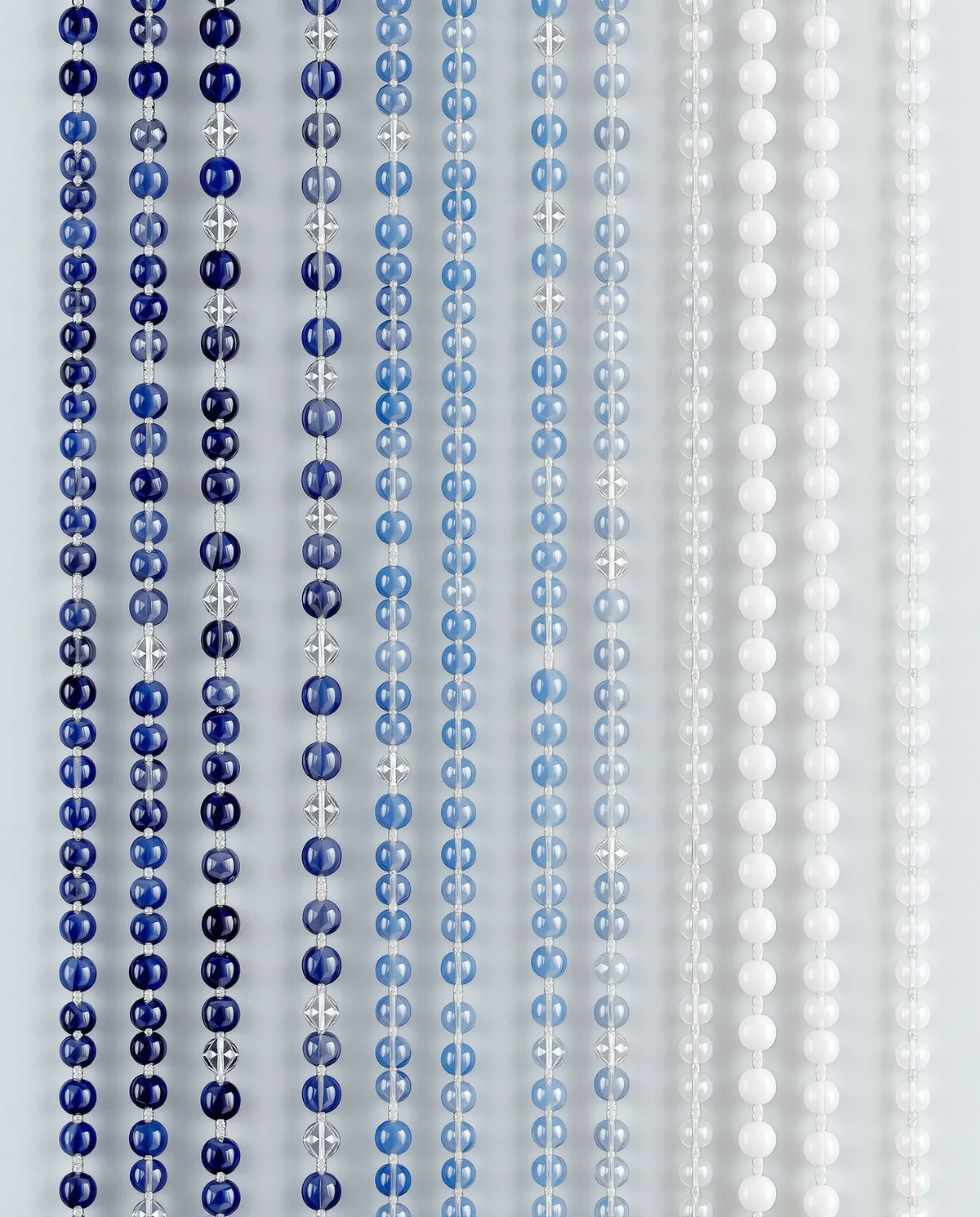
What crystal really means
Faceting, refraction and weight — why the market says crystal, why a specification says glass, and where the premium is actually earned.
Specs and sizes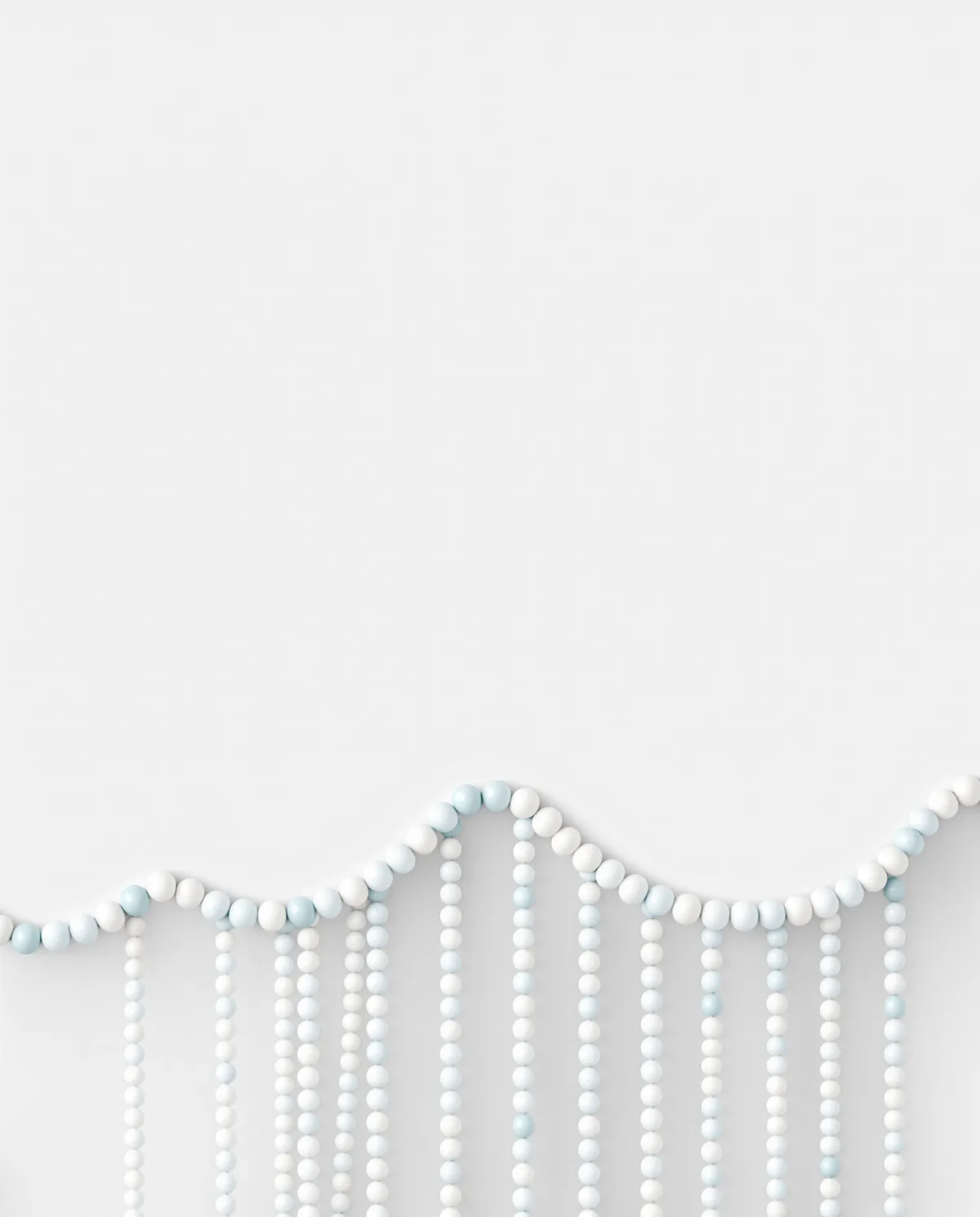
Design · Sea Glass Valance
An irregular bead and a shaped hem. One is a tolerance problem, the other is arithmetic, and the design depends on getting both right.
Twenty bead strands cut to stepped lengths so the hem sweeps up into a scalloped arch, longest at the sides and shortest at the centre.
The Sea Glass valance strings irregular frosted glass beads of about 4 to 5 mm with glass seed beads on 30 hand-strung strands, with larger drop beads at the strand ends. Its hem is a scalloped arch that is fullest at the sides: the longest strand runs 24 in and the shortest 10 in, and every length between is written out.
The Sea Glass valance is a 30 × 24 in piece — 76 × 61 cm — on 30 hand-strung strands on a single wooden dowel. Its feature bead is an irregular frosted glass bead at about 4 to 5 mm, strung with glass seed beads, with larger drop beads at the strand ends.
It was sampled, corrected and re-engineered, and it carries the clearest cost lesson in the valance group.
Seed beads and frosted beads alternating in a written sequence, with a drop bead closing each strand. Thirty strands across 30 inches is a close pitch for a short piece, which is right: a sparse valance has nothing holding it visually.
The complication is the bead. Sea-glass beads are irregular in shape and in opacity by nature, so no two strands are identical and that is the point of using them. What gets approved on the sample is therefore a tolerance band — how much variation is acceptable within one strand — rather than a single bead, and that band goes onto the count sheet as a range.
The two figures that describe this hem are the longest and shortest drop, 24 inches and 10. A single height describes nothing on a scalloped arch. Beyond that, the irregular feature bead is specified as a tolerance band rather than as a bead, and an end bead at every strand tip is what keeps a fine strand hanging straight.
| Specification | Value |
|---|---|
| Finished size | 30 × 24 in, or 76 × 61 cm |
| Strand count | 30, hand-strung on cord |
| Feature bead | Irregular frosted glass, about 4 to 5 mm |
| Ground | Glass seed beads |
| Strand ends | Larger drop beads |
| Hem shape | Scalloped arch, fullest at the sides |
| Longest drop | 24 in |
| Shortest drop | 10 in |
| Primary cost lever | Drop height, multiplied by the strand count |
Because height is multiplied by strand count. Take four inches off a 30-strand valance and ten feet of beaded length leaves the piece, which moves bead count, weight and stringing hours together.
It is also the least visible lever available on this format: a 26-inch valance and a 30-inch one read much the same way over a window, where a sparser pitch or a smaller bead would both be noticed. That is why the drop is the number to settle first and the hem shape the one to protect.
The second lesson is about the hem. The arch was corrected during sampling to a properly curved profile, which is a reminder that a shaped hem drawn as an outline and a shaped hem written as 30 strand lengths are not the same document — and only the second one is buildable.
Shaped hems have a specific packing requirement: the strands are not interchangeable, so they are bundled in sequence and labelled, and the carton height follows the longest strand rather than the nominal drop.
The imagery on this page is editorial and shows the hem principle and the material character. It is not a photograph of the piece a buyer receives.
The note is that this design's real imagery is development material — a computer-aided drawing beside a sample for comparison, and a corrected sample photograph. Those are good evidence and poor lifestyle photography, so they are not used here as if they were the latter.
Its own, described as a multicolour sea glass. By palette and behaviour it sits closest to Moonwater in the design library, which uses the same frosted sea-glass tones alongside foil-lined glass.
The difference is instructive. Here the frosted bead is the whole field; there it is half of a pairing with a reflective bead. A frosted field alone is the simplest version of the material to specify and the hardest to make interesting, which is why this design leans on its hem.
The frosted bead, with the seed beads as its ground and the drop bead as its full stop. Frosting is a glass operation — colouring, frosting and ribbing are all done at our own Firozabad glass works — rather than a surface dye, so the finish is durable and the colour behaviour is stable.
The term on the quote is worth correcting while we are here. Buyers ask for a crystal valance; what is made and shipped is cut, frosted or faceted glass, and we describe it as glass.
A scalloped arch, fullest at the sides: longest strands at the edges, shortest in the middle, with a scallop worked across that curve. The longest drop is 24 inches and the shortest is 10.
Those two numbers are the specification. A single height does not describe a shaped hem, and the commonest brief error on a valance is to give one.
A single turned wooden dowel, made in our own Saharanpur wood factory. A 4 to 5 mm glass bead on a seed-bead ground is a light build by glass standards, which is why the drop bead at each strand end matters — without it a fine strand drifts rather than hanging straight, and a shaped hem with drifting strands loses its profile.
Resized freely, with the record showing what a height change buys. Recoloured within material limits: a frosted irregular bead comes from a glass process rather than a dye bath, so the palette moves in families rather than to an exact reference.
For a buyer who needs an exact colour match, the route is a regular frosted bead or a moulded acrylic equivalent, accepting that the irregularity — the thing that makes it read as sea glass — goes with it.
Good to know
Strands are kept in order and protected against knocking in transit, then packed to your carton, label and packaging specification. On a shaped hem the strands are not interchangeable, so they are bundled in sequence and the carton height follows the longest strand.
Yes. A sketch, photo or artwork with size, materials, colours and quantity becomes a colour-count sheet. On a shaped hem, supplying the longest and shortest drop rather than a single height removes the main ambiguity from the brief.
Within limits set by the material. A frosted irregular bead is made by a glass process rather than dyed to order, so the palette moves in families rather than to an exact reference. For an exact colour, a regular frosted bead or a moulded acrylic equivalent is the better route.
Yes, and height is the lever to use. Height is the single largest lever on a valance because every centimetre is multiplied by the strand count, and it is the least visible one: the hem shape is what carries the design, so that is what to keep intact.
Irregular frosted glass beads of about 4 to 5 mm as the feature, glass seed beads as the ground, and larger drop beads at the strand ends. Glass beads are drawn, frosted and hand-strung in our own Firozabad glass works.
Exclusivity is a commercial decision taken per programme rather than a property of the design. Name it in the brief and it is quoted alongside the piece.
Keep exploring
Material
Faceting, refraction and weight — why the market says crystal, why a specification says glass, and where the premium is actually earned.
Specs and sizesManufacturing
Short strung panels at 120 × 35 cm and other formats, 56 to 60 strands, with scalloped, fan-arch, V-point and straight hems — and why height is the cost lever.
See the detailDesign
Valances at 120 × 30 to 40 cm and café curtains at 76 × 76 cm, documented by hem shape, strand count and bead count.
Read the guideDesign
The deep blue story at valance drop — 120 × 30 to 40 cm, where the same palette runs a fraction of the doorway bead count.
Compare the optionsDesign
A scalloped awning profile over a pastel scatter at the 120 cm width, so the short drop reads as deliberate.
How it is madeColour story
Cool, low-contrast tones in foil-lined and frosted glass, built as a strung hanging and as a linked disc piece.
How it is made
Start a conversation
Send a reference, a colour chip or a sketch. Minimums are set per design and confirmed per quote; sampling is quoted separately and usually runs 16 to 20 days from an agreed brief.