Design
Colour stories, by construction
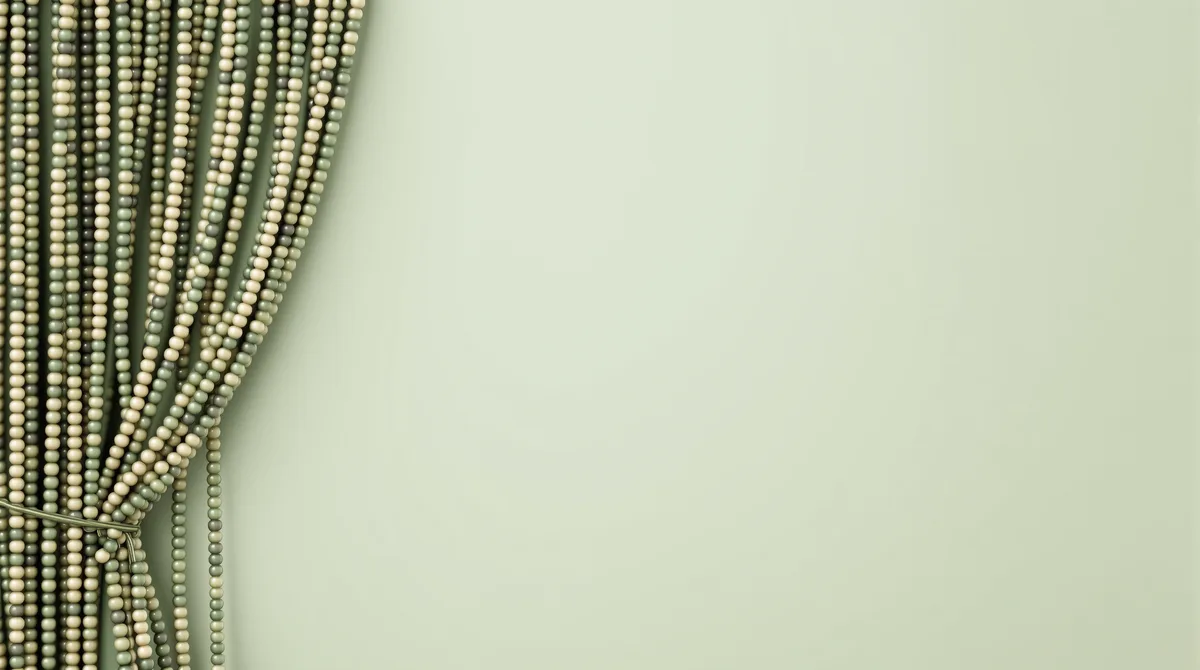
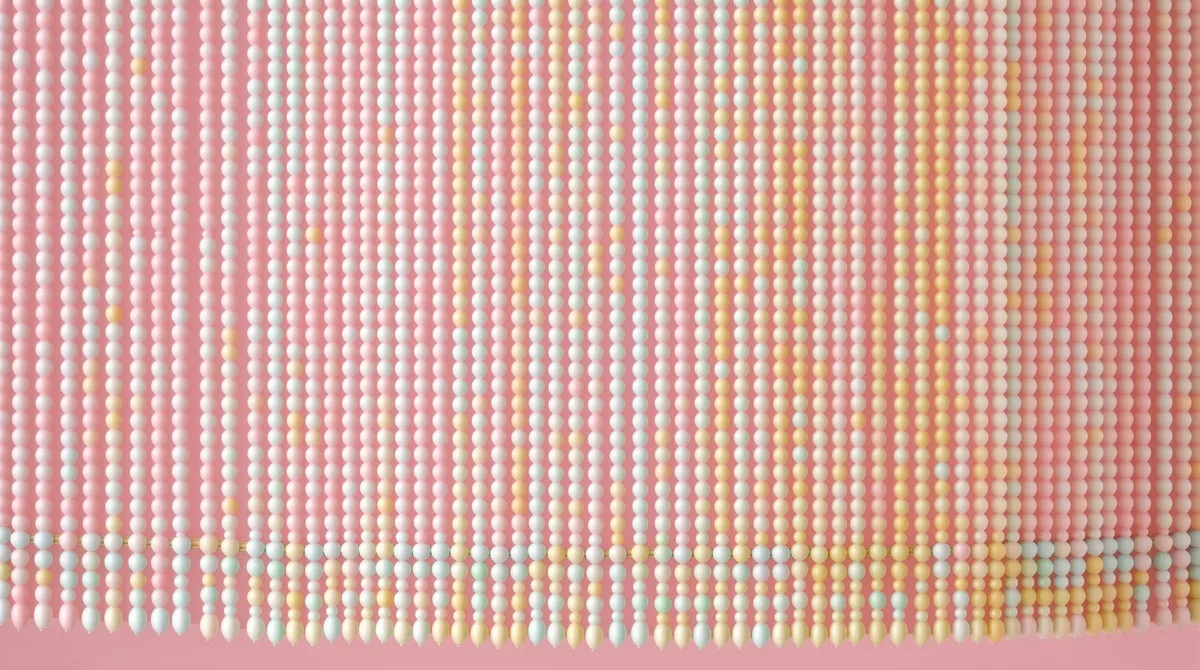
Colour stories documented by how they are built, not by how they look in a mood board.
View the rangeDesign library · Index
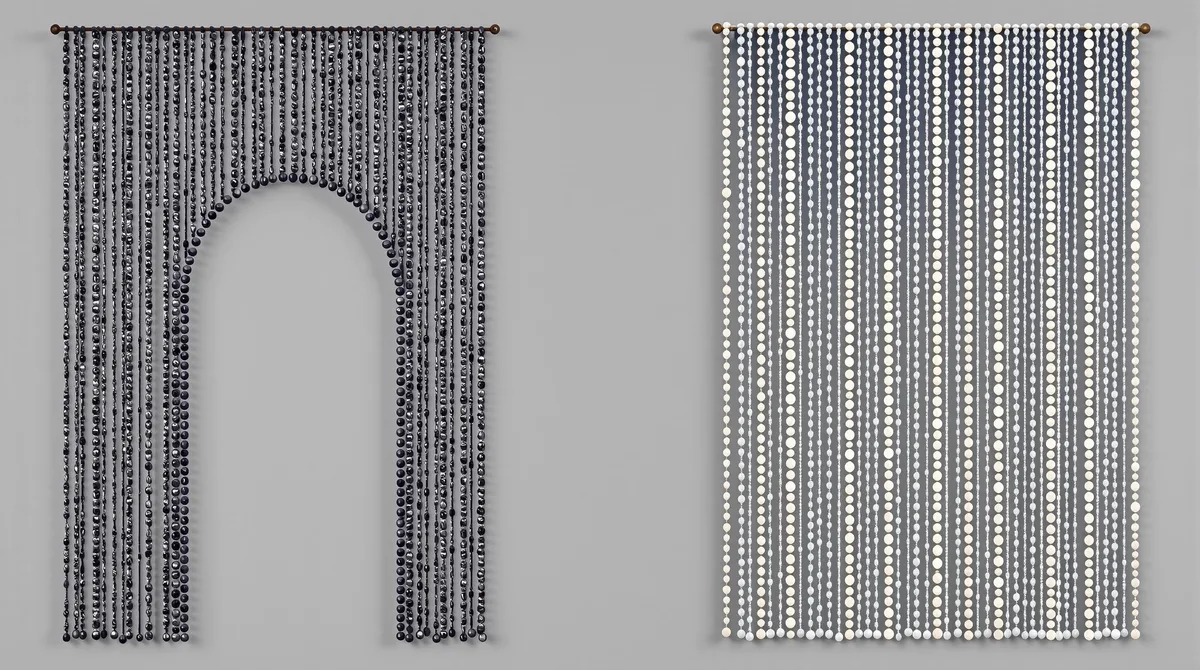
A wall piece is read from one side at close range. That changes which bead earns its place and how the hem has to finish.
The strung wall designs run from 50 × 90 cm to 60 × 100 cm on a dowel turned in our own wood factory, at 20 to 40 strands, plus a wider, shallower 76 × 46 cm format. Cherry Blossom has been sampled, approved and shipped as a faux-capiz piece. The rest are drawn at true size against real beads, with strand and bead figures confirmed on the approved sample.
Design by design
Each page gives the finished size, the strand count, the hem shape and the bead list, and says whether it is a shipped design or one available to develop.
Design
155 to 170 cut faux-capiz blossoms at 18 × 30 in, each held in place by a spacer bead dyed to match the petal.
Design
Rainbow glass seed beads on a rigid bar, using a repeating pattern in place of a gradient to control the bead count.
Design
60 × 100 cm on 22 strands of foil-lined and frosted sea-glass tones, with disc drops closing a straight hem.
Design
60 × 90 cm on 30 strands, with wood rondelles as the body, honey glass as the accent and dotted drops at the ends.
Design
60 × 100 cm on 33 strands of jet and garnet glass with plated gold rounds, to a V-point hem.
Design
60 × 90 cm on 27 strands of cream, lagoon and jade glass ovals, where bead geometry carries the optical read.
Design
50 × 90 cm on 20 strands of clear faceted glass with millefiori and lime coin drops, designed for a window rather than a wall.
The strung wall work. Sizes run 50 × 90 cm to 60 × 100 cm on a turned wooden dowel at 20 to 40 strands, with one wider, shallower format at 76 × 46 cm and 40 strands.
The published range for Gemixx wall pieces is 50 to 76 cm wide on a dowel, in glass, wood and faux capiz. Everything on this index sits inside that band, which is not accidental — a dowel much wider than 76 cm needs a thicker section to stay straight, and a thicker dowel changes the proportion of the whole piece.
Sampled work first, then renders, then within each by hem family. Hem shape is the loudest variable on a wall piece because the hem sits at eye level and nothing is behind it. A V-point hem reads as a pennant. A straight hem with disc drops reads as a panel. An uneven hem reads as a plant.
Strand counts are low relative to width — 20 strands across 50 cm, 22 across 60 cm — because a wall piece is read against a wall, not against daylight. Spacing that would look thin in a doorway looks deliberate on plaster.
With Cherry Blossom, the only design here with a complete production record. Five-petal blossoms in faux capiz — cast resin or dyed cut acrylic finished to imitate capiz shell, with no shell in it — at 18 × 30 in, with small spacer beads dyed to match the petal.
The detail worth the read is the spacer. Without a bead at the centre of each blossom, the blossom slides down its own strand and the pattern collapses. The spacer is not decorative; it is a stop.
Cherry Blossom again, because it records a real trade-off between two mounts. The dowel version carries 155 to 170 blossoms; the rod-pocket version carries 130. Same design, same width, two different bills of materials, because a fabric header eats height that would otherwise hold blossoms.
The Rainbow seed-bead wall art page records the other kind of trade-off: a repeating pattern was used in place of a gradient to bring the bead count down, and the piece hangs from a rigid bar rather than a branch so it stays flat.
Cherry Blossom and the Rainbow wall art come from development documents. Moonwater, Honey Hour, After Hours, Op Pennant and Sun Catcher are drawn designs, each available to develop at the size shown.
Two of those renders are worth reading against each other. Op Pennant and Honey Hour are both 60 × 90 cm with a V-point hem, at 27 and 30 strands. The difference between them is entirely bead material — cream, lagoon and jade glass ovals against wood rondelles, honey glass and dotted drops — which is as clean a demonstration as the library offers that material, not shape, carries the mood.
Every design here carries a specification table. For a wall piece the specification a factory actually needs is narrow: width, longest drop, shortest drop, strand count, dowel length and section, bead list in strand order, and hem shape.
Glass seed beads covers the ground material most of these designs are built on, and bead sizes and stringing specifications gives the sheet shape.
Against an approved sample, like everything else here: the sample fixes the colour, the hem and the blossom or bead count, and production is held to it through our own quality house. The piece arrives on its turned dowel, and the hook is chosen for the wall — plaster, board or masonry all want a different fixing, and the panel is light enough that the dowel length rather than the weight sets the span.
Good to know
Cherry Blossom, because it is the only wall design on this index with a full production record. It is also the one that documents a construction nobody expects: a small spacer bead at the centre of each blossom, there only to stop the blossom sliding down its strand.
Cherry Blossom was adopted in August 2026, approved in September 2026 and shipped as a faux-capiz piece. The Rainbow seed-bead wall art reached CAD and sampling. The colour-story pieces are drawn at true size and available to develop, with every figure confirmed on the approved sample.
Plants we own. Glass seed beads are drawn and hand-strung in our own Firozabad glass works, faux-capiz blossoms are cast or cut to our own dies and finished in our own beadwork studios, the dowels are turned, stained and lacquered in Saharanpur, and first-article and lot inspection run through our own Greater Noida house.
Sampled work first, then the render-library pieces grouped by hem family — straight with disc drops, then V-point, then scalloped and uneven. Hem shape is the strongest visual variable at this size, and it is also the one a buyer changes most often.
The beaded piece on its turned dowel, packed to your carton and label specification. The dowel is ours; the hook and the wall fixing are chosen for the wall the piece hangs on. Hand-knotted cotton work is a separate craft family with its own pages, because knotted work and strung work are specified differently.
Keep exploring
Design
Colour stories documented by how they are built, not by how they look in a mood board.
View the rangePillar
Door curtains, portals, café lengths and valances: the standard sizes, the strand counts and the one question each format answers.
View the rangeDesign
Portals at 76 × 140 cm and hanging divisions at 90 × 180 and 120 × 180 cm, documented by strand count and opening shape.
See the detailDesign
Valances at 120 × 30 to 40 cm and café curtains at 76 × 76 cm, documented by hem shape, strand count and bead count.
View the rangeDesign
Linked faux-capiz disc hangings at 70 × 130 to 90 × 200 cm, and beaded shade designs from a 15 cm sconce to a 50 cm pendant.
See the detailMaterial
How seed beads are drawn, why dye lots are quoted per run, what the drill hole limits, and where seed-bead work earns its cost.
Read the guide
Start a conversation
Send a reference, a colour chip or a sketch. Minimums are set per design and confirmed per quote; sampling is quoted separately and usually runs 16 to 20 days from an agreed brief.