Colour story
Jet and garnet glass
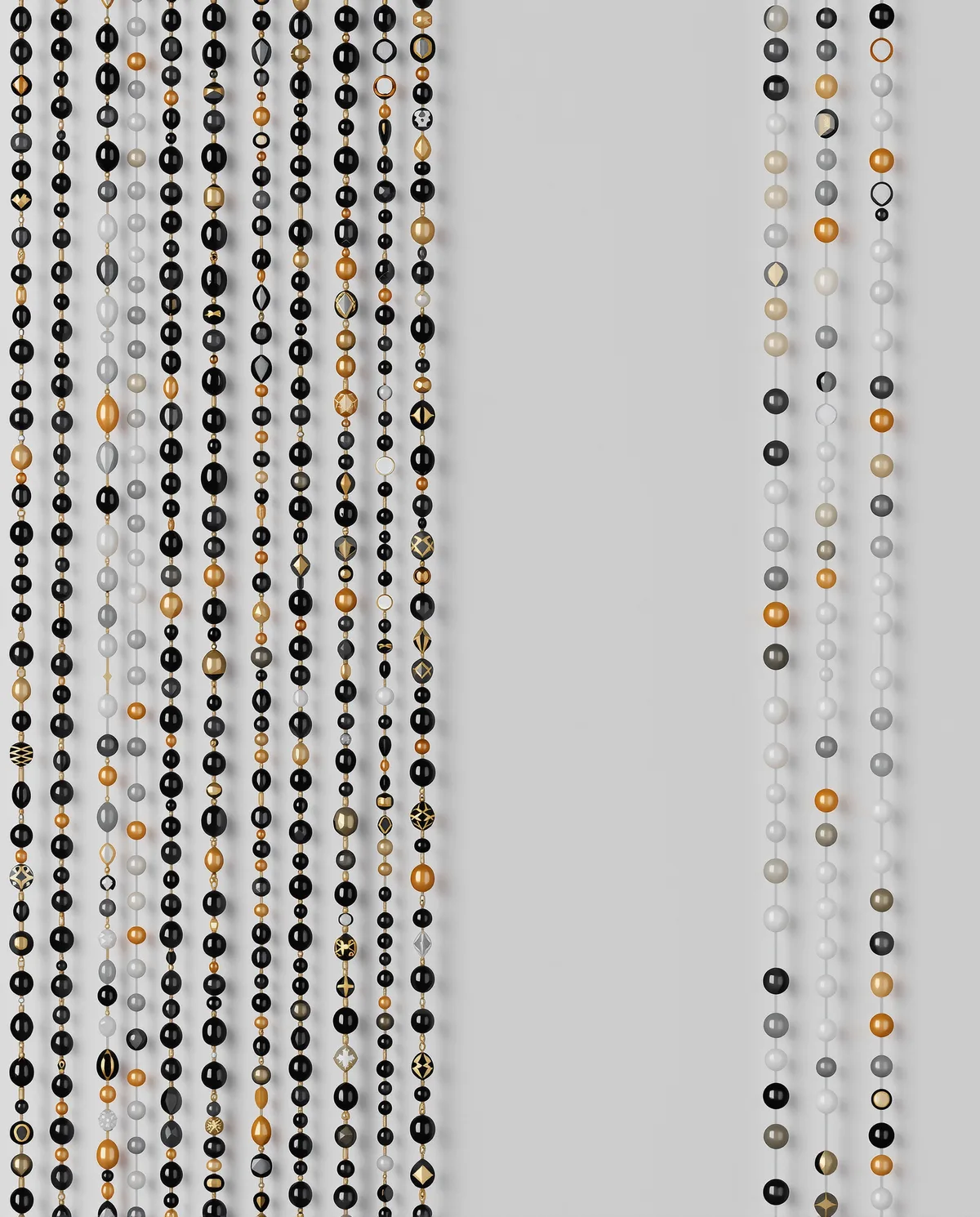
Jet and garnet glass with gold rounds across 33 strands — the point where an all-glass wall piece reaches its sensible weight.
Read the guide
Design · After Hours Wall Hanging
Thirty-three strands of glass on a hundred-centimetre drop. At that density, weight becomes a design question rather than a packing note.
A hand bead-embroidered ornament, jet black and smoke crystal beads couched in tight spiral rows with a band of antique gold bugle beads round the middle.
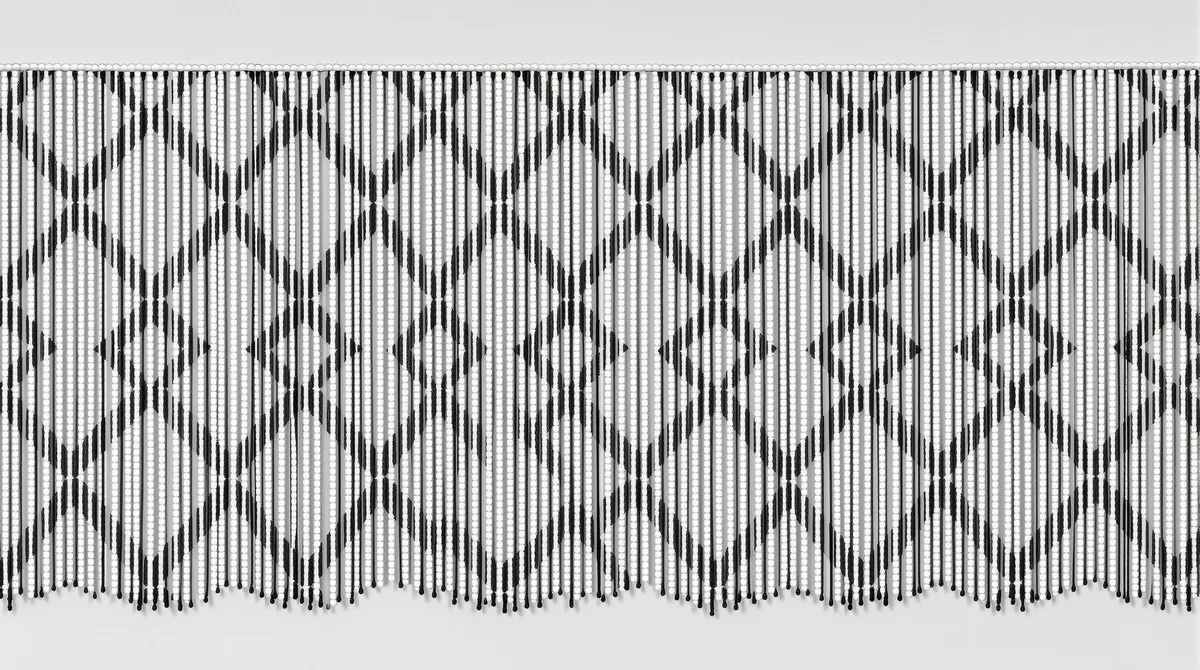
The After Hours wall hanging is drawn at 60 × 100 cm on 33 strands with a V-point hem, in jet and garnet glass with plated gold rounds. Thirty-three strands across 60 cm is a pitch of about 1.8 cm, the closest spacing in the wall group, which makes it the densest and heaviest build there — and no weight figure is published for it.
The After Hours wall hanging is drawn at 60 × 100 cm on 33 strands with a V-point hem, in jet and garnet glass with plated metal gold rounds. Available to develop.
Thirty-three strands across 60 cm is a pitch of about 1.8 cm. That is the closest spacing in the wall group — against 22 strands on the same width for the coolest story and 27 for the optical one — which makes this the densest and heaviest piece drawn in the format.
A written sequence of two close darks with a plated metal round placed into it. There is no scattered accent and no mapped pattern.
The two darks are deliberately close in value: jet reads as absence and garnet reads as a dark with blood in it, and the eye keeps looking for the difference. Without a third element they would average into one black field, which is why the metal is structural rather than decorative.
The entry this sheet is missing is the one that matters. No panel weight is published, and on the densest glass build in the group the hardware load is the figure a fixing has to be chosen against. Beyond that: the strand count sets the density, and the metal finish is named from the standard set rather than described.
| Specification | Value |
|---|---|
| Finished size | 60 × 100 cm |
| Strand count | 33 |
| Strand pitch | About 1.8 cm centre to centre |
| Beads | Body-coloured jet and garnet glass, with plated metal rounds |
| Hem shape | V-point |
| Metal finish | From the standard set — Matte Gold, Brilliant Gold, Champagne Gold and others |
| Where the metal is made | Finished and plated in our own Moradabad plants |
| Weight | Established on the approved sample |
| Status | A design available to develop at the drawn size |
The glass carries the field and the metal carries the event. Of the two, the metal is where the design's character and its risk both sit.
Metal beads are finished and plated in our own Moradabad plants, with eight standard finishes available — Matte Gold, Matte Black, Rose Gold, Brilliant Gold, Champagne Gold, Antique Silver, Brilliant Silver and Matte Silver — and custom finishes using techniques including hand battering, large-grain sand casting, physical vapour deposition and gold plating. So the finish is a specification, not a found look.
It is also the element most likely to drift on a reorder, because plating thickness and final polish both change how warm a gold reads and neither shows on a colour reading.
A V-point: longest strand at the centre, shortest at the two edges, written out as 33 lengths. The piece reads as a pennant.
On a dark piece the V has a second function. A dark rectangle on a wall reads as a hole; a dark pennant reads as an object. The hem is doing as much work as the palette in making the piece legible.
This is the most important section on the page and it has no number in it. What can be said is where it sits relative to the rest of the group. As a general physical property, glass runs around 2.5 g/cm³, and this design has more glass per square metre than anything else drawn in the format. A 60 cm dowel is a short span, so the question is load at the two fixings rather than deflection, and the fixing should be rated on the sample weight rather than assumed from a lighter piece.
Recoloured, with the metal finish as the cheapest effective lever. Brilliant gold to matte gold, or to antique silver, changes the register of the whole piece without touching a glass bead or adding a line to the bill of materials.
Resized, and on this design the pitch is the lever to reach for rather than the dimension. It is the densest build in the wall group, so opening the strand spacing takes weight off the fixing and lifts the palette at the same time, without touching the colour.
Retailers and own-label brands as the premium or contrast piece in a beaded range, and interior specifiers working on bars, restaurants and evening-lit interiors.
It is the hardest piece in the group to merchandise, because a dark piece under flat shelf lighting reads as a black rectangle and needs a dedicated light to show its highlights. Where it earns its place on a shelf is as a contrast piece: beside a pale or pastel story it makes the whole group look more considered.
Not sampled, so the applicable lessons come from adjacent glass work and there are two.
Larger glass feature beads are annealed for strength, and glass strength is colour-dependent, so some colours are poor neighbours when they clink against each other in a hanging piece. Both of those were established on a hand-made Venetian portal and both would need checking against whichever jet and garnet bead lines this design settles on.
The second is the plating question. A plated bead is approved physically, not against a reading, and that approval has to happen before the piece is costed firmly.
This is the heaviest packing case in the wall group, so inner packing would be agreed on the sample rather than assumed. A dense glass strand has nowhere to move but against its neighbour.
What it cannot show is the weight, and on this particular design the weight is the specification item a buyer most needs. The approved sample is weighed, so the fixing can be sized to a real number rather than to an estimate.
The dark story: jet black, deep garnet and gold. This wall hanging is the only design drawn in it in the published library — there is no doorway, valance or portal in this palette.
Good to know
Body-coloured jet and garnet glass, with plated metal rounds. Jet and garnet are among the colours glass holds best as body colours, which makes the dark half of the palette cheap to hold across reorders. The metal is specified by finish rather than by colour.
Exclusivity is a commercial decision taken per programme rather than a property of the design. Name it in the brief and it is quoted alongside the piece.
It shows the size, strand count, hem and bead list as drawn. It cannot show the thing that matters most on this design, which is what 33 strands of glass on a 100 cm drop actually weighs — that is a sample question, and no weight figure is published.
Strands are kept in order and protected against knocking in transit, then packed to your carton, label and packaging specification. A dense glass build is the heaviest packing case in the wall group, so inner packing would be agreed on the sample rather than assumed.
Yes. A sketch, photo or artwork with size, materials, colours and quantity becomes a colour-count sheet. On a metal-bearing design, name the finish from the standard set rather than describing the colour — gold is eight different things.
Yes, and the cheapest effective change is the metal finish rather than the glass. Moving from brilliant gold to matte gold or antique silver turns the piece from evening to architectural without touching a single glass bead.
Keep exploring
Colour story
Jet and garnet glass with gold rounds across 33 strands — the point where an all-glass wall piece reaches its sensible weight.
Read the guideSpecification
What a beaded panel weighs by material and density, and which fixings suit light acrylic against heavy glass.
How it is madeDesign
Strung wall pieces from 50 × 90 to 60 × 100 cm at 20 to 40 strands, documented by hem shape and bead list.
Open the referenceDesign
60 × 90 cm on 27 strands of cream, lagoon and jade glass ovals, where bead geometry carries the optical read.
Specs and sizesDesign
Rainbow glass seed beads on a rigid bar, using a repeating pattern in place of a gradient to control the bead count.
See the detailGuide
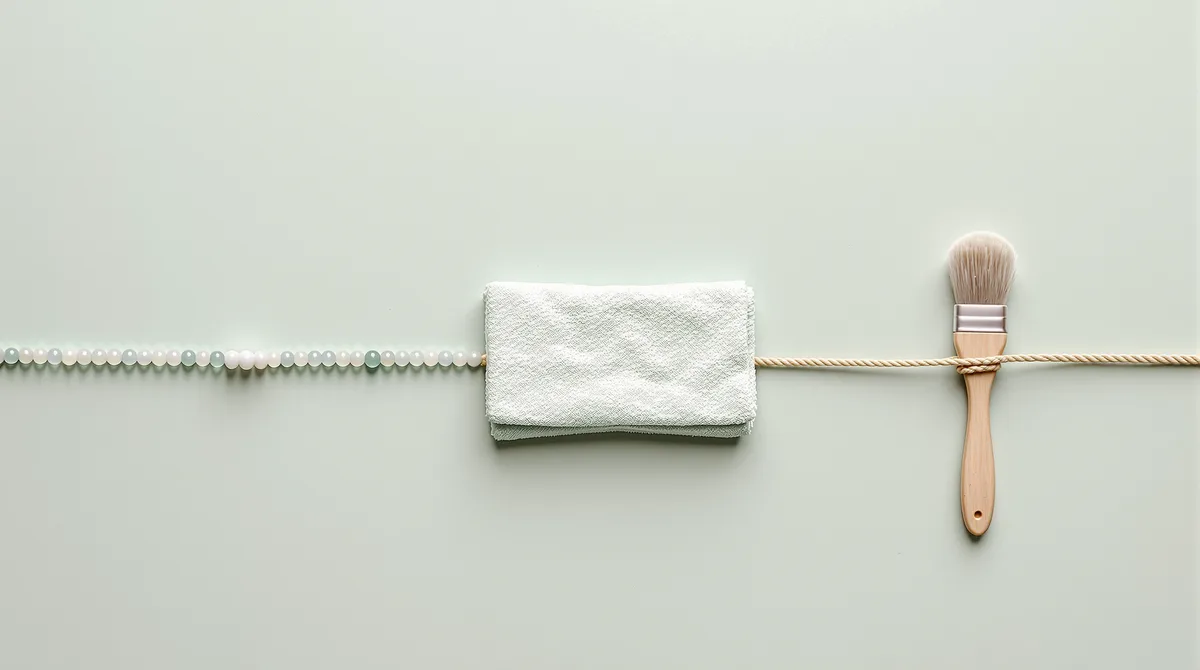
Dry dusting first, spot cleaning the beads, keeping the cord dry, what never to use, and how to handle a broken strand.
Open the reference
Start a conversation
Send a reference, a colour chip or a sketch. Minimums are set per design and confirmed per quote; sampling is quoted separately and usually runs 16 to 20 days from an agreed brief.