Material
Seed beads, in detail
How seed beads are drawn, why dye lots are quoted per run, what the drill hole limits, and where seed-bead work earns its cost.
Compare the options
Design · Rainbow Seed Bead Wall Art
A gradient and a repeat can look similar from across a room and cost very differently to make. This design chose the repeat, deliberately.
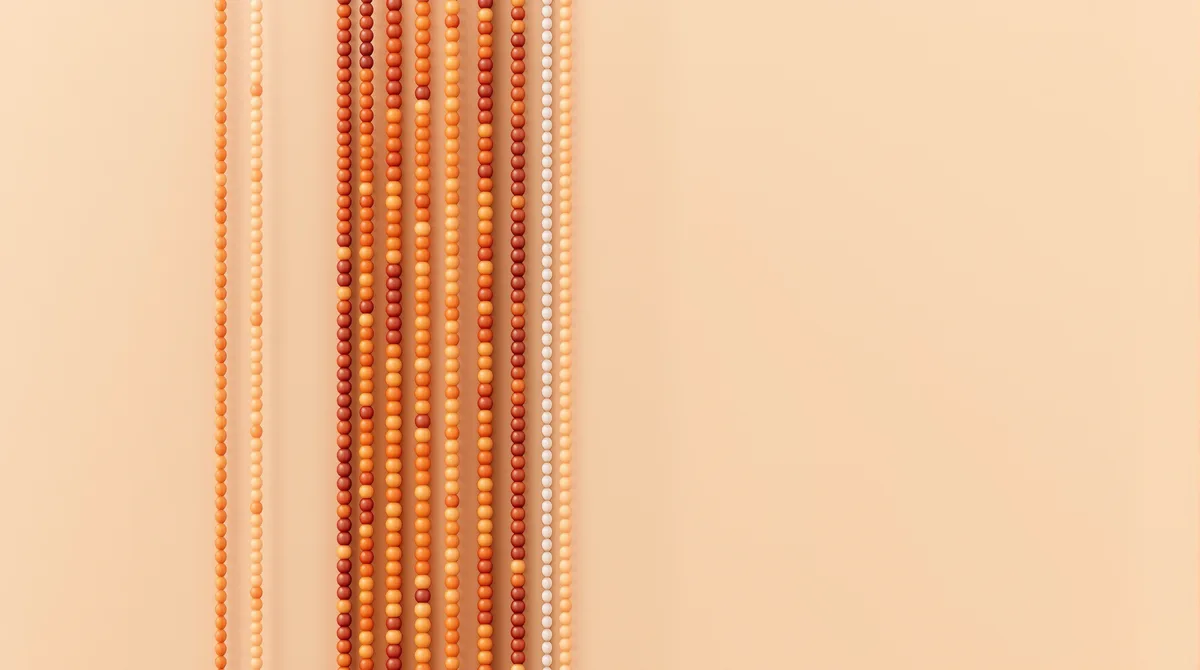
Drawn glass seed beads in lime, forest green and chalk white, scattered loose beside a short threaded sample strand, graded across three sizes from about two millimetres up.
The rainbow seed-bead wall piece is built from rainbow glass seed beads and hangs from a rigid bar rather than a branch, so it stays flat. Its defining decision is that a repeating pattern was used in place of a gradient: a gradient needs a unique bead sequence for every row, where a repeat reuses one sequence, and the bead count and the bench time both fall.
The rainbow seed-bead wall piece is built from rainbow glass seed beads and hangs from a rigid bar. It reached a computer-aided drawing and sampling in 2025 and did not go into production.
It is on the site because it holds two of the most transferable decisions in the whole record: why it uses a repeat instead of a gradient, and why it hangs from a bar rather than a branch.
As a fine seed-bead field worked to a pattern. A seed bead is the right bead for this subject because fine beads make a colour band read as a continuous area rather than as a row of dots — the same reason a seed-bead ground is used under scattered accents elsewhere in the library.
The pattern itself repeats. That is the design's defining decision and it was taken on cost grounds rather than visual ones.
The sheet for this design has two gaps and one warning. No finished drop length and no bead count were captured in the record, and this page does not invent either. The warning is freight cubing: an oversize non-collapsible piece carries a poor carton cost per unit, and on a wall piece that is a drawing-stage decision.
| Specification | Value |
|---|---|
| Beads | Rainbow glass seed beads |
| Hanging element | A rigid bar, chosen over a branch so the piece stays flat |
| Pattern method | A repeating pattern in place of a gradient |
| Reason for the repeat | Bead count and bench time, not appearance |
| Packing | Oversize; the piece is not collapsible |
| Finished size | Confirmed at sampling |
| Stage reached | Computer-aided drawing complete, sampling started, 2025 |
| Status | A design available to develop at the drawn size |
| Production | 40 to 60 days after sample approval |
The clearest statement anywhere in the record of a lever most briefs never mention: a repeating pattern is materially cheaper to build than a gradient, and the two can look similar from across a room.
A gradient needs a unique bead sequence for every row, so the drawing is longer, the sorting at the bench is more complex and there is no reuse anywhere. A repeat reuses one sequence many times. On this design the repeat was adopted specifically to bring the cost down, and the piece still reads as a rainbow.
The second lesson is the hanging element. A branch was considered and a rigid bar chosen, because a branch is not straight, is not repeatable and lets the piece distort. A rigid bar is dull and correct.
Badly, and the record says so. The packaging is oversize and the piece is not collapsible, which means a large carton for a low-value shipment and a poor freight cost per piece.
That is worth stating as a design lesson rather than as a complaint. On a wall piece, whether the object can fold, roll or nest is a design decision taken at drawing stage, and it is one of the few decisions that cannot be fixed later without changing the design.
The imagery here is editorial, and the record slot for real macro photography of drawn seed beads ships marked as pending with its real alt text and dimensions rather than filled with an approximation.
Nothing on this page is presented as a piece a buyer can order. The design reached drawing and sampling and stopped there.
None of the fourteen named 2027 stories. A full rainbow is a palette in its own right, and it is the hardest one in the library to hold across a production run — every colour in it is a dyed seed-bead line, and every line carries its own batch variation.
That is a genuine argument for narrowing the palette on any development of this design. Six colours held well will look better than ten colours held poorly.
Glass seed beads, drawn and hand-worked in our own Firozabad glass works, and dyed. The relevant material fact is that a seed bead's colour sits on the glass rather than in it, so colour is a surface and a batch property and the dye lot is agreed per run.
On a rainbow that exposure is multiplied by the number of colours, which is the single hardest thing about making this design repeatable.
As the bottom edge of the beaded field rather than as a strand profile, because the piece is a worked area rather than a set of hanging strands. The record does not fix a hem shape for it.
A rigid bar. ## Why would a narrower palette improve it?
Both, and both would be easier than on most designs here. A repeating pattern scales cleanly because the repeat is reused, which is a second advantage of the repeat decision beyond its original cost rationale.
Recolouring is where the real improvement is available. A narrower palette is both cheaper and more repeatable than a full rainbow, and on a seed-bead design the number of dyed lines is the thing that decides how closely a reorder will match.
Good to know
Yes, and a narrower palette would be easier to hold than a rainbow. Glass seed beads are dyed, so colour on them is a surface and a batch property, and every additional colour in the palette is another line with its own dye-lot behaviour.
Yes, and the record does not fix a size for it in the first place. Scaling a repeating pattern is straightforward because the repeat is reused; scaling a gradient is not, which is part of why the repeat was chosen.
Rainbow glass seed beads. Glass seed beads are drawn and hand-worked in our own Firozabad glass works, and a seed bead is the right bead here because fine beads are what make a colour band read as a continuous area rather than as a row of dots.
Exclusivity is a commercial decision taken per programme rather than a property of the design. On a design that has not reached production it is a conversation to have alongside the development.
The imagery on this page is editorial and the record slot for real macro photography of drawn seed beads ships marked as pending. The design reached a computer-aided drawing and sampling in 2025, and it is not captioned as a piece a buyer can order.
This is the design's weak point and the record is explicit about it. The packaging is oversize and the piece is not collapsible, so it occupies a large carton for its value. Any development of it should treat the carton as a design constraint rather than a downstream detail.
Yes, and for a seed-bead wall piece the single most useful thing to send is whether the colour should change gradually or in bands. That one answer moves the bead count, the drawing time and the price more than any other decision in the brief.
Keep exploring
Material
How seed beads are drawn, why dye lots are quoted per run, what the drill hole limits, and where seed-bead work earns its cost.
Compare the optionsManufacturing
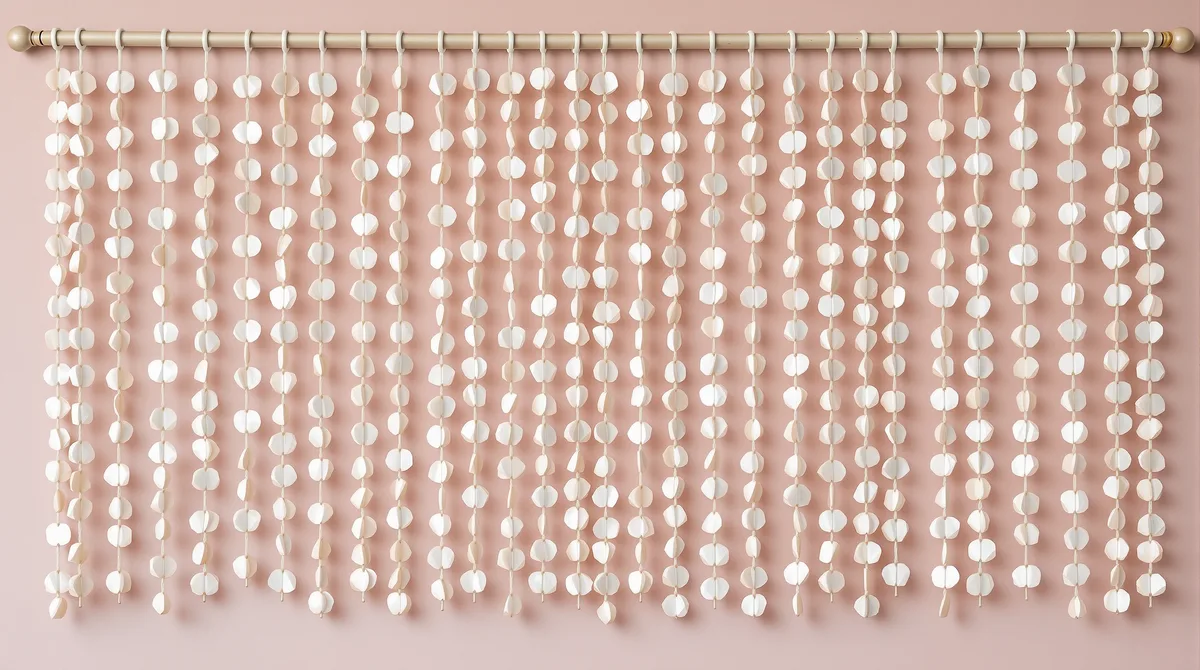
Widths from 50 to 76 cm on a turned dowel, in glass, wood and cast faux capiz — hem shapes, strand counts and what is a shipped format against a concept.
Read the guideDesign
Strung wall pieces from 50 × 90 to 60 × 100 cm at 20 to 40 strands, documented by hem shape and bead list.
Read the guideDesign
50 × 90 cm on 20 strands of clear faceted glass with millefiori and lime coin drops, designed for a window rather than a wall.
Specs and sizesDesign
155 to 170 cut faux-capiz blossoms at 18 × 30 in, each held in place by a spacer bead dyed to match the petal.
Read the guideDesign
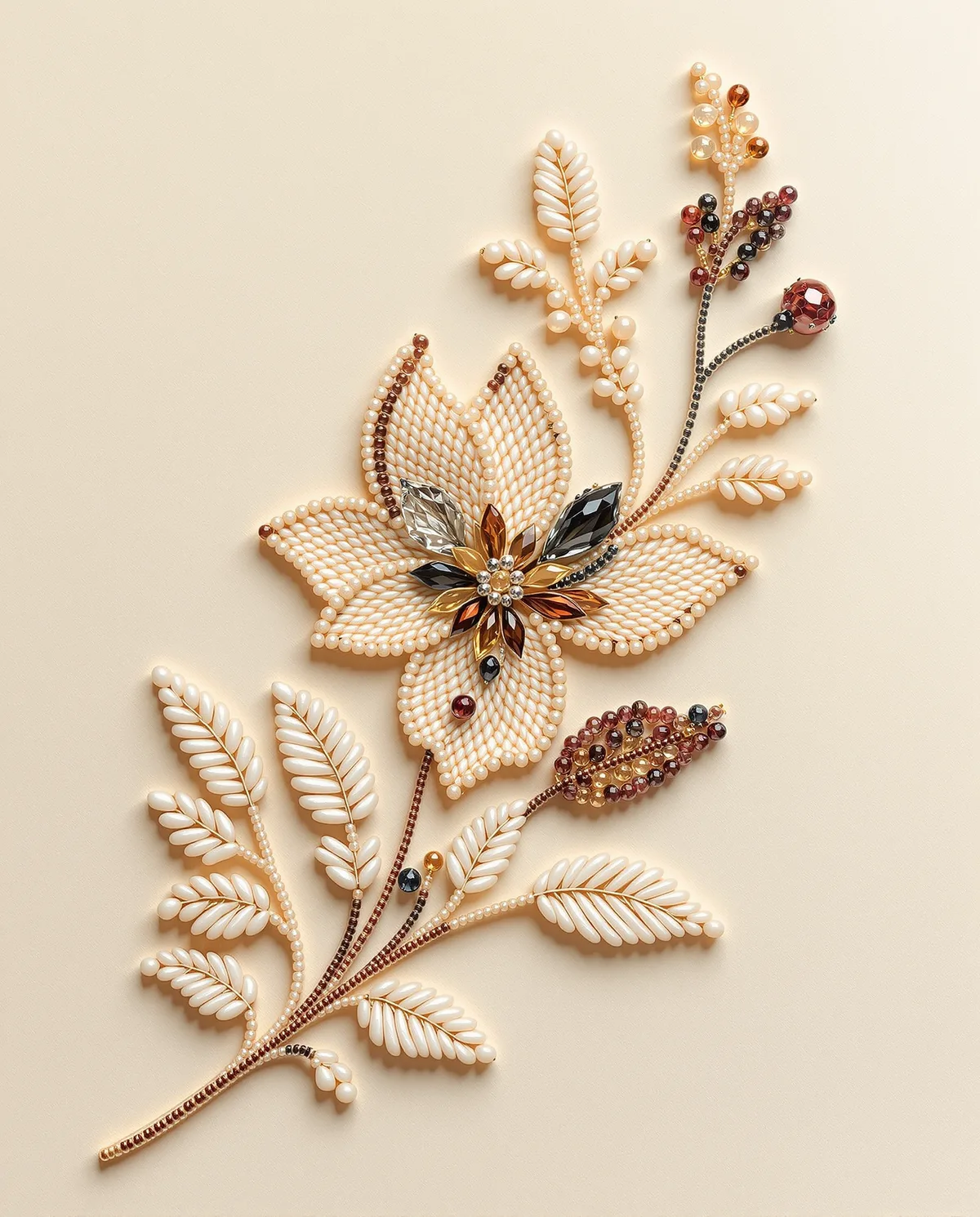
Dyed glass seed beads embroidered onto a sheer ground at 30 inches square, with a three-inch rod pocket.
Read the guide
Start a conversation
Send a reference, a colour chip or a sketch. Minimums are set per design and confirmed per quote; sampling is quoted separately and usually runs 16 to 20 days from an agreed brief.