Material
Cut and faceted glass: the real word for crystal
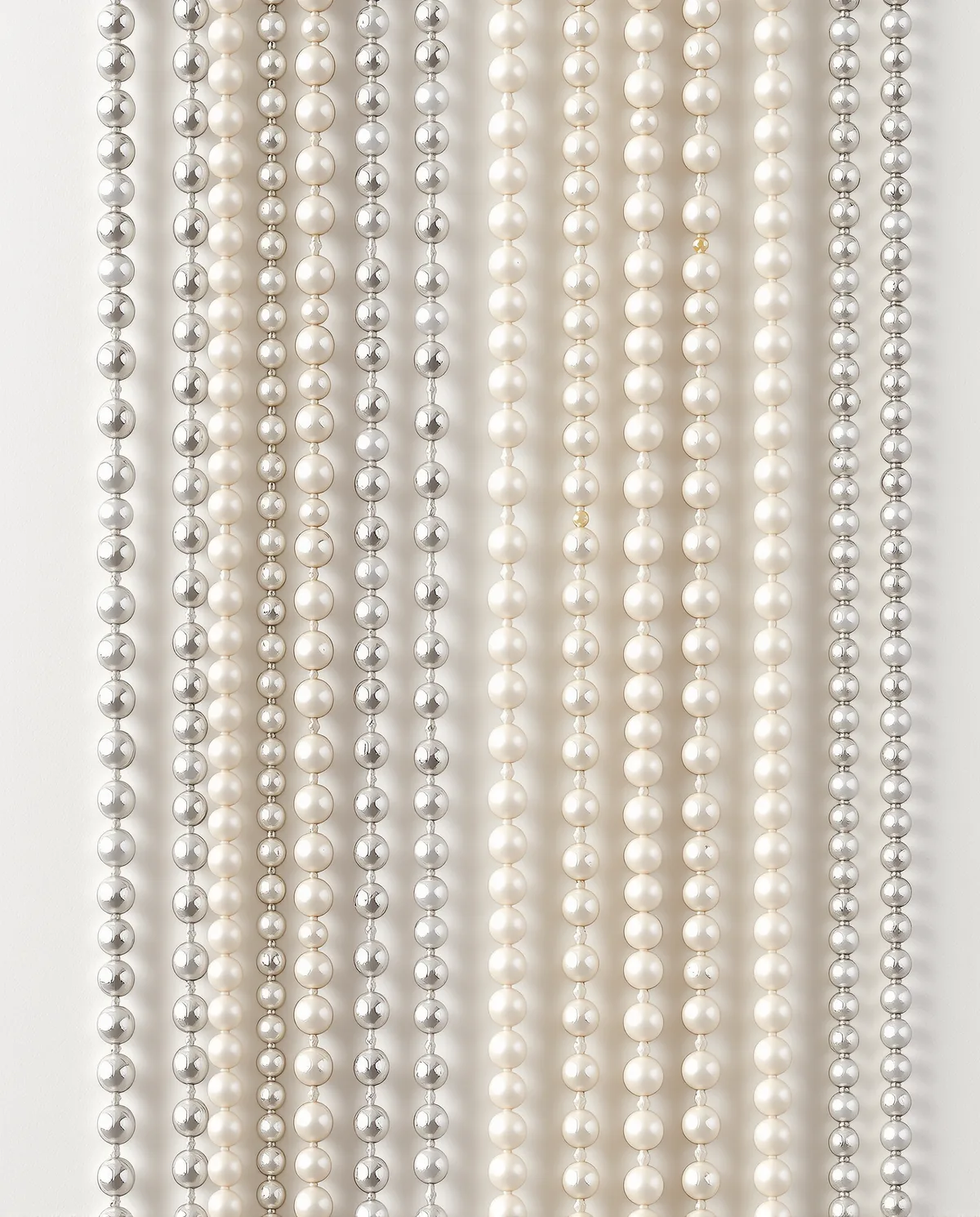
Faceting, refraction and weight — why the market says crystal, why a specification says glass, and where the premium is actually earned.
Read the guide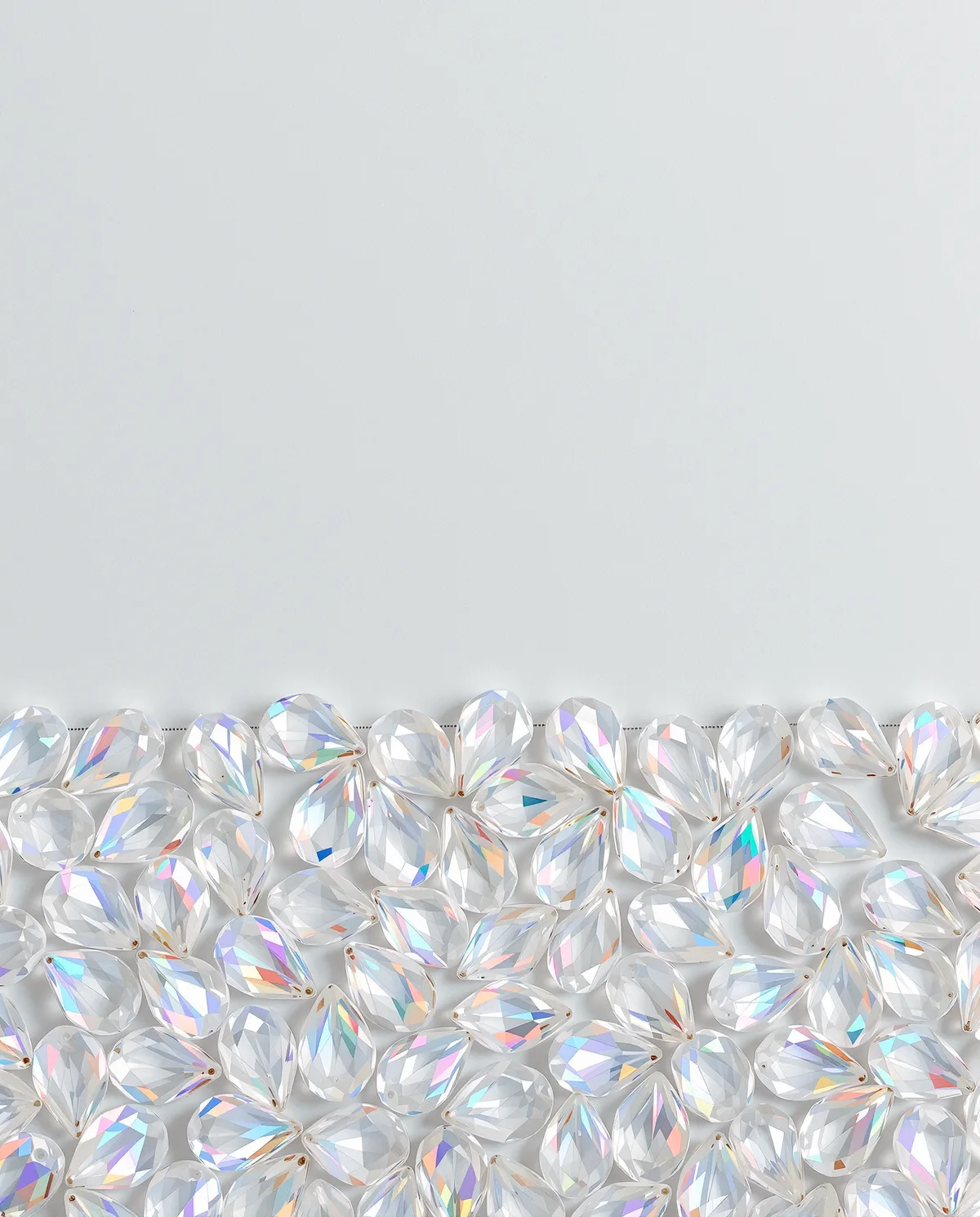
Design · Sun Catcher Wall Hanging
The smallest and most open piece in the group, built around a bead that does nothing at all unless there is light behind it.
Faceted crystal teardrop beads with a pearlised iridescent AB finish, machine cut to even facets over a clean white glass body.
The Sun Catcher is drawn at 50 × 90 cm on 20 strands with a V-point hem, built from clear faceted glass with millefiori beads and lime coin drops. It is the smallest and most open piece in the wall group, and the only one designed for a window rather than a wall — clear faceted glass does nothing against plaster and everything against daylight.
The Sun Catcher is drawn at 50 × 90 cm on 20 strands with a V-point hem: clear faceted glass as the field, millefiori beads as the feature, and lime coin drops at the strand ends. Available to develop.
Twenty strands across 50 cm is a pitch of about 2.5 cm, open for the group. It is also the smallest piece drawn in the format, and the only one that genuinely belongs in a window.
A clear faceted field with millefiori beads spaced into it and a coin drop closing each strand. There is no mapped pattern, and there could not be one — the millefiori bead rules it out.
A millefiori bead carries worked glass canes inside it and is individually made, so no two are identical in size or pattern. That variation is the whole reason to use it, and it is also why a design using it has to be built as a sequence rather than as a graphic. A millimetre of variation per bead accumulates down a 90 cm drop and skews any row.
An open build shifts the sheet towards the hem. At 20 strands the strand pitch is wide, so the open area is part of the design, and the end bead at each strand tip is a specification rather than a finish. The feature bead is hand-made, so it is specified by an approved sample and a tolerance instead of by a dimension.
| Specification | Value |
|---|---|
| Finished size | 50 × 90 cm |
| Strand count | 20 |
| Strand pitch | About 2.5 cm centre to centre |
| Field bead | Clear faceted glass |
| Feature bead | Millefiori glass |
| Strand ends | Lime coin drops |
| Hem shape | V-point |
| Material naming | Glass, not crystal — the term is corrected on every quote |
| Status | A design available to develop at the drawn size |
A turned wooden dowel, made in our own Saharanpur wood factory. At 20 strands on a 50 cm width this is the lightest build in the wall group by a clear margin. The practical consequence is in the opposite direction from the dense designs: a light faceted strand will drift rather than hang true, which is precisely why there is a coin drop at the end of every one.
Recoloured easily and to large effect, because the field is clear and an accent has nothing to fight. One tinted bead line changes the whole register of the piece.
The two elements where colour is really visible are the millefiori and the coin drop. Resized upwards well — a clear palette improves with area, because the accumulated highlights resolve into a surface. Scaling below about 40 cm wide leaves too few strands for the V-point to read as a point.
Retailers and own-label brands in gift and lifestyle, and anywhere a piece will be hung in a window. It is the most giftable object in the wall group: small, light, inexpensive to freight and immediately legible.
The merchandising requirement is specific and non-negotiable. This design needs light behind it. In a shop it should hang in a window or against a light box, and a flat shelf display will make it look like clear plastic.
Not sampled, so the applicable lessons come from adjacent glass work and from the naming problem.
Larger glass feature beads are annealed for strength, and glass strength is colour-dependent, so colours that clink against each other in a hanging piece have to be mutually compatible. Both were established on a hand-made Venetian portal, and both apply to a millefiori bead, which is also hand-made and also large.
The naming lesson is simpler. Buyers ask for a crystal piece and are delivered cut or faceted glass, and we describe it as glass. The word crystal implies a material we are not making, and correcting it at quote stage avoids a problem at delivery.
Faceted glass chips at its facet edges, which is where it is thinnest, so inner packing matters more on this design than the low bead count suggests. The millefiori beads and the coin drops are the two elements that would be protected first.
What it cannot show is the thing this design exists for. A render of a clear faceted piece flattens exactly the refraction and the cast light that the design is built to produce, so the render is the least representative image in the whole library of what the finished object does.
Its own, and it is the only piece in the wall group that is essentially colourless. By palette and behaviour it sits closest to Sterling Swan, which is built at backdrop scale on the same principle: faceting rather than hue as the mechanism.
The comparison is instructive. That story needs 120 × 210 cm before a clear palette reads as silver. The Sun Catcher solves the same problem at a fifth of the area by adding two coloured incidents — a millefiori bead and a lime coin drop — so the piece has something to be clear against.
The faceted bead makes the light and the millefiori makes the design. A faceted bead returns a dozen small specular highlights where a round returns one, and in a palette with no colour contrast those highlights are the only visual event.
The millefiori is the bead a customer looks at. It is hand-made lampwork rather than a pressed bead, which means it costs more per bead, varies individually, and cannot be specified by a drawing — it is specified by an approved sample and a tolerance.
A V-point, with the coin drops tracing the point. On an open-pitch design the hem is more visible than on a dense one, because there is nothing behind the drops, so the coin is read as a shape rather than as a weight.
That makes the drop choice the design's cheapest significant lever: the coin is 20 beads out of hundreds and it is the element a viewer describes.
Good to know
It shows the size, strand count, hem and bead list as drawn. It cannot show what this design is actually for, which is transmitted light — a render of a clear faceted piece flattens exactly the refraction the design exists to produce.
Strands are kept in order and protected against knocking in transit, then packed to your carton, label and packaging specification. Faceted glass chips at its facet edges, so inner packing matters more here than the low bead count suggests.
Yes. A sketch, photo or artwork with size, materials, colours and quantity becomes a colour-count sheet. For a light-driven design, tell us the window orientation — that affects the specification more than the palette does.
Yes, and small changes go a long way because the field is clear. One tinted bead line shifts the whole piece. The millefiori and the coin drop are the two elements where a colour choice is really visible; the clear field is a constant.
Yes. At 50 × 90 cm it is already the smallest in the group, and it scales up well because a clear palette improves with area. Scaling down below about 40 cm wide leaves too few strands for the V-point to read.
Clear faceted glass as the field, millefiori glass as the feature, and lime coin drops at the strand ends. Glass is drawn, cut and hand-strung in our own Firozabad glass works, and millefiori is hand-made lampwork rather than a pressed bead.
Keep exploring
Material
Faceting, refraction and weight — why the market says crystal, why a specification says glass, and where the premium is actually earned.
Read the guideManufacturing
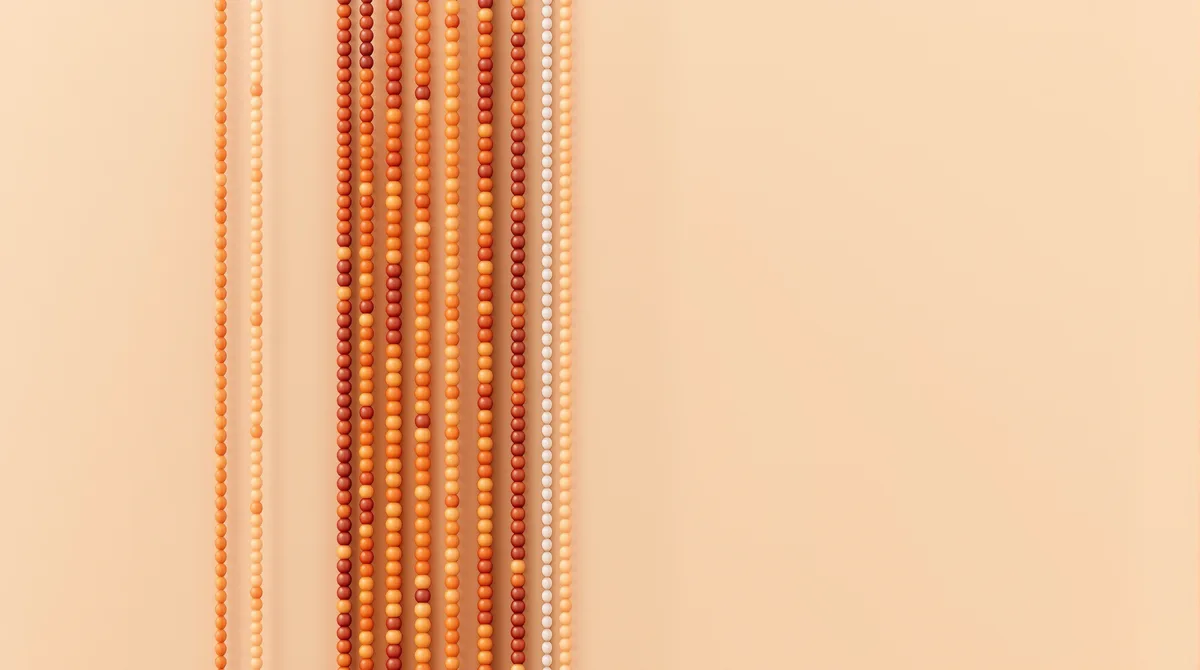
Widths from 50 to 76 cm on a turned dowel, in glass, wood and cast faux capiz — hem shapes, strand counts and what is a shipped format against a concept.
Compare the optionsDesign
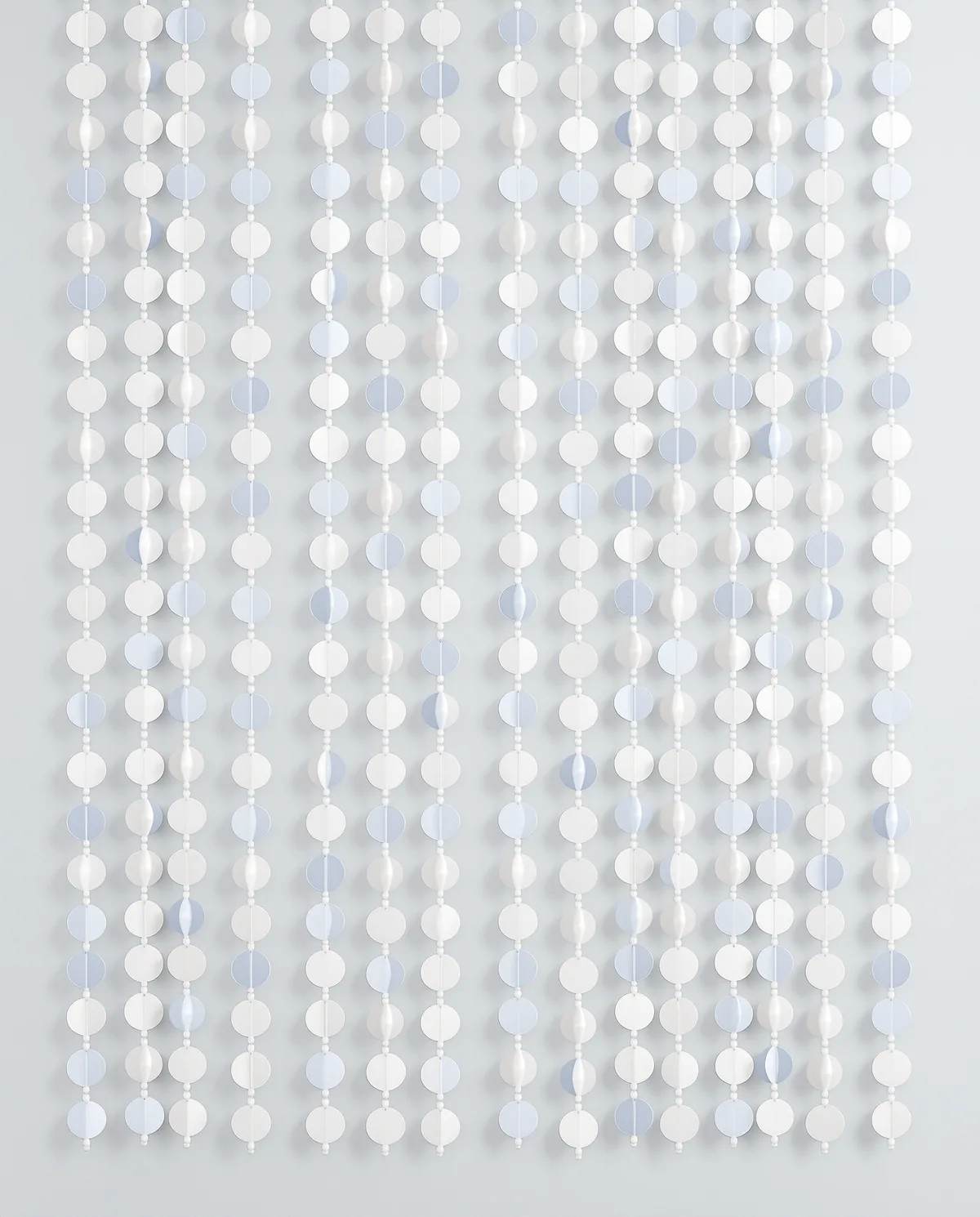
Strung wall pieces from 50 × 90 to 60 × 100 cm at 20 to 40 strands, documented by hem shape and bead list.
Compare the optionsDesign
60 × 100 cm on 22 strands of foil-lined and frosted sea-glass tones, with disc drops closing a straight hem.
Compare the optionsDesign
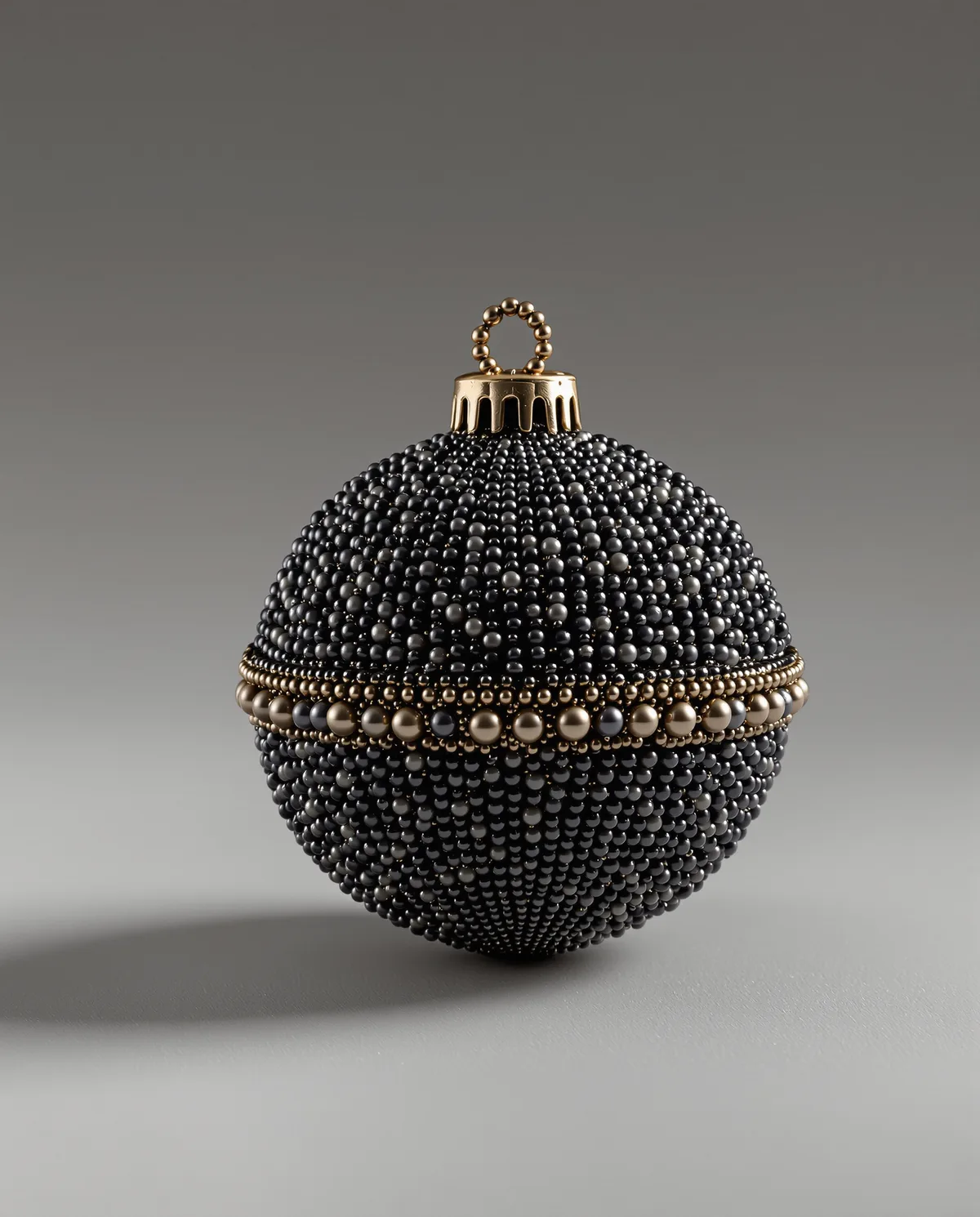
60 × 100 cm on 33 strands of jet and garnet glass with plated gold rounds, to a V-point hem.
Read the guideColour story
A pale, reflective palette drawn at 120 × 210 cm, where silver and clear glass read as light rather than as colour.
Compare the options
Start a conversation
Send a reference, a colour chip or a sketch. Minimums are set per design and confirmed per quote; sampling is quoted separately and usually runs 16 to 20 days from an agreed brief.