Guide
Pet-safe bead panels
Cats climb, dogs push through: which builds survive it, which beads are a swallowing risk, and how to hang in a pet home.
Read the guide
Guide · Safety
A hanging panel of independent strands is, to a cat, a ladder with handholds every centimetre. Plan for it and the panel survives. Ignore it and the fixing goes.
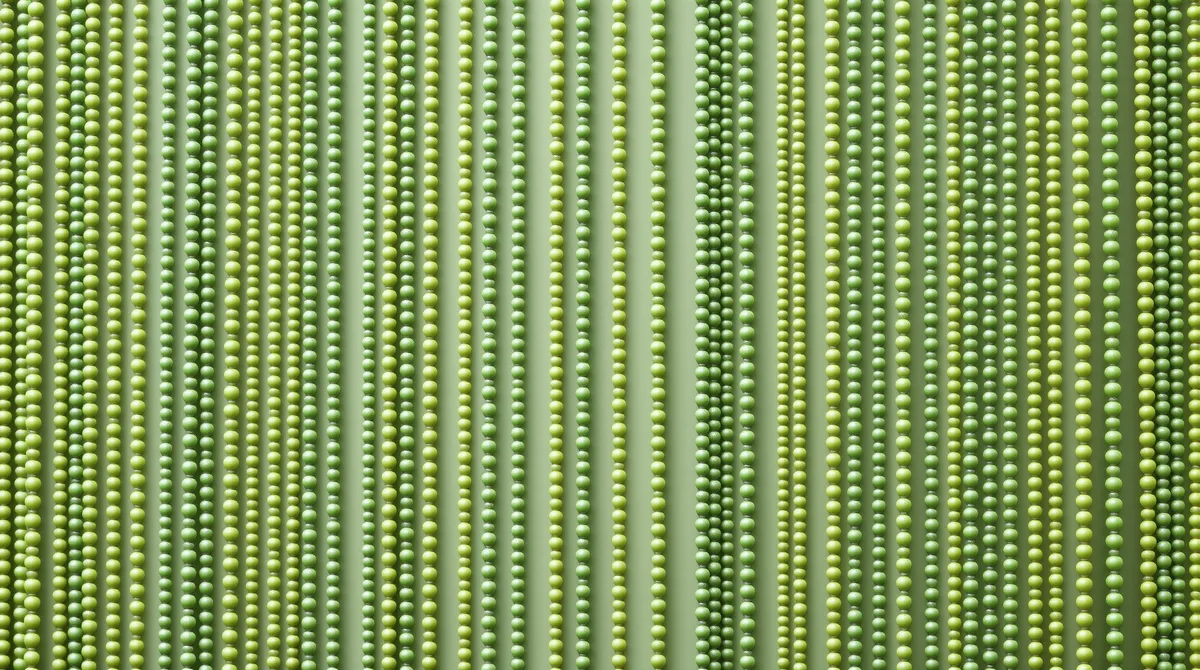
A hand-strung bead curtain in lime and forest green with one cord dragged out of line, hanging short and crooked with a bare frayed tail of stringing cord below its last bead.
A climbing cat loads one or two strands with its whole body weight, which is far more than a strand is designed to carry. The cord parts at a drill hole or the header knot pulls through, and the beads scatter. Prevent it by hanging on a fixing stronger than the panel, choosing acrylic or wood over glass, and keeping the hem clear of the floor.
A cat will climb it. Plan the failure rather than trying to prevent the behaviour.
A strand is designed to carry its own beads. A climbing animal puts several kilograms onto one or two cords, which is an order of magnitude more, so something gives. The design question is what: the correct answer is the strand, because a re-strung strand is a half-hour repair and a pulled-out wall fixing is a plasterer.

A strung panel is thirty or forty independent cords, each running through the drill hole of every bead it carries. That is its structural logic and also its weakness under a point load: the cord has no lateral support and abrades at every hole it passes through.
When a cat climbs, it does not spread the load. It grips one or two strands and pulls downwards and outwards. Either the cord parts at a hole, or the header knot pulls through, or — if the fixing is the weakest element — the hook leaves the wall and the whole panel comes down.
The independence of the strands is what saves the piece. A failure is one strand. Nothing cascades, because no cord carries another.
| Component | Under a climbing load | Mitigation |
|---|---|---|
| Strand cord | Abrades and parts at a drill hole | Specify a heavier cord for the bead weight at sampling |
| Header knot or loop | Pulls through or slips | Individually knotted strands, so one failure is local |
| Stopper bead at the hem | Can be pulled off, emptying the strand | A crimp or stopper, never a knot alone |
| Wooden dowel | Bows, then splits at the hook | Match the dowel to the panel weight; a metal rail for a heavy panel |
| Cup hook or bracket | Opens or pulls out of plasterboard | Fix into the frame or into structure, not into plaster |
| Glass beads on impact | Chip or break; sharp fragments | Acrylic or wood in a household with a climber |
| Acrylic beads on impact | Scuff; do not shatter | The default for pets and children |
| Hem position | A pooling hem invites batting | Finish the drop just above the floor |
In two opposing directions, which is why the answer is a middle size.
A large bead is a better handhold. A panel of 13 × 22 mm ovals or chunky wooden rounds gives a claw something positive to grip, and it will be climbed more often than a fine seed-bead panel that offers nothing but a smooth column.
A small bead is a worse small part if the panel does come down. A loose glass seed bead at one to three millimetres is the hardest thing in the piece to find on a floor and the easiest for an animal to eat.
A mid-size bead at an open pitch — forty strands on a 90 cm panel, a pitch of about 2.25 cm — is less interesting to climb and less troublesome if it fails.
A fixing that is stronger than the wall it is in. That is the one outcome worth engineering away, because it is the only one that damages the building.
Hang a panel on a rod with brackets fixed into the door frame or into structure behind the plaster. Do not hang a glass panel from adhesive hooks or from cup hooks driven into plasterboard: those fail by tearing out a patch of wall rather than by releasing the panel.
The second failure to design out is a hem that pools on the floor. A pooling hem is a toy. A drop that stops just above the floor so the strands hang free is both the correct specification for a doorway and much less interesting to an animal.
Cord is specified against bead weight at sampling, which is the single decision that matters most here and the one most briefs leave blank. A heavier bead on an under-specified cord abrades faster at the drill holes, and a climbing load simply accelerates something that was going to happen anyway.
Strands are knotted over the header individually in bead-map order, so a failure stays local. Ends are finished with a crimp or a stopper bead rather than a knot alone — a slipped knot empties a strand onto the floor, which with a cat in the room is the worst available outcome. Spare beads are worth specifying with the order, because this is one of the repairs they are for.
For a household with a known climber: acrylic beads, a mid-size bead at an open pitch, a drop finishing just above the floor, a rod on brackets fixed into the frame, and the spare beads kept somewhere findable.
For a hospitality interior where animals are present — a hotel that takes dogs, a grooming salon, a veterinary waiting room — hang the panel higher than an animal's reach and treat it as a valance or an upper screen rather than a full-length doorway panel. A valance at roughly 120 × 30 to 40 cm does the decorative job with nothing in reach.
Nothing, and that is worth stating because buyers sometimes expect a pet-safety standard to exist here.
A decorative bead panel is not a pet product and is not regulated as one. There is no cord-strength standard, no climbing-load test and no pet-safety mark that applies to it in any market we ship to. The rules that do touch beadwork are about children's products, small parts and material compliance — lead testing against California Proposition 65 appears as a standard line in the retail programmes we run — and none of them say anything about a cat.
So the absence of a rule is not a clean bill of health; it means the decision is the specifier's. The two decisions that matter are the bead material and the fixing, and both are made at the brief rather than conceded to a standard.
What is verified is the construction, through first-article and lot AQL inspection at our quality-control and packaging house in Greater Noida, which confirms the strand is the one specified. The practical specification follows from that rather than from a load figure: a short drop, a synthetic medium, and a header fixed into structure so the panel carries a pull without the fixing giving way.
That the panel is hand-strung on cord and is not designed to carry an animal's weight. That the fixing should be rated above the panel's weight and fixed into the frame or structure. That spare beads were specified with the order, where they were, so a damaged strand can be re-strung.
A listing that says this sells fewer panels to people who were going to be disappointed, and more to people who will hang it correctly.
Pet-proof. No hanging panel of independent cords is pet-proof, and a manufacturer who says otherwise is selling a claim rather than a product.
We also refuse to publish a strand load figure. A cord's datasheet breaking strain is measured on a clean length of cord, not on a cord running through several thousand drilled glass holes with a knot at each end, and quoting the first as though it described the second would be misleading in the most practical possible way.
If the worry is the animal, ask a vet — a cat that chews cotton cord is a veterinary question and not a manufacturing one, and we have no basis for advising on it.
If the worry is the panel, ask whoever knows what is behind your wall. The load path from bead to hook to substrate decides this, and the substrate is the part a manufacturer cannot see.
In a nursery the climbing animal and the climbing toddler raise the same question and have the same answer: hang it in a doorway, not over furniture, fix it into the frame, and specify acrylic.
In a hotel the question is usually commercial rather than safety-led — how often will this need repairing in a pet-friendly room. The answer is that a panel in reach of an animal is a consumable, a panel out of reach is not, and the specification should choose one of those two positions deliberately rather than landing between them.
Good to know
Treat a bead panel as a decorative element rather than a climbing frame. What this page offers is construction reasoning from how the panels are made — strand cord, header knots, stopper beads and dowel sizing — and the practical answer is a short drop, a synthetic medium and a header fixed into structure, so a cat that does climb it finds nothing that comes away.
That a panel is pet-proof, and any weight a strand will hold. We do not publish a strand breaking strain because we have not had one measured across our cord and bead combinations, and a number taken from a cord supplier's datasheet would not describe a cord running through several thousand drill holes.
A vet, if the concern is the animal rather than the panel — the ingestion question for a cat that chews cord is a veterinary one and not a manufacturing one. For the fixing, anyone who can tell you what is behind your plaster; the load path matters more here than the panel does.
Yes, in two directions. A large bead gives a claw a better handhold, so a big-bead panel is more climbable. A small bead is a worse small part if the panel comes down. The usual compromise is a mid-size bead at an open pitch, which is less interesting to climb and less messy if it fails.
A cat will climb a bead panel at least once, so hang it on a fixing stronger than the panel, specify acrylic or wood rather than glass, finish the hem just above the floor, and keep the spare beads — because the likely outcome is one re-strung strand rather than a lost panel.
Substantially, and mostly in how a failure ends. Acrylic and wood beads scuff and bounce. Glass beads chip and break, and the clear-up is a sharp-edge and small-parts problem on a floor where an animal walks. In a household with a climber, specify acrylic and accept that it will sway more.
That the panel is hand-strung on cord and is not designed to carry an animal's weight, that the fixing should be rated above the panel's weight, and that spare beads were specified with the order for re-stringing, where they were. It is useful, and it sets an expectation that prevents a complaint.
Keep exploring
Guide
Cats climb, dogs push through: which builds survive it, which beads are a swallowing risk, and how to hang in a pet home.
Read the guideGuides
One guide per question that arrives often enough to be worth answering properly.
View the rangeGuide
Where a loop can form on a strung panel, why strands are finished individually, and what to check on an older piece.
Compare the optionsGuide
A detached bead becomes a small part, which is why bead attachment is tested rather than assumed.
Read the guideGuide
Which component carries the fire risk, which materials change it, and how a classification is tested on the specified build.
Specs and sizes
Start a conversation
Send a reference, a colour chip or a sketch. Minimums are set per design and confirmed per quote; sampling is quoted separately and usually runs 16 to 20 days from an agreed brief.