Manufacturing
Beaded coasters
Bead-embroidered glass coasters on stiffened felt, or moulded acrylic sets in translucent and opaque — construction, sizes and what moves the cost.
Specs and sizes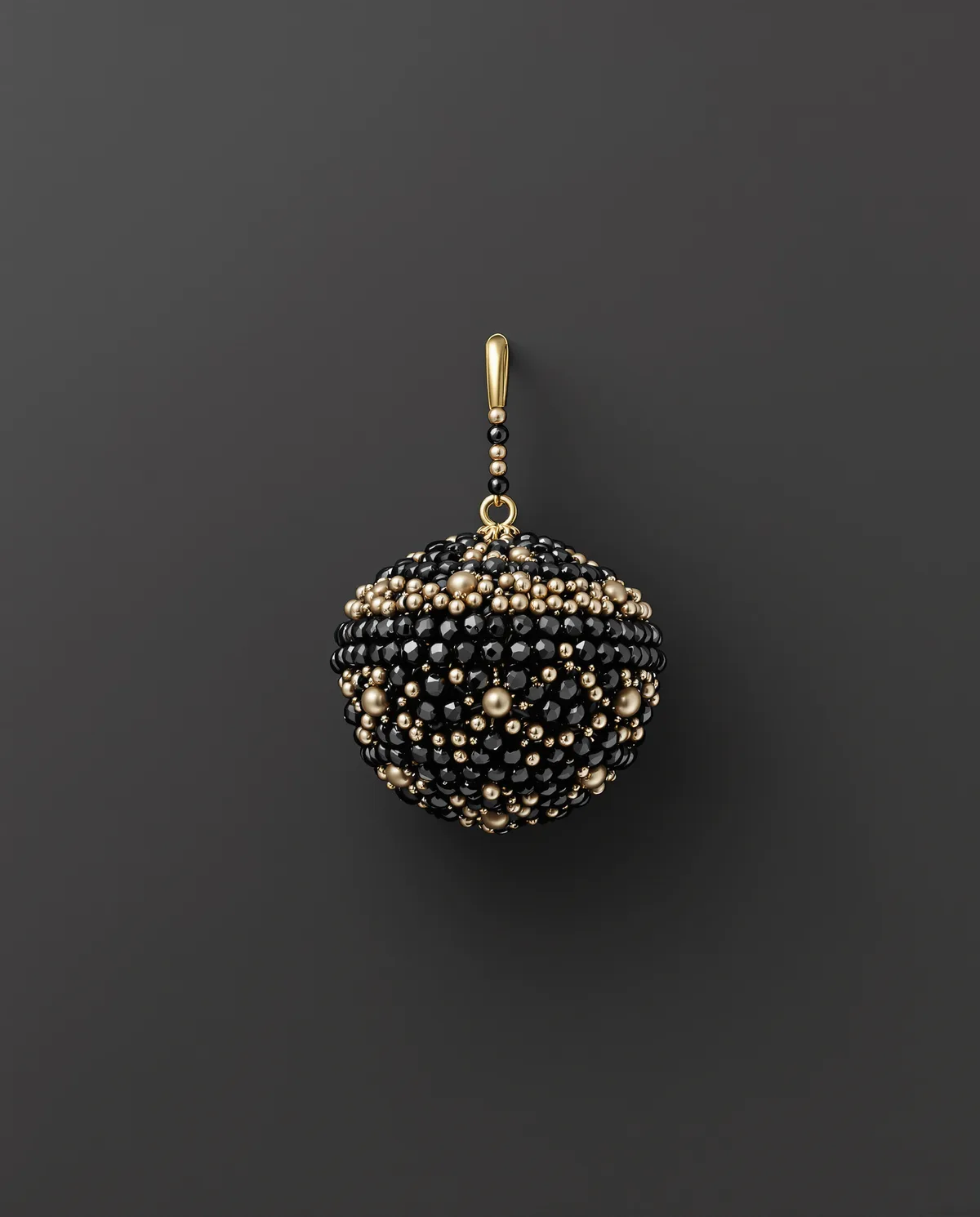
Guide · Buying
The dividing line is fit. A piece that needs a measurement and a wall fixing is a bad surprise and a good voucher.
A hand bead-embroidered ornament, jet black and smoke crystal beads couched in spiral rows with a band of antique gold bugle beads round the middle.
Give the pieces that need no measuring and no fixing: coasters, napkin rings, ornaments, charms and small wall hangings. A doorway panel needs the opening measured and a fixing chosen for the wall, so it makes a poor surprise — give the design and the colour story, and let the recipient confirm the size.
Two different propositions wearing one name. There is the fit-free half of the category — coasters, napkin rings, ornaments, charms, wine charms, small purses and cases — which needs no measurement, no fixing and no decision from the recipient, and posts in a small carton. And there is the fit-dependent half — doorway panels, café curtains, valances, window panels — which needs an opening measured and something solid to fix into.
The first makes an excellent present. The second makes an excellent choice made together.
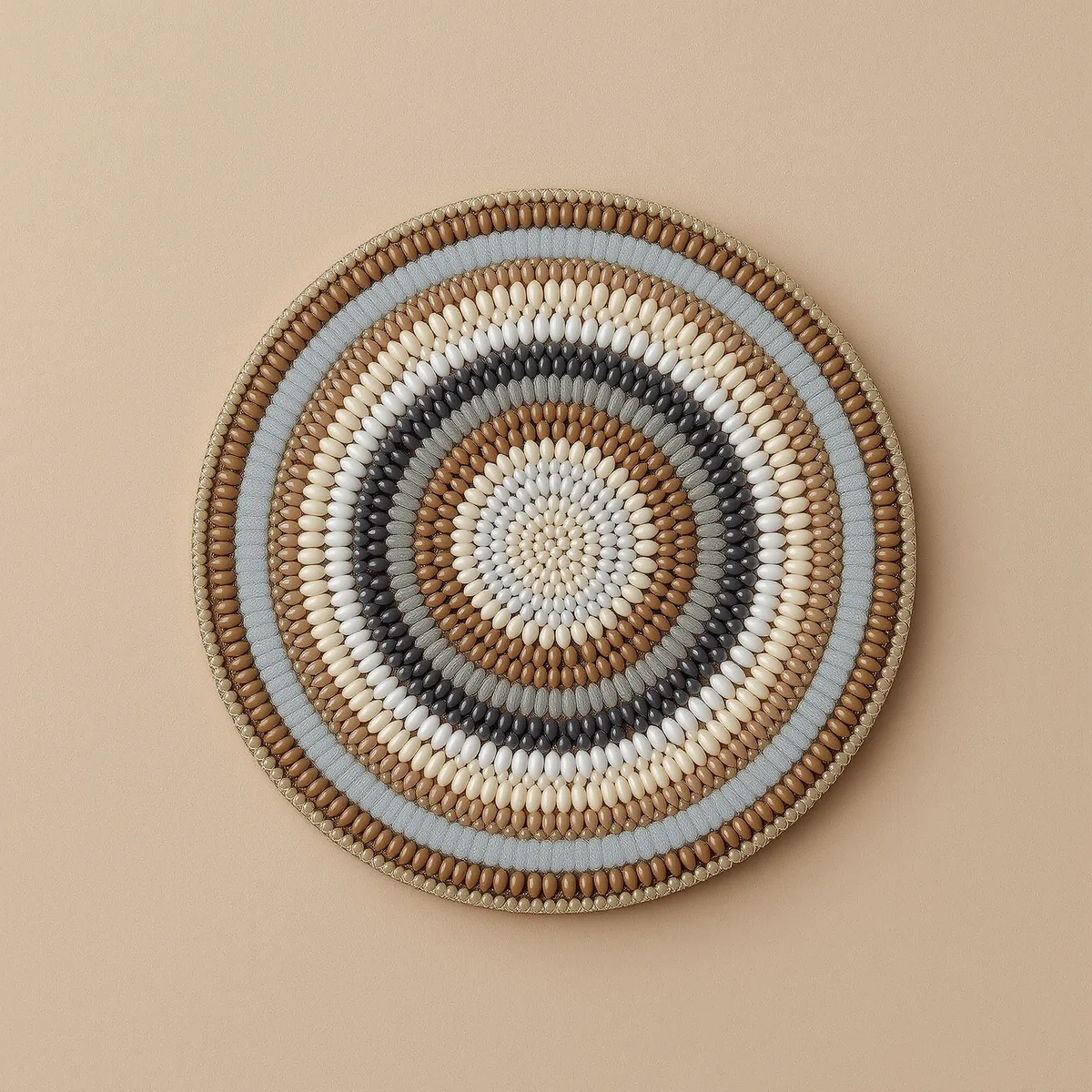
The small pieces do what good small objects do: they put handwork on a table or a tree where it is picked up and looked at closely. A bead-embroidered coaster of ten or eleven centimetres carries several hundred beads couched down one at a time, which reads as craft at arm's length in a way almost nothing else at that price does.
The hanging pieces change a room rather than furnishing it. A small wall hanging 50 to 76 cm wide on a dowel catches light through glass and throws it onto the wall behind, which is a different kind of gift — closer to giving a lamp than to giving an object.
Glass is the gift material. Body-coloured glass holds its colour permanently, nothing about it needs maintaining, and light through it is the whole appeal. For a piece that will be kept for twenty years, specify glass.
Acrylic is the practical choice where a gift will be handled constantly or lives in a household with children: it does not shatter, and the colour is moulded into the body of the bead so it cannot be rubbed off.
Wood and bone suit a natural palette and want to stay dry. Cast-resin faux capiz — an engineered imitation of capiz shell rather than shell — gives the shell look with consistent colour and none of the shell paperwork, and it is the most striking of all with light behind it.
The gifting end of the category is substantial rather than incidental for us. A single season's buyer offer runs right across the small-format range, the large majority of it beadwork: ornaments, keychains and charms, purses and boxes, coasters, plus pouches, cases, bags and cushions.
What that range tells you about rooms is that the gift pieces cluster where people gather: tables, bars, trees and hallways. The hanging pieces go where light arrives — a landing window, a stairwell, a kitchen doorway.
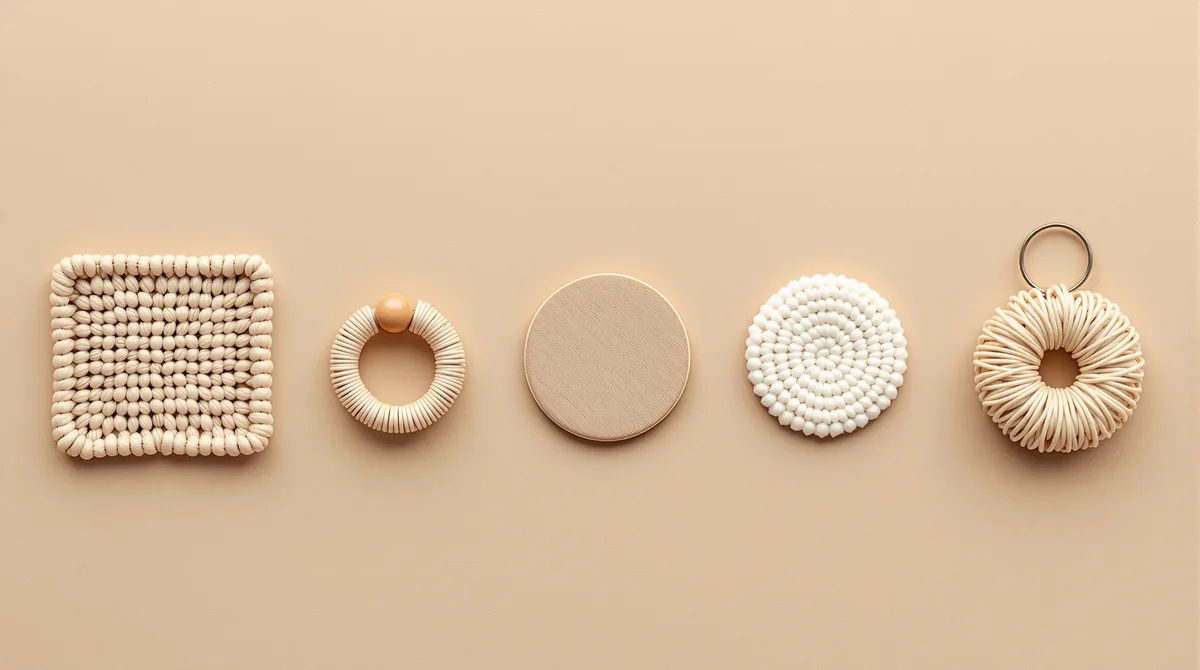
The small pieces are not strung at all. A coaster or an ornament is bead and thread embroidery in the zardozi tradition: glass seed and bugle beads couched onto stiffened fabric or felt with fine thread, often with metallic thread alongside. A napkin ring is wire-wrapped — seed beads threaded onto fine brass wire and wrapped turn against turn over a shaped armature.
The hanging pieces are strung: beads threaded onto cord in a specified order, knotted over a turned wooden dowel, with the strand drops cut to shape the hem. Thirty hand-strung strands on a single dowel is our standard build.
Those are two different trades with two different sets of artisans, which is worth knowing because it explains why a coaster and a curtain feel like such different objects.
If you are buying one piece, ask two things: the bead material, and whether anything about the piece needs measuring or fixing.
If you are a retailer specifying a gift range, the questions are different. Ask for body-coloured glass rather than surface dye, because a gift is opened in a shop and kept for years. Ask for a canvas backing rather than felt on anything that will meet liquid. Ask for the care text to be printed and included — a short care card in the pack saves returns, and a buyer's own care copy can be included in the packing alongside labels and cartons to the specification given.
Fit, almost always. A doorway panel given as a surprise is the single most common disappointment in this category: the opening is 36 inches and the panel is 90 cm, or the wall is plasterboard and there is nothing to fix into.
Second: care. A beaded coaster put in a dishwasher is finished — the beads survive, the couching thread and the stiffened ground do not — and a recipient with no care card will reasonably assume it washes like anything else on the table.
Third: small parts. A box of beaded ornaments in a house with a toddler is a hazard nobody thought about while wrapping it.
For a table, a tree or a hallway, it is a very good choice and better than most things in its price band, because the handwork is visible at close range.
For a doorway, give the decision rather than the object. Our design library is organised by colour story, so a recipient can choose the palette while the width and drop get confirmed properly. That is a better gift than a panel that does not fit.
Nothing in the gift half of the category needs a fixing. A coaster, a charm, an ornament or a napkin ring weighs a few tens of grams.
A small wall hanging on a dowel is light enough for an ordinary wall fixing done properly, which means into something solid rather than into plaster alone. Its one real requirement is an annual check of the hanging cord and the header knots — a static piece hides a weakening fixing, and that is the only maintenance a wall piece ever needs.
A full-length glass doorway panel is at the other extreme: a rod carried by brackets screwed into structure, rated above the panel's weight.
On the hanging pieces, a great deal, and that is the point of giving one. A strung panel is roughly as much gap as bead — forty strands on a 90 cm width sit at a pitch of about 2.25 cm on our 2027 design-render basis — so light passes between the strands and through the glass at the same time.
On flat pieces the question inverts: light does not pass through a coaster, it reflects off it, which is why a faceted or iridescent bead reads so well on a small object seen under a lamp.
None, and that is worth saying plainly if the gift is a doorway panel.
A bead panel breaks up a sightline; it does not obscure one. There is no darkness, no acoustic separation and no insulation in it. If the recipient's actual problem is a doorway with no door, a bead panel solves the look and not the privacy, and giving it as a solution to the second thing produces a polite thank-you and a cupboard.
Longer than almost anything else given at the same price, provided it is not washed.
The beads are effectively permanent. On a hanging piece the cord is the service item and will run for years dry; on a flat piece the couching thread is, and it fails from use rather than from age. Both are repairable: a parted strand is re-strung in bead-map order, and a run of loose beads is re-couched by hand. Ask for spare beads with the order and keep them, and nothing about either repair is difficult.
On a made-to-order piece the same five levers apply as anywhere in the category: bead size and material, construction and strand count, strand spacing, the dowel and packing, then height. Coverage density does the same job on flat work, and de-densifying a fill — a tight outline with an open interior — is the strongest single lever there.
On a gift the guidance is different from the trade guidance: spend on the bead rather than on the size. A small piece in body-coloured glass with a dense, well-planned bead field reads as considerably more valuable than a larger piece in a sparse, cheaper build, and it will still look right in a decade.
Extractable data
| Piece | Needs measuring? | Posts well? | Typical size |
|---|---|---|---|
| Beaded coaster | No | Yes | 10–11 cm across, or 3 in on an acrylic set |
| Napkin ring, wire-wrapped | No | Yes | 6–9 cm |
| Ornament | No | Yes | 7–11 cm |
| Charm or keychain | No | Yes | 7–10 cm |
| Lampwork wine charm, icon bead | No | Yes | A few centimetres |
| Beaded coin purse or small case | No | Yes | Hand-sized |
| Small wall hanging on a dowel | No, but needs a hook | Awkward | 50–76 cm wide |
| Café curtain | Yes | Fairly | 24 × 30 in with a 3 in rod pocket |
| Valance | Yes | Fairly | About 120 × 30–40 cm |
| Doorway panel | Yes, and a fixing | Poorly | 90 × 200 cm |
Good to know
The small pieces are small parts, so a coaster, charm or ornament should not be given for a household with a child under three without saying so. A hanging piece raises the usual questions: hang it in a doorway rather than over furniture, and keep any spare beads sealed and out of reach.
The beads outlast the room, particularly in body-coloured glass where the colour is inside the glass. The service items are the cord on a hanging piece and the couching thread on a flat one. Neither needs attention for years, and both are repairable rather than terminal.
Yes, and the instruction is short enough to write on a card. Flat pieces: brush dry, wipe the beads with a barely damp cloth, dry at once, never immerse. Hanging pieces: dust dry, downwards from the header to the hem, and keep the cord and any timber dry.
A doorway panel is, and that is exactly why it is a poor surprise: it has to fit the opening and be fixed to something solid. A 90 cm panel suits most single interior doors, but a 36-inch opening or wider needs 120 cm, and nobody should be guessing that on someone else's behalf.
A coaster or an ornament is a few tens of grams. A small wall hanging 50 to 76 cm wide on a dowel is light enough for an ordinary wall fixing. A full-length glass doorway panel is the heaviest object in the category and needs brackets into structure — which is another reason it is not a posting proposition.
Made-to-order pieces can be, because width, drop and strand count are set per order and matched to a Pantone reference or a physical chip. What that cannot be is quick: sampling is usually 16 to 20 days from an agreed brief, and production runs 40 to 60 days after sample approval for beaded décor.
Flat pieces cannot tangle. A strung piece arrives with its strands fixed to the dowel and kept in order in the packing, and the way to keep it that way is to lay the package flat, open it fully, and lift the piece by its dowel rather than by its strands.
Keep exploring
Manufacturing
Bead-embroidered glass coasters on stiffened felt, or moulded acrylic sets in translucent and opaque — construction, sizes and what moves the cost.
Specs and sizesIndex
Seventeen beaded objects documented from inside the craft — what each one is, how the tradition builds it, and what it would take to develop one.
Compare the optionsGuides
One guide per question that arrives often enough to be worth answering properly.
Read moreGuide
Which four numbers decide the product, which words mean less than they appear to, and what a missing strand count tells you.
See the detailGuide
Cord first, then knots, then the dowel, then the finish — and why none of it is about the beads themselves.
See the detail
Start a conversation
Send a reference, a colour chip or a sketch. Minimums are set per design and confirmed per quote; sampling is quoted separately and usually runs 16 to 20 days from an agreed brief.