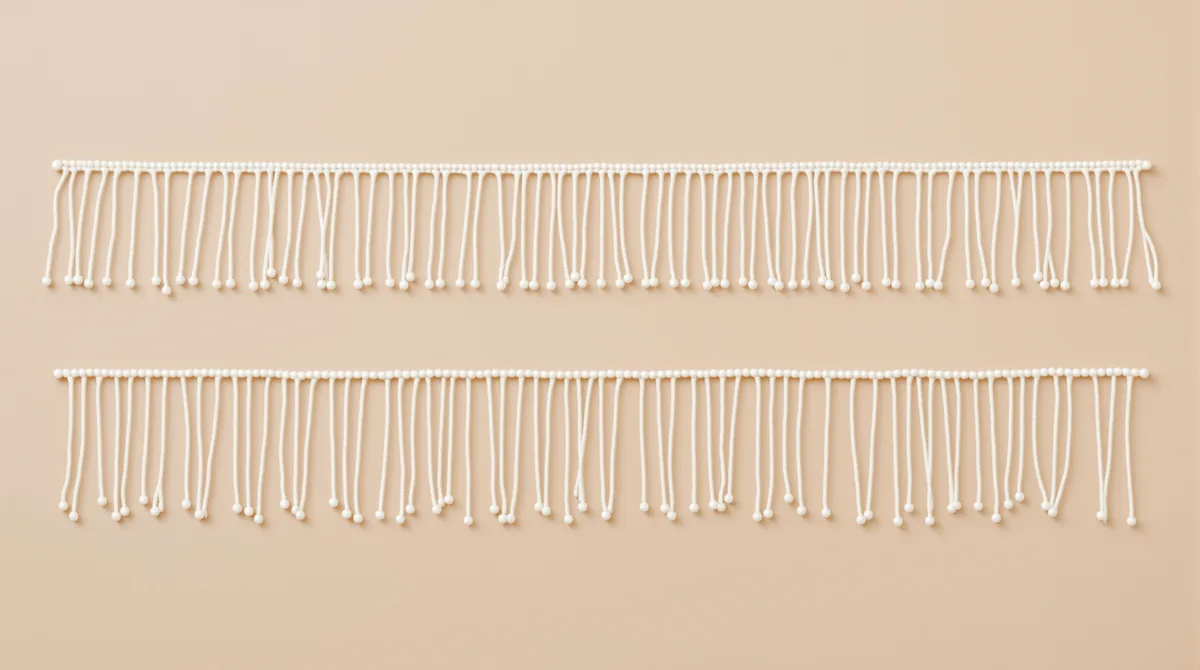
Guide
Eight things to inspect
Knot finish, strand length consistency, bead alignment, drill quality, header fixing, dye evenness, spares and packing.
Compare the options
Guide · Buying
Bead curtain listings are rarely dishonest and often uninformative. The useful skill is knowing which four numbers decide the product and noticing when they are absent.
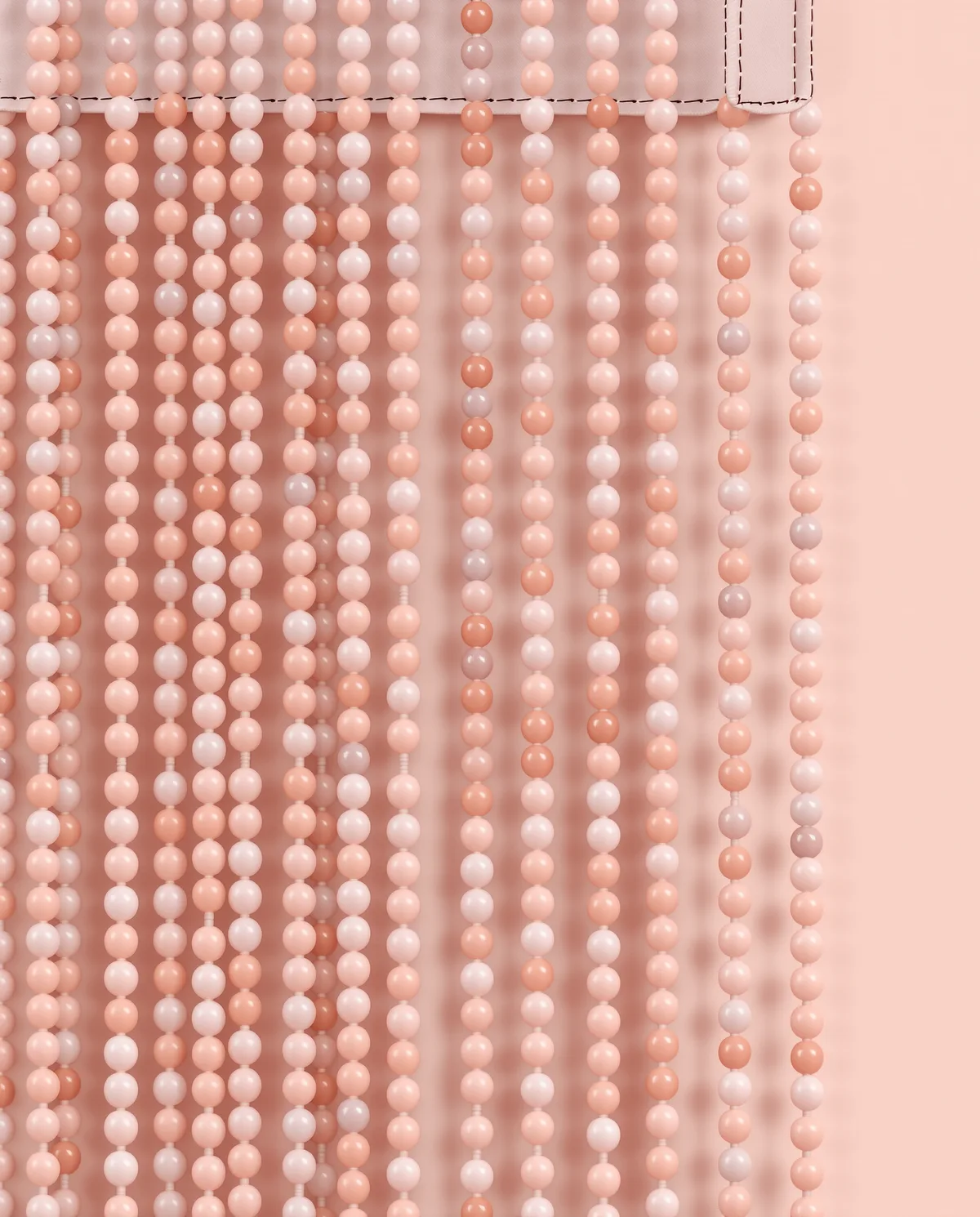
A beaded panel half in shadow, with a colour chip and a steel rule laid across the lower strands.
Four numbers decide a bead panel: finished size, strand count, bead material and bead size. A listing that gives all four is describing a product; a listing that gives only size and a bead count is describing a photograph. Treat "crystal" as glass, treat a large bead count with no strand count as unverifiable, and treat a missing strand count as the real tell.
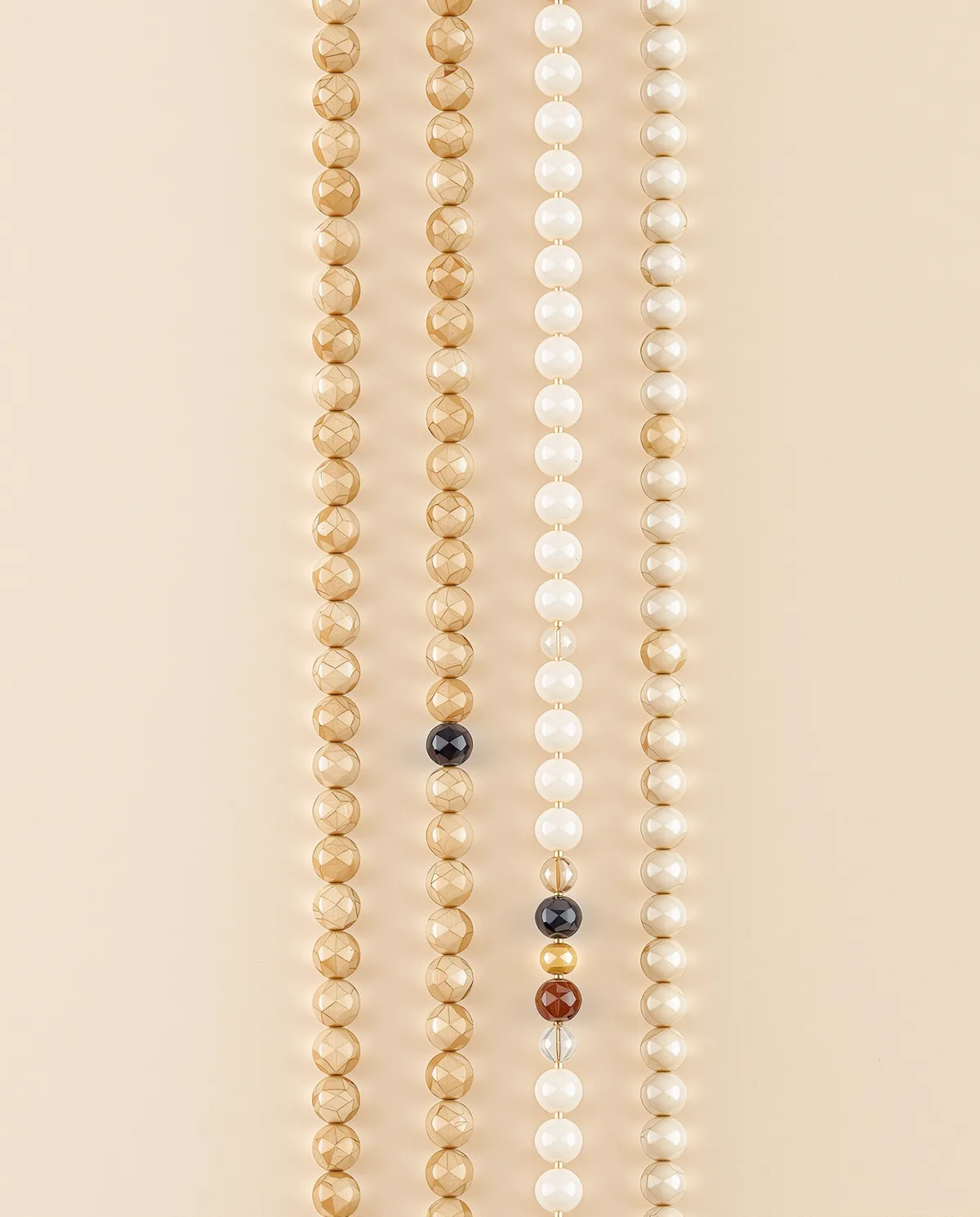
Finished size, strand count, bead material, bead size. Everything else on a listing is either derived from those or is decoration.
Size tells you whether it fits. Strand count tells you how it will look, because density is what the eye reads. Material tells you weight, sound and durability in one go. Bead size tells you the texture and, with the strand count, roughly the bead count. A listing with all four is describing a product. A listing with size and an adjective is describing a photograph.
It tells you size, colour, a bead count if the number is flattering, and a room it would look good in. It leaves out strand count, bead size, stringing medium and whether the dowel is included.
Those four omissions are not a conspiracy. They are the result of listings being written from photographs rather than from specifications. But the pattern is consistent enough to be useful: the omissions cluster around the facts that would let you compare two panels directly.
| Claim on a listing | What it should say | What it often means |
|---|---|---|
| Size | Width × drop, both finished | Sometimes the panel before the dowel |
| Strand count | A number | Usually absent |
| Bead material | Glass, acrylic, wood, bamboo, resin, capiz imitation | Glass-look, crystal-effect |
| Bead size | Millimetres | Rarely stated |
| Bead count | Total, with the strand count beside it | Total alone, unverifiable |
| Crystal | Cut or faceted glass | Glass, or acrylic cut to look faceted |
| Capiz | Cast resin or dyed cut acrylic, if engineered | Sometimes implied as shell |
| Stringing medium | Cord, coated wire or monofilament | Almost never stated |
| Header | Dowel, rail, rod pocket or loops | Rod not included |
Because it has no agreed meaning in this category. It is a customer-side term, and it is delivered as cut or faceted glass by anyone being careful. Some listings use it for faceted acrylic, which refracts less and weighs much less.
Our own position is to describe them as glass, because that is what they are. The practical test on a listing: if it says crystal and never says glass, assume it is not telling you the material, and ask.
Faux capiz is an engineered material. Ours is cast resin or dyed cut acrylic, cut and finished to imitate capiz shell — an imitation deliberately, which is what gives it consistent colour and better durability than shell.
Real capiz is a shell, and it is a legitimate material in its own right. The thing to notice on a listing is an implication rather than a claim: a description that uses the word capiz, shows a pearlised disc, and never says what the disc is made of. Either answer is respectable; the absence of an answer is the signal.
The scale of the labour, and nothing about the density unless the strand count is beside it.
Our own published figure is a useful calibration: a densely patterned 90 × 200 cm curtain can hold about 11,800 beads, every one placed by hand. Against that, a sparser panel of the same dimensions sits near 3,100 beads, with 40 strands at roughly 2.25 cm pitch.
So a four-figure bead count at door size is a sparse-to-moderate panel, and a five-figure one is dense. A bead count with no dimensions attached is a number, not information.
By naming the construction and saying whether the rod comes with it. The four real options are a bare turned dowel, a stained header rail, end suspension loops knotted at the top of each strand, and a stitched cotton header band with a rod pocket — three inches is the pocket depth on the café-curtain builds.
Those are not interchangeable. A rod pocket needs a rod you supply and sized to the pocket. Loops need two hooks. A rail needs a square opening. A listing that shows a photograph and says "ready to hang" has told you none of this.
Dry dusting, nothing wet, and a word about the cord. That is the whole of good practice and it fits on a hangtag.
The bad sign is a washing instruction. A strung panel has no textile structure — the cord carries everything — so immersion soaks the one structural component. A listing that suggests machine washing has been written by somebody who has not taken a panel apart.
Something closer to a specification than to a description. Finished width and drop. Strand count. Bead material, named properly. Bead size in millimetres. Stringing medium. Header type and whether a rod is included. Care in one line. Whether spare beads were supplied.
That is nine facts, and it is the list a tech pack would carry. The reason it is rare on consumer listings is not secrecy; it is that most sellers do not have it, because they did not build the panel.
Three predictable disappointments. A panel sparser than the photograph, because density was never stated. A panel that will not hang, because the header type and the fixing were never matched to the wall. And a panel that is the wrong drop, because the size was the panel rather than the panel plus the dowel.
The fourth, slower: a panel that fades in a sunlit doorway, because the listing said the colour and not how the colour was held. Surface dye and body colour behave completely differently in light, and no photograph distinguishes them.
It removes most of them, because the four numbers are things you set rather than things you read. Width, drop and strand count are specified per order; beads are matched to a Pantone reference or a physical chip and confirmed on the sample; nothing is held in stock, so there is no catalogue size to compromise with.
What replaces the listing is a brief. The decisions are the same decisions a careful reader is trying to reverse-engineer from a product page, and it is considerably easier to state them than to infer them.
Five questions, and any seller who built the panel can answer them in a line each. How many strands. What are the beads made of, in a word that names a material rather than a look. What size are the beads. What is the stringing medium. Is the rod included.
If the answers do not come, that is itself the answer. It does not mean the panel is bad; it means nobody can tell you whether it is, which is a different and more expensive problem.
Good to know
Because a bead count is impressive and a strand count is checkable. A total like four thousand beads sounds substantial until you divide it by the strands — and without the strand count you cannot. Density is the thing that decides how a panel looks, and only the strand count tells you about it.
No. In this category crystal is a customer-side word for cut or faceted glass, and some listings use it for faceted acrylic. We describe ours as glass, because that is what they are. If a listing says crystal and does not say glass, ask which it is.
That the panel is sparser than the photograph suggests. Photographs are taken flat-on against a plain ground, where a 20-strand panel and a 40-strand panel look far more alike than they do in a doorway. A listing proud of its density states it.
Imperfectly, and by the light. Glass refracts and throws coloured shadows; acrylic reads flatter and more uniform; wood shows grain variation between beads; faux capiz discs are broad, thin and pearlised rather than round. A product shot lit to flatter is specifically designed to blur those differences.
It means more beads, which means more stringing hours, which usually means a higher price for a reason. It says nothing about knot quality, bead consistency or drill-hole finish. Bead count is a scale claim, not a quality claim, and the two are routinely conflated.
Dry dusting, nothing wet, and that the cord is the vulnerable part. A listing that recommends washing a strung panel has not thought about what holds it together, and a listing that says nothing at all about care is leaving the customer to improvise with a spray bottle.
It would be useful and almost nobody does, including us — no weight is published per design, because it follows from bead material, size and count rather than from the format. The workaround is the material: glass is the heaviest family by a wide margin, and that fact alone decides the fixing.
Keep exploring
Guide
Knot finish, strand length consistency, bead alignment, drill quality, header fixing, dye evenness, spares and packing.
Compare the optionsGuides
One guide per question that arrives often enough to be worth answering properly.
Read moreGuide
What survives guests and fast cleaners, which builds to avoid, and how to make a replacement easy two years later.
See the detailGuide
Colour matching across a batch, the real timetable, how panels pack, and what to hold back as spares.
Specs and sizesGuide
The header, a care card and packing that held the strands in order — plus the spare beads you have to specify yourself.
Specs and sizesGuide
Colour consistency, durability, paperwork and the two production routes faux capiz actually uses — cast resin, or dyed cut acrylic.
Compare the options
Start a conversation
Send a reference, a colour chip or a sketch. Minimums are set per design and confirmed per quote; sampling is quoted separately and usually runs 16 to 20 days from an agreed brief.