Guide
Dusting a bead panel
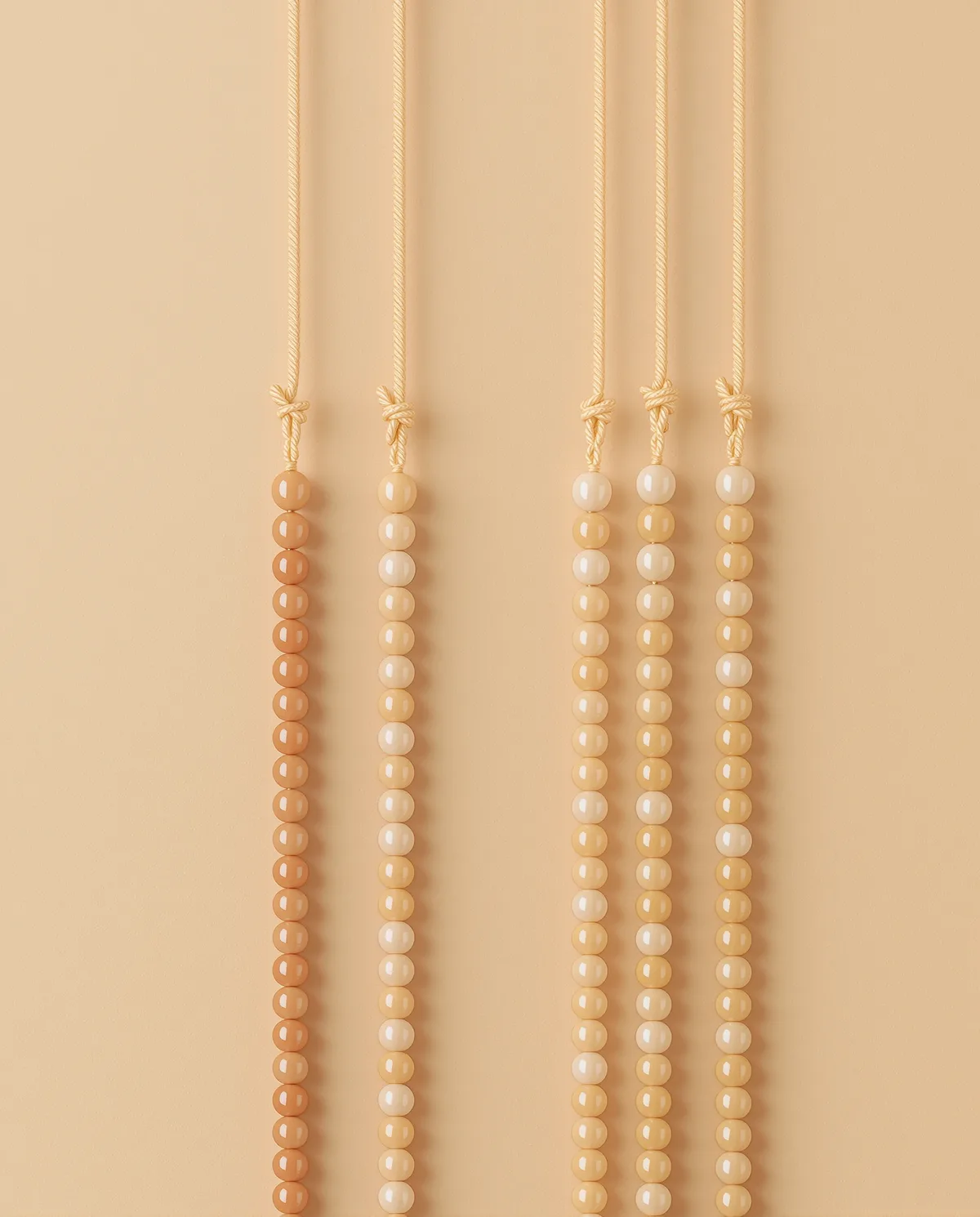
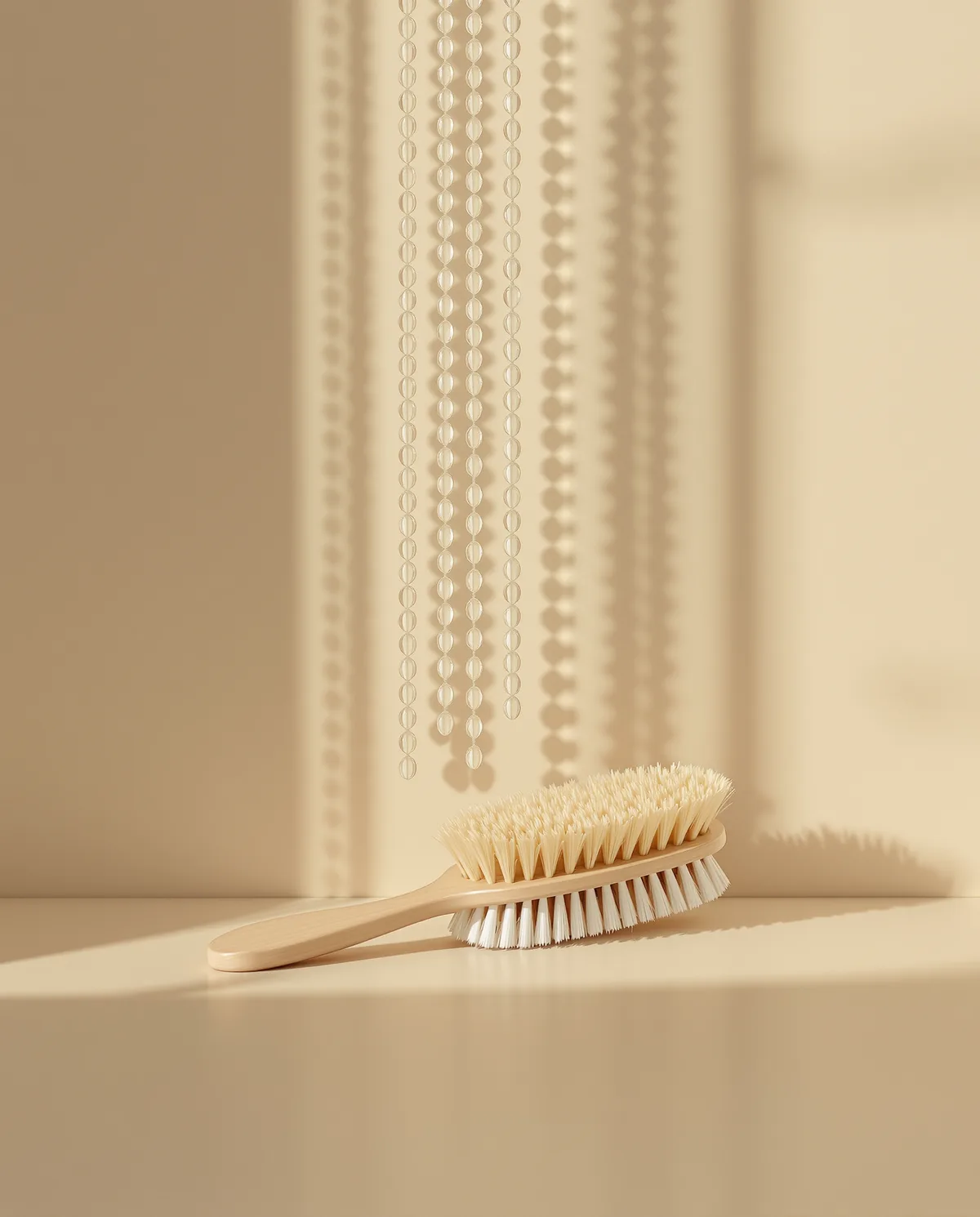
A soft brush drawn downwards, strand by strand, so dust leaves at the hem instead of compacting in the header.
See the detail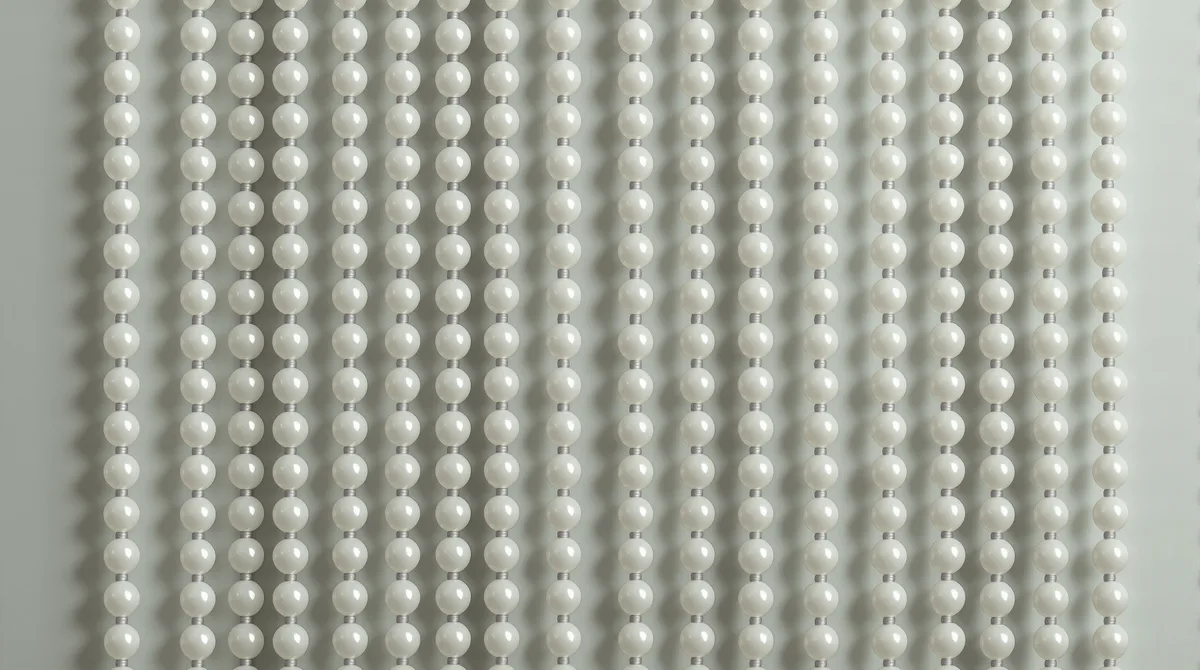
Guide · Safety
A bead panel holds less dust than a fabric curtain and shows more of it. Both halves of that sentence are useful in an allergy household.
A hand-strung panel set at a wide open strand pitch with broad clear bands between the cords, every glossy pearl-grey and chalk-white bead surface flawless.
A hanging bead panel holds considerably less dust than a fabric curtain of the same size: there is no pile, no weave and no fibre to shed, and dust sits on hard surfaces rather than inside a textile. It also shows dust far sooner, which is a maintenance advantage rather than a hygiene problem. No allergen testing has been carried out on these builds.
A bead panel holds less dust than a fabric curtain, and shows more of it.
Less, because beads are hard and non-porous: dust settles on the surface and a dry brush removes it. A textile curtain holds dust inside its weave, where brushing cannot reach and only laundering helps.
More visible, because a clean glass bead reflects light and a dusty one does not, so a film that would be invisible on a woven cotton face is obvious on beadwork within weeks. That is useful. It means the panel asks to be cleaned at the point where cleaning it still works.
Dust in a house is skin cells, fabric fibre, soil and pollen. Textiles contribute to it as well as collecting it: a woven or piled face sheds its own fibre continuously.
A bead panel contributes nothing. Across the bead materials we work in — glass, ceramic, metal, acrylic, finished wood — nothing sheds. The only textile in the construction is the cotton cord, and the cord spends almost its whole length inside the drill holes of the beads, with a few millimetres exposed between each pair. Some builds add a cotton header band or a three-inch rod pocket, which is a genuine textile component and sits at the top where dust accumulates least.
So the comparison is between a product that collects dust and a product that collects and generates it.
| Factor | Bead panel | Fabric curtain |
|---|---|---|
| Dust retention | On the surface; removable by dry dusting | Within the weave and pile; needs laundering |
| Fibre shed from the product | None from beads; negligible from cord | Yes, continuous from a textile face |
| Visibility of dust | High, especially on glass | Low until heavy |
| Effective cleaning method | Dry brush or microfibre, downwards | Machine or dry clean |
| Can it be laundered? | No — the cord must stay dry | Usually yes |
| Surface area facing upwards | Small on seed beads; larger on big beads | The whole face |
| Pitch effect | Open pitch lets a brush pass between strands | Not applicable |
| Textile components present | Cotton cord; a cotton header on some builds | The entire product |
In two opposing directions, which is why the useful answer is a middle size at an open pitch.
A larger bead has a larger flat surface facing upwards, so it catches more settled dust per bead and shows it as a visible grey film. A dotted oval at about 13 × 22 mm is the clearest example: it is a shelf.
A very small bead collects little individually but creates more crevices. A dense field of glass seed beads at one to three millimetres has more junctions per square centimetre than any other construction, and dust lodges in the junctions where a brush skims over. The bead sizes reference carries the working dimensions.
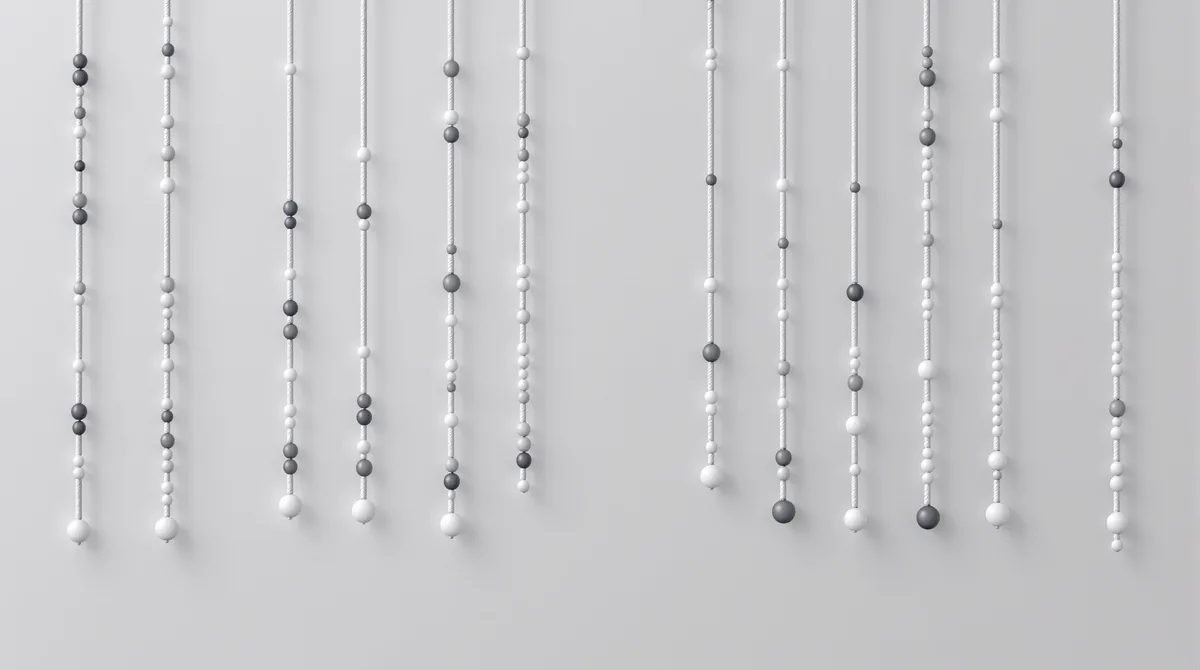
The practical specification for an allergy household is a mid-size bead, strung at an open pitch so a brush can pass between strands rather than dragging dust sideways. On a 90 cm panel we normally run forty strands at a pitch of about 2.25 cm; on 120 cm, sixty at about 2 cm.
A panel that cannot be cleaned without damp work, because damp work is the one thing a strung panel does not tolerate.
The failure comes from three choices made on the drawing. A very dense, very fine seed-bead field, where dust lodges between beads and a brush cannot reach. A surface-dyed bead, which will not take a firm wipe if a film does establish. And a fabric header in a dusty position, which collects and holds in exactly the way the beads do not.
The inverse specification — mid-size body-coloured glass beads, open pitch, a turned wooden dowel rather than a textile header — gives a panel that can be fully maintained with a dry brush for its whole life. The panel headers reference sets out which header options exist.
Dry, and that is relevant here rather than incidental. First-article and lot AQL inspection at our quality-control and packaging house in Greater Noida is a dry process, panels are checked against the approved sample without water, and strands are kept in order and protected against knocking in transit before packing to the carton and label specification given.
A panel is checked against the sample dry and arrives clean, with nothing applied to it: no anti-static treatment, no dust-repellent coating, no finish beyond the bead's own. That is deliberate. A coating on a decorative panel would be a claim rather than a feature, and it would be the first thing to go patchy.
For an allergy household, specify beadwork over fabric at the doorway and put the effort into position rather than product.
A doorway panel is in moving air by definition, which is why it collects less than a window curtain in a still room. Avoid hanging a panel over a radiator, where convection drives dust up into it continuously. Avoid a position directly in an extract path from a kitchen, where the dust arrives with grease attached and stops being removable by brushing.
Then commit to the interval, and on a contract job put it on a maintenance schedule rather than leaving it to housekeeping's judgement. A panel dusted monthly is a low-dust object; a panel dusted annually is a shelf.
Monthly dry dusting in a normal interior, which is the same interval as any bead panel.
Fortnightly in an allergy household, and fortnightly for an acrylic panel regardless, because acrylic takes a static charge and pulls airborne dust towards it in a way glass does not.
Use a dry microfibre cloth rather than a feather duster. Microfibre traps and carries dust away; a feather duster redistributes it into the room, which in an allergy household is the opposite of the objective.
Nothing has been tested on dust or allergens. No particulate retention figure, no allergen assay, no dust-mite study. None of it exists for these builds and this page will not imply otherwise.
What exists is construction fact: hard, non-porous bead surfaces; no pile and no weave on the face; no shed fibre from the beads; one largely enclosed cotton cord; and in some builds a cotton header. Those facts support a reasonable inference and they are not a test result, and the difference between those two things is exactly what a buyer with a medical reason to care should be told.
Hypoallergenic. Anti-allergy. Dust-free. Asthma-friendly. Any of them, in any form, qualified or not.
We also refuse to compare against fabric numerically. It is obvious from the construction that a hard surface releases dust more readily than a weave, and it would be trivially easy to dress that up as a percentage. We have no measurement, so there is no percentage.
Anyone making a decision for a specific person's allergy or asthma should ask a clinician, and should bring the construction to them rather than a marketing claim: glass beads, cotton cord, no pile, dry-dusted monthly, not launderable.
That is a description a clinician can reason about. "Hypoallergenic beaded curtain" is not.
Two things. That the panel is maintained by dry dusting rather than laundering, and how often. That is the whole of the claim and it happens to be the most persuasive version.
Where a retailer wants to speak to allergy households, the defensible sentence is a description: hard non-porous beads on cotton cord, with no pile and nothing to shed. Let the customer do the comparison. They will, and they will get it right.
Good to know
Yes, and it is the most actionable variable here. A large bead presents a bigger flat surface facing upwards and collects more settled dust; a glass seed bead at one to three millimetres collects very little. On the other hand a dense seed-bead field has more crevices between beads, so the answer is a mid-size bead at an open pitch.
Yes. Beads are hard and non-porous, so dust settles on them and comes off with a dry brush, where a textile curtain holds dust inside its weave and only releases it in a wash. The trade-off is that beads show dust much sooner.
Mainly through static. Acrylic takes a surface charge and attracts airborne dust towards it, so an acrylic panel needs dusting more often than a glass one in the same room. Wood is textured even when finished and holds a little more than glass. Glass is the cleanest-running material in the category.
That the panel is dusted dry rather than laundered, and how often. Avoid the words hypoallergenic and allergy-friendly: no allergen testing has been carried out on these builds, and the genuine advantage — a hard surface that releases its dust — is more persuasive stated plainly than dressed up as a health claim.
No. There is no particulate, allergen or dust-retention testing on any of these builds and no figure is published. What this page offers is reasoning from the construction: hard non-porous surfaces, no pile, no shed fibre, and a cotton cord that is largely enclosed inside the beads.
Hypoallergenic, anti-allergy, dust-free and any variant. Those are health claims and we have no test behind them. We will describe the construction and let a reader or a clinician draw the conclusion.
A clinician, if the question is about a specific person's allergy. We can tell you precisely what a panel is made of and how dust behaves on it. Whether that is better or worse for one household's asthma or dust-mite allergy is a medical judgement and not a manufacturing one.
Keep exploring
Guide
A soft brush drawn downwards, strand by strand, so dust leaves at the hem instead of compacting in the header.
See the detailGuides
One guide per question that arrives often enough to be worth answering properly.
Specs and sizesGuide
Where a loop can form on a strung panel, why strands are finished individually, and what to check on an older piece.
How it is madeGuide
A detached bead becomes a small part, which is why bead attachment is tested rather than assumed.
Compare the optionsGuide
Which component carries the fire risk, which materials change it, and how a classification is tested on the specified build.
Read the guide
Start a conversation
Send a reference, a colour chip or a sketch. Minimums are set per design and confirmed per quote; sampling is quoted separately and usually runs 16 to 20 days from an agreed brief.