Manufacturing
Beaded cushion covers
The face cloth, the couched bead field, de-densified infills and the closure — and what actually keeps beads attached on an object people lean on.
Compare the options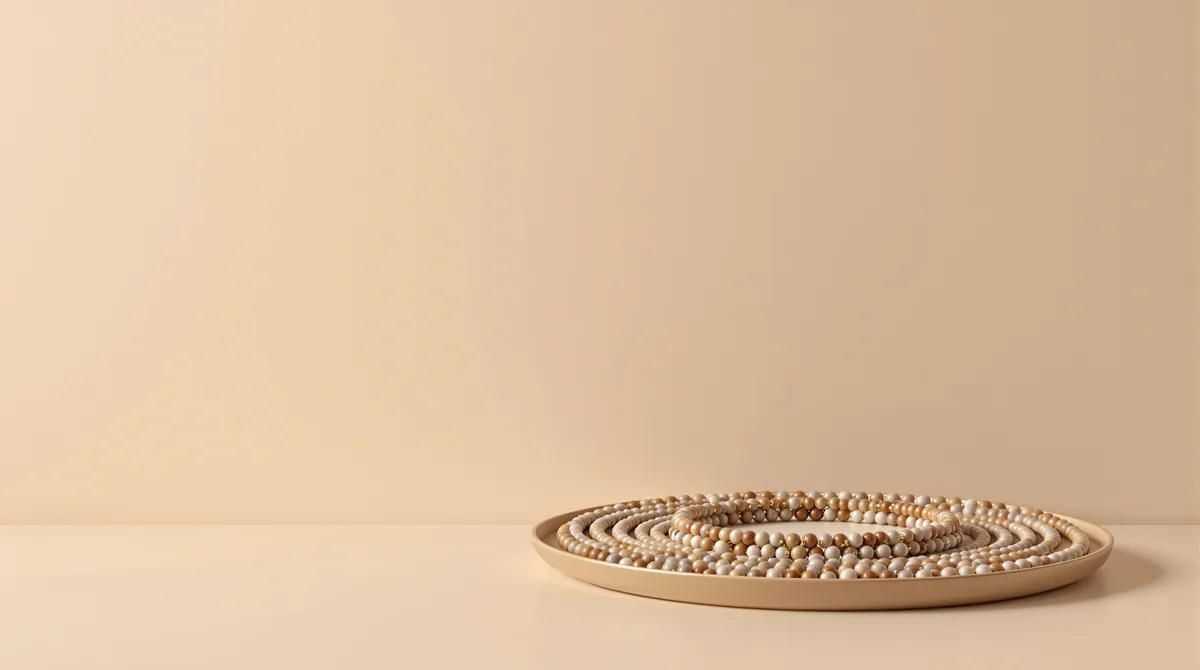
Guide · Tabletop
A beaded cushion is the only piece of beadwork that gets leaned on. That changes the care model from cleaning to load management.
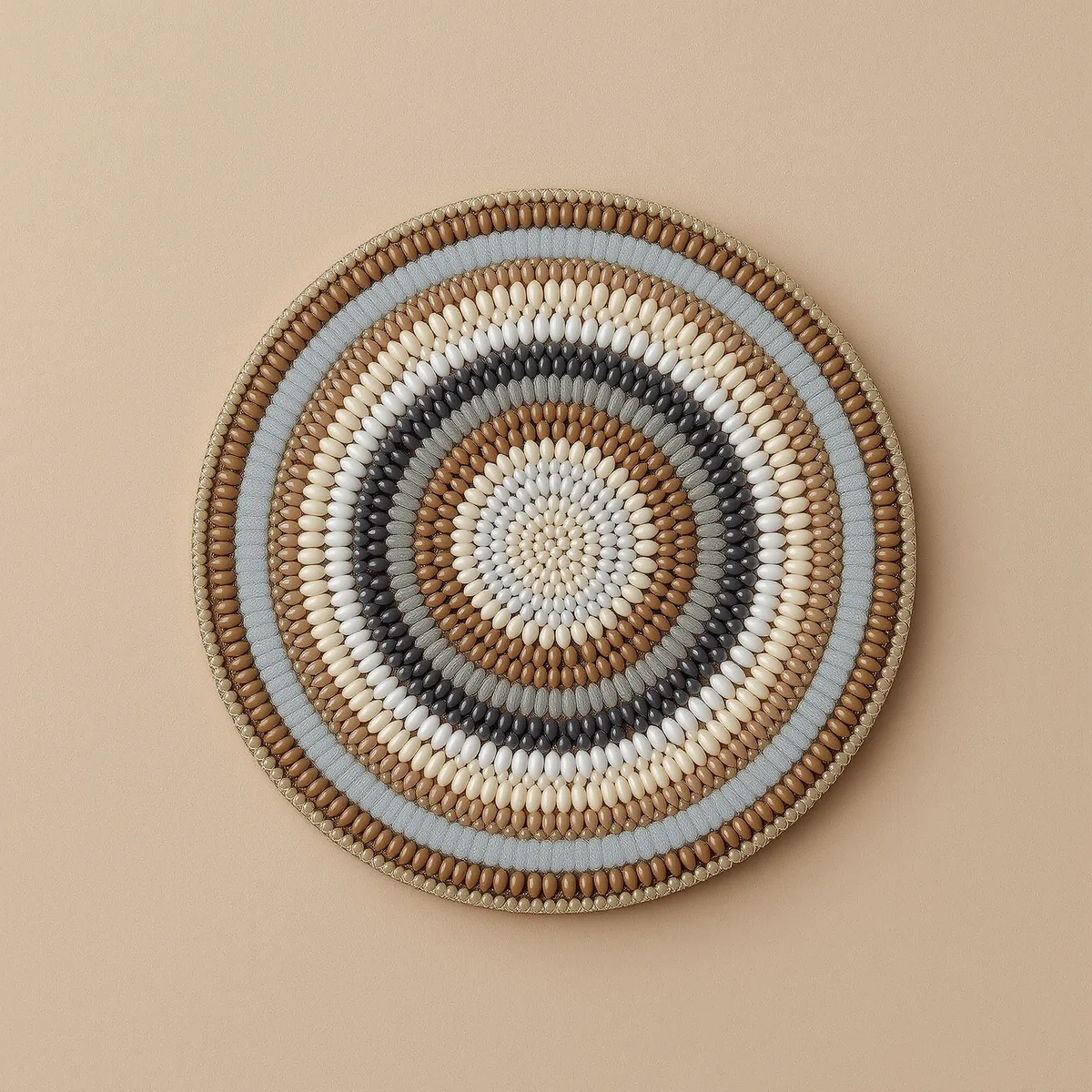
A coiled beaded mat lying flat, strands of wood and glass beads wound in close concentric rounds.
Spot-clean a beaded cushion and never machine wash it: every bead is couched onto a face fabric individually, and water slackens all of those stitches at once. Manage the load as much as the cleaning — turn the cushion so the beadwork is not constantly compressed, and keep the beaded face off the seat of a chair.
Brush. Spot-wipe. Dry. Turn.
Brush dry with a soft brush in the direction the bead rows lie. Spot-wipe the bead tops with a barely damp cloth only where something has marked them. Dry in the same pass. Then turn the cushion, which is the step that belongs only to this product and matters more than the other three combined.
A cushion has no cord. Its equivalent is the couching thread, and unlike a hanging panel's cord it fails from use rather than from water.
Every bead on a beaded cushion face is stitched down individually onto a face fabric — on one of our builds, a poly-cotton of roughly 60 to 65 GSM over a polyester fill, with an envelope closure. Those stitches are fine, and they sit on a surface that compresses every time someone leans against it.
Compression drags beads sideways against each other and works the thread against the bead's drill hole. That is the real wear mechanism on this product, and it is why a cushion that is never cleaned at all can still develop a run of loose beads along one line: that is where the shoulder goes.
| Component | Dry brush | Damp cloth | Immersion | Notes |
|---|---|---|---|---|
| Glass seed beads | Yes | Yes | No | Used for sampling; durable but heavier per area |
| Acrylic or plastic seed beads | Yes | Lightly | No | Specified in production on an icon cushion build |
| Couching thread | Yes | Avoid | No | The service item; slackens when wet, abrades under compression |
| Metallic thread, zari | Yes | Avoid | No | Tarnishes and frays |
| Face fabric | Yes | Spot only | No | A poly-cotton face of roughly 60–65 GSM on one of our builds |
| Velvet face | Yes, with the pile | Spot only | No | Marks where water sits; brush with the pile, never against |
| Polyester fill | — | — | No | Cannot be dried from the inside once wet |
| Envelope or overlap closure | Yes | Yes | No | Lets the cover come off to air, not to wash |
| Typical size | — | — | — | Our icon seed-bead cushion ran at 10 × 10 in |
Solvent, bleach, abrasive cream, steam, hot water, a washing machine, a dry cleaner's solvent process.
Two that are specific to cushions. A vacuum cleaner, even on a low setting through a mesh guard: suction pulls at individual beads and finds the weakest stitch in the piece, which is how a careful owner creates the fault they were trying to prevent. And fabric-freshening spray, which is mostly water and alcohol — it wets the ground, can lift a surface dye and leaves a tide line on a velvet face.
With the pile, with the rows, and with less pressure than feels sufficient.
On a velvet-ground cushion the ground is as vulnerable as the beads. Brush with the pile; brushing against it lifts the nap into a patch that catches light differently and reads as a mark. Water on velvet leaves a tide line at the edge of the damp area, so spot work has to be very small and very dry.
Surface-dyed beads come off under pressure, and on a cushion pressure is unavoidable because the beads sit on something soft. The instruction is to glide rather than press, and to accept a mark rather than create a bald patch.
Neither exists. The components that matter instead are the closure and the fill.
An envelope or overlap closure lets the cover come off, which is genuinely useful — a cover off the fill can be aired flat, inspected from the reverse, and stored properly. It is not an invitation to launder, and that distinction should be explicit on the care card, because a removable cover reads as a washable cover to almost everybody.
The fill is the component with no recovery path. A polyester fill that has been soaked cannot be dried from the inside, and it holds moisture against the back of the beadwork for days, which is long enough to slacken thread and mark a face. Take the cover off and keep the fill dry.
The cushion equivalent is a run of loose beads along a compression line.
Repair it by hand, re-couching the run in its original order from the spare beads, if the order specified them. Do it early: loose beads move, and movement abrades the thread holding the beads either side, so the fault spreads along the line it started on.
Then change the use. A repaired run that goes straight back under the same shoulder every evening will fail again. Turning and rotating the cushion is the actual fix; the re-couching is housekeeping.
Flat, dry, and nothing on top of it.
A beaded cushion at the bottom of a pile has the weight of the pile on its bead field for months, which is the same load that causes wear in use, applied continuously. Store it on top of a stack, or box it flat with acid-free tissue laid over the beadwork.
Take the cover off the fill for long storage if the closure allows. A cover stored flat keeps its shape; a filled cushion stored flat keeps the compression.
Five lines, and one of them is unusual for a cushion.
Spot clean only. Brush dry with a soft brush. Do not machine wash, dry clean, steam or vacuum. Turn and rotate in use. Store flat with nothing on top.
"Turn and rotate in use" is the line that extends this product's life more than any cleaning instruction, and it is the line that is almost never printed.
Substantially, and the answer is that a beaded cushion is a front-of-house decorative object rather than a working one.
In a hotel lobby or a restaurant banquette, a beaded cushion is leaned on by a different person every twenty minutes and will show a compression line within a season. Specify it for a position where it is seen rather than used — a bed runner arrangement, a window seat, a styled chair — and specify something else for the seat people actually sit on.
Where it has to go into use, specify a de-densified bead field. A tight outline with an open fill has fewer stitches exposed to compression, and it is also the strongest cost lever in flat beadwork: we have used it to bring a fully beaded cushion face to a target without changing the approved design.
A slackened couching stitch. A tide line on a velvet face. A lifted surface dye. A deformed acrylic bead. A fill that has been soaked and dried unevenly, which leaves a cushion permanently lumpy behind the beadwork.
Repairable: a run of loose beads, a lifted cabochon, a worn closure. As on every piece of flat beadwork, most of what cleaning does is permanent and most of what use does is fixable.
Turn it, rotate it, and keep the beaded face away from the point of contact.
Then brush rather than wait. A cushion brushed monthly never needs damp work, and damp work is where the permanent faults come from. Keep the spare beads somewhere findable, because an early repair is a ten-minute job and a late one is a re-beading.
Checks the stitch, dry, against the approved sample — bead order, coverage density, thread tension and closure.
Our own cushion development work is instructive on the density question. An icon cushion at 10 × 10 in was brought to its target by de-densifying the infills rather than by changing the design, and glass beads were allowed for sampling while plastic seed beads were specified for production, because the production bead had to survive handling at volume. A canvas background was used on a related piece specifically to reduce the bead count.
Those are cost decisions that happen to be durability decisions. First-article and lot AQL inspection happens at our quality-control and packaging house in Greater Noida, dry, with network product issue rates running at a fraction of a percent.
Good to know
A cushion has no dowel and no cord. The components to keep dry are the face fabric and the fill, and the fill is the harder of the two — a polyester fill that has been soaked cannot be dried from the inside and will hold moisture against the back of the beadwork for days.
Brush dry in the direction the beads lie, wipe the bead tops with a barely damp cloth, dry in the same pass, and never immerse. On a cushion, work with the piece flat on a table rather than in your lap, so you are not pressing the beadwork into the fill while you clean it.
A cushion has no strands; the fault is a broken couching thread showing as a run of loose beads, usually along a compression line where someone has leaned. It is repairable by hand and worth repairing early, because loose beads abrade their neighbours' thread.
Flat, dry, and not under anything. A beaded cushion stored at the bottom of a pile has the whole weight of the pile on its bead field for months, which is exactly the load that abrades couching thread. Store it on top, or box it flat with acid-free tissue over the beadwork.
No, and a cushion cover is the case where people most often try. A drum slackens every couching stitch simultaneously and abrades the beads against the drum wall and each other. A cover that comes off through an envelope closure is designed to be removed for airing, not for laundering.
A soft brush, worked in the direction the bead rows lie and, on a velvet ground, with the pile rather than against it. Do not vacuum a beaded cushion, even on a low setting through a mesh — suction pulls at individual beads and finds the weakest stitch in the piece.
Solvent, bleach, abrasive cream, steam, hot water, a washing machine, a dry cleaner's solvent process, and a vacuum. Add fabric-freshening spray, which is mostly water and alcohol: it wets the ground, lifts surface dye and leaves a tide line on a velvet face.
Keep exploring
Manufacturing
The face cloth, the couched bead field, de-densified infills and the closure — and what actually keeps beads attached on an object people lean on.
Compare the optionsGuide
Why soaking slackens every couching stitch at once, and the brush-then-damp-then-dry routine that works instead.
Read the guideGuides
One guide per question that arrives often enough to be worth answering properly.
View the rangeGuide
What a hot dish does to each component, why no temperature rating is published, and the service-piece distinction that resolves it.
Read the guideGuide
Why the backing fails before the bead, the blot-and-dry-flat routine, and how a service rotation keeps a set alive.
Specs and sizes
Start a conversation
Send a reference, a colour chip or a sketch. Minimums are set per design and confirmed per quote; sampling is quoted separately and usually runs 16 to 20 days from an agreed brief.