Technique
Couched beadwork
Seed and bugle bead couched onto a stiffened ground in the zardozi tradition: the stitch, the interval, the failure modes and why images live here.
Compare the options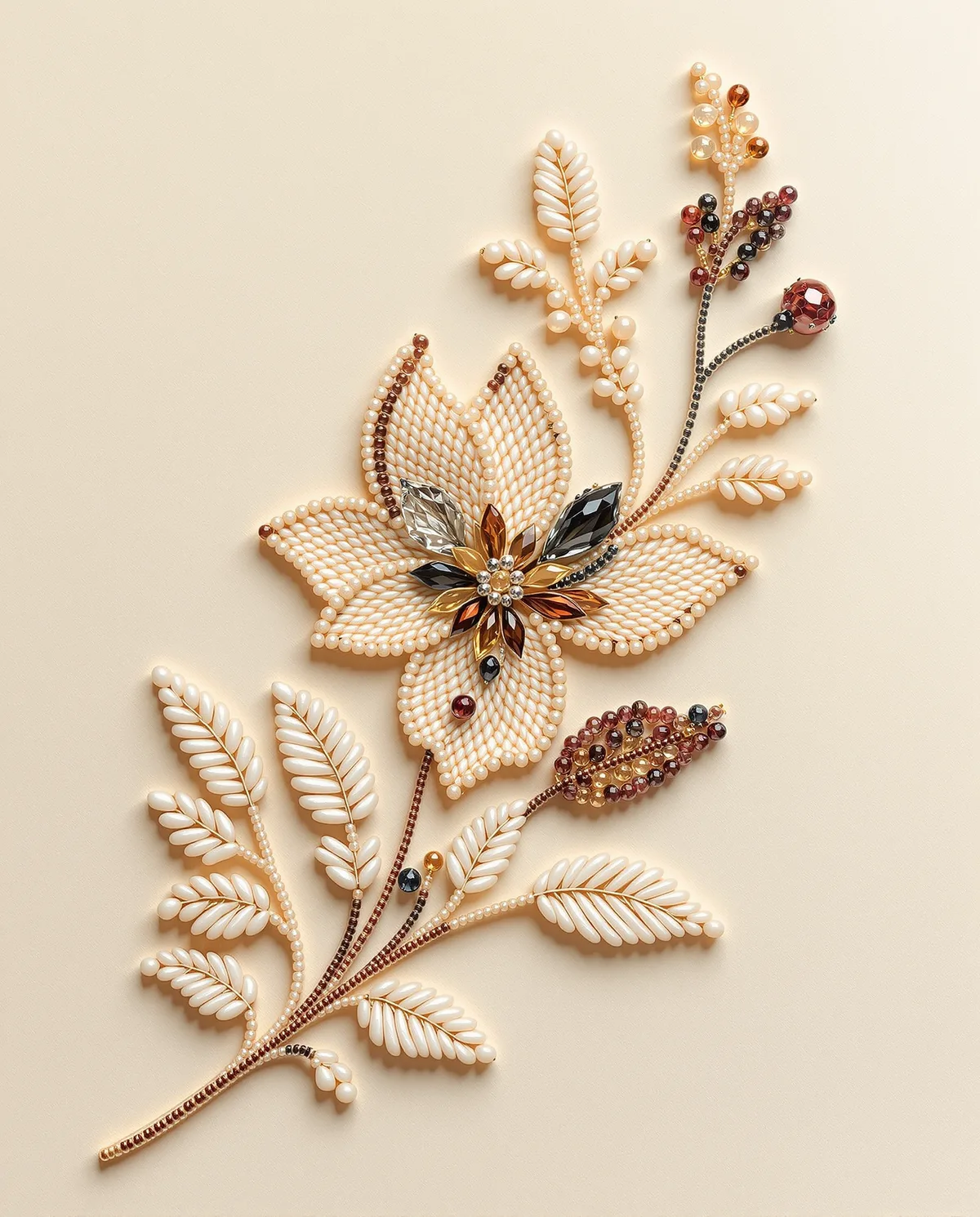
Guide · Care
On flat beadwork the thread is the structure, and thread is what water attacks. Every rule on this page comes from that.
Glass seed and bugle beads couched onto stiffened felt in the zardozi tradition, the fine thread crossing between beads at every stitch.
Spot-clean bead embroidery and never immerse it. Lift crumbs and dust with a soft dry brush, wipe the beads with a barely damp cloth, and dry immediately. Soaking swells the stiffened ground, slackens the couching thread that holds every bead individually, and leaves a permanent water line on a felt backing.
Brush. Wipe. Dry. In small areas, in that order, every time.
Brush dry first with a soft brush, working in the direction the bead rows run, to lift crumbs, hair and dust out of the gaps. Only then take a cloth wrung until it is barely damp to the bead surfaces. Dry each area with a second cloth before moving to the next, so the piece never carries a wet edge.
Reversing the first two steps is the most common mistake: a damp cloth on a crumb grinds it into the beadwork and the thread.
There is no cord on flat beadwork, and the component that takes its place is less forgiving.
On a strung panel the cord carries the beads and gravity holds them in order. On an embroidered piece every bead is couched down individually with fine thread, often alongside metallic thread in the zardozi tradition, onto stiffened fabric or felt. The thread is doing the structural work of the cord and the gravity together.
Water slackens all of it simultaneously. A strung panel with a wet cord has one weakening element; an embroidered piece that has been soaked has several hundred, and a slackened couching stitch cannot be re-tensioned.
| Component | Dry brush | Damp cloth | Immersion | Notes |
|---|---|---|---|---|
| Glass seed beads | Yes | Yes | No | The most tolerant part of the piece |
| Glass bugle beads | Yes | Yes | No | Long beads; a cloth can catch an end |
| Surface-dyed beads | Yes | Lightly | No | Dye is a coating; pressure and solvent lift it |
| Acrylic or plastic seed beads | Yes | Lightly | No | Used in production on some cushion builds |
| Couching thread | Yes | Avoid | No | Slackens when wet; cannot be re-tensioned |
| Metallic thread, zari | Yes | Avoid | No | Tarnishes and frays |
| Stiffened fabric ground | Yes | Avoid | No | Swells and loses stiffness |
| Felt backing | Yes | Avoid | No | Takes a permanent water line; can shrink unevenly |
| Canvas backing | Yes | Barely damp | No | Tougher than felt; still not washable |
| Sequins, cabochons | Yes | Lightly | No | A glued cabochon has no hole and no stitch holding it |
Brushing: whenever the piece has been used. Beaded coasters and beaded placemats that are brushed after each service never need damp work at all, and in a commercial interior that belongs on a maintenance schedule rather than on somebody's judgement.
Damp wiping: when something has actually marked the beads. On a coaster that will be weekly; on a cushion face, rarely.
The frequency rule for flat beadwork is the opposite of the one for hanging work. A hanging panel wants scheduled maintenance because dust settles on it whether anyone touches it or not. A flat piece wants event-driven care, because what marks it is use.
Solvent, bleach, abrasive cream, steam, hot water, a dishwasher, a washing machine.
Two more belong on the list specifically for flat work. A melamine sponge, because it abrades both the bead surface and the exposed thread between bead rows — it is the single most destructive thing commonly found in a kitchen drawer. And spray-on upholstery or fabric cleaner, because it soaks a ground that has no way of drying out from the inside.
Lightly, in one direction, and with the understanding that on flat work you cannot avoid touching the thread.
Surface-dyed seed beads carry colour as a coating, and a coating comes off under pressure. On a hanging panel you can wipe along a strand without the cloth bearing down. On a flat piece the cloth is pressing the beads into the ground, so the pressure is unavoidable and the only control is how much. A bead dyed to match an accent carries a surface colour, which is exactly the case where that matters.
The practical answer: use the damp cloth on the bead tops only, let it glide, and accept that a persistent mark on a dyed field is a mark. Body-coloured glass is the tolerant case here as everywhere, and a piece built on it can be wiped with real confidence.
Flat beadwork has neither, and that absence is the defining fact of the construction. There is no header gathering thirty strands, no dowel, no rod pocket.
What it has instead is a backing, and the backing is the component to protect. Where a flat piece does meet a strung one — a beaded top band above hand-strung strands, say — the panel headers reference covers the join. Felt is the least forgiving: it takes a water line at the edge of any damp patch and the line is permanent, and it can shrink unevenly so that a flat piece cups. A canvas backing is tougher and tolerates a barely damp cloth on the reverse, which felt does not.
On a cushion the equivalent is the closure and the fill. An envelope or overlap closure lets a cover come off a polyester fill, which is useful for airing — and is not an invitation to wash the cover.
The flat-work equivalent is a broken couching thread, which shows as a short run of loose or missing beads rather than as a dropped strand.
Repair it early. Loose beads move, and moving beads abrade the thread holding their neighbours, so a two-bead fault becomes a twenty-bead fault over a season. A hand repair re-couches the run in the original order; keep the spare beads from the original order, because matching a dye lot later is harder than matching a bead shape.
A glued cabochon is the one component with no stitch at all: a flat-backed bead with no hole sits on a glued seat, and bead shapes divide on exactly that line. If one lifts, it is re-seated rather than re-stitched, and it should never be prised at.
Flat, dry, and never folded through the beadwork.
A folded bead field puts every bead on the fold line under pressure against its neighbours, which abrades both the beads and the thread. Interleave pieces with acid-free tissue, lay them flat in a box, and keep the box somewhere dry and out of direct sun.
Do not vacuum-pack. Compression on a dense bead field is the same problem as folding, applied everywhere at once.
Four lines, and they should be on every flat beadwork SKU.
Spot clean only. Brush dry first, then wipe the beads with a barely damp cloth and dry at once. Do not immerse, machine wash, dishwash or steam. Store flat and dry.
A short care card in the pack saves returns, and we can include a buyer's own care text in the packing alongside labels and cartons to the specification given. On tabletop beadwork this is the highest-value page of print in the box.
The method does not change; the specification should.
In a restaurant or a bar, the piece will be wiped by someone with thirty seconds and no care card. Design for that: specify a canvas backing rather than felt, specify body-coloured glass rather than surface dye, and specify an open fill rather than a solid field. Realistic tolerances matter here too — hand work varies, and a replacement ordered two years on will sit within a range rather than on a point.
A slackened couching stitch. A water line on felt. A dulled or lifted surface dye. A deformed acrylic bead. A cupped ground that has swelled and dried unevenly.
Against those, the repairable faults are a broken thread run and a lifted cabochon. The ratio is worth noting: on flat beadwork, most of what goes wrong from cleaning is permanent and most of what goes wrong from use is repairable, which is the opposite of what people assume.
Brush after use. That is most of it.
The other half is specification. De-densifying a fill — a tight bead outline with an open interior — is the strongest cost lever in flat beadwork, and it has a care benefit nobody quotes: fewer stitches, fewer gaps to trap crumbs, and less thread exposed to a cloth. We have used it to bring a fully beaded cushion face to a target without changing the design the customer approved, and the resulting piece is also the easier one to keep clean.
Good to know
No, and flat beadwork is the worst case of all. A strung panel at least has nothing to swell; an embroidered piece has a stiffened ground and several hundred individual stitches, and a drum slackens every one of them while abrading the beads against each other.
A soft dry brush, worked in the direction the beads lie, before anything damp touches the piece. On a flat piece, brushing is doing most of the work: it lifts crumbs, hair and dust out of the gaps between bead rows where a cloth simply skims the tops.
Solvent, bleach, abrasive cream, steam, hot water, a dishwasher and a washing machine. Add two that are specific to flat work: a melamine sponge, which abrades a bead surface and the thread between beads, and spray-on upholstery cleaner, which soaks a ground that cannot be dried properly.
Flat beadwork has no dowel, which is the point of the construction — there is no header and no cord, so all the structural work is done by thread. The equivalent component to keep dry is the backing, and it is less forgiving than a dowel because a water line on felt is permanent.
Brush dry, wipe the beads with a barely damp cloth, dry in the same pass, and never immerse. Work in small areas and dry each before moving on, so the piece never carries a wet edge — the water line that develops at the boundary of a damp patch is the most common avoidable fault.
There are no strands on flat beadwork; the failure is a broken couching thread, which shows as a short run of loose beads. It is repairable by hand and it is worth repairing early, because loose beads abrade their neighbours' thread. Keep the spares from the original order, if the order specified any.
Keep exploring
Technique
Seed and bugle bead couched onto a stiffened ground in the zardozi tradition: the stitch, the interval, the failure modes and why images live here.
Compare the optionsGuide
Why a dishwasher cycle destroys bead embroidery, which component fails first, and the routine that works instead.
Compare the optionsGuides
One guide per question that arrives often enough to be worth answering properly.
How it is madeGuide
The four dos, the four nevers, the material note and the one line about the cord that prevents most returns.
Specs and sizesGuide
Solvents, bleach, abrasive cream, steam and hot water — what each does to dye, to frosted surfaces, to acrylic and to the cord.
Specs and sizes
Start a conversation
Send a reference, a colour chip or a sketch. Minimums are set per design and confirmed per quote; sampling is quoted separately and usually runs 16 to 20 days from an agreed brief.