Compliance
Tabletop safety
What food-contact rules cover, why a charger is a service piece, and what Gemixx's FDA statement actually applies to.
Read the guide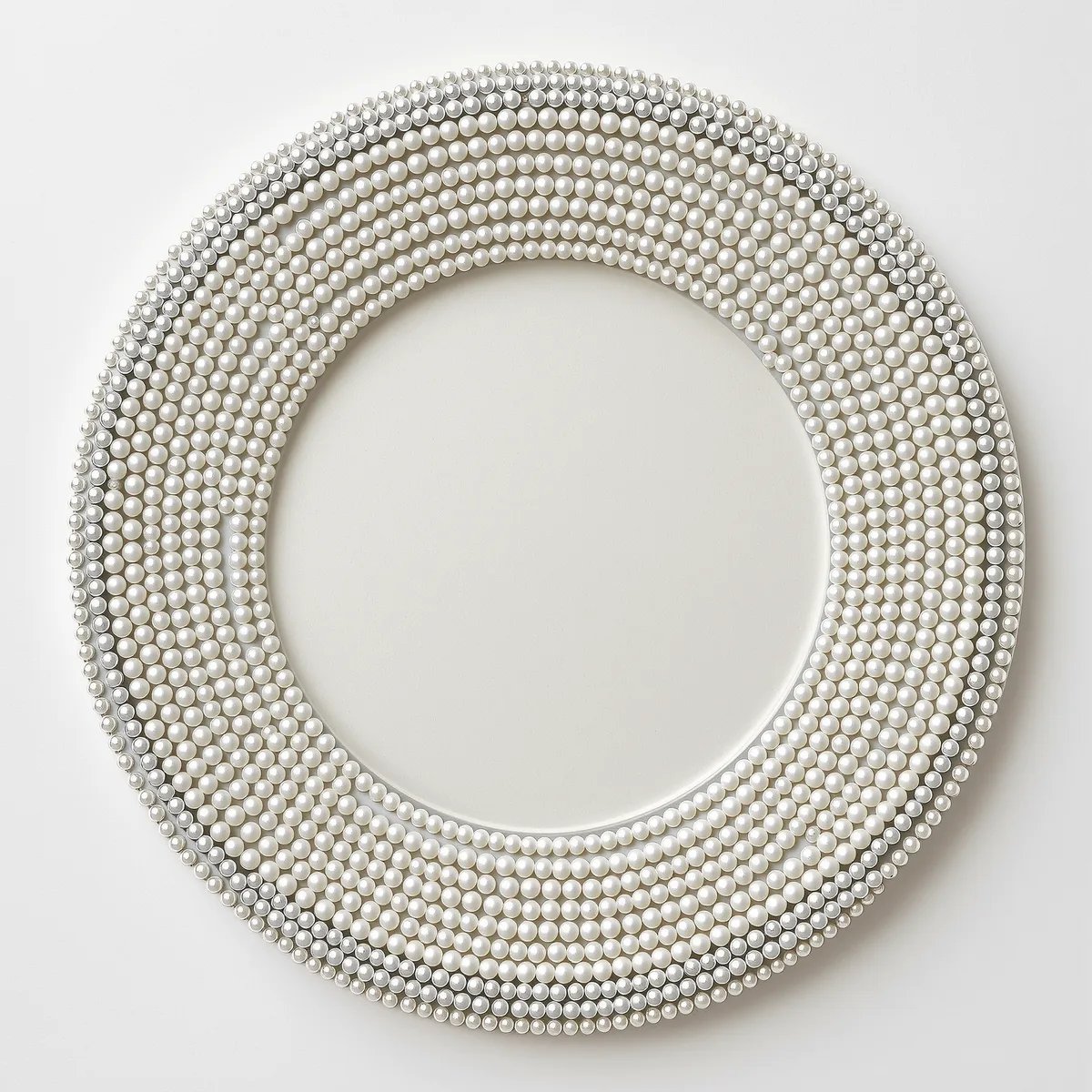
Guide · Tabletop
Glass beads do not care about a hot plate. Acrylic beads, couching thread and a stiffened ground all do, and they are the whole piece.
A round beaded charger plate, mirrored silver and pearl beads couched in concentric rings with a beaded rope edge at the rim.
Treat a beaded mat or charger as a decorative service piece, not a trivet. A hot dish straight from an oven will soften acrylic beads, scorch couching thread and mark a stiffened ground. Glass, ceramic and metal beads tolerate heat; the thread and the ground underneath them do not, and no temperature rating is published for these builds.
A beaded mat or charger is a decorative service piece, not a trivet. Plates and glasses, yes. Serving dishes straight from an oven or a hob, no.
The useful rule of thumb: if the dish would need a trivet on a polished wooden table, it needs one on beadwork. The failure is in the same place — a material underneath that cannot take the heat.
The beads are almost never the limiting component on a glass or ceramic piece. Glass tolerates heat and fails only to sudden thermal shock; ceramic tolerates it outright.
What sits under the beads is the problem. A bead-embroidered mat is a stiffened fabric or felt ground carrying several hundred glass seed beads couched down individually with fine thread. Thread scorches and weakens. A stiffened ground marks and loses its stiffness. Felt marks permanently and can scorch.
On an acrylic piece the order reverses: acrylic softens well below the point at which thread would scorch, so the bead deforms first. That is worth knowing, because acrylic is the material most used in tabletop sets — our own acrylic coaster development ran as a set of four at three inches across, in translucent and opaque versions.
| Component | Under a hot dish | Limiting factor? |
|---|---|---|
| Glass beads | Tolerate heat; can crack from sudden thermal shock | No |
| Ceramic beads | Tolerate heat | No |
| Metal beads | Tolerate heat; conduct it into the ground | Indirectly |
| Acrylic beads | Soften and can deform | Yes — the first to fail |
| Cast-resin faux capiz | Softens; surface can dull | Yes |
| Wood beads | Can scorch and check | Yes |
| Couching thread | Scorches and weakens | Yes |
| Stiffened fabric ground | Marks, loses stiffness | Yes |
| Felt backing | Marks; can scorch | Yes |
Separate the jobs, which is what the charger format already does.
A charger sits under a plate. The plate takes the food and the heat; the beadwork takes the plate. That is the construction answer to the entire question, and it is why beaded chargers are a better hospitality specification than beaded placemats for anything served hot.
Where a hot dish genuinely has to land on the table, specify a trivet in a material chosen for it — metal, finished and plated in our own Moradabad plants, or ceramic, glazed and fired in our own Khurja plant. The bead materials reference sets out what each family tolerates. Both exist, both take heat, and neither has thread in it.
Slightly, and in one direction only: a larger bead lifts the dish further from the ground.
A coiled mat of turned wooden beads carries a plate the better part of a centimetre clear of its backing, which is a genuine air gap. A flat bead-embroidered mat does not — the beads are couched flush and the dish sits almost on the ground.
The effect is real and it is not a rating. A centimetre of air under a 200-degree casserole buys a few seconds, not a service life.
Localised heat on an unprotected ground. In practice that means two design choices.
First, the backing. A felt backing marks visibly and takes a scorch mark permanently; a canvas backing is tougher. On a piece likely to meet warm plates, specify the tougher backing even though it costs a little more.
Second, the bead material in the centre field. If a design needs acrylic for colour, keep the acrylic at the border and put glass or ceramic where the plate lands. That is the same scattered-accent logic we use on hand-strung work, applied to a thermal problem rather than a visual one.
Three lines. Decorative service piece. Not heat resistant. Use a trivet under hot dishes.
Then the care instruction, because the two questions arrive together: spot clean with a barely damp cloth and dry immediately; never immerse. A care card in the pack is the most effective version of this, and we can include a buyer's own care text in the packing to the specification given.
Beads are couched onto stiffened fabric or felt with fine thread, often with metallic thread alongside in the zardozi tradition. Coasters run about ten to eleven centimetres across. The acrylic set we developed used plastic beads at three inches diameter in two finishes.
We do not apply a heat-resistant treatment or a barrier layer, because a barrier that has not been proved on the build is a claim rather than a component. If a programme needs thermal performance, the route is a different material, and that conversation happens before sampling rather than after.
A use instruction rather than a number: these are decorative pieces, and a hot dish belongs on a trivet rather than on the beadwork. A figure would be read as a tolerance, and the piece is not specified to one.
Where a programme needs a thermal figure, it goes through the same mechanism as the rest of the test package: run against a specific build and quoted with the programme. Lead testing against California Proposition 65 already appears as a standard line in the retail programmes we run, and incremental testing for the United Kingdom and the European Union is quoted and amortised across an order.
A temperature. Any temperature. The heat tolerance of the glass is not the heat tolerance of the piece — the thread and the ground fail first — so the honest statement is the use instruction rather than a figure.
We also refuse the word heatproof in any construction, including qualified ones. "Heat resistant to normal table temperatures" sounds careful and means nothing, and a reader will take it as permission for the casserole.
Any hospitality buyer specifying for hot service. Ask us for a metal or ceramic charger instead, and ask the kitchen what actually arrives at the table — in most dining rooms the answer is a plated dish at eating temperature, and the beadwork is fine.
In a nursery, do not specify beaded tabletop pieces. The heat question is the least of it; small parts and spot-clean-only care rule them out first.
In a hotel, the distinction that matters is banqueting against room service. A beaded charger laid for a banquet sees a plated course and is dusted afterwards. A beaded mat on a room-service tray sees a cloche, a hot plate and a trolley, and will not last the season. Specify by service, not by room.
Good to know
It changes which component fails first. On a glass-bead mat the thread and the ground are the limit. On an acrylic mat the bead is, because acrylic softens well before thread scorches. On a coiled wooden mat the bead can check and scorch. In every case something fails before the hot dish has cooled.
"Decorative service piece. Not heat resistant. Use a trivet under hot dishes." A listing that leaves this out will be read as permission, and a mat that has had a casserole on it is unmistakable and unrepairable.
No. The correct answer here is a use instruction rather than a number: these are decorative pieces, and a hot dish belongs on a trivet rather than on the beadwork. A figure would be read as a tolerance, and the piece is not specified to one.
Any temperature, and the word heatproof in any form. The right statement is the use instruction: these are decorative pieces, and a hot dish belongs on a trivet rather than on the beadwork. The heat tolerance of the glass is not the heat tolerance of the piece, because the thread and the ground are what fail first.
If a hospitality brief genuinely requires a heat-tolerant underplate, ask for a metal or ceramic charger — both of which are things we make in our own Moradabad and Khurja plants. The answer to a heat requirement is a material change, not a beadwork variation.
Larger beads lift the dish further off the ground, which is a real effect and a small one. A coiled mat of chunky wooden beads carries a dish a centimetre clear of the backing, where a flat bead-embroidered mat does not. Neither makes a mat a trivet.
Anything you would not put on a polished wooden table. If a dish needs a trivet on timber, it needs a trivet on beadwork, and for the same reason — the heat reaches a material that cannot take it.
Keep exploring
Compliance
What food-contact rules cover, why a charger is a service piece, and what Gemixx's FDA statement actually applies to.
Read the guideManufacturing
Two constructions — a couched bead field on a stiffened ground, and coiled strung rounds lashed together — plus the limits on heat and washing.
Open the referenceGuides
One guide per question that arrives often enough to be worth answering properly.
See the detailGuide
Why the couching thread is the service item, how to use a cushion without abrading it, and what spot cleaning actually involves.
See the detailGuide
The lamp-off, dust-downwards method, why the fitting sets the rules, and what a plated frame will and will not take.
See the detail
Start a conversation
Send a reference, a colour chip or a sketch. Minimums are set per design and confirmed per quote; sampling is quoted separately and usually runs 16 to 20 days from an agreed brief.