Manufacturing
Bead-embroidered coasters
Bead-embroidered glass coasters on stiffened felt, or moulded acrylic sets in translucent and opaque — construction, sizes and what moves the cost.
Read the guide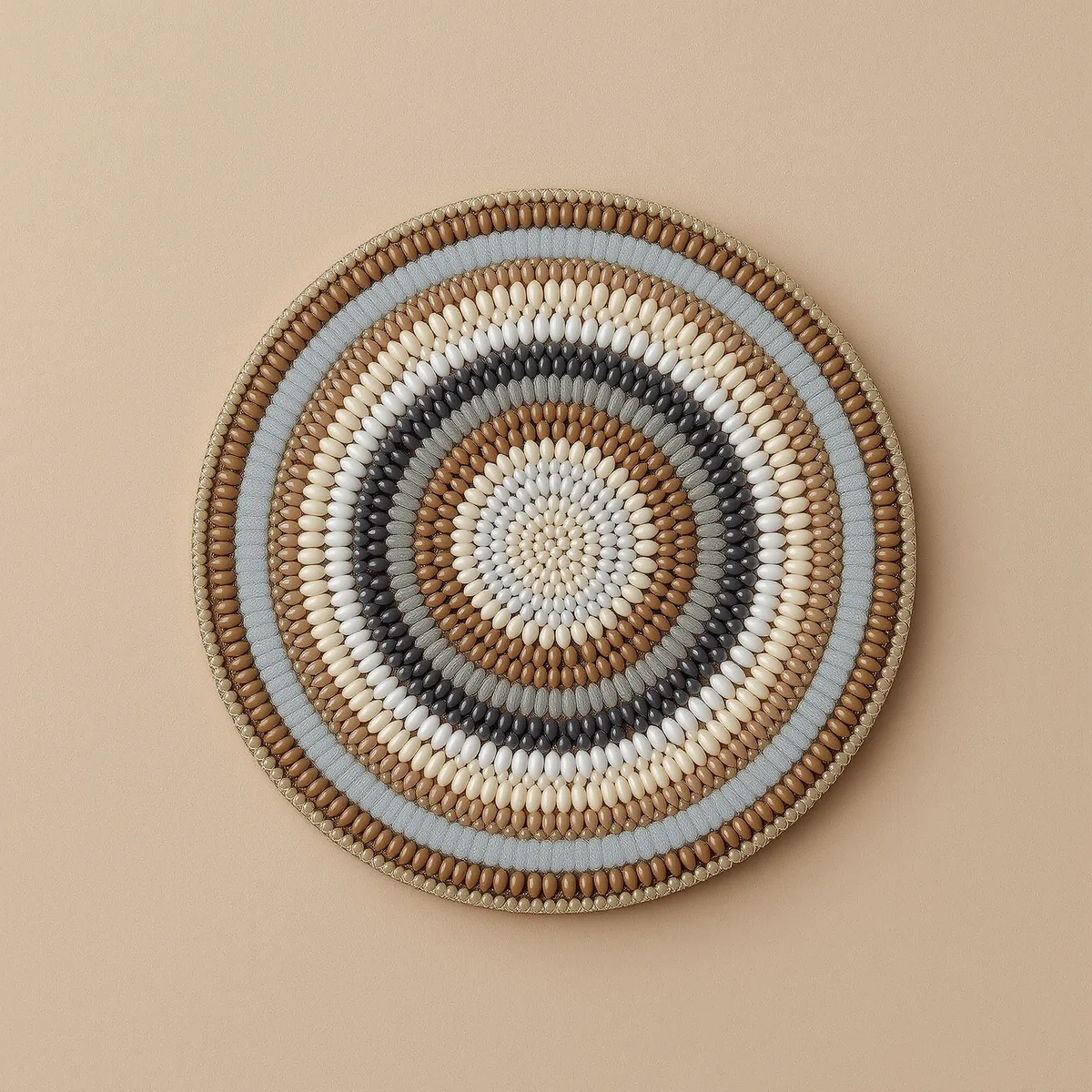
Guide · Tabletop
A coaster is the one piece of beadwork designed to meet water. The beads cope. The backing is what you are actually looking after.
A round beaded coaster, glass seed and bugle beads couched onto stiffened felt in concentric rings, the felt backing turned at the edge.
Blot a beaded coaster the moment it is wet, press rather than rub, and dry it flat and face-up. The beads are unaffected by condensation; the stiffened ground and the felt backing are not, and a soaked backing cups, marks and loses its stiffness permanently. Never immerse a coaster and never dry it on a rail or a radiator.
Blot. Brush. Wipe. Dry flat.
Blot standing liquid the moment it appears, pressing a dry cloth onto the bead field rather than rubbing across it. Brush dry, later, to lift anything the blot left. Wipe the beads with a barely damp cloth only if something has actually marked them. Then dry flat and face-up, every time, before the coaster goes back into use.
The first step is the one that matters. Everything else is recovery.
There is no cord on a coaster, and the component that takes its place is the one you cannot see.
A beaded coaster is glass seed beads and bugle beads couched onto stiffened fabric or felt, in the zardozi tradition, usually in concentric rows, with a backing behind. Nothing in it is hand-strung: there is no cord and no header. Each bead is held by a stitch. The thread and the ground are doing the structural work that cord and gravity do on a hanging panel.
Condensation goes through the bead field — the beads are not a seal — and lands on the ground. A ground that stays wet swells, loses stiffness and dries unevenly, so the coaster cups. The beads are completely unaffected, which is why a failed coaster still looks fine from above and will not sit flat.
| Component | Tolerates condensation | Tolerates immersion | Notes |
|---|---|---|---|
| Glass seed beads | Yes | No, as part of the piece | Couched onto the ground in concentric rows |
| Glass bugle beads | Yes | No | Long beads; an end can catch a cloth |
| Surface-dyed beads | Yes if dried at once | No | Standing liquid can lift a surface dye |
| Acrylic beads | Yes | No | Our acrylic coaster set ran at three inches across in translucent and opaque versions |
| Couching thread | Only if blotted promptly | No | Slackens when wet; cannot be re-tensioned |
| Metallic thread, zari | Poorly | No | Tarnishes where liquid sits |
| Stiffened fabric ground | Poorly | No | Swells and loses stiffness |
| Felt backing | Poorly | No | Takes a water line; can shrink and cup |
| Canvas backing | Better | No | The specification to prefer for daily service |
| Typical size | — | — | Embroidered coasters 10–11 cm across; acrylic set 3 in |
Blotting: every time. That is the discipline that decides whether a set lasts a decade or a season.
Dry brushing: after each service, or weekly at home. A coaster collects crumbs and dust in the gaps between bead rows, and a brush lifts them where a cloth skims the tops.
Damp wiping: when something has marked the beads, not on a schedule. Each damp pass risks reaching the ground. In a commercial dining room this belongs on a maintenance schedule alongside the glassware, because the interval is what protects the piece rather than the technique.
Solvent, bleach, abrasive cream, a melamine sponge, hot water, steam, a dishwasher, a washing machine.
Two specific to coasters. Spray surface cleaner, which is designed to wet a surface and is therefore exactly wrong on a piece with an absorbent core. And a bar towel used wet: in a commercial setting, a coaster wiped with the same cloth that wiped the counter is being soaked rather than cleaned.
Blot it faster, and wipe it less.
Surface-dyed beads carry colour as a coating. Standing liquid with any alcohol or acid in it — which covers most of what ends up on a coaster — will lift that coating given time. The remedy is timing rather than technique: blot in seconds and the dye never gets the exposure.
For a set that will be used daily, specify body-coloured glass rather than surface dye at the design stage — and note that a bead dyed to match another in the build carries a surface colour by definition. It is the single most useful durability decision available on this product and it costs nothing.
Neither exists on this piece, and the absence is worth stating because it changes the care model completely.
A hanging panel has a dowel and a cord and a hem, and care is about keeping water away from the top. A coaster has a ground and a backing, and care is about keeping water from going down. There is no component to keep dry at the edge: the whole piece is the thing that must not soak.
Where a coaster is part of a tabletop set, the same logic applies across it: beaded placemats and chargers take the plate and the plate takes the food, and beaded napkin rings never meet liquid at all. The rest of the beaded table décor range follows the same spot-clean rule.
On a coaster the failure is a broken couching thread rather than a dropped strand, and it shows as a short run of loose beads — usually on the edge the glass has been dragged over.
Repair it early. Loose beads move, and movement abrades the thread holding the beads either side, so a two-bead fault grows into a twenty-bead fault across a season. A hand repair re-couches the run in its original order, working from the spare beads supplied with the set, if the order specified them.
A glued cabochon, where a design has one, has no stitch at all — a flat-backed bead with no hole sits on a glued seat. Bead shapes differ in how they are held, and that is the one shape that is never wired. If one lifts, it is re-seated rather than re-stitched, and it should never be prised at.
Flat, dry, face-up, interleaved.
Never stack coasters wet. The piece at the bottom of a damp stack takes the moisture from every coaster above it, and that is the one that cups. In a bar, the end-of-service routine should be: blot, lay out face-up on a dry surface, and only stack when everything is dry to the touch.
For long storage, interleave with acid-free tissue and keep the set flat in a box, away from direct sun. Do not vacuum-pack: compression on a dense bead field abrades beads against each other.
Five short lines, and this is a product where the card genuinely prevents returns.
Blot spills immediately, pressing rather than rubbing. Brush dry to clean. Wipe beads with a barely damp cloth if needed, and dry at once. Do not immerse, machine wash or dishwash. Dry and store flat.
We can include a buyer's own care text in the packing alongside labels and cartons to the specification given, which is the most effective place for it on a boxed set of four. The tech pack records what goes in the box alongside the beadwork itself.
Yes, and the difference is a rotation rather than a method.
At home a coaster has all night to dry. In a bar it goes back under a glass in four minutes, still damp, and does that twenty times a shift. No cleaning routine survives that; only a rotation does. Specify twice the quantity you need on the floor, run half and dry half, and swap at the shift change.
Specify a canvas backing rather than felt for the same reason, and specify body-coloured beads. Both decisions cost very little at quote stage and they are the difference between a consumable and an asset.
A cupped ground. A water line on felt. A slackened couching stitch. A lifted surface dye. A tarnished metallic thread.
Against those, a broken thread run is repairable and a lifted cabochon is re-seatable. The ratio is the argument for blotting: almost everything water does to a coaster is permanent, and almost everything use does to it is fixable.
Good to know
On a coaster: solvent, bleach, abrasive cream, a melamine sponge, a dishwasher and a washing machine. Add spray surface cleaner, which soaks a backing that has no way of drying from the inside — the most common well-meant mistake on a bar coaster.
A coaster has no dowel and no cord: it is beads couched onto a stiffened ground with a backing. The component that plays the dowel's role — the part that must stay dry and usually does not — is the backing, and it is less forgiving than timber because a water line on felt is permanent.
Brush dry first, wipe the beads with a barely damp cloth, dry in the same pass, and never immerse. On a coaster, add the step that comes before all of those: blot standing liquid immediately, pressing rather than rubbing, so it never reaches the ground.
A coaster has no strands; the equivalent fault is a broken couching thread showing as a run of loose beads. Repair it early, because loose beads move and abrade their neighbours' thread. Keep any spare beads supplied with the set — matching a dye lot later is harder than matching a bead shape.
Flat, dry, face-up, and interleaved with acid-free tissue if the set is going away for a season. Never stack wet coasters: the piece on the bottom takes the moisture from all of them and is the one that cups.
No, and a coaster is the least survivable case. A drum slackens every couching stitch at once, soaks a ground that cannot dry from the inside, and tumbles a small rigid disc against the drum wall so the bead edges chip. One cycle ends the piece.
Keep exploring
Manufacturing
Bead-embroidered glass coasters on stiffened felt, or moulded acrylic sets in translucent and opaque — construction, sizes and what moves the cost.
Read the guideGuide
Why soaking slackens every couching stitch at once, and the brush-then-damp-then-dry routine that works instead.
Compare the optionsGuides
One guide per question that arrives often enough to be worth answering properly.
Specs and sizesGuide
The dusting routine, the yearly cord check at the dowel, and the two wall positions to avoid entirely.
Specs and sizesGuide
Why a dishwasher cycle destroys bead embroidery, which component fails first, and the routine that works instead.
Read the guide
Start a conversation
Send a reference, a colour chip or a sketch. Minimums are set per design and confirmed per quote; sampling is quoted separately and usually runs 16 to 20 days from an agreed brief.