Technique
Bead maps
What a bead map records, why a scattered accent has to be drawn rather than left to the bench, and why a reorder lives or dies on this one document.
See the detail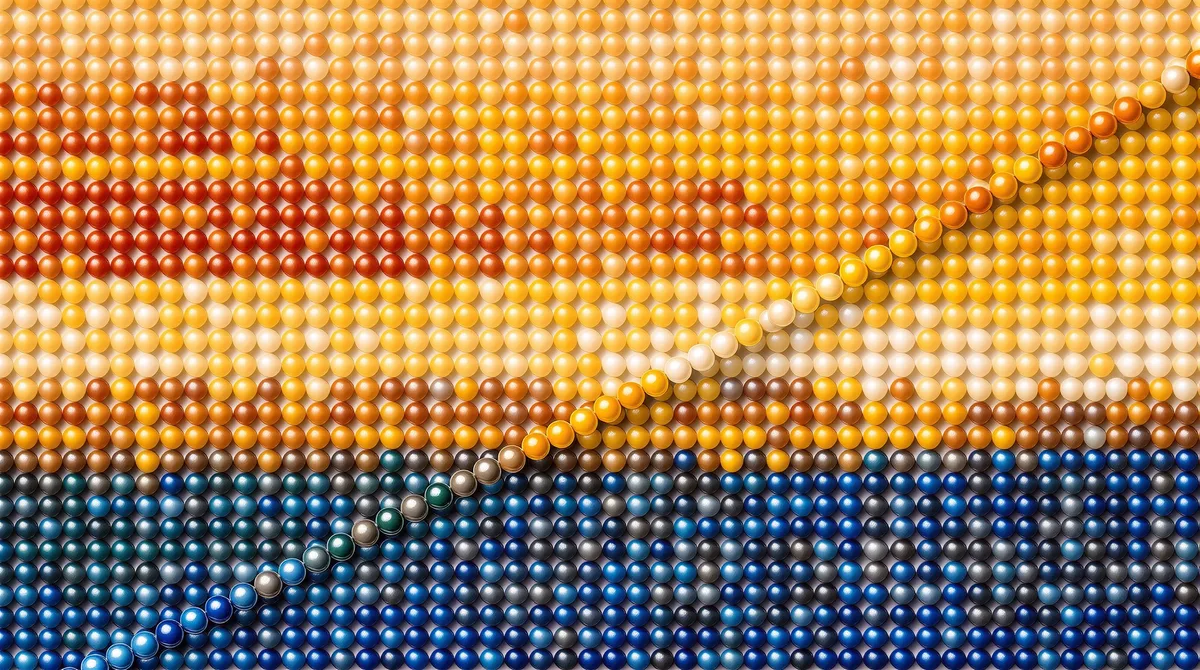
Guide · DIY
A strand is a column and a bead is a cell. Once you see a panel as a grid, every pattern question becomes arithmetic.
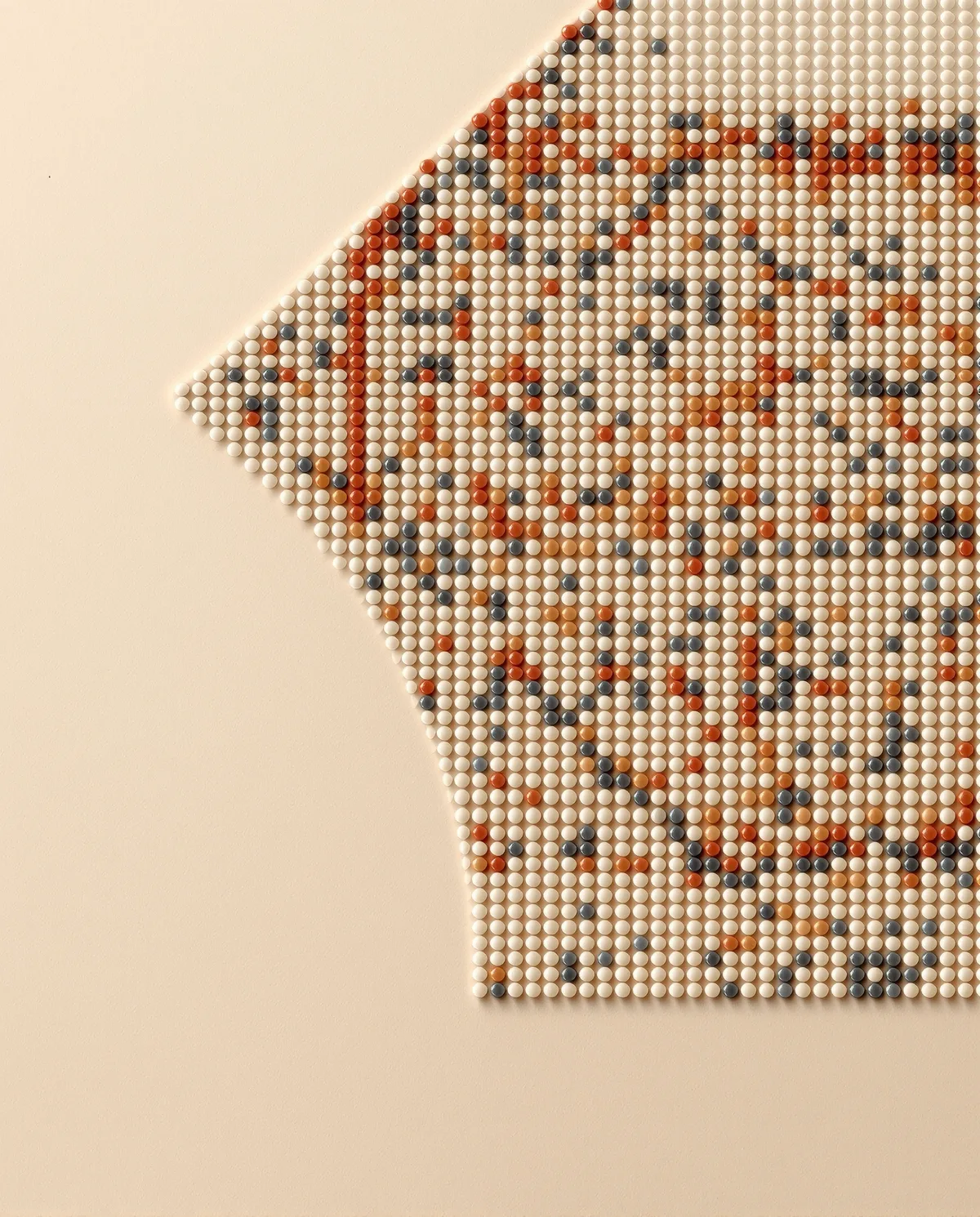
Round glass beads laid out in counted rows by colourway — rust, honey mustard, cornsilk, chalk white and cobalt — with a threaded sample strand across them showing the sequence…
Draw the panel as a grid before stringing anything: one column per strand, one row per bead position, then colour the cells. Column count comes from the width divided by the strand pitch, and row count from the drop divided by the bead height. A repeating pattern is far easier and cheaper to execute than a gradient.
Turning a panel into a grid, then colouring the grid in.
One column per strand, one row per bead position. Width divided by strand pitch gives the columns; drop divided by bead height gives the rows. From there a pattern is arithmetic rather than art, and that is what makes it repeatable.
The panel's finished width and drop, the strand pitch you intend, and the height of the beads you are going to use.
Then squared paper and coloured pencils, or a spreadsheet with narrow columns and cell shading. A spreadsheet is better for a repeat because it counts for you; paper is better for a motif because you can see the whole panel at once and judge whether it reads.
Work out the column count. At 90 cm with a centre-to-centre spacing of about 2.25 cm that is a strand count of forty; at 120 cm with a pitch of about 2 cm, sixty. Both figures come from our 2027 design renders.
Work out the row count by dividing the drop by the bead height. Then draw the grid at the right aspect ratio — and this is the step everyone skips. Beads sit much closer together down a strand than strands sit to each other, so the grid is tall and narrow rather than square. A diagonal drawn at 45 degrees on square paper will run far shallower than 45 degrees on the finished panel.
Colour the cells. Then convert each column into a written sequence — twelve cream, one amber, eighteen cream — because that written sequence is what you actually string from.
Moulded acrylic gives the most reliable grid, because every bead is the same height to a fraction of a millimetre — the bead sizes reference carries the working dimensions. A row drawn on paper will be a horizontal line on the panel.
Pressed glass is nearly as reliable. Hand-made glass is not: wound and lampwork beads vary, so a row accumulates error down the panel and a long horizontal line will wander. Design with vertical and scattered elements rather than long horizontals if the beads are hand-made.
Wood varies in tone rather than in size, so plan for a range rather than a colour: natural grain means realistic tolerances, with a tone band approved on a sample and production held to it.
Drawing on square paper and expecting the result to be square. That single error turns circles into ovals and 45-degree diagonals into shallow ones, and it is responsible for most of the disappointment in home-designed panels.
Second: planning a gradient. A gradient needs every strand to be slightly different from its neighbour, which means forty unique written sequences instead of one. On one of our own seed-bead wall-art developments a repeating pattern was used instead of a gradient specifically to cut cost, and the same arithmetic applies at home with hours instead of money.
Third: a motif too small for the grid. A bead is a pixel, and a panel at forty columns has a resolution of forty. Letters and faces need many more.
Re-pattern it. A strung panel's pattern is fixed by the order the beads went on the cord, and changing it means unthreading.
Which is the whole argument for the plan: never start stringing a pattern you have not drawn, counted and checked against the strand count.
An hour for a repeat. An evening for a motif, including the redraws.
It is the cheapest hour in the build. A pattern error found on paper costs a rubber; the same error found at strand twenty costs twenty strands.
Writes the grid down formally, as a colour-count sheet — the bead-by-bead plan for every strand on the panel, held inside the tech pack. That document is what makes a pattern repeat exactly across a production run and keeps strand lengths identical, and it is the single most important document in beaded manufacture.
Two of our own constructions show what a map carries beyond colour. On a dotted portal, large oval glass beads of about 13 × 22 mm are scattered three or four to a strand, placed at random and specified never to align in a row across the panel, over a base of seed beads dyed to match the dots: roughly ninety to a hundred and twenty accents per curtain. On a mushroom-accent portal, about a hundred and twenty glass mushroom beads are placed on the same basis, up to four per strand, with the orange and brown mushrooms alternating at the buyer's request.
"Random, never in a row" is a specification. Left to improvisation, a stringer will drift into alignment, and the panel will read as a grid rather than as handwork.
A pattern fault found at strand three is a repair; the same fault found at strand thirty is a rebuild. String one complete strand of a new pattern and hang it before committing to the rest. That single strand is the sample, and deciding what to sample before sign-off is exactly how the trade handles it: a prototype is developed and approved before a full run begins.
That a repeat is easier, cheaper and more forgiving than a gradient or a motif, and that the grid is taller than it is wide.
For a retailer selling kits, printing a blank grid at the correct aspect ratio on the inside of the box would be the single most useful addition available to the product.
The plan. Keep the grid and the written sequences with the panel, because they are what a repair works from: a strand re-strung in bead-map order matches its neighbours, and a strand re-strung from memory does not.
Keep the leftover beads sorted by colour and size against the plan, so a replacement can be found without guessing.
Extractable data
| Quantity | How to get it | Typical value |
|---|---|---|
| Columns | Panel width ÷ strand pitch | 40 at 90 cm; 60 at 120 cm |
| Strand pitch | Chosen for density | About 2.25 cm at 90 cm; about 2 cm at 120 cm |
| Rows | Drop ÷ bead height | Varies with bead size |
| Total beads, spaced 90 × 200 cm | Columns × rows, with gaps | About 3,100 |
| Total beads, densely patterned 90 × 200 cm | Columns × rows, close-strung | About 11,800 |
| Grid aspect | Compare pitch with bead height | Taller than square; a diagonal runs shallow |
| Scattered accents per strand | Chosen, then randomised | 3–4 on a dotted construction |
| Accent beads per panel | Accents per strand × columns | About 90–120 on a dotted portal |
| Cost lever | Repeat instead of gradient | Used on a wall-art development to cut cost |
Good to know
An hour to draw a repeat, a full evening to draw a motif. It is the cheapest hour in the whole build, because a pattern error found on paper costs a rubber and the same error found at strand twenty costs twenty strands.
A plan can always be redrawn, which is the point of planning on paper. A strung panel cannot be re-patterned without unthreading, so the rule is simple: never start stringing a pattern you have not drawn, counted and checked against the strand count.
Squared paper, a pencil and coloured pencils, or a spreadsheet with narrow columns and cell shading. A spreadsheet is genuinely better for a repeat because it counts for you; paper is better for a motif because you can see the whole panel at once.
Planning does not touch the cord, but a bad plan does. A pattern that puts a large feature bead directly against another large bead on the same strand concentrates weight and lets the two knock together, which on glass is how a chip starts. Space the accents.
Glass gives you two extra constraints worth drawing in. Bead heights vary more in hand-made glass than in moulded acrylic, so a row is less reliable as a horizontal line; and glass strength is colour-dependent, so a plan should avoid putting incompatible colours adjacent where they will knock together.
A retailer planning a bespoke display panel should draw it, yes — and should then ask whether a repeat will do the job, because a repeat can be strung by anyone from a short written sequence while a motif needs the whole grid in front of them.
Keep exploring
Technique
What a bead map records, why a scattered accent has to be drawn rather than left to the bench, and why a reorder lives or dies on this one document.
See the detailGuides
One guide per question that arrives often enough to be worth answering properly.
Read the guideGuide
Strand count and pitch, cord choice, the bead order on paper, stringing, knotting, fixing to a dowel — and the hour count.
Compare the optionsGuide
The typical contents list, the two items usually left out, and how to check a kit holds enough beads for the panel it promises.
Specs and sizesGuide
The three realistic options, how each behaves under bead weight, and the end finish each one needs.
See the detail
Start a conversation
Send a reference, a colour chip or a sketch. Minimums are set per design and confirmed per quote; sampling is quoted separately and usually runs 16 to 20 days from an agreed brief.