Guide
How to make a beaded curtain
Strand count and pitch, cord choice, the bead order on paper, stringing, knotting, fixing to a dowel — and the hour count.
Specs and sizes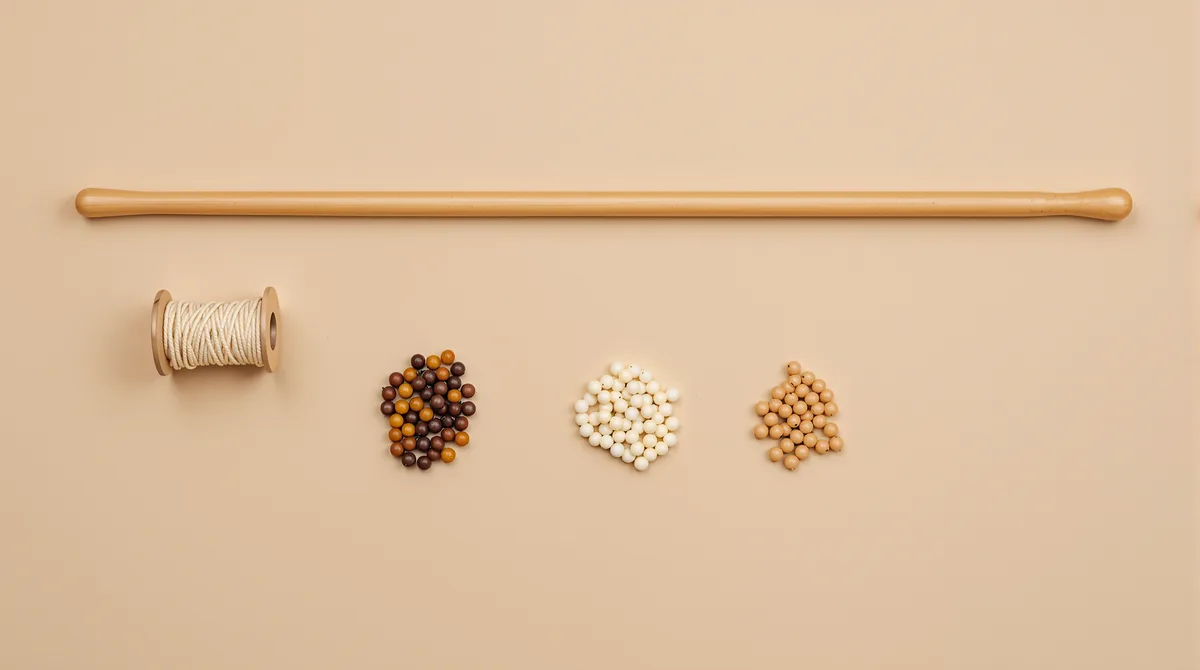
Guide · DIY
A kit is beads, cord and usually nothing else. The two items most often missing are the two you cannot improvise.
A turned wooden dowel, a spool of braided stringing cord and three separate heaps of loose glass beads in amber, cream and chocolate, laid out as the parts a beaded curtain kit…
A beaded curtain kit usually contains loose beads and a length of cord, and sometimes end stoppers. What is normally missing is the header — a dowel or rod — and the wall fixings. Check the bead count against the panel the kit promises: a spaced 90 × 200 cm panel needs roughly 3,100 beads on our design-render basis.
A box of loose beads and a length of cord, sold with a promised finished size. Sometimes end stoppers are included. A dowel is uncommon, a pattern plan is rare, and wall fixings are almost never in the box.
That is not a criticism — it is what a kit is. The useful question is not whether a kit is complete but whether you know which two items you will have to supply.
Exactly what a made panel does, if it is strung well: marks a threshold, lets air and light through, moves when someone passes, and never has to be drawn aside.
Where a kit-built panel differs is in evenness. A factory panel holds every strand to an identical finished drop, because each one is strung to a colour-count sheet and checked against an approved sample. A kit panel is as even as the person who cut the cord, and the hem is where that shows.
Acrylic is the material kits are mostly sold in, and for good reasons: the beads are light, they do not shatter, they do not chip the cord, and the colour runs through the body of the bead so leftovers still match years later.
Glass kits exist and are harder work. Glass is roughly twice as dense as acrylic, so the stringing medium has to be heavier and the ends have to be crimped rather than knotted. The drill holes on hand-made glass can also be sharper, which abrades a cord before the panel has even been hung.
Wood kits are light and forgiving, and the one thing to watch is tone: natural grain varies, so a kit's beads will not be uniform, and the panel looks better if you distribute the tones deliberately rather than stringing at random.
Four numbers that most kits do not print.
The bead count, so you can check it against the panel size. The drill-hole size, because that decides whether the cord fits. The cord material and length. And the number of strands the kit is designed for.
With those four you can verify the kit before you open it. Without them you find out at strand twenty-eight.
A great deal, and that is the product working rather than failing. A strung panel is mostly air: at forty strands on a 90 cm width the pitch is about 2.25 cm, so roughly as much of the panel is gap as is bead.
A kit gives you one lever a made panel does not: you decide the pitch. String thirty strands and you get the pitch our shipped panels are built at; string forty and it matches the denser design-library drawing; string fifty and it reads almost solid and uses a quarter more beads than the box provides. Decide that before cutting cord, because it changes how many strands' worth of beads you have.
None worth the word, in any density you can build from a kit. A bead panel breaks up a sightline; it does not obscure one.
If privacy is the brief, the answer is a fabric curtain or a blind, and no amount of bead density closes that gap. What a bead panel does instead is mark a threshold while leaving the opening usable, which is a different and genuinely useful job.
That depends entirely on the bead in the box, and it is worth knowing before buying because it is the one property nobody checks.
Glass gives a bright chime. Acrylic gives a lighter click. Wood gives a soft knock, and bamboo a dry rattle. For a bedroom or a treatment room the quieter materials win; for a bar or an event entrance the chime of glass is part of the appeal.
A 90 cm panel — about 35 inches — covers most single interior doors, which in North America are commonly 28 to 36 inches wide. For a 36-inch opening and anything wider, 120 cm, about 47 inches.
Those two widths drive the strand count: forty strands at 90 cm, sixty at 120 cm, and the standard curtain sizes reference carries the rest. A kit sized for forty strands cannot be stretched across a 120 cm opening without the panel reading as a sparse screen.
Light, in acrylic, which is why kits are nearly always acrylic. A full-length acrylic panel will sit on a tension rod sprung inside the door frame, which needs no drilling and is the right answer for a rented room.
In glass the answer changes: a rod carried by brackets screwed into the solid timber of the door lining, rated above the panel weight. If a glass kit does not come with a dowel, buy the dowel and the brackets together and choose both for the weight of beads you are about to string.
The beads outlast the room. The cord is the service item, exactly as on a made panel: it runs through the drill hole of every bead on its strand, abrades there, and slackens if it ever gets wet.
A kit panel's life is therefore decided at build time. A cord chosen for the bead weight and an end finished with a crimp or an end bead will run for years. A light cord and a single knot will drop a strand within a season.
A kit shifts the labour rather than removing it. The bead and the cord still cost what they cost; what changes is who spends the hours threading them, and on a dense panel those hours are most of the price.
What a kit changes is who pays for the labour. A densely patterned 90 × 200 cm panel holds about 11,800 beads on our 2027 design-render basis against roughly 3,100 for a spaced one. In a kit that fourfold difference is your evenings rather than your money, which is why kits are sold for plain and simple-repeat designs and almost never for graphic ones.
A kit is right for one plain panel in a room you live in, and for anyone who wants the making as much as the object.
It is the wrong choice for a pattern, for an exact colour, for more than one matching panel, and for anything a business will sell — because a run of panels has to hold to one approved sample rather than to the builder's mood on a given evening.
For completeness: we do not sell kits. Every beaded door curtain we ship is made to order, with no retail stock programme, with beads matched to a Pantone reference or a physical chip and confirmed on a sample before production. That is a different product from a box of beads, and the comparison is between a plan and an improvisation rather than between two prices.
Extractable data
| Item | Usually included? | What to check |
|---|---|---|
| Loose beads | Yes | Count against the promised panel size |
| Cord | Usually | Material and length; elastic is a warning sign |
| End stoppers or crimps | Sometimes | A knot alone will eventually slip |
| Dowel or rod | Rarely | Diameter must suit the strand loops |
| Wall fixings | Almost never | Choose for the substrate, not from the box |
| Bead drill-hole size | Rarely stated | The number that decides whether the cord fits |
| A pattern plan | Rarely | A written sequence per strand, or a grid |
| Beads needed, spaced 90 × 200 cm | — | About 3,100 |
| Beads needed, densely patterned 90 × 200 cm | — | About 11,800 |
| Strands needed at 90 cm | — | 40, at a pitch of about 2.25 cm |
Good to know
That is a kit's one real advantage: you cut the cord, so the width and drop are whatever you make them. The constraint is the bead count — a kit sized for a 90 × 200 cm panel will not stretch to 120 × 210 cm, because a wider panel needs sixty strands rather than forty.
A kit cannot tangle, but a panel strung from one can, and more than a factory-strung panel does. The reason is strand length: hand-cut strands vary, and strands of different lengths cross each other as they settle. Cut every strand from one template rather than from the previous one.
Supply your own tension rod and string the strands with loops sized for it, or build the panel on a dowel and rest the dowel on a tension rod. Kits almost never include either, so decide the fixing before you cut the cord — the loop size depends on it.
A kit is loose small parts in a box, so it should be kept away from young children entirely until it is strung. The finished panel raises the normal questions: hang it in a doorway rather than over furniture, finish every strand with a crimp or a stopper so it cannot empty, and keep leftover beads sealed and out of reach.
The beads last indefinitely; the cord is the service item, exactly as on a made panel. What shortens a home-built panel's life is a cord chosen too light for the bead weight, or an end finished with a knot alone. Both are specification decisions taken at the kitchen table.
The finished panel follows the same rules as any strung panel. Dust dry, downwards, strand by strand. Acrylic strands can be washed in lukewarm water with mild soap off the dowel; glass, wood, bamboo and faux capiz are wiped. Keep the cord and any timber header dry.
Keep exploring
Guide
Strand count and pitch, cord choice, the bead order on paper, stringing, knotting, fixing to a dowel — and the hour count.
Specs and sizesGuide
Beads, cord, dowel, end beads, header and fixings: the six components, what each one has to do, and which decision comes first.
Specs and sizesGuides
One guide per question that arrives often enough to be worth answering properly.
Open the referenceGuide
How to draw the strand grid, how a diagonal actually reads, and why a repeat costs less than a gradient.
See the detailGuide
How to strip a panel without losing the order, how to sort, and what the beads are realistically good for afterwards.
See the detail
Start a conversation
Send a reference, a colour chip or a sketch. Minimums are set per design and confirmed per quote; sampling is quoted separately and usually runs 16 to 20 days from an agreed brief.