Specification
What the beads hang on
Cotton cord, nylon thread and coated steel wire compared on drape, repair and how each one eventually fails.
See the detail
Guide · DIY
The cord is the panel. Choose it for the weight it will carry and the knot it will hold, and nothing else about a home build is difficult.
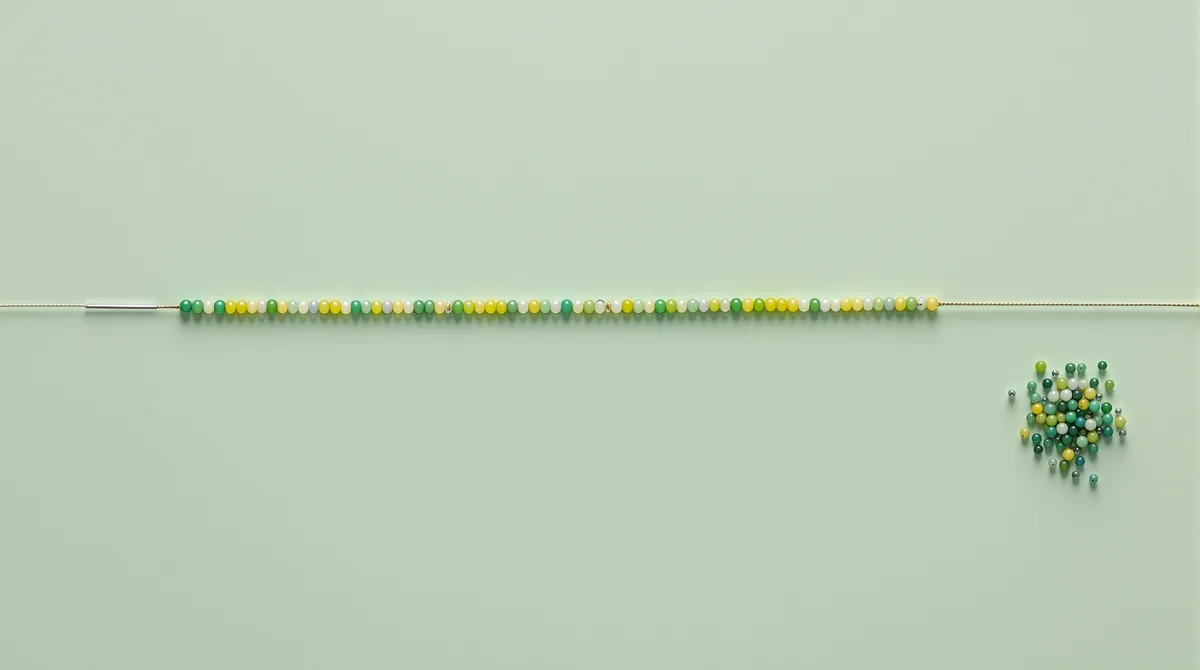
A single glass bead turned so the drill hole faces the camera, the waxed cord passing in one side and out the other.
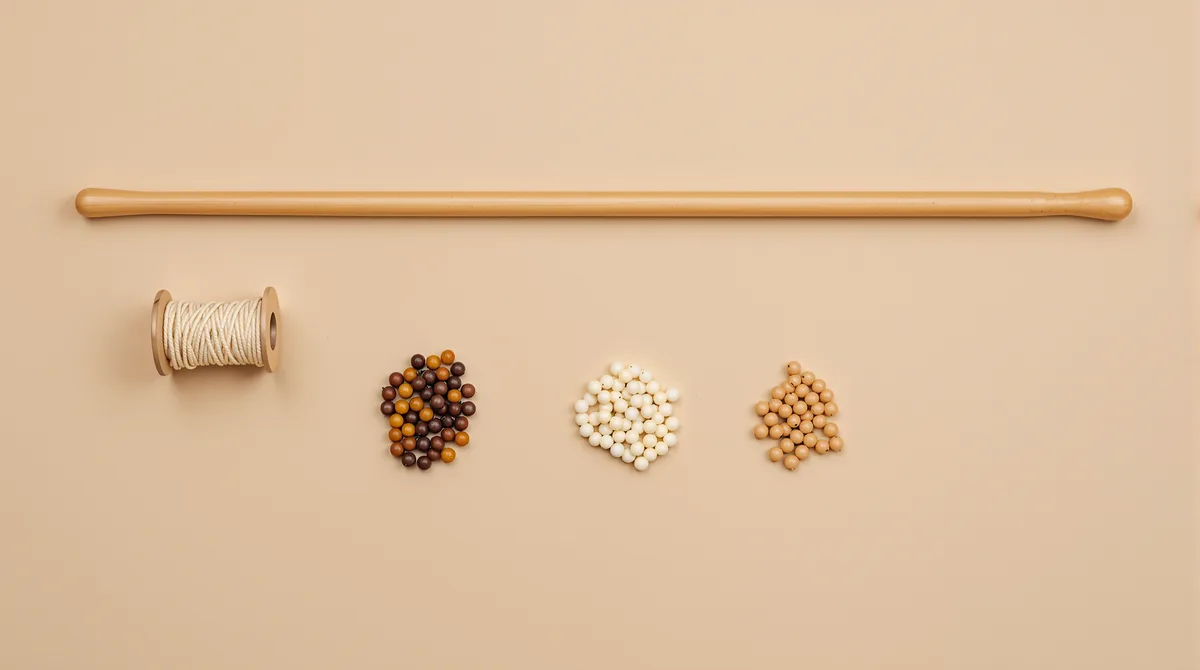
Use waxed cotton cord for wood and acrylic beads, braided nylon for glass, and nylon-coated steel wire where beads are heavy or sharp-holed. Match the cord to the smallest drill hole in the design, not the largest, and finish every strand with a crimp or a stopper bead rather than a knot alone.
Choosing one component correctly, then repeating a simple action several thousand times.
The cord is the panel's entire structure: there is no backing and no frame, only thirty or forty lengths of cord carrying beads. Everything that goes wrong with a home-built panel traces back either to the cord or to the strand lengths.
The beads, and specifically the smallest drill hole among them. That number chooses the cord, and the mistake most home builders make is choosing cord to suit the beads they are thinking about rather than the beads that will actually stop them.
Then: the finished width and drop, crimp beads, a crimping tool, scissors, and a beading needle if seed beads are involved.
Finally, a plan. At 90 cm wide, a strand count of forty at a pitch of about 2.25 cm; at 120 cm, sixty at about 2 cm. Both figures come from our 2027 design renders, and both are good starting points for a home build.
Test one bead first. Thread the cord through the tightest bead in the design and pull it through twice. If it binds, grips or frays, the cord is too heavy and no amount of patience will fix that across three thousand beads.
Cut all the strands to length at once, from a single measured template, adding an allowance at each end for the header loop and the end finish. Cutting them individually is how strand lengths drift.
String each strand. Finish the bottom end with a crimp, or with a stopper bead and a double knot above it.
Then attach the strands to the panel header in order, at a marked centre-to-centre spacing. Marking the dowel first — pencil ticks at the pitch — is worth five minutes and saves an hour.
On a home build there is nothing to void, but two habits damage cord before the panel is ever hung.
Forcing cord through a tight hole stretches and abrades it. The cord then looks fine and is already compromised at exactly the points that will carry load.
Dragging cord repeatedly over a sharp-edged drill hole does the same. Moulded acrylic holes are usually smooth; glass holes vary, and a large hand-made bead can have a surprisingly keen edge. The bead sizes reference carries hole diameters and cord gauges. If a hole is sharp, use nylon-coated steel wire through that bead.
Wood and acrylic: waxed cotton. It knots well, it sits comfortably in a moulded hole, and the beads are light enough that abrasion is slow.
Glass: braided nylon, crimped. Glass is roughly 2.5 g/cm³ against about 1.2 for acrylic as general material figures, so the same strand carries roughly twice the load, and nylon knots slip — a crimp is not optional.
Heavy or sharp-holed beads, and fringe ends: nylon-coated steel wire, crimped, never knotted. This is also the right choice for a strand whose bottom bead is a large feature drop.
Strand lengths. A panel whose strands vary by a centimetre has a hem that wanders, and there is no way to correct it except re-stringing. Cut from a template, not from the previous strand.
Second: the end finish. A knot alone on nylon or coated wire will let go, and when it does the strand empties onto the floor.
Third: elastic cord, which some kits supply. Elastic creeps under a static load, so a panel strung on it drops over months and the hem goes slack and uneven. It has no place in a hanging panel.
String it on monofilament fishing line, which goes brittle and yellow and then snaps without warning. Use elastic. Tie off with a single knot. Hang it before the ends are finished.
And never thread wet. Waxed cotton in particular takes up water readily, and a cord that is strung damp dries tight inside the beads and abrades from the first day.
An evening per ten strands on a plain design. Four evenings for a forty-strand panel.
A patterned design is a different proposition. A densely patterned 90 × 200 cm panel holds about 11,800 beads on our design-render basis against roughly 3,100 for a spaced one — a near-fourfold difference inside identical dimensions. That is the reason a graphic panel is a factory job and a plain one is a weekend.
Specifies the cord and the hole together, before anything is strung.
The hole is part of the bead specification, not an incidental. One development customer specified a bead hole of four to five millimetres and we made beads to it, because a hole that is too tight abrades the cord and a hole that is too loose lets a bead rock and chip its neighbour.
The other difference is the plan. Every strand is strung to a colour-count sheet — the bead-by-bead plan that makes a pattern repeat exactly across a production run and keeps the finished drop identical. Glass seed beads are drawn and hand-strung in our own Firozabad glass works, which means hole consistency is ours to control rather than ours to discover, and first article inspection is where it is checked.
On a home build, re-stringing one strand is always cheaper than starting again, and it is also the best diagnostic available. If one strand fails, the specification was marginal on all of them: re-string that strand with a heavier cord and a crimped end, and watch what the others do.
If you sell loose beads or kits, say what cord suits them and what hole size they have. Those two numbers are the whole of what a home builder needs and almost no kit states them.
If you sell finished panels, the useful message is different: altering a made panel is far faster than building one, and an acrylic panel shortens with scissors and a crimp.
Spare crimps, spare cord from the same reel, and any beads left over, sorted by size.
The cord from the same reel matters more than it sounds. A replacement strand strung on a different cord sits and ages differently from its neighbours, and on a panel that is a visible difference within a year.
Hang the panel and leave it a week before judging anything. Strands settle, and a new panel always looks slightly crossed on the first evening.
Then check two things: the hem, sighted from one side at eye level, and the ends. A crimped end does not move. Anything that is going to work loose does so in the first month.
Extractable data
| Cord | Best for | End finish | Weakness |
|---|---|---|---|
| Waxed cotton | Wood, bamboo and acrylic beads | Double knot plus a stopper bead | Abrades at drill holes; slackens if it gets wet |
| Braided nylon | Glass beads, including seed beads | Crimp, or a knot plus a crimp | Knots slip; needs a crimp to be reliable |
| Nylon-coated steel wire | Heavy beads, sharp-edged holes, fringe ends | Crimp only, never a knot | Kinks permanently if bent sharply |
| Monofilament, fishing line | Nothing we would recommend | — | Goes brittle, yellows and snaps without warning |
| Elastic cord | Not for a hanging panel | — | Creeps under a static load; the hem drops over months |
| Hole size to design around | The smallest hole in the design | — | One tight bead halts the whole strand |
| A hole size customers specify | About 4–5 mm | — | Comfortable for a substantial cord |
| Strand count at 90 cm | 40 strands, about 2.25 cm pitch | — | The spacing our 90 cm designs are drawn to |
| Strand count at 120 cm | 60 strands, about 2 cm pitch | — | The spacing our 120 cm designs are drawn to |
Good to know
On a home build, a broken strand is usually a cord that was too light for the beads or an end knot that slipped. Re-string with a heavier cord and a crimp rather than re-knotting the same cord: a single failure on one strand of a new panel almost always means the specification was marginal across all of them.
Allow an evening per ten strands on a plain design, which puts a forty-strand panel at four evenings. The threading is rhythmic and quick; what takes the time is keeping every strand the same length, which is the whole difficulty of a home build.
A home build has no original state to return to, which is its advantage: nothing is wasted by re-stringing a strand you are unhappy with. Keep the beads sorted by size and colour as you unthread, and the second attempt is much faster than the first.
Scissors, a tape, crimp beads and a crimping tool, and a beading needle if you are using seed beads. For coated steel wire, a pair of flush cutters. Nothing costs much, and the crimping tool is the one item worth buying rather than improvising with pliers.
Threading does not, but two common habits do. Pulling a cord through a tight bead stretches and abrades it before the panel has even been hung, and dragging a cord repeatedly over a sharp-edged drill hole does the same. If a bead resists, change the cord or change the bead.
Yes. Glass is roughly twice as dense as acrylic, so a glass strand carries about twice the load, and glass drill holes can be sharper than moulded acrylic ones. Use braided nylon with a crimped end, or nylon-coated steel wire for large feature beads.
Stringing a display panel from loose beads is slower than it looks and rarely worth it. If a display needs a bespoke width or drop, it is faster to alter a made panel — acrylic strands shorten with scissors and a crimp — than to string one from scratch.
Keep exploring
Specification
Cotton cord, nylon thread and coated steel wire compared on drape, repair and how each one eventually fails.
See the detailGuide
Strand count and pitch, cord choice, the bead order on paper, stringing, knotting, fixing to a dowel — and the hour count.
Read the guideGuides
One guide per question that arrives often enough to be worth answering properly.
Compare the optionsGuide
The typical contents list, the two items usually left out, and how to check a kit holds enough beads for the panel it promises.
See the detailGuide
How to draw the strand grid, how a diagonal actually reads, and why a repeat costs less than a gradient.
Specs and sizes
Start a conversation
Send a reference, a colour chip or a sketch. Minimums are set per design and confirmed per quote; sampling is quoted separately and usually runs 16 to 20 days from an agreed brief.