Guide
Curtain bead parts
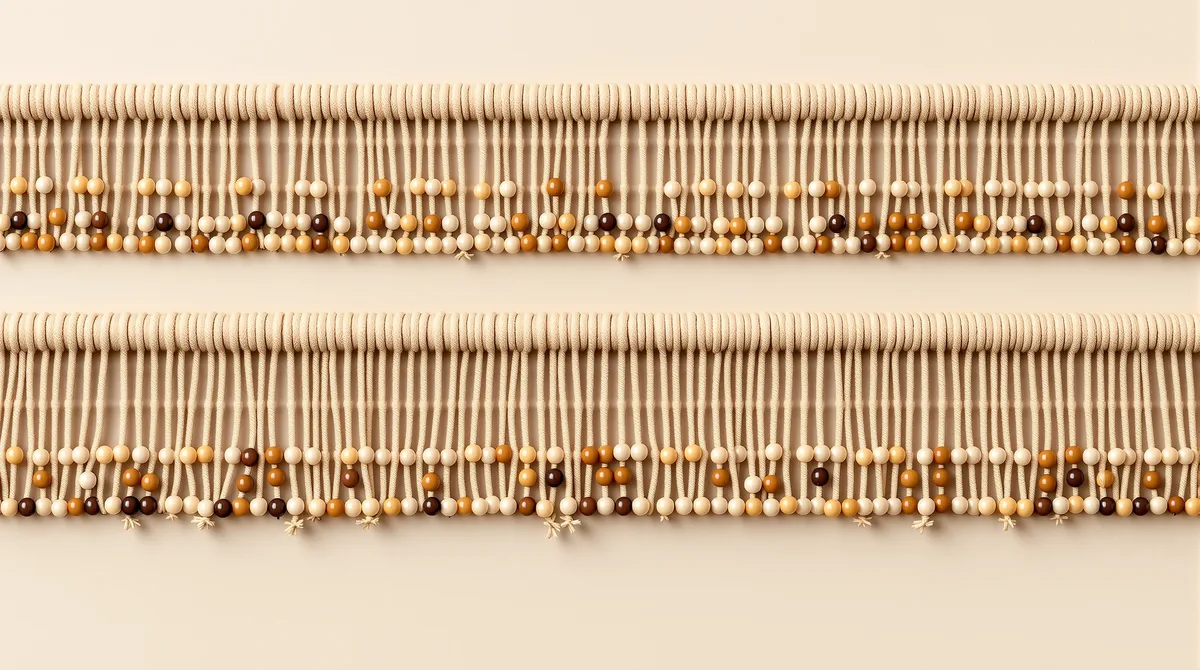
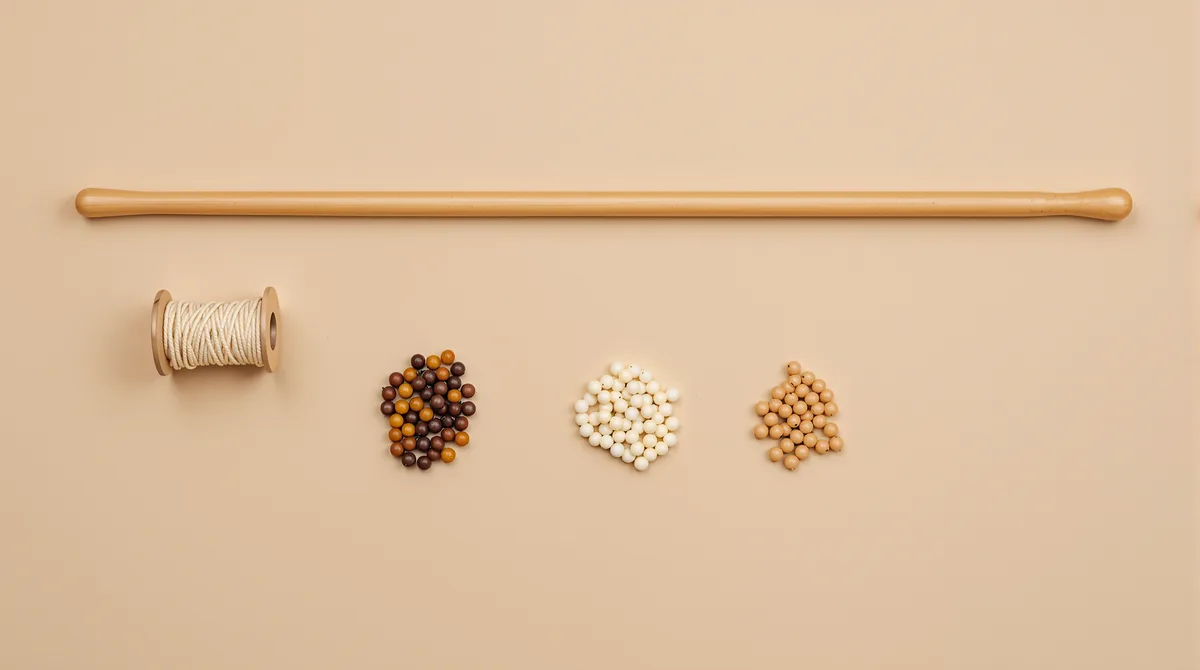
Beads, cord, dowel, end beads, header and fixings: the six components, what each one has to do, and which decision comes first.
Read the guide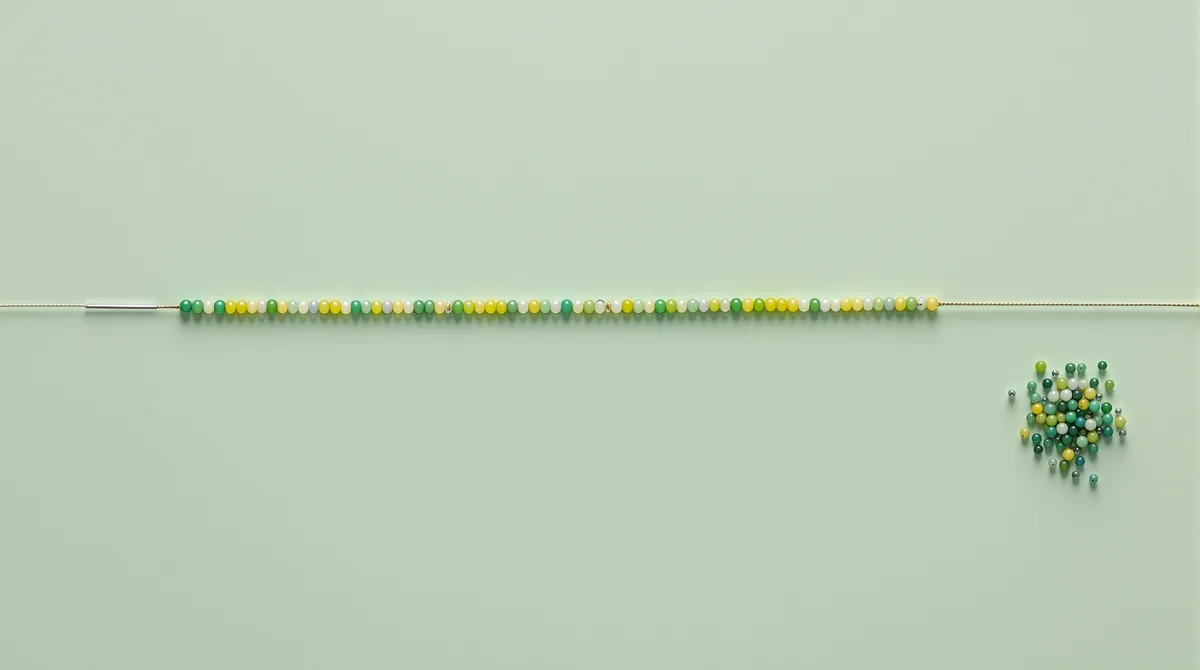
Guide · DIY
The stringing is the easy part. The parts people skip — the arithmetic and the bead order on paper — are the parts that decide whether it looks made or looks improvised.
A bead strand part-strung: round lime and forest-green glass beads threaded along a cord stretched across the frame, with a loose heap of the same beads waiting at the bare end.
Measure the opening, divide the width by your chosen strand pitch to get the strand count, write the bead order for one strand on paper, then string every strand to that sheet, knot each end, and fix the strands to a dowel at even spacing. The planning takes an hour. A 40-strand panel takes considerably longer than most people budget.

Four stages: arithmetic, a written bead order, stringing, and mounting. Three of the four are desk work.
The romance of the job is the threading, and the threading is the part that needs the least judgement. What decides whether the finished panel looks deliberate is the strand count, the evenness of the pitch, and whether every strand carries the same bead sequence. Get those right with cheap beads and it looks good. Get them wrong with expensive beads and it looks home-made.
The opening width and the drop you actually want, which includes a decision about the floor gap. A strand pitch, chosen rather than inherited. Enough beads — count, do not estimate. Cord. A dowel the width of the panel plus enough each side to sit in its fixings.
Then the thing that is not in any kit: a sheet of paper with the bead order for one strand written on it, bead by bead, from the top down.
Measure the opening width. Divide by your pitch to get the strand count. Round to a whole number and recalculate the pitch from it so the spacing comes out even.
Decide the drop, then subtract the floor gap. That is your strand length.
Write the bead order for one strand. If the panel is plain, that is one line. If it has a pattern, draw it on squared paper, one square per bead.
Cut the first cord generously longer than the strand length. Knot or crimp the bottom end, or use a stopper bead.
String to the sheet. Check the finished length against your jig, not against the previous strand.
Knot the top end, leaving a tail long enough to tie to the dowel.
Repeat. Count completed strands against your target rather than guessing.
Mark the dowel at your pitch, then tie each strand at its mark. Do not space by eye.
Width divided by pitch. That is it, and the only decision is the pitch itself.
For calibration against designed panels: our 2027 renders put 40 strands on a 90 cm panel, which is about a 2.25 cm pitch, and 60 strands on a 120 cm panel, which is about 2 cm. Below roughly 2 cm a panel starts to read as a solid surface; above roughly 3 cm it reads as a fringe and stops screening anything.
Valances are denser because they are short: render figures put 56 to 60 strands across 120 cm.
Because thirty strands built from memory are thirty slightly different strands, and the eye reads the difference as sloppiness even when it cannot name it.
A written bead-by-bead plan is exactly what we use in production, where it is the sheet that makes a pattern repeat identically across a run and keeps every strand the same length. It is also what makes a panel repairable: a strand that parts in two years can be rebuilt from the sheet rather than guessed at from its neighbours.
For a patterned panel, draw it on a grid, one square per bead. That is a bead map, and it is how a reference image becomes a buildable panel.
Waxed cotton cord is the forgiving choice: it knots reliably, holds a knot under load, and is easy to thread. Nylon-coated steel wire is the strong choice, will not knot usefully and must be crimped. Monofilament disappears visually and is the least tolerant of a knot.
Whatever you choose, both ends of every strand must be secured. The bottom end takes a knot, a crimp or a deliberately larger stopper bead; the top end ties to the dowel. An unsecured bottom end will empty the strand the first time somebody walks through it, which is the most demoralising failure available in this project.
Pitch by eye, strand length by comparison, and running out of beads.
Spacing strands by eye produces a panel that is slightly denser at one end, and once you see it you cannot stop seeing it. Measuring each new strand against the previous one accumulates error down the panel, which is why a jig at the finished length is worth the five minutes it takes to make. And bead quantities are consistently underestimated, because people think in strands rather than in beads.
Never hang it by the strands. Never tension a strand to make it straight. Never trim the hem on the day you hang it — new strands hold the shape of whatever they were coiled in and come out of it over a day or two.
And never skip securing a bottom end because you intend to come back to it. That strand is the one that empties.
Two hours of planning and arithmetic, then hours of stringing that scale directly with bead count rather than with panel size.
The number worth holding in your head is the bead count. A densely patterned 90 × 200 cm curtain can hold about 11,800 beads, and every one of them is placed by hand. A sparser panel at the same size runs nearer 3,100. That is a difference of a factor of nearly four in labour for an identical pair of dimensions, which is also why a quoted price tracks bead count rather than square metres.
Four things, and they are all about repeatability rather than skill.
The bead order is issued as a document, so a hundred panels agree with each other. Strand lengths are held to a jig, not to the previous strand. Beads are matched to a Pantone reference or a physical chip and confirmed on an approved sample before any production starts. And finished panels go through first-article and lot inspection at our quality control and packaging house at Greater Noida before they are packed with the strands held in order.
On the material side, the reach goes further back than a home build can: glass beads are drawn and hand-strung in our own glass works at Firozabad, dowels are turned in our own wood factory at Saharanpur, and acrylic beads are moulded and dyed to colour — to our own dies where a design needs a bead that does not exist, as on the moulded daisy connectors used in one café-curtain build.
When the panel is small, when the design is yours, or when the point is the making. A valance, a window panel or a 76 × 76 cm café format is a satisfying weekend. A patterned doorway panel is a different proposition, and the comparison is against a panel made to your drop, in your colours, in 40 to 60 days after sample approval.
The middle path that works: build the simple panel yourself, and reserve the patterned one for a build that has a bead map behind it.
Extractable data
| Format | Size | Strands | Pitch | Beads |
|---|---|---|---|---|
| Full-length door curtain | 90 × 200 cm to 120 × 210 cm | 40 to 60 | about 2.0 to 2.25 cm | about 3,100 to 5,600 |
| Densely patterned door curtain | 90 × 200 cm | — | — | about 11,800 |
| Spaced door curtain | 90 × 200 cm | 40 | about 2.25 cm | about 3,100 |
| Door portal | 76 × 140 cm | 27 to 40 | 2.0 to 2.8 cm | — |
| Valance | 120 × 30 to 40 cm | 56 to 60 | about 2.0 cm | about 900 to 2,000 |
| Café curtain | 76 × 76 cm | — | — | about 1,800 |
Good to know
Yes, in two ways. Glass is heavy, so a glass panel needs a stronger cord and a fixing chosen for the load rather than for convenience. And glass drill holes vary more than moulded ones, so buy beads with a stated hole size — a bead development we are running specifies a 4 to 5 mm hole, which tells you how much that dimension matters once a cord has to pass through hundreds of them.
It is possible and rarely sensible. The time is the problem: hand-stringing a doorway panel is hours of skilled repetitive work, and an uneven pitch or an inconsistent strand length shows immediately next to a manufactured panel on the same wall.
Re-string it rather than knotting the break. A knot mid-strand becomes the point the strand fails at later, and on a panel you have built yourself you have the bead order written down, so rebuilding one strand is twenty minutes rather than a crisis.
Budget a full weekend for a 40-strand doorway panel, and expect the arithmetic and the bead order to take the first two hours before a single bead is threaded. For scale: on average sixteen artisans contribute to every finished product we ship, each applying one craft discipline — stringing is only one of those.
Yes, and that is a genuine advantage of building it yourself: you know the bead order, so any strand can be stripped and rebuilt. Keep the sheet you wrote the bead order on. It is the only thing that makes the panel repairable in two years.
A tape, a beading needle if your cord is soft, fine scissors or flush cutters, crimps and a crimping plier if you use coated wire, and a dowel. A simple jig — two nails in a batten at the finished strand length — is the cheap trick that makes every strand come out the same length.
Only if you force it. The cord abrades against the drill hole of every bead it passes through, so a hole with a sharp or rough edge is worth rejecting. Waxed cotton cord is forgiving and knots well; monofilament is invisible and unforgiving; coated steel wire is strongest and has to be crimped rather than knotted.
Keep exploring
Guide
Beads, cord, dowel, end beads, header and fixings: the six components, what each one has to do, and which decision comes first.
Read the guideGuide
The real hours in a hand-strung panel, where a home build wins outright, and where the bead count makes it a bad idea.
Read the guideGuides
One guide per question that arrives often enough to be worth answering properly.
Read the guideGuide
How to strip a panel without losing the order, how to sort, and what the beads are realistically good for afterwards.
Specs and sizesGuide
The typical contents list, the two items usually left out, and how to check a kit holds enough beads for the panel it promises.
Read the guideGuide
Where it hangs, which material, how dense, how long, which hem, how it fixes — and why colour is the last decision, not the first.
Specs and sizes
Start a conversation
Send a reference, a colour chip or a sketch. Minimums are set per design and confirmed per quote; sampling is quoted separately and usually runs 16 to 20 days from an agreed brief.