Material
Cut and faceted glass
Faceting, refraction and weight — why the market says crystal, why a specification says glass, and where the premium is actually earned.
Compare the options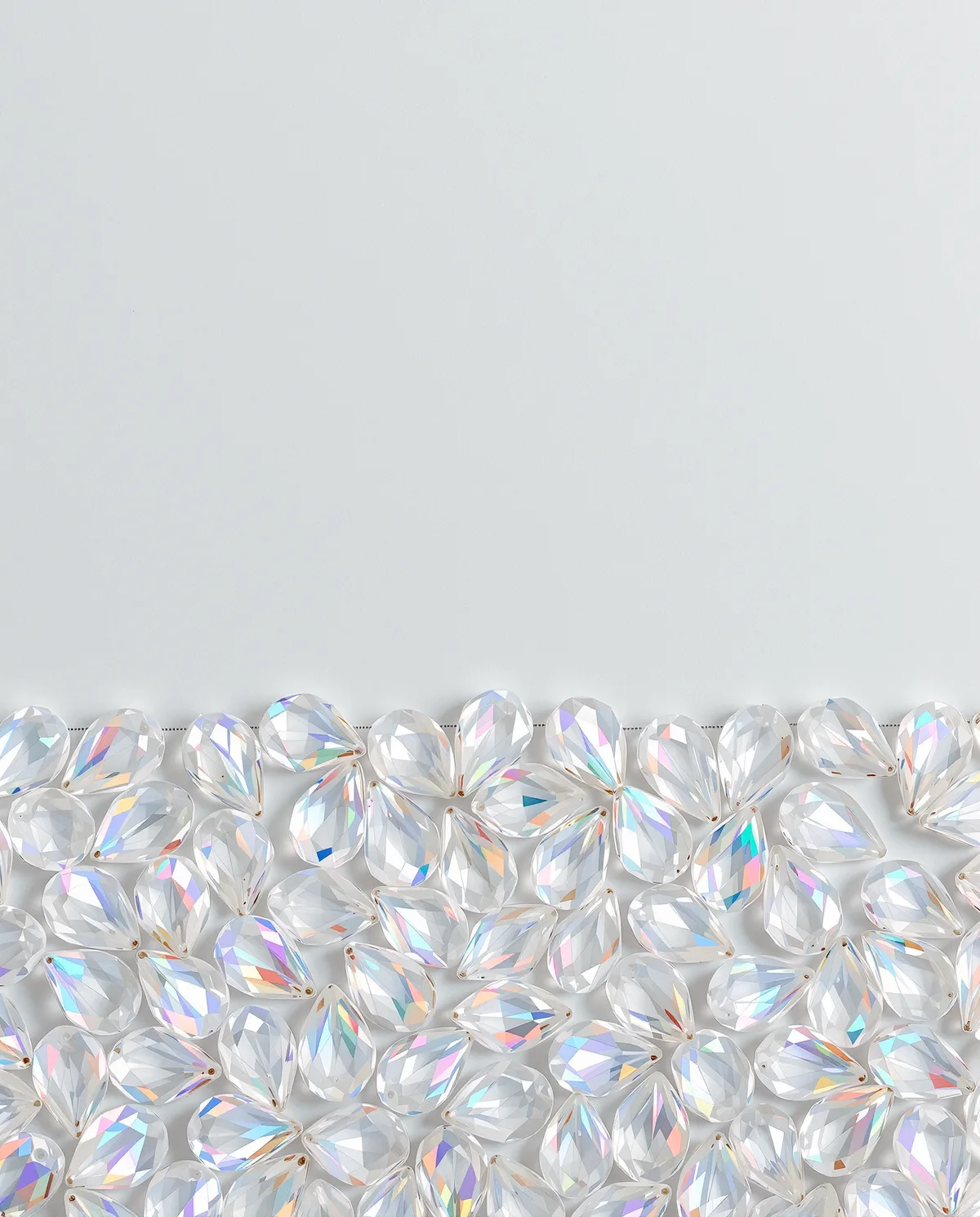
Guide · Comparison
This is a vocabulary question dressed as a material question. Resolve the word and the specification writes itself.
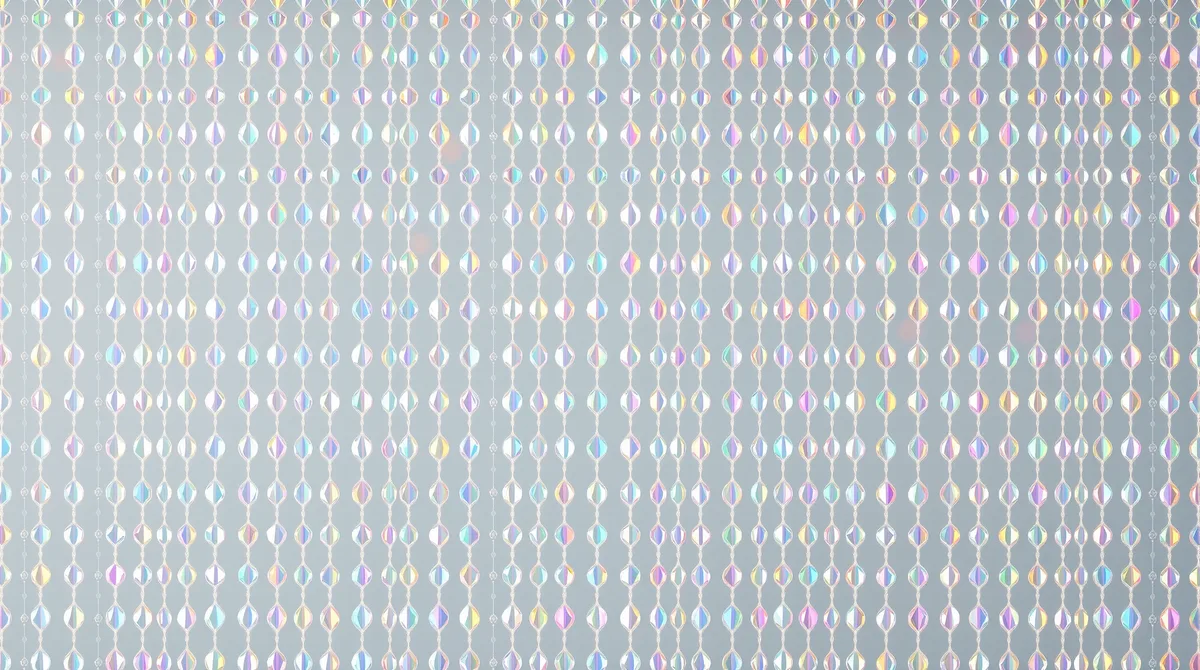
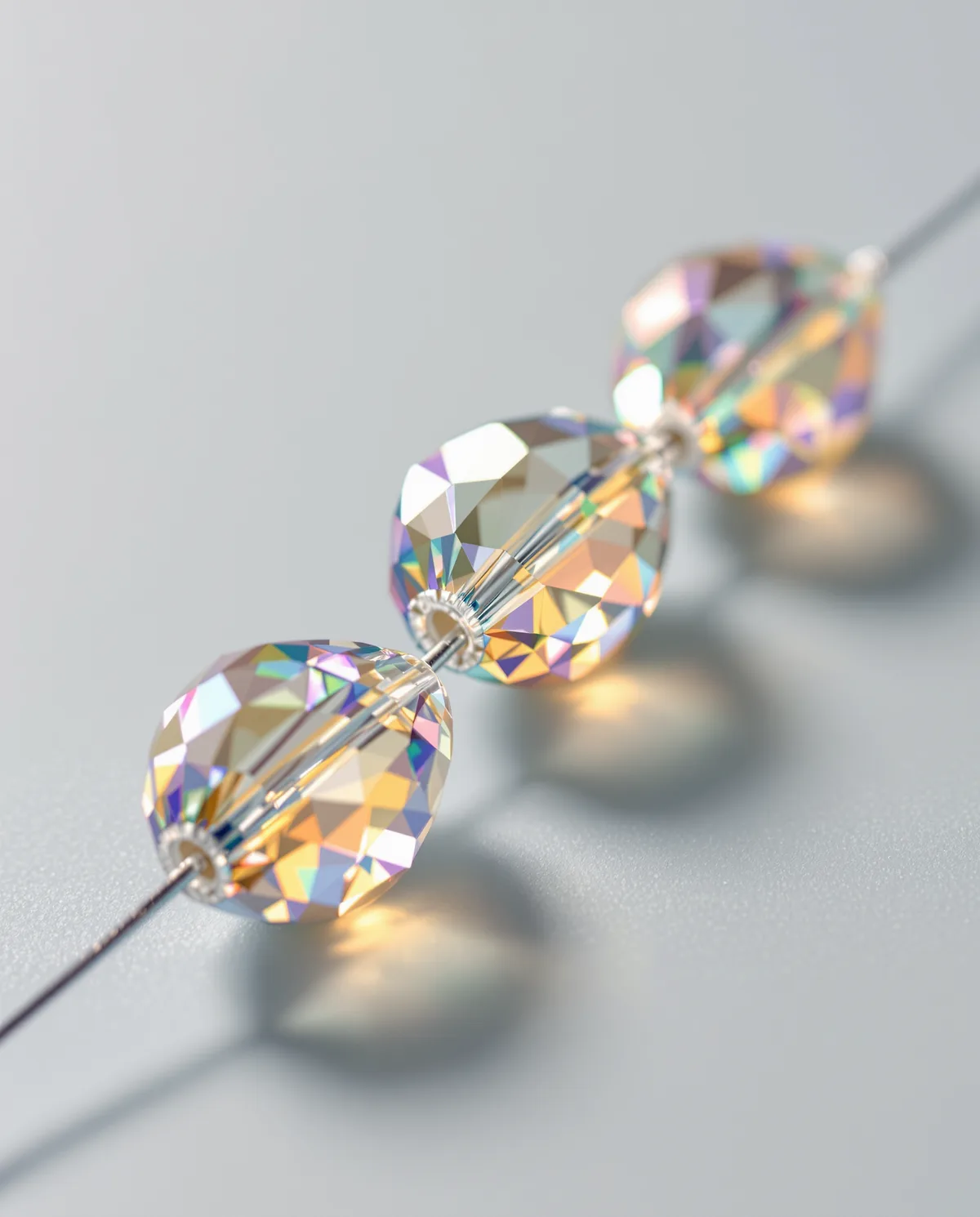
Faceted crystal teardrop beads with a pearlised iridescent AB finish, machine cut to even facets over a clean white glass body.
A crystal bead curtain is a glass bead curtain. In beaded décor, crystal is a customer-side word for cut or faceted glass, and we describe those beads as glass rather than crystal. The real distinction is not the material but the finish: a cut bead returns light in hard points, a plain bead returns it as a soft glow.
A crystal bead curtain is a glass bead curtain. In this category, crystal is a customer-side term, and what arrives is cut or faceted glass. We say glass, on every tech pack and in every quote, because the alternative is a buyer expecting a different material.
The decision worth making is between a cut surface and a smooth one. That changes how the panel behaves in light, what it costs, and how a chip shows.
Plain glass beads: soda-lime glass, drawn or pressed, smooth-surfaced. Seed beads run about one to three millimetres. Pressed shapes go up to about 13 × 22 mm for a dotted oval accent. Irregular frosted "sea glass" beads run four to five millimetres.
Cut or faceted glass beads: the same glass, with facets cut into the surface, usually finished with an iridescent or pearlised coating — the finish often listed as AB. A faceted iridescent teardrop is the archetype and it is the bead most people mean when they write "crystal".
Lead crystal is a genuinely different glass, with lead oxide added to raise the refractive index and soften the glass for cutting. It belongs to stemware and chandeliers. It is not what a decorative bead panel is built from, and nobody should specify a doorway in it.
| Specification | Cut or faceted glass ("crystal") | Plain glass |
|---|---|---|
| Material | Soda-lime glass | Soda-lime glass |
| Surface | Machine-cut facets, often with an iridescent or pearlised finish | Smooth round, oval, drop or irregular |
| Light behaviour | Hard points and rainbow flashes | Soft, even glow; colour reads cleanly |
| Typical formats we have made | Faceted iridescent teardrops; cut rounds as accents | Seed beads at 1–3 mm; dotted ovals at 13 × 22 mm; frosted sea-glass at 4–5 mm |
| Cost driver | The cutting operation, per bead | The glass and the stringing time |
| Chip behaviour | A cut edge is a stress point; chips show as a dulled facet | Chips show as a flat spot and are less visible |
| Colour method | Body colour plus a surface finish | Body colour, tint or surface dye |
Neither. They are the same glass at the same density — about 2.5 g/cm³ as a general material figure — so a faceted bead and a smooth bead of the same volume weigh the same, and a panel of either hangs with the same load on the fixing.
What changes is the apparent density. A faceted surface breaks up the silhouette, so a faceted panel reads lighter and busier than a smooth one of identical mass. If the brief wants a panel to look substantial, smooth rounds do more with the same weight.
Plain glass, where the colour is in the body of the glass. It is as permanent as the bead.
On a faceted bead the visible effect is usually two layers: a body colour or a clear glass, plus an iridescent finish over the top. The finish is a surface. It survives normal handling and dusting, and it is the component to ask about if the panel will sit in hard afternoon sun or be wiped frequently. Specify body colour where the colour has to be exact for years; treat the iridescence as the decorative layer it is.
Faceted glass costs more, and the extra is the cutting, charged per bead. Nothing else about the panel changes.
That makes it an unusually clean cost lever. On a design where the sparkle only matters at eye level, cutting the top third of each strand and leaving the rest smooth takes most of the extra cost out without changing what the room sees. The same logic applies to the four other levers that move a bead panel's price: bead size and material first, then strand count and tightness, then spacing, then the dowel and packing, then height.
The same, for the same bead volume, because freight follows weight and the material is identical.
The faceted panel earns more protective packing, because a dulled facet is visible and a scuff on a smooth bead is not. Strands are kept in order and cushioned so beads cannot knock against each other in transit, and the panel is packed to the carton and label specification given to us.
Both fail by chipping rather than by breaking, and the cord usually outlasts neither — it is the real service item on any strung panel.
The faceted bead is marginally the more fragile, because every cut edge is a stress concentration. It also shows damage more: one dulled facet catches the eye from across a room, where a flat spot on a smooth bead disappears into the pattern.
Glass strength is colour-dependent, which surprises people. Some colours knocking against others in a hanging panel will chip, and the fix is a furnace-process change, annealing the larger feature beads, and revising the palette so incompatible colours are not adjacent. That is a sampling conversation, not a warranty one.
Faceted glass: bridal, event and hospitality, where a panel is lit deliberately and seen at night. Anything sold on sparkle.
Plain glass: colour-led retail, anywhere the design is doing the work rather than the light, and any programme that has to repeat a colour exactly across several runs.
Both: premium home retail, where a faceted accent on a smooth ground is the most saleable version and the cheapest way to look expensive.
Yes, and the mixed version is usually the best-looking one. Faceted beads at intervals on a plain glass strand give the flash where the eye lands, and the smooth beads between them let the colour read instead of fragmenting it.
The construction is the same one we use for any scattered accent: large beads placed three or four to a strand, deliberately not aligned in a row across the panel, over a ground dyed to match. Random placement is specified on purpose — aligned accents read as a grid and the panel stops looking hand-made.
Write the finish into the brief and the word "crystal" stops mattering. "Cut faceted glass, iridescent finish, teardrop, 90 × 200 cm, thirty strands on a single wooden dowel" is a specification. "Crystal curtain" is a mood board.
If a brief arrives saying crystal, the first question back is whether the buyer wants facets or wants sparkle, because frosted sea-glass beads and a pearlised smooth round both deliver sparkle for less money than cutting does.
One of our live doorway portal designs is built on faceted iridescent teardrop beads with a pearlised finish — hand-strung on cord at 90 × 200 cm from a stained wooden header rail. The same base construction also runs in plain translucent acrylic and in wood-tone beads, which is the clearest evidence that the construction, not the bead finish, is what the format is.
On the plain side, a frosted sea-glass valance at 30 × 24 in uses irregular glass beads of about four to five millimetres strung with seed beads, thirty strands, with a scalloped arch hem running from a 24 in longest drop to a 10 in shortest. Neither panel is described to a buyer as crystal, and no buyer has ever asked us to change that.
Good to know
No. We use cut or faceted glass beads to give a crystal look, and we describe them as glass. Lead crystal is a real and different glass formulation, with lead oxide added to raise the refractive index, but it is not the material a decorative bead panel is built from.
Yes, and it is the better-looking answer most of the time. Faceted beads at intervals on a plain glass strand give you the flash without the whole drop paying for cutting, and the plain beads let the colour read. It is planned on the same bead map as any other mixed strand.
They are the same material at the same density, so freight is identical for the same bead volume. Where the cost differs is protection: a cut facet dulls visibly if it is abraded in transit, so a faceted panel earns more cushioning inside the carton.
Plain body-coloured glass. On a faceted bead the sparkle usually comes from an iridescent or pearlised finish applied after forming, and that is a surface rather than a body colour. For a window that takes direct sun all afternoon, specify body colour and treat the finish as decoration.
The faceted bead, marginally, and not by breaking. A cut edge is a stress point and a dulled facet is visible from across a room, where a chip on a smooth bead reads as a flat spot and disappears. Larger glass feature beads of either kind can be annealed for strength.
One of our live doorway portals is built on faceted iridescent teardrop beads with a pearlised finish, hand-strung on cord from a stained wooden header rail at 90 × 200 cm. The same base construction also runs in plain translucent acrylic and in glass.
Write the finish, not the word. "Cut faceted glass, iridescent finish" is a specification. "Crystal" is a mood, and it is the single most common cause of a sample arriving in the wrong material. If the brief came in saying crystal, confirm whether the buyer wants facets or simply wants sparkle.
Keep exploring
Material
Faceting, refraction and weight — why the market says crystal, why a specification says glass, and where the premium is actually earned.
Compare the optionsGuide
Cut or faceted glass, described plainly: the heaviest panel in the category and the only one that genuinely dazzles.
Open the referenceGuides
One guide per question that arrives often enough to be worth answering properly.
Open the referenceGuide
What a noren actually is, how it differs from strung beadwork, and which of the two a threshold brief needs.
Specs and sizesGuide
Light control against airflow and character, with the window cases where a bead panel is genuinely the better answer.
See the detail
Start a conversation
Send a reference, a colour chip or a sketch. Minimums are set per design and confirmed per quote; sampling is quoted separately and usually runs 16 to 20 days from an agreed brief.