Guide
Light and shade from beads
Breaking light rather than blocking it: what a bead panel does to daylight through the day, and which beads come closest to shade.
View the range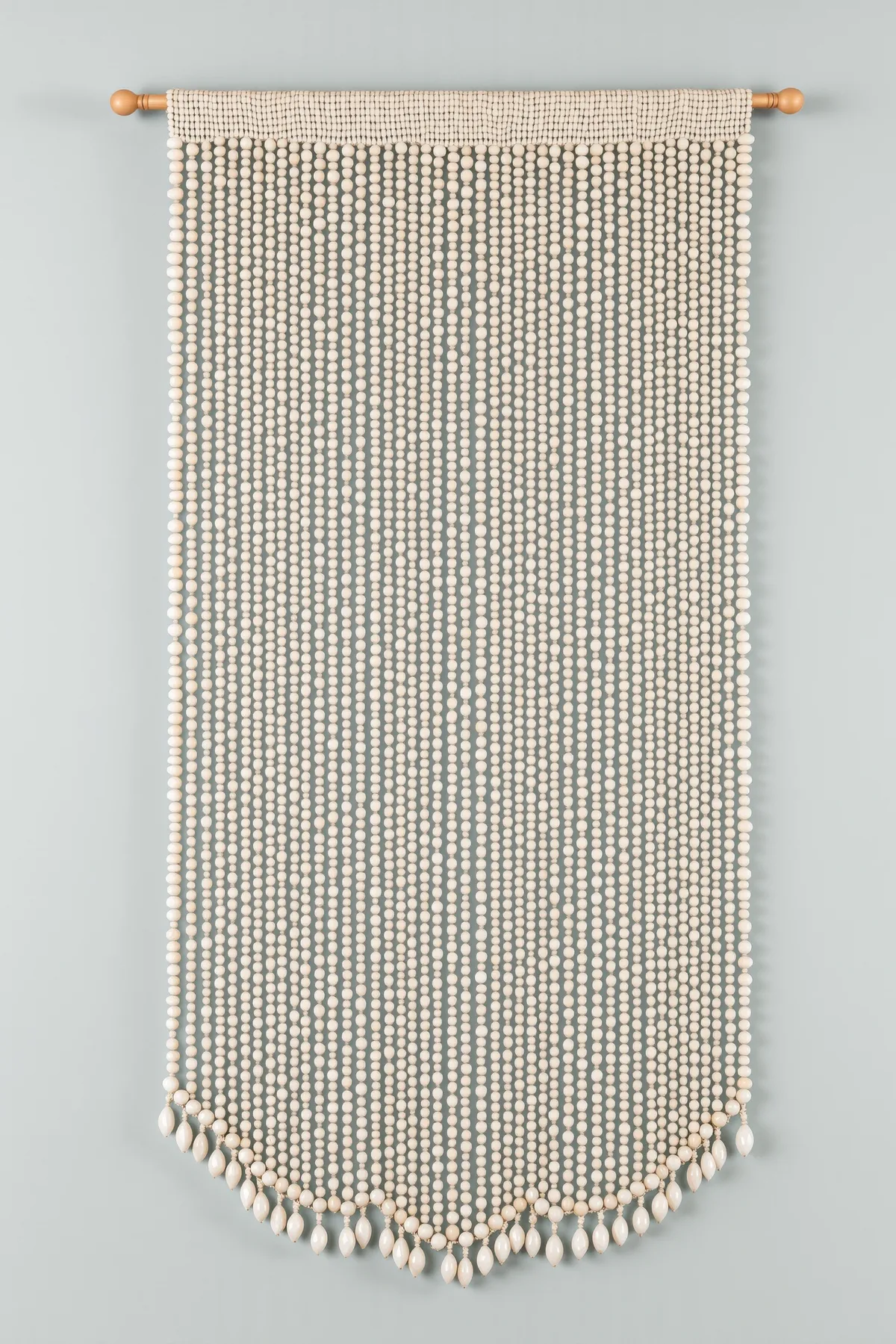
Guide · Comparison
A blind is a light-control device. A bead panel is not, and no bead specification will make it one. What a bead panel does instead is worth knowing precisely.
A beaded window panel: thirty strands of frosted sea-glass and seed beads on a turned dowel, falling to a scalloped arch hem ended with drop beads.
Choose a blind when the window needs its light controlled, dimmed or stopped — that is what a blind is engineered to do. Choose a bead panel when the window needs character and ventilation and the light is welcome: beads break a sightline, move in a draught and never have to be raised. A bead panel offers no dimming and no blackout.
A blind controls light. A bead panel does not, and nothing you can specify — bead size, density, opacity — will change that in any useful way.
Choose a blind if the room will ever need to be dimmed or darkened. Choose a bead panel if the light is welcome and what the window needs is character, a broken sightline and unimpeded ventilation. The two also layer, which is usually the answer for a kitchen or bathroom.
A blind is a mechanism. A roller blind is a sheet of fabric on a spring or chain barrel; a venetian is a stack of slats on a tilt cord; a cassette blind adds a blackout seal at the edges. All of them have an operating part, and all of them are designed to vary how much light reaches the room.
A bead panel at a window is the same construction as a doorway panel, scaled. Our window formats are typically thirty hand-strung strands on a single wooden dowel, a valance at roughly 120 × 30 to 40 cm, or a café panel at 24 × 30 in on a cotton header band with a three-inch rod pocket. There is no mechanism. The panel hangs and stays.
| Performance | Bead panel | Blind |
|---|---|---|
| Light control | None; light passes between and through the beads | Graduated, by slat angle or by raising |
| Blackout | Not achievable | Available with a blackout roller or cassette |
| Airflow | Unimpeded | Reduced when lowered; a roller blind blocks it |
| Operation | Static; nothing to raise or lower | Cord, chain, spring or motor |
| Exposed cord or chain | Strand cord only, finished individually at the hem | An operating cord or chain loop in most types |
| Formats we make | Window panel 30 strands on a dowel; valance about 120 × 30–40 cm; café 24 × 30 in | Not made here |
| Bead count, valance | About 900–2,000 | — |
| Cleaning | Dry dust downwards; damp cloth on the beads | Wipe slats; vacuum a fabric roller |
| Behaviour in a draught | Moves and chimes | Rattles, or is tied down |
Over a window, the comparison is closer than at a doorway, because a window panel is shorter than a door panel and therefore lighter. A valance at 30 to 40 cm deep is a genuinely light piece even in glass.
A blind concentrates its weight in a barrel at the head, which is why blinds are fixed with two brackets and nothing more. A bead panel spreads its weight along the dowel but puts it all on whatever carries the dowel — two cup hooks into the frame are enough for a valance; a full-length glass panel over a tall window is not a cup-hook job.
Where the panel hangs matters as much as its mass. Inside the reveal the fixing is into the frame or the reveal lining; across the face it is into the wall, and the fixing has to be chosen for the substrate.
The beads, provided they are body-coloured glass. Colour in glass is permanent, and a window is the hardest place in a house to keep a colour.
A fabric roller blind lives in direct sunlight for its entire service life and fades accordingly, usually unevenly where a pelmet or reveal shades part of it. Among beads the same caveat applies to surface-dyed seed beads, where the dye is a coating: specify body colour for a south-facing window and keep surface dye for interior positions.
A plain roller blind is cheaper than almost any bead panel, and there is no point pretending otherwise. A bead panel's cost is the bead count and the stringing hours: a valance holds roughly 900 to 2,000 beads, and a café panel at 76 × 76 cm about 1,800. Every one is placed by hand.
Where the comparison narrows is at the top of the blind market. A motorised cassette blackout blind in a specified fabric is not a cheap object, and against that a bead valance in glass is competitive — and will still be there in fifteen years, because it has nothing to break.
The levers that move a bead panel's price are, in order: bead size and material, strand count and tightness, strand spacing, the dowel and packing, then height. Height is the one that moves most on a window, because a window panel is mostly height.
The blind. It rolls.
A bead panel has a rigid header and strands that have to stay in order, so the carton is large for the finished piece and glass adds mass on top. The exception is the valance: at 30 to 40 cm deep it packs close to flat, which is one reason valance formats are the easiest window beadwork to land economically. On one of our own valance developments the height was cut from 30 inches to 26 to take beads and cost out of the piece, and the packing improved as a side effect.
The blind, and it fails at its mechanism. A spring that will not hold, a cord lock that slips, a chain that jumps the barrel — and when the mechanism goes the blind is usually replaced rather than repaired.
A bead panel has no mechanism to fail. It fails at a single cord, locally, and that strand is re-strung in bead-map order and re-knotted at the header. Spare beads specified with the order are what that repair runs on. The cord is the service item; the glass will outlive the room.
A blind: bedrooms, home offices with screens, hotel rooms, anywhere a guest will expect to control the light.
A bead panel: kitchen windows above a sink or a hob, bathroom windows that must stay ventilated, stairwell and landing windows nobody can reach to operate, café and salon frontages where the window is a display, and any window where the design brief is about how the light arrives rather than how much of it.
For a kitchen window above a sink: a bead valance at roughly 120 × 30 to 40 cm in body-coloured glass. It dresses the window, it never has to be reached over a tap, and it cannot be ruined by steam the way a fabric roller blind can.
For a bathroom: a café panel at 24 × 30 in on a cotton header with a three-inch rod pocket, in acrylic. Ventilation stays unimpeded, and acrylic does not care about humidity.
For a bedroom window: a blind, and beadwork somewhere else in the room. There is no bead specification that makes a bedroom dark, and specifying one anyway is how a good product acquires a bad reputation.
For a shopfront or a café window: a full window panel on thirty hand-strung strands and a single wooden dowel, in glass, hung across the face so the edges are covered and the panel reads from the street.
Not in one piece, but routinely on one window, and that layered arrangement is usually the right specification.
Put the blind in the reveal, where it can seal reasonably well, and the beadwork across the face — or put a bead valance above the reveal and let the blind work behind it. Order the bead panel to the dimension of whichever plane it occupies, and keep the blind's operating cord clear of the strands, because a cord that catches in beadwork is both a nuisance and a safety question.
Window-scale beadwork is a real and recurring part of what we make, not an offcut of the doorway range. Window panels on thirty hand-strung strands and a single wooden dowel; a frosted sea-glass valance at 30 × 24 in, strung from irregular glass beads of about four to five millimetres with seed beads between them, thirty strands, a scalloped arch hem from a 24-inch longest drop to a 10-inch shortest; café panels at 24 × 30 in with a cotton header and a three-inch rod pocket, finishing in a scalloped chevron hem.
What a bead panel cannot be specified against is a light-transmission or blackout figure. Those describe a continuous surface, and a strand curtain is not one — so a specification written around either is a blind specification, and the honest answer is to say so.
Good to know
A blind, in nearly every case, because it rolls or stacks into a compact carton. A bead panel is rigid at the header and the strands must stay in order and cushioned, so the carton is large relative to the piece. A short valance format is the exception and ships close to flat.
The bead panel, where the beads are body-coloured glass, because the colour is in the glass and sunlight cannot lift it. A fabric roller blind spends its whole life in direct sun and fades on a schedule. Surface-dyed beads are the exception and behave more like a textile.
A blind fails at its mechanism — the spring, the cord lock, the chain — and when that goes the whole blind is replaced. A bead panel has no mechanism; it fails at a single cord, and one strand is a repair rather than a write-off. Longevity favours the beads, light control does not.
Window formats are a real part of the programme. We have made window panels on thirty hand-strung strands on a single wooden dowel, a frosted sea-glass valance at 30 × 24 in with a scalloped arch hem running from a 24-inch longest drop to a 10-inch shortest, and café curtains at 24 × 30 in on a cotton header band with a three-inch rod pocket.
A blind if anyone will ever want the room darker. A bead panel if the brief is about how the window looks and how the air moves. If both are true, use both: a bead valance or café panel for character, with a roller blind behind it for the evenings.
They answer different questions. A bead panel asked to dim a bedroom will fail outright; a roller blind asked to dress a kitchen window without blocking the extract will also fail. The genuine advantage of beadwork at a window is that it needs no operation at all, which matters most where a blind is awkward to reach.
Keep exploring
Guide
Breaking light rather than blocking it: what a bead panel does to daylight through the day, and which beads come closest to shade.
View the rangeGuides
One guide per question that arrives often enough to be worth answering properly.
See the detailGuide
What a noren actually is, how it differs from strung beadwork, and which of the two a threshold brief needs.
See the detailGuide
The real hours in a hand-strung panel, where a home build wins outright, and where the bead count makes it a bad idea.
See the detailGuide
Round against tube: what the geometry changes about texture, direction, coverage and how fast thread wears.
See the detail
Start a conversation
Send a reference, a colour chip or a sketch. Minimums are set per design and confirmed per quote; sampling is quoted separately and usually runs 16 to 20 days from an agreed brief.