Pillar
Beaded drapes
Door curtains, portals, café lengths and valances: the standard sizes, the strand counts and the one question each format answers.
Specs and sizes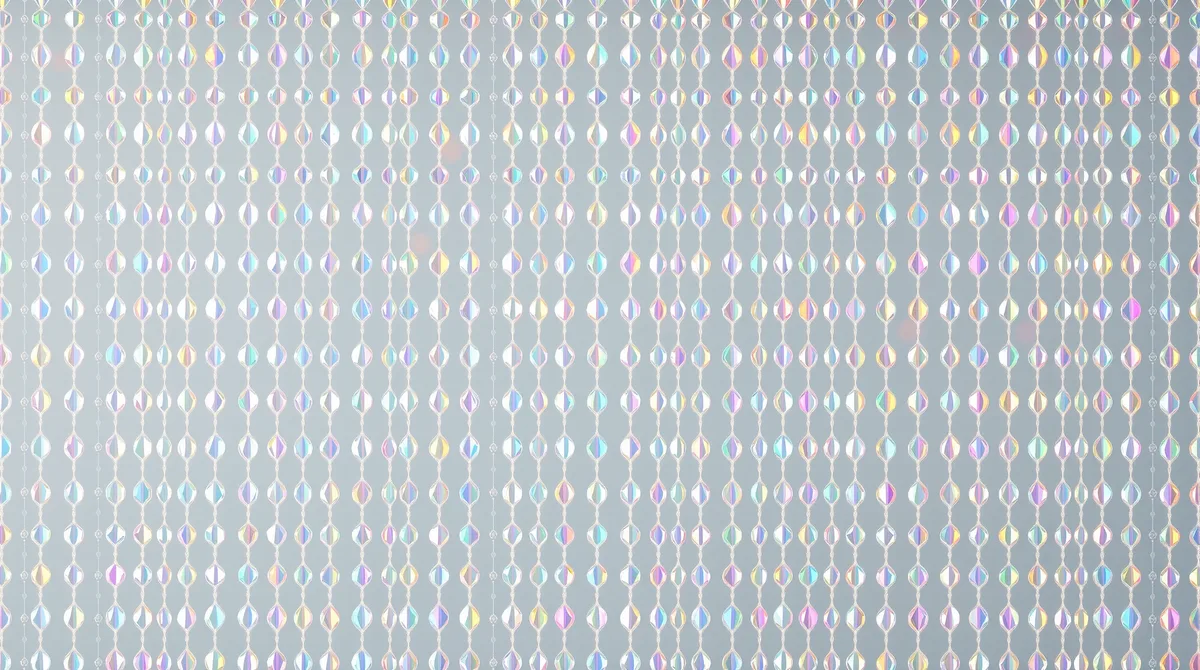
Guide · Material
Crystal is a customer's word, not a material. What you get is cut or faceted glass — and we would rather tell you that than let the word do work it has not earned.
A curtain of faceted iridescent teardrop crystal beads strung point downward, every cut facet catching a crisp highlight and throwing fine spectral colour.
A crystal beaded curtain is made of cut or faceted glass beads, and we describe them as glass rather than crystal. Faceting is what produces the dazzle: each cut face reflects separately, so a panel in direct light throws moving points across a room. It is the heaviest build in the category and needs a fixing specified for it.
A panel of cut or faceted glass beads. We describe them as glass, not as crystal, and the distinction is deliberate.
Crystal is a term customers use and we understand what it means when they do: they want the hard, bright, multi-point sparkle of a cut stone. That is what faceted glass delivers. What it is not is lead crystal, which is a specific glass composition, and we will not use a word that implies one when the bead does not meet it.
Everything else on this page is about what faceting actually does, which turns out to be more interesting than the naming question.
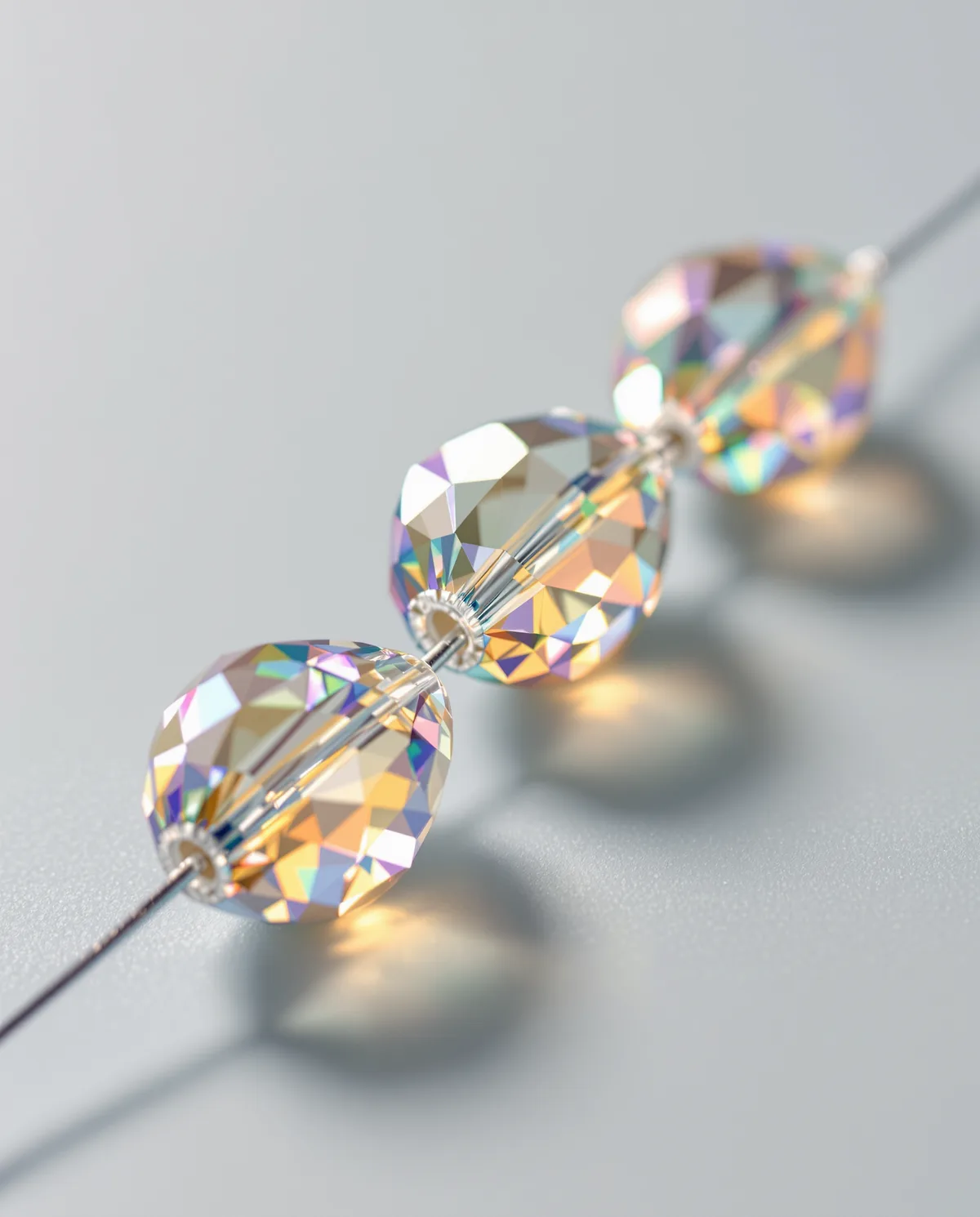
Faceting, and specifically the number of independent reflecting planes. A machine-cut bead has many flat faces meeting at sharp edges, and each face reflects light in its own direction.
Move the bead a millimetre, or move your head, and a completely different set of faces is catching the light. That rapid switching between bright and dark is what the eye reads as sparkle — it is a temporal effect, not a brightness one.
A smooth round bead cannot do it. Its surface is one continuous curve, so it gives one soft highlight that slides rather than flickers. This is why a faceted panel in a doorway is spectacular while someone walks through it and relatively quiet when nobody does.
It changes the character. A pearlised or AB finish spreads a rainbow sheen over the bead's surface, which softens the hard white glints into coloured ones.
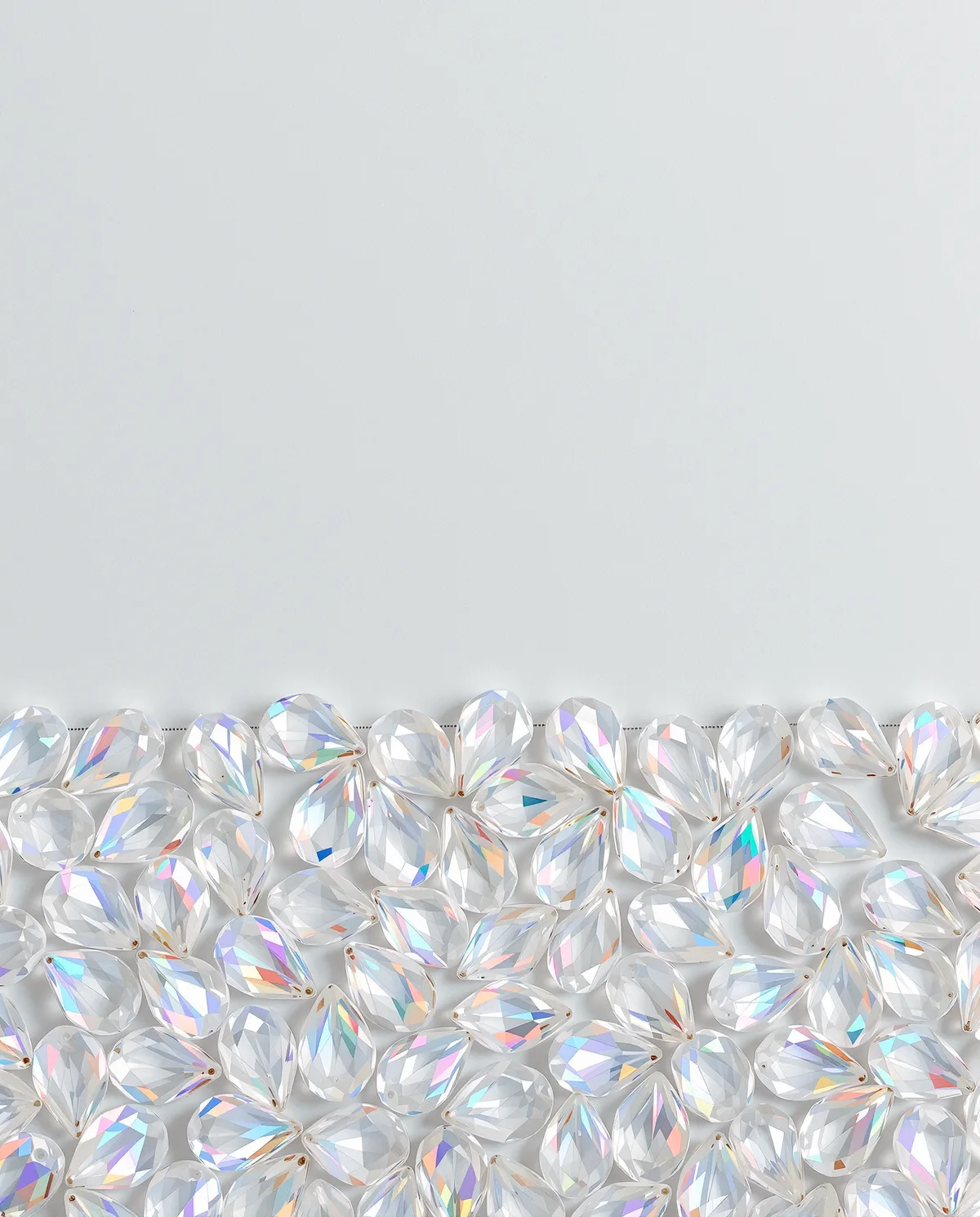
Our Chiara iridescent portal is built from faceted iridescent teardrop beads in a pearlised crystal finish on a clean white base, and the effect reads as shimmer rather than as dazzle. If you want the hard glitter, specify clear cut glass; if you want something softer and more atmospheric, specify the iridescent finish.
At the top of the category, for two compounding reasons. Glass is the densest common bead material — near 2.5 g/cm³, against acrylic at about 1.2 and most woods below 1. And faceted beads tend to be feature-sized rather than small, because faceting a tiny bead wastes the effect.
Practically, a full 90 × 200 cm panel in cut glass is the heaviest thing this cluster describes. It wants a rod on brackets fixed into the door frame or solid wall. A tension rod is not adequate, and the failure mode of a friction fixing under a heavy glass panel is sudden.
Where light will actually reach it. This is the real constraint on the material and it gets almost no attention.
Faceted glass needs a point source — direct sun, a raking window, a lamp or a spot. In flat overcast light a cut-glass panel reads as a grey, slightly dull object, because there is nothing for the facets to switch between.
The best positions are a doorway catching afternoon sun down a hallway, an opening facing a window, or a panel with a light placed deliberately to rake across it. The worst is an internal doorway with nothing but ambient light.
Doorways and openings with nothing behind the panel are ideal. The beads have room to move, nothing touches them, and the light has a path.
A closet is the worst possible location. Cut edges catch loops of knitwear, and a closet panel is in contact with hanging clothes all day. Specify smooth rounds, ovals or faux-capiz discs there and keep the faceted beads for an opening where nothing brushes past them.
A window works, with the caveat that a cut-glass bead backlit does something different from a cut-glass bead front-lit: backlighting fills the whole bead with light rather than glinting off single faces.
The brightest chime in the category. Glass against glass at point contact, with hard edges rather than curves meeting, gives a higher and more ringing note than a smooth round bead does.
In a hallway that is a genuine pleasure. Outside a bedroom door it is not, and it is worth deciding which you have before specifying it.
They can. Glass chips when knocked hard against glass, and a faceted bead concentrates an impact on an edge rather than spreading it round a curve, so cut beads are marginally more vulnerable than smooth ones.
In a doorway in daily use that is an occasional event rather than a constant one. The important point is that it is repairable: a damaged or parted strand is re-strung onto new cord in bead-map order and re-knotted at the header, which is why spare beads are worth specifying with the order and worth keeping once they arrive.
Dust dry first, drawing a soft brush down each strand from the header to the hem. Then, if needed, a barely damp cloth on the beads, dried in the same pass.
Cut glass is the most tolerant surface in the category — body-coloured glass is close to indestructible in domestic use — but the cord is not, so keep water out of it. No solvents, no abrasive cream, and nothing hot. An iridescent or pearlised surface finish is more delicate than the glass under it and should be wiped gently rather than rubbed.
Glass bead curtains is the parent material page and the better starting point if the sparkle is negotiable. A plastic bead curtain is the comparison people are usually making without saying so, and faux pearl beads is the other coated-finish option. Panel weight matters because cut glass is the heaviest build in the category. A closet bead curtain is the one opening to keep faceted beads away from. For light, light and beadwork explains why a cut bead needs a point source to do anything at all.
Three more pages are worth reading. Mixing bead materials is how most cut-glass designs are actually built, with faceted beads placed only where the light falls. Tangled strands matters because a heavy faceted strand settles fast and is among the better-behaved builds. And routine care sets out the lighter hand an iridescent surface finish needs.
Good to know
No. We use cut or faceted glass beads to give a crystal look, and we describe them as glass. Lead crystal is a specific glass composition and we do not claim it. Saying so matters, because the word crystal carries implications about composition that a faceted glass bead does not meet.
Faceting. A machine-cut bead has many flat faces meeting at crisp edges, and each face reflects independently, so a tiny movement of the bead or the viewer swaps which faces are catching the light. That rapid switching is what the eye reads as sparkle. A round bead with a smooth surface cannot do it.
It changes the effect rather than increasing it. A pearlised or AB finish spreads a rainbow sheen across the surface, which softens the hard white glints into colour. Our Chiara iridescent portal uses faceted iridescent teardrop beads in a pearlised finish, and it reads as shimmer rather than as dazzle.
At the top of the category. Glass sits near 2.5 g/cm³ against acrylic at about 1.2, and faceted beads tend to be larger feature beads rather than small ones. A full 90 by 200 cm panel in cut glass wants a rod on brackets fixed into the frame or solid wall, not a tension rod.
Much less well, and this is the caveat. Faceted glass needs a point source — direct sun, a raking window, a lamp — to do anything. In flat overcast light a cut-glass panel reads as a grey, rather dull object. Place it where light will actually hit it.
It is the worst bead in the category for a closet. Cut edges catch loops of knitwear, and a closet panel is in constant contact with hanging clothes. Specify smooth rounds, ovals or discs for closets and keep the faceted beads for an opening with nothing behind them.
Glass can chip if knocked hard against glass, and a faceted bead concentrates any impact on an edge rather than spreading it over a curve. In a doorway in daily use that is a real if infrequent event. The panel is repairable — a parted or damaged strand is re-strung — which is why spare beads in the panel colours are worth putting on the order.
Keep exploring
Pillar
Door curtains, portals, café lengths and valances: the standard sizes, the strand counts and the one question each format answers.
Specs and sizesGuide
Flat translucent discs in linked columns: a different construction, a different sound, and an engineered imitation of shell rather than shell.
Specs and sizesGuide
Acrylic or PVC: the distinction that decides colour depth, smell, chemical compliance and lifespan.
Specs and sizesGuide
The heaviest panel and the only one that refracts: weight, chime, a straight hang, and the chipping risk that comes with them.
Compare the optionsMaterial
Faceting, refraction and weight — why the market says crystal, why a specification says glass, and where the premium is actually earned.
See the detailGuide
What the trade means by crystal, how cutting changes a bead, and which of the two a brief actually needs.
See the detail
Start a conversation
Send a reference, a colour chip or a sketch. Minimums are set per design and confirmed per quote; sampling is quoted separately and usually runs 16 to 20 days from an agreed brief.