Guide
Re-stringing a broken strand
Release the old strand at the header, rebuild the bead sequence from the count sheet or a sibling strand, and knot it back true to length.
See the detail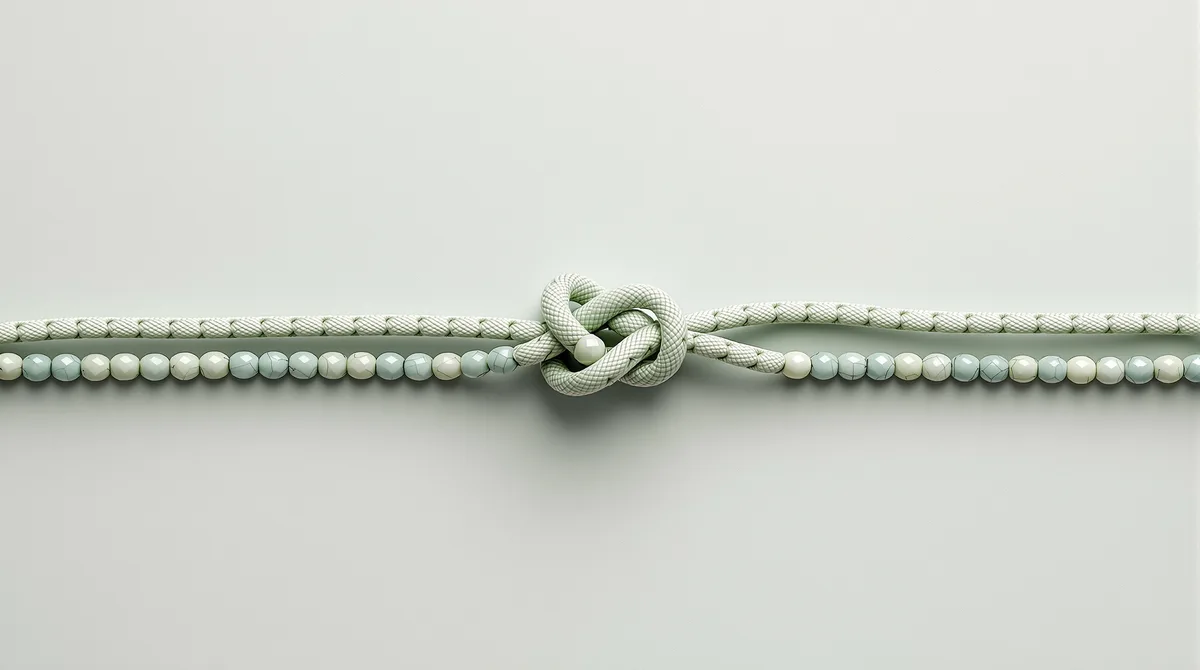
Guide · Repair
A bead panel is a set of independent strands, which means it is the rare decorative object that fails one replaceable unit at a time. Almost nothing about it is a write-off.
Two lengths of bead strand laid end to end and joined at the centre by a single square knot tied in the braided stringing cord.
Diagnose first: a panel fails at the cord, at a header knot, at a bead or at the dowel, and each has a different fix. A parted strand is re-strung in its original bead order and re-knotted at the header. A slipped knot is re-tied. A chipped bead is swapped from the spares, if spares were specified with the order. Replacing the panel is almost never the answer.
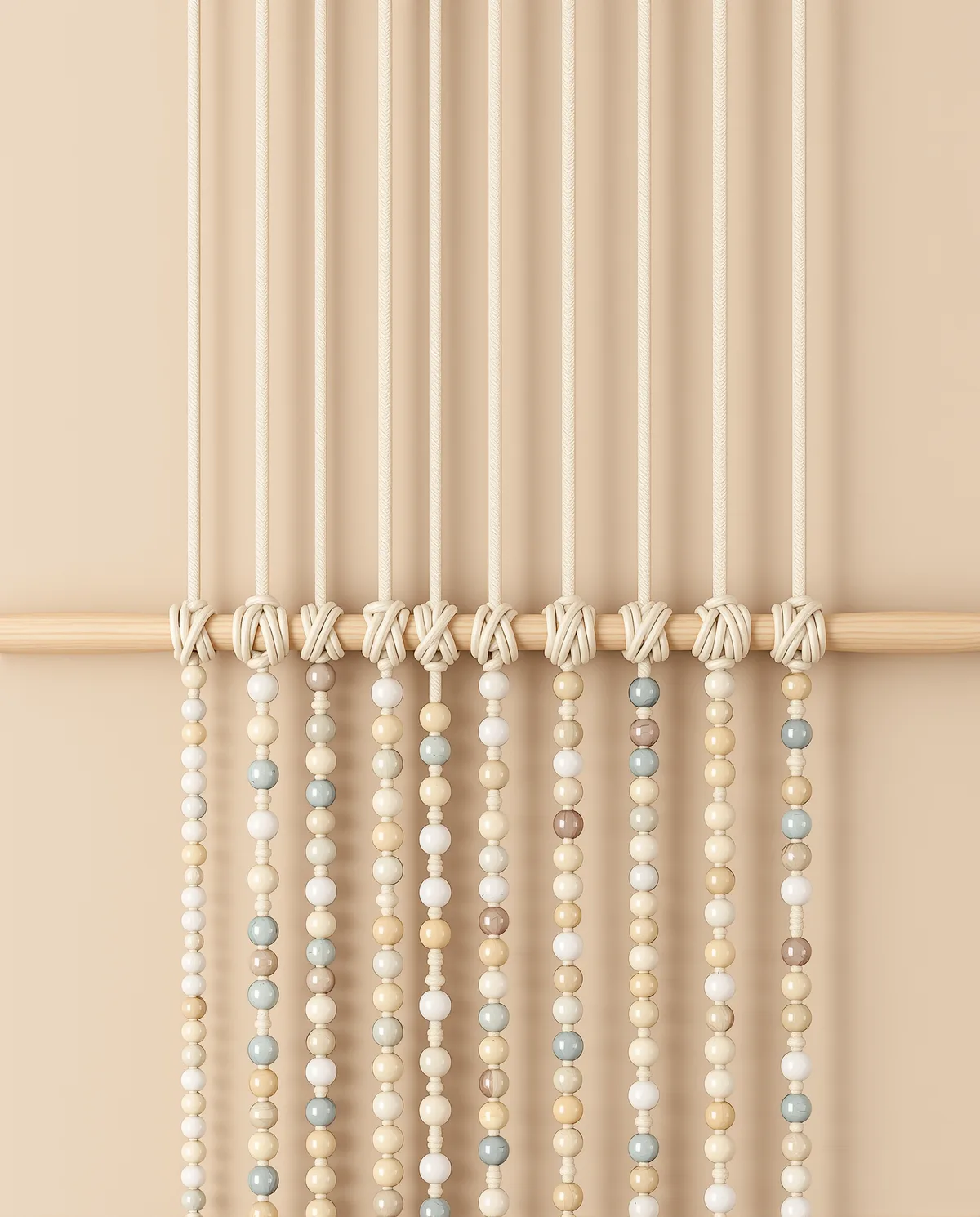
Diagnosis, then one of five small jobs. The diagnosis is the part that gets skipped and the part that decides whether the repair holds.
A strung panel has exactly four things that can fail: the cord, the knot at the header, a bead, and the dowel the whole thing hangs from. They look similar from a few paces away — a strand out of line, a gap, beads on the floor — and they need completely different work. Work out which one it is before you touch anything.
The spare beads for that panel, if spares were specified on the order. A straight-on photograph of the damage and of the strands either side of it, taken before anything is released. Good light. A tray.
And a short assessment: is this one strand, or is this a cause? One parted strand after four years is wear. Three parted strands in a month is a vacuum cleaner, a leak, or a fixing that has already dropped the panel once.
Photograph the damage, straight on, with the panel hanging.
Identify the failure: cord, knot, bead or dowel.
If it is the knot, release it and re-tie it at the dowel. Done.
If it is a bead, work out whether it can be swapped in place or whether the strand has to be opened. A bead at the bottom is reachable; a bead in the middle usually is not.
If it is the cord, release the strand at the header, lay it flat in order, and photograph it again. That photograph is now your bead order.
Rebuild the strand onto new cord in that order, to the same finished length as its neighbours.
Re-knot it at the header at the same pitch as the strands either side, and re-secure the bottom end.
Hang, settle for a day, then compare against the neighbouring strands.
A parted cord leaves beads on the floor and a strand that is suddenly short. A slipped header knot leaves a full-length strand hanging low or lying on the floor intact — that is the good news case, because nothing has to be rebuilt.
An empty strand still at full length means the end stopper has gone, and the beads went out of the bottom. A chipped bead usually catches the light differently before it catches the eye. A rolling or bowed dowel shows as a whole panel that has twisted or sagged in the middle rather than as a single strand problem.
Spare beads, kept in a labelled bag, dry, with the panel they belong to named on the label. A short length of the stringing medium if you have it. The original end stoppers if the panel used a specific bead rather than a knot.
Spares are not automatic, and that is the part worth knowing at order stage rather than after the damage. They are a packing-specification item agreed per order: ask for spare beads by colour on the packing specification, and a replacement strand and spare beads can be built into the production run and packed with the goods. Once they arrive, keeping them is the whole discipline. Matching a bead later is the hard part of every repair on this page, and matching a surface-dyed bead to a run you no longer have is sometimes not possible at all.
Three options. Swap to another stocked colour of the same bead, which works where the panel is multicoloured and reads as part of the mix. Move an existing bead from a less visible strand at the edge and put the mismatch there instead. Or send us a photograph of the strand and the header — the construction of anything we have built is documented, so identifying the bead is usually possible even years later.
What does not work is a visually similar bead of a different diameter. Diameter changes the strand length and the drape, and it shows at the hem rather than where you put it.
Acrylic is the most repairable material in the category: moulded and dyed to a colour reference, so a match is a specification rather than a search, and it does not shatter in the first place.
Wood hides repairs best, because natural grain variation means a replacement bead was never going to be identical anyway. Glass is the least forgiving: body colour is set in the glass, specialty beads come from specific runs, and larger hand-made beads are colour-graded for strength. Faux capiz discs match well on colour and have to match exactly on diameter.
Never pull a trapped strand free. Never knot a broken cord mid-strand and call it fixed — that knot becomes the next failure, carrying everything below it. Never use adhesive to hold a bead on a strand. Never take the panel down and work on it in a heap on the floor, because you will lose both the bead order and several beads.
And never immerse a panel to clean it before repairing it. Wet cord is the fastest route from one failed strand to several.
When the cord has gone brittle across the whole panel rather than at one point, which happens after prolonged damp or strong sun on the cord itself rather than on the beads. At that stage every strand is a future failure, and re-stringing all of them is rebuilding the panel.
That is the real distinction. A panel with a parted strand is damaged. A panel whose cord has failed as a material is finished, and the beads are then worth salvaging as a bead supply rather than as a panel.
A knot is five minutes. A bead is ten. A strand is half an hour to an hour, because on a full-length panel a single strand can carry a few hundred beads.
Set that against what the panel is. A densely patterned 90 × 200 cm curtain holds about 11,800 beads, every one placed by hand, and on average sixteen artisans contribute to each finished product we ship. An hour of re-stringing against that is the clearest value proposition in the category.
We would rather re-string a strand on site than replace a piece, and on a contract installation that is the stated preference. The reason is documentation: the bead order for anything we have built exists as a record, so a strand can be rebuilt exactly rather than approximated.
That is also why spare beads are worth putting on the packing specification in the first place. They are not a courtesy that turns up by itself — they are the repair kit for a product whose failure mode is known in advance, and asking for them at order stage is what gets them from the same run and the same dye lot as the panel.
The published position is that a broken strand is a repair rather than a write-off, and that spare beads should be specified with the order for precisely that purpose. Every beaded door curtain is made to order, with no retail stock programme behind it, which is exactly why repair matters more here than in a category where a replacement is on a shelf.
Service life is a construction question rather than a catalogue figure: the beads outlast the room, and the cord is the service item.
Extractable data
| What failed | How it shows | Fix | Difficulty | Parts needed |
|---|---|---|---|---|
| Cord, mid-strand | Beads on the floor; strand short | Re-string the strand in bead order | Moderate | Cord, the original beads |
| Header knot | One strand hangs low or has fallen | Release and re-tie at the dowel | Easy | None |
| End stopper | Strand empties from the bottom | Re-knot, crimp or refit a stopper bead | Easy | A crimp or stopper bead |
| A single bead | Chip, crack or a missing bead | Swap from the spares | Easy | One matching bead |
| Dowel or header rail | Split, bowed or rolling in its seat | Change the dowel, re-tie the strands | Moderate | A dowel of the same diameter |
| Service life | — | Cord is the service item | — | The beads outlast the room; the cord is re-strung |
Good to know
Not if you work at the header and support the strand you are handling. The cord fails from water, from abrasion against a drill hole under load, and from being pulled against a knot. Untying a knot is none of those. Yanking a strand to free it is all three at once.
The method is identical; the care is not. Glass strands are heavy, and glass strength is colour-dependent, so large feature beads in some colours chip where they knock against beads of another colour. Support released glass strands rather than letting them swing, and lay them flat instead of coiling them.
A slipped header knot or a chipped bead, yes, and both are worth being able to do. A re-strung strand is more than a shop-floor job unless you hold the beads for that design. Photograph the damage either way, because that is what any conversation about the panel will need.
Repair them one at a time, hanging the panel between each, so the strands that are still correct remain your reference. Several parted strands at once usually means a single cause — water, a vacuum nozzle, or a fixing that dropped the panel — and the cause is worth finding before the repairs.
A re-tied header knot is five minutes. A swapped bead is ten. A fully re-strung strand is thirty to sixty minutes depending on the bead count, which on a full-length panel can be a few hundred beads for that one strand alone.
If you keep the beads, yes. A strand rebuilt in its original order from its original beads is the panel as made. The irreversible version is a replacement bead from a later dye lot in a plain field, where a near-match reads as a mark rather than as a bead.
Fine scissors or flush cutters, a beading needle for soft cord, a crimping plier if the panel is built on coated wire, good light and a tray that stops beads rolling off the table. The tray is the one people regret skipping.
Keep exploring
Guide
Release the old strand at the header, rebuild the bead sequence from the count sheet or a sibling strand, and knot it back true to length.
See the detailSpecification
Spare beads by colour, pre-made replacement strands, the cord spec, and who re-strings a strand on site.
See the detailGuides
One guide per question that arrives often enough to be worth answering properly.
Compare the optionsGuide
Replacing one bead mid-strand without dismantling it, and the options when no matching bead is left.
Read the guideGuide
How strands transfer in order, why loop diameter decides the replacement, and when a rail beats a round dowel.
See the detailGuide
Work with the panel hanging, separate in small groups, never pull against a knot, and support the weight as each strand comes free.
Read the guide
Start a conversation
Send a reference, a colour chip or a sketch. Minimums are set per design and confirmed per quote; sampling is quoted separately and usually runs 16 to 20 days from an agreed brief.