Guide
Fixing a damaged panel
Identify what failed, re-string that strand, re-knot it at the header, and match the bead from the spares specified with the order.
Compare the options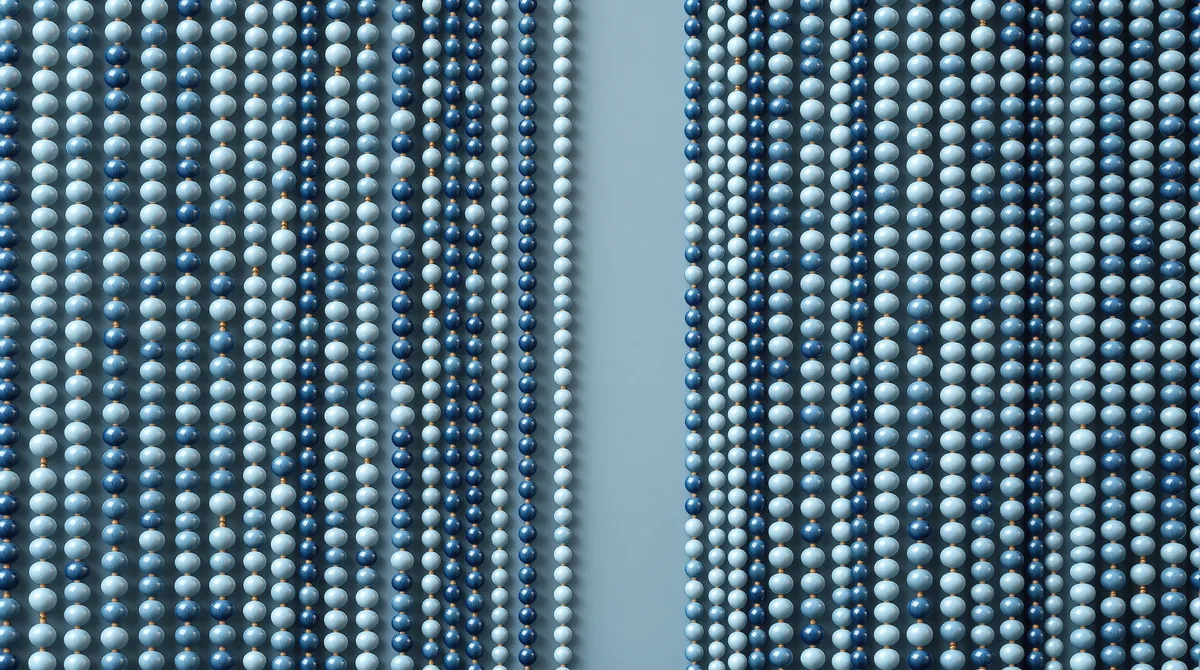
Guide · Repair
One strand, rebuilt in order, to the same length as its neighbours. The method is simple; the discipline is in recording the bead order before you destroy it.
A dense hand-strung panel in lapis and pale sky with one cord missing from its pitch, leaving a clear gap down the full drop.
Release the broken strand at the header, lay it out and photograph it so the bead order is recorded, then rebuild that order onto fresh medium and finish the bottom end as the original was finished. Knot it back at the header at the same pitch and the same finished length as the strands either side, then let the panel settle for a day.

Four things: record the order, release the strand, rebuild it, knot it back. The only difficult one is the first, and it is difficult only because it is tempting to skip.
A strand is a sequence. On a plain panel that sequence is one bead repeated, and the job is mechanical. On a mapped panel the sequence is specific to that strand's position across the width, and once the old strand is dismantled the sequence exists nowhere except in whatever record you made.
The loose beads from the broken strand, collected before anything else. A photograph of the strand in place, and of the strands either side of it. Fresh stringing medium of the same type. And the spare beads, if spares were specified with the order.
And a jig: two nails in a batten at the finished length. Measuring the new strand against the old one does not work, because the old one is short by however many beads hit the floor.
Collect every loose bead. Bag them.
Photograph the broken strand hanging, and its two neighbours, straight on.
Release the broken strand at the header, supporting its weight.
Lay it out flat, in order, on a tray. Photograph it again. This is now the bead order.
Measure a neighbouring strand's finished length and set your jig to it.
Cut fresh medium generously long. Finish the bottom end first — knot, crimp or stopper bead, matching the original.
Thread the sequence from the bottom up, checking against the photograph.
Check against the jig. Adjust by one bead if needed.
Knot it to the header at the same pitch as its neighbours.
Hang, settle a day, then compare.
Three places to get it, in order of reliability. The old strand itself, laid out and photographed — best, because it is literally the answer. A sibling strand, if the panel's pattern repeats across the width and you can identify which strand carries the same sequence. Or the production record: the bead-by-bead sheet behind anything we have built exists as a document, which is what makes a strand rebuildable years later rather than approximable.
That sheet is the central concept of the whole craft. It is what makes a pattern repeat exactly across a production run and keeps strand lengths identical, and it is why a hand-strung panel is a reproducible object rather than a one-off.
Look at the bottom end of an intact strand. A knot in matte, slightly fuzzy cord means waxed cotton. A flattened metal sleeve means a crimp on nylon-coated steel wire. A clear, stiff, nearly invisible medium with a knot and a stopper bead means monofilament.
Match the type, not just the diameter. Cord and coated wire have different stiffness, so a wire strand in a cord panel hangs noticeably straighter than its neighbours, which reads as a fault even though nothing is wrong.
From the neighbours, with a jig, and then from the hem by eye after settling.
A new strand is slightly shorter than it will be in a fortnight, because fresh medium takes up a little under load. Err one bead long rather than one bead short: a strand a bead long settles into line, and a strand a bead short shows as a step in the hem for the rest of the panel's life.
On a shaped hem, the target is not the nearest strand but the shape. Work out the intended length from the strands either side of the gap and interpolate.
The same way the original was. Waxed cord takes a tight double knot, trimmed close, and the knot must be larger than the drill hole of the last bead or the bead will ride over it. Coated wire takes a crimp, flattened properly with a crimping plier rather than squeezed with pliers. Monofilament takes a double knot and a stopper bead, because knots in monofilament creep.
Some builds use a deliberately larger last bead as the finish rather than a knot. If the panel is built that way, keep that bead — it is the end finish, not a decoration.
Dismantling before photographing. Measuring against the broken strand. Finishing the bottom end last, so beads come off while you are still threading. And forcing a needle through a bead whose drill hole is rough, which starts the next failure at the same point.
The fifth: re-knotting the strand at the header too tight, so it sits higher than its neighbours. The header knot sets the strand's starting height as well as holding it.
Never knot a broken cord mid-strand and rehang it. That knot carries everything below it and becomes the next failure, at a point where it is visible. Never glue a bead. Never substitute a bead of a different diameter — diameter changes strand length and shows at the hem, not where you put it.
And never work on a strand that is still attached at the header. Release it first; working on a loaded strand is how a second one breaks.
Acrylic is the most repairable: moulded and dyed to a colour reference, so a match is a specification rather than a hunt, and the beads do not shatter in the first place. Wood is forgiving on colour because grain varies naturally. Faux capiz matches well on colour and must match exactly on disc diameter.
Glass is the hardest. Body colour is set in the glass, and large hand-made beads are strength-graded by colour because some colours chip against others in a hanging panel — on one Venetian-glass portal the furnace process was changed, the beads annealed and the palette revised specifically so incompatible colours were not knocking together. A replacement bead has to respect that, not just the colour.
Half an hour to an hour per strand. Almost always worth it, because the alternative is replacing a panel carrying several thousand hand-placed beads, on which on average sixteen artisans contributed a craft discipline each.
The exception is a panel whose cord has gone brittle across its whole width rather than at one point. At that stage every strand is a future repair, and re-stringing all of them is rebuilding the panel.
Works from the sheet rather than from the strand. In production, strand lengths are held to the bead-by-bead plan rather than compared to each other, which is why thirty strands come out identical, and finished panels pass first-article and lot inspection at our quality control and packaging house at Greater Noida before packing.
On a contract installation the stated preference is to re-string a strand on site rather than replace the piece. That is only possible because the construction is documented — which is also the argument for asking, when you buy, whether the bead order for your panel exists anywhere other than in the panel.
That a broken strand is a repair rather than a write-off, and that the parts for it are the thing to get right at order stage. Spare beads and a pre-made replacement strand can be built into the production run and packed with the goods, which is what makes a later re-string a half-hour job rather than a matching exercise. They are the repair kit for a known failure mode, and they exist only because somebody asked for them on the packing specification.
Breaking strain, strand service life and how many re-strings a header will take are all established against a specific build rather than published as category figures, which is why the medium is chosen on the sample.
Extractable data
| Property | Where to get it | Tolerance | If you get it wrong |
|---|---|---|---|
| Bead order | The old strand, or a sibling strand | Exact on a mapped pattern | The pattern breaks visibly |
| Finished length | The neighbouring strands | Within a bead | The hem shows a step |
| Stringing medium | The old strand's end finish | Same type | Two strands hang differently |
| End finish | The old strand's bottom | Same method | The strand empties later |
| Header knot | The neighbouring knots | Same pitch | A gap or a crowded pair |
| Breaking strain | — | Confirmed per build | Established against the specified medium |
Good to know
The method is the same; the matching is harder. Glass colour is usually in the body of the bead and set at the furnace or the press, so a replacement comes from a specific run rather than from a dye bath. Specialty beads — dotted ovals, Venetian-style feature beads, irregular frosted sea glass — are the hardest of all to match after the fact.
Only if the beads for that design are held, which a shop normally is not. A slipped header knot or a swapped bead is a shop-floor job; a rebuilt strand is not. Photograph the damage and the neighbouring strands, because that is what any conversation about the panel needs.
Rebuild them one at a time, hanging the panel between each, so the intact strands remain the reference for length and order. Several breaks in a short period almost always share one cause — water, suction from a vacuum, or a fall — and the cause is worth finding before the third repair.
Thirty to sixty minutes, mostly threading. On a full-length panel a single strand can carry a few hundred beads: a densely patterned 90 × 200 cm curtain holds about 11,800 beads across its whole width, which gives a sense of what one strand of it represents.
Yes, if you have its own beads and its bead order. That is the whole case for keeping the loose beads and for photographing before dismantling. Without either, the outcome is a strand that is correct in construction and approximate in colour.
A beading needle for soft cord, fine scissors or flush cutters, a crimping plier if the panel is on coated wire, a shallow tray, and a simple jig — two nails in a batten at the finished length — so the new strand comes out exactly as long as its neighbours.
Keep exploring
Guide
Identify what failed, re-string that strand, re-knot it at the header, and match the bead from the spares specified with the order.
Compare the optionsTechnique
The bead map, the cord, thirty strands on a dowel, hem shapes, suspension loops — and the three levers that move the cost.
Compare the optionsGuides
One guide per question that arrives often enough to be worth answering properly.
View the rangeGuide
Replacing one bead mid-strand without dismantling it, and the options when no matching bead is left.
Compare the optionsGuide
How strands transfer in order, why loop diameter decides the replacement, and when a rail beats a round dowel.
Read the guideGuide
Work with the panel hanging, separate in small groups, never pull against a knot, and support the weight as each strand comes free.
How it is made
Start a conversation
Send a reference, a colour chip or a sketch. Minimums are set per design and confirmed per quote; sampling is quoted separately and usually runs 16 to 20 days from an agreed brief.