Specification
Bead sizes and stringing specs
Diameters, drill holes, cord selection, strand counts and format dimensions — the sheet to copy into a tech pack.
See the detailReference · Stringing medium
The beads outlive the thing they hang on. Choosing the medium is choosing which failure you would rather have in five years.
Three media are used: cotton or waxed cord, nylon thread and nylon-coated steel wire. Cord gives the softest drape and the easiest repair, nylon is the most transparent, and coated wire holds a shape and is crimped rather than knotted. The medium is selected from the smallest drill hole in the build, never from the look of the panel.
The smallest drill hole in the build, and a statement of what the panel has to do: drape, hold a shape, or be repairable on site. Those two together select the medium.
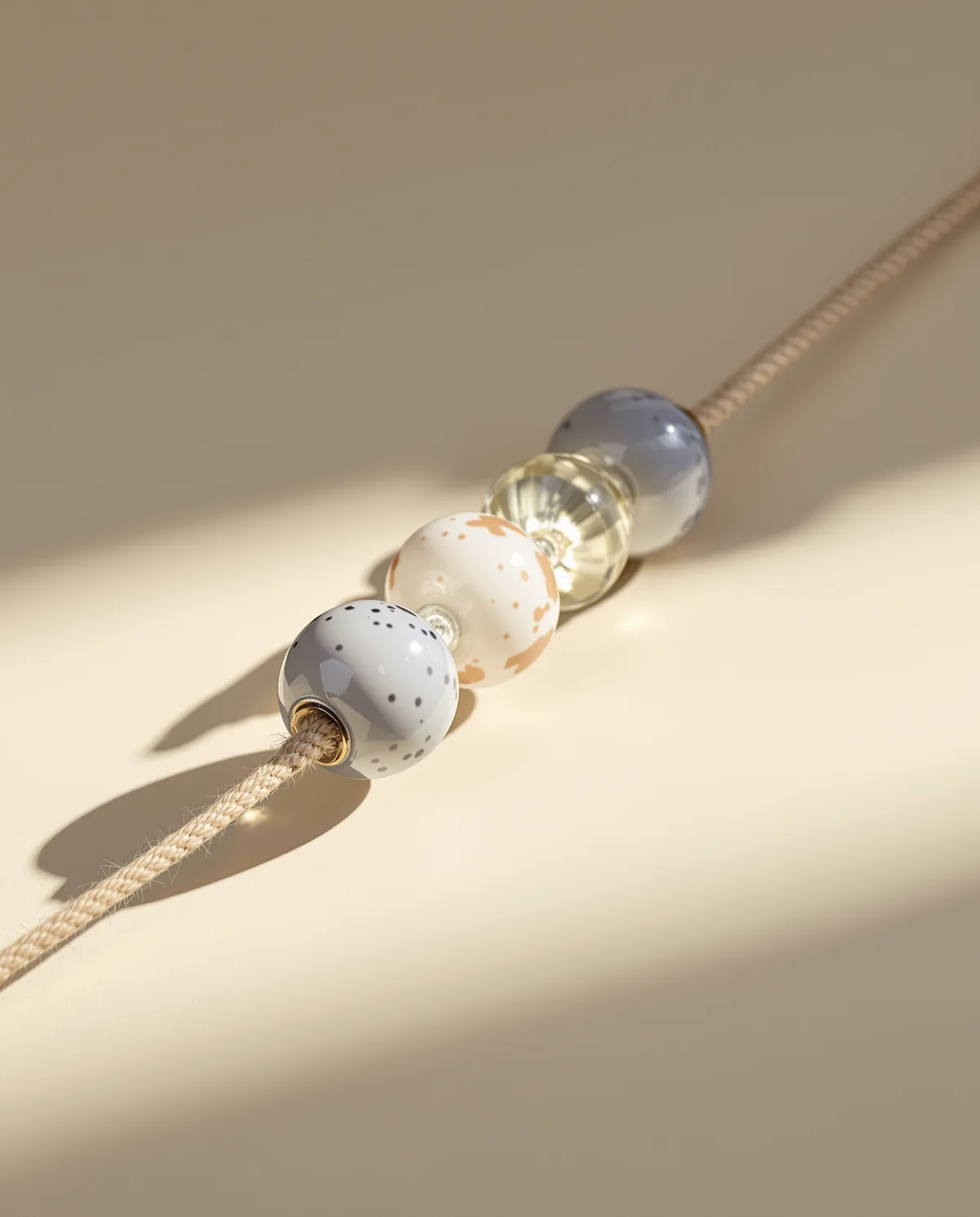
What the specification should not contain is a cord chosen for the hand of the finished panel. Cord is always selected from the smallest hole in the build — on almost every panel that means the glass seed beads on the base strand, not the large accent the design is about.
| Medium | Drape and behaviour | How it terminates | Repair |
|---|---|---|---|
| Cotton or waxed cord | Softest drape; strands settle and swing freely | Knotted at the header and below the end bead | Easiest — a strand can be re-strung and re-knotted by hand |
| Nylon thread | Near-invisible between beads; slight stretch over time | Knotted, often with a crimp or bead stop | Straightforward, but the knot has to be held under tension |
| Nylon-coated steel wire | Holds a shape; does not swing as freely | Crimped, usually through two holes and back | Needs a crimp tool; cannot be re-knotted by hand |
| Brass wire | Rigid; used for armatures and wrapped work, not hanging strands | Wrapped and tied down at anchor points | A workshop repair, not a site one |
| Buyer-specified hole for loose beads | 4–5 mm hole commonly requested | Set by the customer's own cord or wire | Determined by the assembler |
The media are from our own production use. The hole figure is from a customer specification: four to five millimetres is what buyers assembling their own pieces have asked for, and it is the range we have supplied against.
What is deliberately absent is a tensile figure or a service life. Neither has been tested across the formats we build, and a specification page that invented one would be the most damaging kind of error.
Hole diameter with a pin gauge or a caliper, on the actual beads rather than from the drawing, because a drawn hole and a drilled hole are not always the same. Cord by its stated gauge, confirmed by threading a sample of the smallest bead in the build.
That threading test is the only measurement that matters. A cord that passes on paper and binds in the hand will not be strung several thousand times.
Termination, strand by strand on the sampled pieces: the knot at the header, the knot or crimp below the end bead, and whether the strand sits at even tension. A slack strand hangs long; an over-tight one pulls the header.
A failed termination is the defect with the worst retail consequence, because it does not produce a flaw, it produces a floor covered in beads. It is checked on the first-article pieces and again at lot inspection.
Hole and cord diameter as if they were the same number. A cord has to be smaller than the hole by enough to be threaded by hand repeatedly, and on a 1 mm seed bead that margin is most of the hole.
The second is treating a stated cord gauge as a strength statement. Gauge describes thickness. It says nothing about the material, the construction or how the cord behaves after five years in sunlight, and none of those is published here because none is measured.
The spec table above, organised by medium. It cuts across formats deliberately: the same decision is made on a door panel, a valance and a café curtain, and the answer changes with the beads rather than with the format.
Flat work makes the equivalent decision about thread rather than cord, which is why a coaster programme is specified by ground and stitch rather than by a stringing medium at all.
A tensile strength, a breaking load, a service life or a UV rating for any of these media. None is tested in our record. A buyer who needs one should treat it as a test to commission against a specific build rather than a figure to read off a page.
Nor is there a standard cord gauge per format. It is set per build, from the smallest bead.
The maker selects, which is usually the right outcome, because the maker is the one who knows the bore of the beads. The failure case is different: a brief that names a cord without naming the holes, which is a specification the beads may not accept.
Where that happens the sample stalls, and the first question back is always the same one about the drill hole.
Drawn glass seed beads have the smallest bores in most builds and therefore govern the choice. Moulded acrylic beads can be specified with a generous hole, because the hole is formed in the die rather than drilled. Wood and bone beads are drilled and can be specified to a larger hole, but the hole weakens the bead and there is a practical limit.
Laser-cut faux-capiz blossoms are a different problem: the hole is near the edge rather than through the centre, and the structural question is the material left between hole and edge.
On clearance, generous. The cord has to pass the smallest bead easily, by hand, several thousand times over a panel. Tight clearance is not precision, it is a stringing-rate problem and a cord-abrasion problem at once.
On termination, tight. A knot either holds or it does not, and the inspection is binary.
Less than the beads, and more than buyers expect. A tighter cord clearance slows stringing. A crimped termination takes longer than a knotted one and needs a tool. A coated wire build cannot be repaired by a retailer, which moves cost from manufacture into returns.
The medium also decides whether a panel can be shortened at the hem by removing beads to a mark and re-securing the end — easy on knotted cord, a workshop job on crimped wire.
That hand-strung on cord is the dominant construction across the shipped bead programme: thirty hand-strung strands on a single wooden dowel, strand after strand, panel after panel. Coated steel wire and crimped terminations belong to framed and wired work rather than to hanging panels.
Brass wire appears in a third role entirely — as an armature for wire-wrapped beadwork, where beads are strung and wrapped over a shaped wire form. That is a construction, not a hanging medium.
In the construction block, with the smallest drill hole in the build stated beside it. Termination method named explicitly — knotted, crimped, bead-stopped — and a note on whether the panel is intended to be field-repairable.
That last line is worth including on anything specified into a building, because it is the difference between a maintenance task and a replacement.
Good to know
The relevant tolerance is clearance, not dimension: the cord has to pass the smallest bead in the build with enough room to be threaded by hand, several thousand times, without being forced. A cord specified to exactly the bore of a seed bead is a cord that will not be threaded.
The bead material changes the hole, and the hole changes the cord. Drawn glass seed beads have the smallest bores in most builds and therefore govern. Moulded acrylic beads can be specified with a generous hole because the hole is part of the die. Laser-cut faux-capiz blossoms are drilled near the edge, which is a different constraint again.
The smallest drill hole in the build, and whether the piece needs to drape, to hold a shape, or to be repairable on site. Those two pieces of information select the medium. A brief that names a cord without naming a hole has specified the wrong half of the relationship.
Termination, on every strand sampled: the knot at the header, the knot or crimp below the end bead, and that no strand is under visible tension or slack. A loose termination is the defect that produces a bead shower in a shop, and it is checked on the first-article pieces.
Because a breaking strain belongs to a medium at a diameter in a build, not to a category, so the useful statement is the behaviour we see in production across the formats we build. Where a programme needs a tested figure, the build is tested and the testing is quoted with the project.
For loose beads supplied for a customer's own assembly, four to five millimetres is the hole range most often requested and the one we have supplied against. For our own finished panels there is no standard cord gauge, because it is set per build from the smallest bead in it.
Keep exploring
Specification
Diameters, drill holes, cord selection, strand counts and format dimensions — the sheet to copy into a tech pack.
See the detailGuide
Mark one strand, work to that mark on every strand, and re-secure each end — the method depends on cord, wire or monofilament.
Open the referenceReference
Specification sheets and definitions — the pages to send a designer before they draw.
View the rangeSpecification
Width divided by pitch gives the strand count — the value that sets density, weight, view-through and cost together.
Open the referenceSpecification
How bead count is estimated from size, pitch and diameter — and why density matters more than dimensions.
Open the reference
Start a conversation
Send a reference, a colour chip or a sketch. Minimums are set per design and confirmed per quote; sampling is quoted separately and usually runs 16 to 20 days from an agreed brief.