Specification
Headers, dowels and rod pockets
Dowel, stained header rail, sewn rod pocket or suspension loops — what each hangs from and when each fits.
Compare the options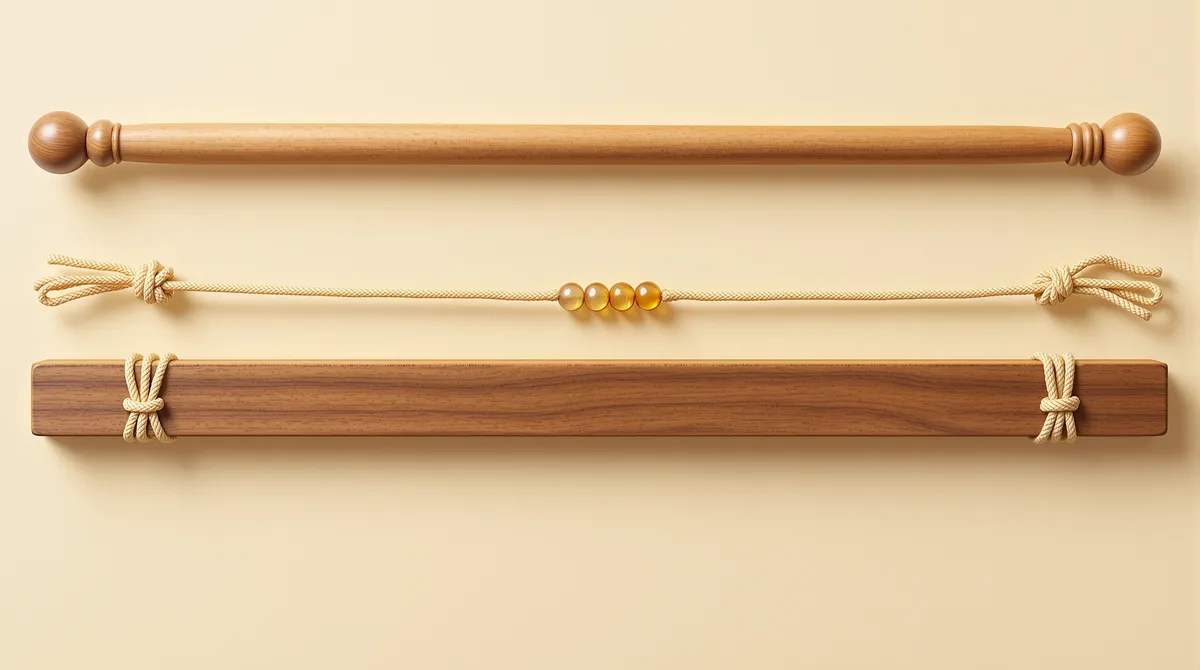
Guide · Repair
Yes, and without re-stringing a single bead — provided the replacement matches the diameter the strand loops were made for.
A round turned dowel and a rectangular stained beam side by side with the lifted-off knotted header of a beaded panel between them, each cord looped and its first honey-amber…
Yes. On a looped header the strands slide off one dowel and onto another in order, with no re-stringing, provided the replacement matches the original diameter so the loops still sit correctly. On a knotted header each knot has to be untied and re-tied, which is slower but still a repair rather than a rebuild.
Moving thirty strands from one header to another without losing their order.
That is the whole job on a looped header, and it is genuinely straightforward. On a knotted header it becomes thirty small jobs instead of one, which is slower but no harder.
A bench or table longer than the panel is wide, so the strands can lie out fully supported. Masking tape, to hold the strand order. Scissors. A crimping tool if the original strands are crimped rather than knotted.
And the replacement header, measured against the original. Diameter is the specification that matters: match it, and everything else follows — the panel headers reference sets out the profiles we build to, and the stringing specifications carry the hole diameter and cord gauge the loops were made for.
Take the panel down by its dowel and lay it flat on the bench, strands straight and in order.
Run a strip of masking tape across all the strands about 10 cm below the header and press it down. That tape is now holding your strand order, and it is the single most important thing on the bench.
For a looped header: slide the old dowel out from one end while feeding the new one in behind it, so the loops never come free. On a thirty-strand panel this is one continuous operation and takes a few minutes.
For a knotted header: untie each knot and re-tie it onto the new header, working from one end, leaving the tape in place throughout.
If the new header is going onto different hardware, check the panel weight against what the fixing will hold before the panel goes up rather than after.
Then lift the panel by the new header, hang it, remove the tape, and settle the panel for a day.
The method is identical. The handling is not.
A thirty-strand glass panel laid flat is heavy, and if the bench is shorter than the panel's width the overhanging strands pull sideways against the header — which is exactly the load that parts a cord. Support the full width, work with a second person for the lift, and do not let the panel hang off the edge of a table at any point.
On a wide glass panel, consider whether the replacement should be a different profile rather than a like-for-like dowel. A round dowel under glass over 120 cm will bow, and a bow puts an uneven load on the end strands.
Nothing about a dowel swap harms the beadwork, provided the diameter matches.
A larger-diameter replacement stretches every loop as it is fed through, and the loop is the most heavily loaded few millimetres of the whole strand. A stretched loop will be where the panel fails in two years.
A smaller-diameter replacement goes on easily and then lets the strands slide along it, so the pitch drifts and the panel develops a bunched section. If a smaller dowel is all that is available, treat it as temporary and add a stop at each end or a shallow groove per strand.
Glass: handling and bowing are the constraints, so think about profile as well as diameter.
Acrylic and wood: light and easy, and the common reason for a swap is cosmetic rather than structural — someone wants a different timber tone or a metal rod.
Hand-strung panels in glass seed beads behave like any other strung panel here. Faux capiz disc columns do not: the columns are linked rather than strung, so a swap means transferring the top link of each column. Work slowly and keep the columns from twisting, because a twisted column does not untwist by itself.
Losing the strand order. A panel's pattern is a plan: every bead position on every strand is specified on a bead map, and the strands are in a sequence. Shuffle them and the pattern is gone, permanently, because nobody can reconstruct thirty strand positions by eye.
That is why the masking tape goes on before anything is untied. It is a ten-second step that prevents the only unrecoverable mistake in this job, and it is the same discipline that first article inspection applies on our own bench.
Second most common: buying a dowel by eye. A broom handle is not a dowel; it is a different diameter and a different finish, and both matter.
Untie all the strands and then look for the order. Lift the panel by its strands. Work with the panel hanging. Force a thicker dowel through the loops because it is what was in the shed.
And never cut the loops off to get the old dowel out. A cut loop is a re-string, and a re-string has to match the finished drop of every neighbouring strand.
Forty minutes for a looped header on a thirty-strand panel. Two to three hours for a knotted one.
Add half an hour if any strands need repairing while the panel is down, which is the right moment to do it.
Treats the header as a specified component rather than as a rod.
Dowels for our curtains are turned in our own Saharanpur wood factory, to a diameter chosen for the panel's weight and for the loop size on the strands. The profile is a design decision too: a round dowel on most constructions, a rectangular beam profile where the span and the load call for it, and a stained wooden header rail where the header is part of the look.
On a wide or heavy panel a rectangular beam is the better component for two reasons that matter in a repair: a flat section resists bowing far better than a round one of the same depth, and strands cannot slide along it, so the pitch stays as it was set.
Nearly always. A split dowel, a bowed dowel, a water-marked dowel and a dowel that is simply the wrong colour for a new scheme are all header problems, not panel problems, and the beadwork is untouched by any of them.
The panel itself is the expensive part: a densely patterned 90 × 200 cm curtain holds about 11,800 beads on our 2027 design-render basis, every one placed by hand. Replacing a panel because its header failed is replacing the wrong component.
That the header is replaceable without re-stringing, and that the replacement must match the original diameter.
For a retailer holding stock, it is also worth keeping a short length of the correct dowel, and keeping the spare beads supplied with each panel where the order specified them. A customer with a split header is a repair rather than a return, and a repair that can be posted is the cheapest outcome available to both sides — the retail packing reference covers how a panel travels without tangling.
Extractable data
| Header | Transfer method | Suits | Watch for |
|---|---|---|---|
| Round turned dowel, same diameter | Slide the loops across in order | Any looped panel | Strands sliding along a smooth dowel in use |
| Round dowel, larger diameter | Not recommended | — | Every loop is stretched; loops are the weak point |
| Round dowel, smaller diameter | Slides on easily | A temporary repair | Strands bunch; pitch goes uneven |
| Rectangular beam profile | Re-tie, or slide if the loops allow | Wide and heavy panels | Needs brackets sized for a flat section |
| Stained wooden header rail | Re-tie each strand | Panels where the header is part of the look | Matching the original stain |
| Metal rod | Slide the loops across | Commercial interiors; non-combustible headers | A cold, smooth surface lets strands slide |
| Knotted header | Untie and re-tie strand by strand | Any knotted panel | Keeping the strand order |
| Strand-order discipline | Lay the strands out in order on a bench | Every panel | A lost order means a lost pattern |
| Anti-slide detail | A shallow groove, a stop, or a re-tie at each end | Smooth dowels and metal rods | Pitch drifting over months |
Good to know
Deal with it during the swap — the panel is off the wall and laid out, which is the easiest moment it will ever offer. Re-string the strand on new cord in bead-map order from the spare beads, finish with a crimp or the original stopper bead, and transfer it with the rest.
Forty minutes for a looped header on a thirty-strand panel, because the strands slide across in a single operation once the order is secured. Two to three hours for a knotted header, because every strand is untied and re-tied individually and the order has to be kept the whole time.
Yes, if you keep the original dowel. Nothing about the beadwork changes in a dowel swap, so the panel can go back onto its original header at any time. That is worth knowing if the swap is being made for a temporary installation rather than because the dowel failed.
A clean bench longer than the panel is wide, masking tape to secure the strand order, scissors, a crimping tool if the strands are crimped, and the replacement header. For a knotted header, add a needle-nose plier for picking out tight knots and good light.
Only if the replacement is the wrong diameter. A thicker dowel stretches every loop as it goes on, and a stretched loop is a future failure point at the most loaded part of the strand. Measure the original before buying anything.
The method is the same; the handling is not. A thirty-strand glass panel laid out on a bench is heavy and awkward, and the strands will pull sideways if the bench is too short. Work with the panel fully supported along its whole width, and get a second pair of hands for the lift.
Keep exploring
Specification
Dowel, stained header rail, sewn rod pocket or suspension loops — what each hangs from and when each fits.
Compare the optionsGuides
One guide per question that arrives often enough to be worth answering properly.
Read the guideGuide
Replacing one bead mid-strand without dismantling it, and the options when no matching bead is left.
See the detailGuide
Work with the panel hanging, separate in small groups, never pull against a knot, and support the weight as each strand comes free.
Specs and sizesGuide
Identify what failed, re-string that strand, re-knot it at the header, and match the bead from the spares specified with the order.
Specs and sizes
Start a conversation
Send a reference, a colour chip or a sketch. Minimums are set per design and confirmed per quote; sampling is quoted separately and usually runs 16 to 20 days from an agreed brief.