Guide
Why bead panels knot
Strand weight, pitch, handling and packing: the four variables that decide whether a panel knots, and the three set at the brief.
Open the reference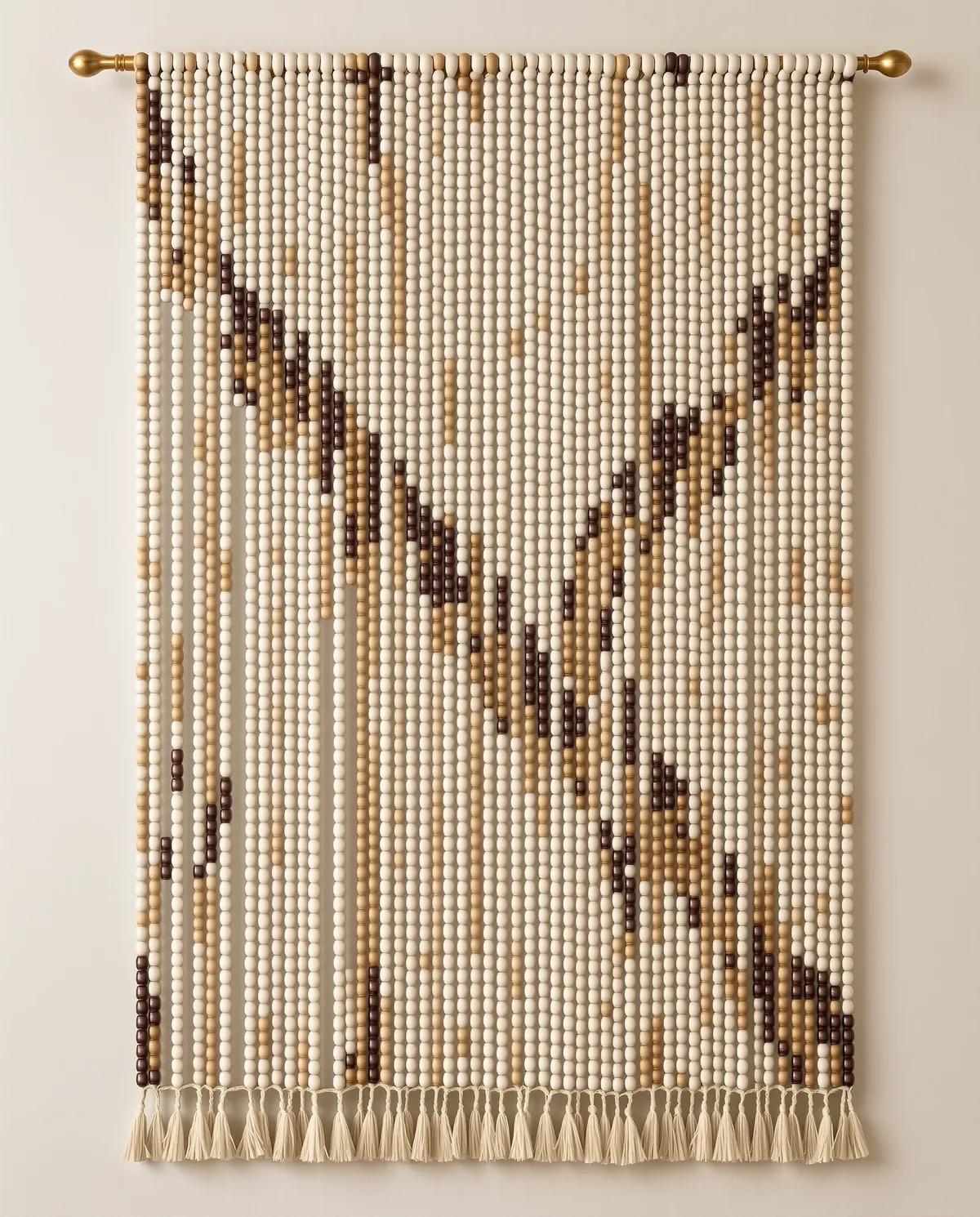
Guide · Repair
Every tangle is solvable and almost every broken strand is somebody solving one impatiently. The method is slow on purpose.
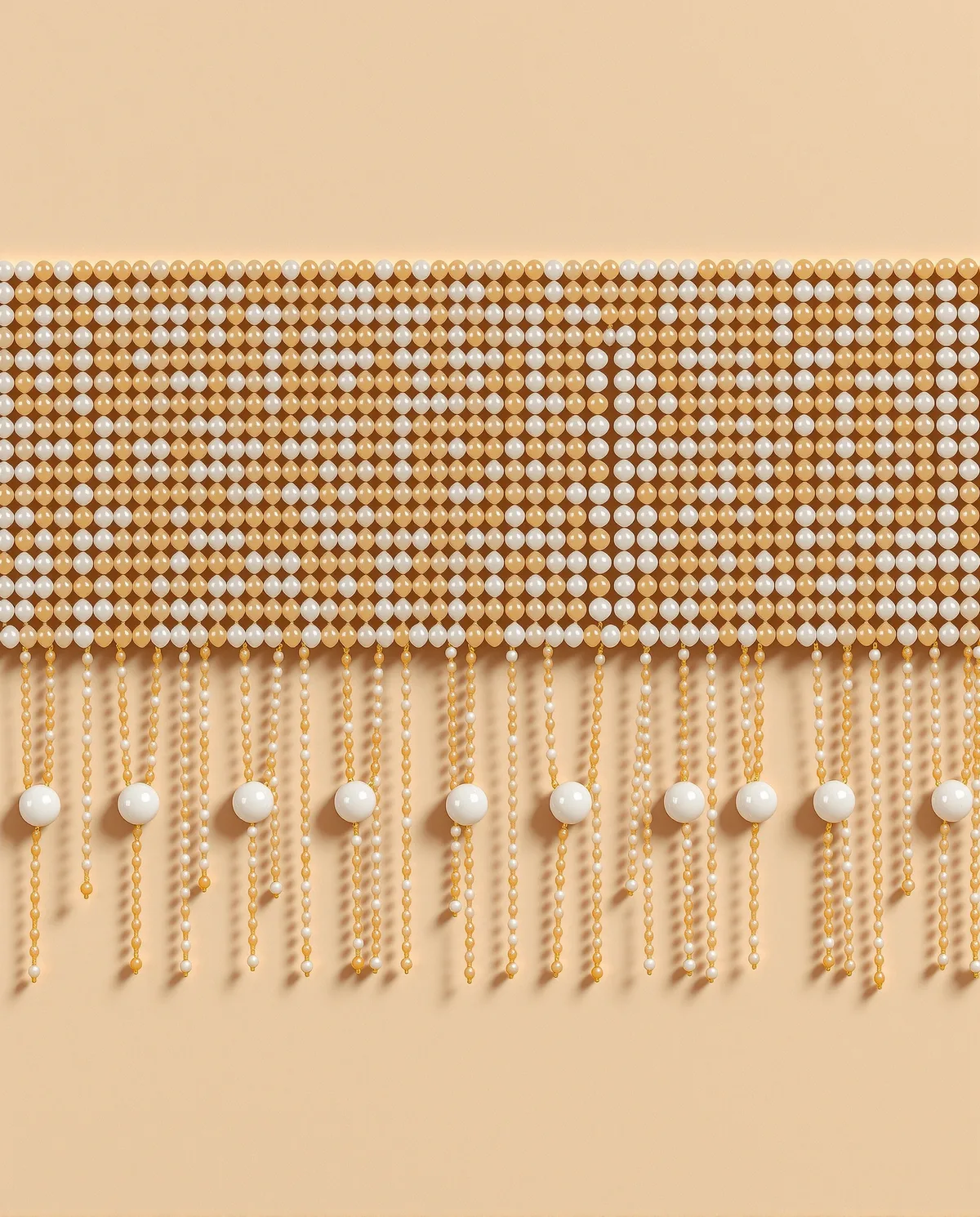
A beaded panel hung from a slim rail, worked in oat, chocolate and chalk white so the colour changes bead by bead into a graphic pattern across the strands.
Hang the panel first, then work in small groups of strands rather than across the whole width. Free strands one at a time, easing beads apart and sliding knotted strands past each other instead of pulling. Clip each cleared group aside before starting the next. Never pull a trapped strand against its header knot: that is what parts cord.

Tracing, not pulling. The work is finding where two strands cross and in which direction one has to move; the movement itself takes a second.
That is the opposite of the instinct, which is to take the mass in both hands and shake. Shaking a tangle tightens it, because the strands are not elastic and every bead is a stop. The only thing force achieves on a bead panel is loading a header knot that was never designed for a lateral pull.
The panel hanging. If it is in a heap, hang it from its dowel first even if the tangle gets worse in the process — working against gravity is harder than anything that happens on the way up.
Then clips to hold cleared groups aside, a blunt needle to ease crossings, and light at the height you are working. Most of the difficulty in untangling is not being able to see which strand goes where.
Hang the panel by its dowel. Let it settle for a few minutes.
Identify the top of the tangle. Work there first, always.
Take the five or six strands at one edge that are already free. Clip them aside.
Work along: find the first crossing, work out which strand sits over which, and lift the upper one clear.
Ease beads apart rather than sliding a whole strand through a gap. A bead is a stop; the gap between two beads is not.
When a strand is free down its whole length, clip it with the cleared group.
Repeat across the panel. If a strand will not move, leave it and come back from the other side.
Release the clips from the top down and let the panel settle for a day.
Because a tangle is a stack and the header end is the top of it. Free the top crossing and the strand below has slack to move; free a bottom crossing first and the strand is still held above, so everything you do is against tension.
It is also where the damage would happen. The header knot is carrying every bead on its strand, and a lateral pull from below is the one load it is not designed for. Working downwards means you are never pulling against it.
A twist is two strands spiralled around each other with no crossing — lift one and it unwinds in a single movement. A tangle is strands passing over and under each other, and it has to be traced.
Twists are usually a dowel problem: if the dowel can roll in an open hook, the whole panel slowly rotates and neighbouring strands wind together over weeks. Clearing it is easy and it will come back unless the dowel is seated so it cannot turn.
Four ways. Working on a table. Pulling a strand that is caught. Cutting something to make progress. And working at the hem, where the tangle looks worst and the solution is not.
The fifth, subtler: clearing strands without clipping them aside, so freed strands fall back into the mass and are tangled again by the time you get to the other end.
Never pull. Never shake. Never twist the dowel to try to unwind it. Never introduce water, oil or any lubricant — a wet cord is a weakened cord, and a slippery bead is harder to hold, not easier.
And never cut a strand to free the rest. It is almost never necessary, and the strand you cut is the one you then have to rebuild bead by bead.
Ten minutes on a new panel that is really just unsettled. An hour on a genuine tangle in a 30-strand panel. Several sittings on a bundle that has been in a box, badly tied, for a season.
The useful mental model: the time is proportional to the number of crossings, not to the number of strands. Six strands locked into a dense knot take longer than thirty strands each crossed once.
We prevent it rather than solve it, and the prevention is in the packing. Panels are packed with the strands held in order so they cannot move relative to each other in transit, which is why a new panel arrives as a panel rather than as a problem.
The same principle is the answer to tangling in use: strands are fixed to the dowel in a set sequence and spaced at a chosen pitch, and a panel whose strand weight and spacing were designed for its material hangs straight and recovers after being walked through. A panel that tangles in normal use is usually under-weighted for its drop.
When the strands are locked together at the header. At that point it is faster and far safer to release the affected strands at the dowel, clear them individually with no load on them, and re-tie them at the correct pitch.
That is a repair in the sense that it touches the header, but it is a ten-minute one and it removes all the risk, because no cord is ever under tension during it.
Lift it by the rod. Hang it before untying anything. Settle it with your hands, from the top down, in sections. Give it a day.
Those four lines prevent the great majority of tangles, because the great majority of tangles are created in the first five minutes after the carton is opened.
The transit ties that came with the panel, because they are the right thing to use if it ever comes down again. The clips you bought for this job. And the spare beads, which belong in the same bag as always — a cleared tangle sometimes reveals a bead that chipped during it.
The construction that resists it is documented rather than theoretical: strand weight and spacing are set on the approved sample, and strands are fixed to the dowel in a set order. Our live portal builds run 30 hand-strung strands on a single wooden dowel at around 90 × 200 cm, which is a pitch generous enough for strands to part and fall back.
Where light strands are at risk, the design answers rather than the care instructions: a heavier end bead steadies a light acrylic, wood or bamboo strand so it hangs straight instead of drifting into its neighbour. That is a specification decision taken at the brief, not something that can be retro-fitted to a tangled panel.
Extractable data
| Tangle type | How it shows | Clearance method | Risk to cord |
|---|---|---|---|
| Transit set | Strands crossed near the hem on a new panel | Settle it; it clears itself in a day | None |
| Lift tangle | A mass just below the header | Release at the dowel and re-tie | High if pulled |
| Twist | Two strands spiralled around each other | Lift one strand and unwind, do not pull | Low |
| Walk-through snag | A few strands knotted mid-drop | Trace the crossing, ease beads apart | Moderate |
| Storage knot | A whole bundle locked together | Suspend the bundle, work top down | High |
| Cord breaking strain | — | Confirmed per build | Established against the specified cord |
Good to know
Clips or clothes pegs to hold cleared groups aside, a blunt tapestry needle or a knitting needle to ease crossings apart, and good light at the height of the tangle. Nothing sharp: scissors near a tangle end up cutting cord you meant to keep.
Only if you pull. Cord fails from water, from abrasion against a drill hole under load, and from being pulled against a knot — and a trapped strand under tension is the last of those. Easing and sliding does no damage at all, which is why the slow method is also the safe one.
Yes, and it is the harder case. Glass strands are heavy, so a trapped glass strand is under real tension before you touch it, and glass beads chip where they knock together hard. Support the weight of each strand you free rather than letting it drop against its neighbours.
Yes, and it is worth doing on the hanging fixture rather than in the stockroom. A panel that arrives tangled almost always arrived that way because it was lifted out of its carton by the strands, so the fix for a shop is a handling instruction rather than a repair process.
Clear the tangle around it first, then treat the break as a separate repair: the strand is re-strung in its original bead order and re-knotted at the header. Collect the loose beads before you clear anything else, because they will be gone once strands start moving.
Ten minutes for a new panel that only needs settling. An hour or more for a storage knot in a 30-strand panel, and it genuinely cannot be hurried — the time goes into tracing crossings rather than into undoing them.
Nearly always, yes, and that is the encouraging thing about this job. A tangle displaces strands but does not change them. What cannot be undone is a parted cord or a chipped bead, and both come from force rather than from the tangle itself.
Keep exploring
Guide
Strand weight, pitch, handling and packing: the four variables that decide whether a panel knots, and the three set at the brief.
Open the referenceGuides
One guide per question that arrives often enough to be worth answering properly.
View the rangeGuide
How strands transfer in order, why loop diameter decides the replacement, and when a rail beats a round dowel.
Specs and sizesGuide
Identify what failed, re-string that strand, re-knot it at the header, and match the bead from the spares specified with the order.
Read the guideGuide
Release the old strand at the header, rebuild the bead sequence from the count sheet or a sibling strand, and knot it back true to length.
Specs and sizesGuide
Open the carton flat, find the header first, lift by the rod, hang it, then release transit ties one at a time from the top down.
How it is made
Start a conversation
Send a reference, a colour chip or a sketch. Minimums are set per design and confirmed per quote; sampling is quoted separately and usually runs 16 to 20 days from an agreed brief.