
Specification
Retail packing and tangle prevention
Strand order, inner packing, header protection and labels — how a panel arrives untangled and sells from the box.
Read the guide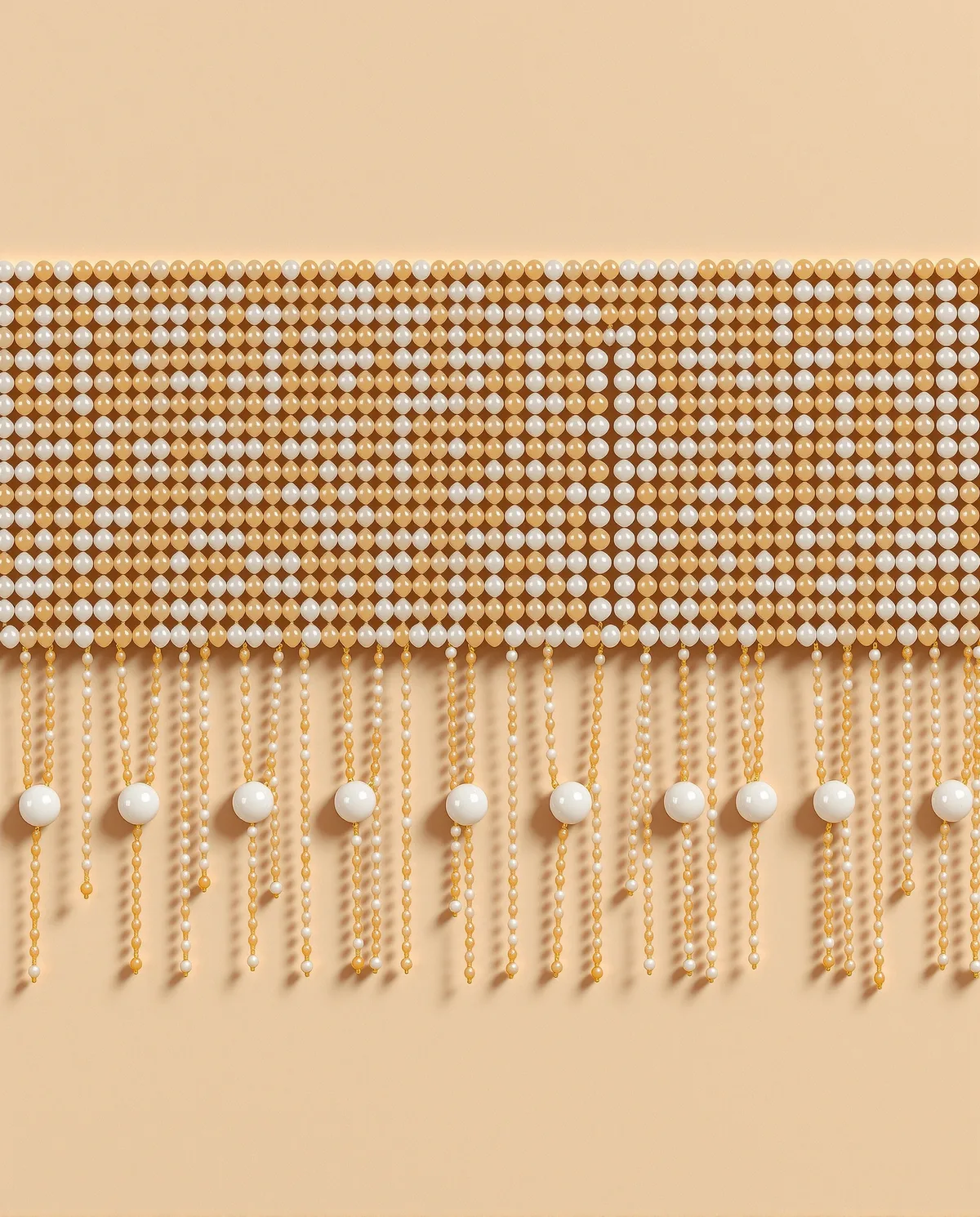
Guide · Install
The panel was packed with its strands in order. Everything you do in the next five minutes either preserves that or destroys it, and destroying it takes about two seconds.
A solid beaded top band worked in close horizontal rows above the point where the strands separate and fall free.
Lay the package flat and open it fully before lifting anything out. Find the dowel or header, lift the panel by that, and let the strands fall straight. Hang the panel first, then remove any transit ties one at a time from the top down. Never lift it by the strands and never shake it out of the carton.

Finding the header before you lift anything, and leaving the strands alone until the panel is hanging.
That is the whole method. A finished panel is packed with the strands held in their order and protected against knocking, because transit is the moment a strung panel is most vulnerable. The packing is doing a job, and the point of unpacking carefully is to hand that job over to gravity rather than to interrupt it.
The fixing already in the wall. That is the one genuinely useful piece of preparation, because it lets you go from carton to hanging in a single movement rather than putting the panel down somewhere in between.
A flat floor or table long enough to open the carton out fully. A blade. Somewhere to put the spare beads, if the order specified any, so they do not go out with the packaging.
Because it loads a handful of strands laterally while the rest of the panel's weight hangs off the dowel, and the strands you are holding slide against their neighbours.
Lifting a curtain by the strands is the most common cause of tangles, and the tangle it produces is the worst kind: a mass just below the header, which is where everything is held and where nothing has slack to move. That is the one tangle type that is often better cleared by releasing strands at the dowel than by working them free.
Because the ties are holding the strand order, and gravity is the only thing that can take over from them. Untie on a table and the strands have no reason to stay in sequence; untie with the panel hanging and each strand drops straight into its place.
Top down, one at a time, matters too. Release a lower tie first and the strands above it are still bundled, so the freed section has nowhere to fall.
| Item | What it is for | Keep it? |
|---|---|---|
| The panel on its header | The product | Yes |
| Dowel, rail or end loops | The mount, built into the panel | Yes |
| Transit ties | Holding strand order in the box | Yes — for storage or a move |
| Spare beads, if specified | Repairs; a known failure mode | Yes, labelled and dry |
| Care card | Dusting and cord guidance | Yes |
| Inner packing | Stopping beads knocking in transit | Yes, if the panel may travel again |
| Outer carton | The best container the panel will ever have | Yes, if you have room |
Four ways, in order. Lifting by the strands. Shaking the panel to make it fall straight. Untying before hanging. And binning the spare beads with the packaging — where spares were specified, nobody notices they have gone until a bead is needed two years later.
The fifth, specific to retail: unpacking in a stockroom and carrying the panel to the floor. A loose panel in transit across a shop is a panel being handled by the strands, however carefully.
Never shake it out. Never comb or brush the strands to separate them. Never cut a tie that is under load — slide it off instead. Never tension a strand that looks short.
And never judge the panel on the day. A new panel has been in a carton and carries its shape; the hem will look slightly ragged and slightly short, and both correct themselves over a day or two.
Five minutes if the fixing is already in place, fifteen if it is not. Against that, an hour or more untangling a panel that was hurried, with a real risk of a parted strand in the process.
Packs so that unpacking cannot go badly. Strands are kept in order and protected against knocking in transit, and panels are packed to the buyer's carton, label and packaging specification at our quality control and packaging house at Greater Noida, which also runs first-article and lot inspection on an AQL plan before anything is packed.
For a sense of how tightly that is specified: one wall-hanging build uses a master carton of 85 × 32 × 25 cm for ten pieces. Packing at that density only works if the strand order is genuinely held, which is why the carton is a drawing rather than a box.
When beads are loose in the carton, when a strand has parted in transit, or when the packing has clearly failed — crushed corners, strands out of their retention.
Photograph it before touching it. Those photographs are the record, and they are also what distinguishes a transit problem from a handling one, which matters to everybody.
The same four lines that go on the care card, because unpacking is when they are needed. Lift it by the rod. Hang it before you untie anything. Separate crossed strands by hand. Give it a day.
Those four lines prevent the majority of tangles, the majority of early returns, and almost all of the panel damage that happens in a customer's first hour with it.
The carton and the inner packing, if there is room, because they are the correct container for a move or for seasonal storage. The transit ties, for the same reason.
And the spare beads, labelled with the panel rather than the colour — assuming the order specified them, because spares are a packing-specification item rather than a standard inclusion. A broken strand is a repair rather than a write-off, and that repair depends entirely on having the beads, which is why the bag is worth asking for before production and worth keeping once it arrives. In a house with two bead panels, an unlabelled bag of beads is no help at all.
Good to know
The method is identical and the stakes are higher. Glass is heavy, so a panel lifted by its strands puts real load into whichever strands your hand happens to be holding, and glass beads chip where they knock together. Support the dowel with both hands on a glass panel.
Only in that a shop should unpack straight onto the fixture: open the carton flat beside the display rail, lift by the dowel, hang, then untie. Unpacking in a stockroom and carrying a loose panel to the shop floor is how display panels arrive tangled.
Photograph it before anything moves, collect any loose beads, and hang the panel anyway. A parted strand is a repair — re-strung in its original bead order and re-knotted at the header — and the photograph is what makes the conversation about it straightforward.
Five minutes, and it is worth taking all five. The time saved by hurrying comes straight back as untangling, which on a badly handled 30-strand panel is an hour or more of tracing crossings.
Yes, if you kept the ties and the inner packing and you have not untied anything. That is a practical reason to hang the panel on its fixing before removing ties: you can judge the size and the colour with the panel still effectively packed.
A blade for the carton tape and nothing else. If you find yourself needing anything more, something is being pulled rather than lifted.
Only through force. Cord is harmed by water, by abrasion against a drill hole under load, and by being pulled against a knot — and lifting a panel by its strands is the last of those applied to whichever strands you grabbed.
Keep exploring
Specification
Strand order, inner packing, header protection and labels — how a panel arrives untangled and sells from the box.
Read the guideGuides
One guide per question that arrives often enough to be worth answering properly.
View the rangeGuide
What settling is, how long it takes, how to help it along, and why nothing should be cut until it is finished.
How it is madeGuide
Where to put the join, how to match pitch across it, and how to get two headers level with each other.
How it is madeGuide
Brushing the floor looks intentional and wears fast; a clear gap of a few centimetres lasts and still reads finished.
Open the referenceGuide
Work with the panel hanging, separate in small groups, never pull against a knot, and support the weight as each strand comes free.
View the rangeGuide
The header, a care card and packing that held the strands in order — plus the spare beads you have to specify yourself.
How it is made
Start a conversation
Send a reference, a colour chip or a sketch. Minimums are set per design and confirmed per quote; sampling is quoted separately and usually runs 16 to 20 days from an agreed brief.