Pillar
Beaded curtains: the formats, and what each one is for
Door curtains, portals, café lengths and valances: the standard sizes, the strand counts and the one question each format answers.
Compare the options
Guide · Performance
Some panels tangle every week and some never do, and the difference is not luck. It is four variables, three of which are decided before the panel is made.
Hand-strung strands of cobalt and pale sky glass beads hanging plumb, the cords through the middle crossing and looping over one another into a tangle.
Yes, some do. Tangling is caused by light strands at a tight pitch, handled by the hem rather than the rod, and stored folded rather than bundled. A heavier end bead, a slightly wider strand pitch and the habit of lifting a panel by its dowel remove nearly all of it. Very thin discs are the worst offenders.

Some panels tangle every week. Some never do. The variance is enormous and it is not random.
Four variables decide almost all of it. Strand weight, strand pitch, handling and storage. The first two are decided when the panel is designed; the second two are decided by whoever lives with it. So most of the answer to "will mine tangle" is settled before the first bead goes on a cord.
Because a strand that does not hang straight will eventually wrap around its neighbour.
A heavy strand falls true and returns to vertical fast after being disturbed. A light strand drifts in any air movement, swings further for a given push, and takes much longer to settle. Given enough drifting, two adjacent strands cross, and once crossed they stay crossed.
The density ranking is the tangling ranking: glass near 2.5 g/cm³, acrylic near 1.2, most woods below 1, bamboo lighter still for its volume because the bead is hollow. Glass is the least tangle-prone material in the category and bamboo the worst.
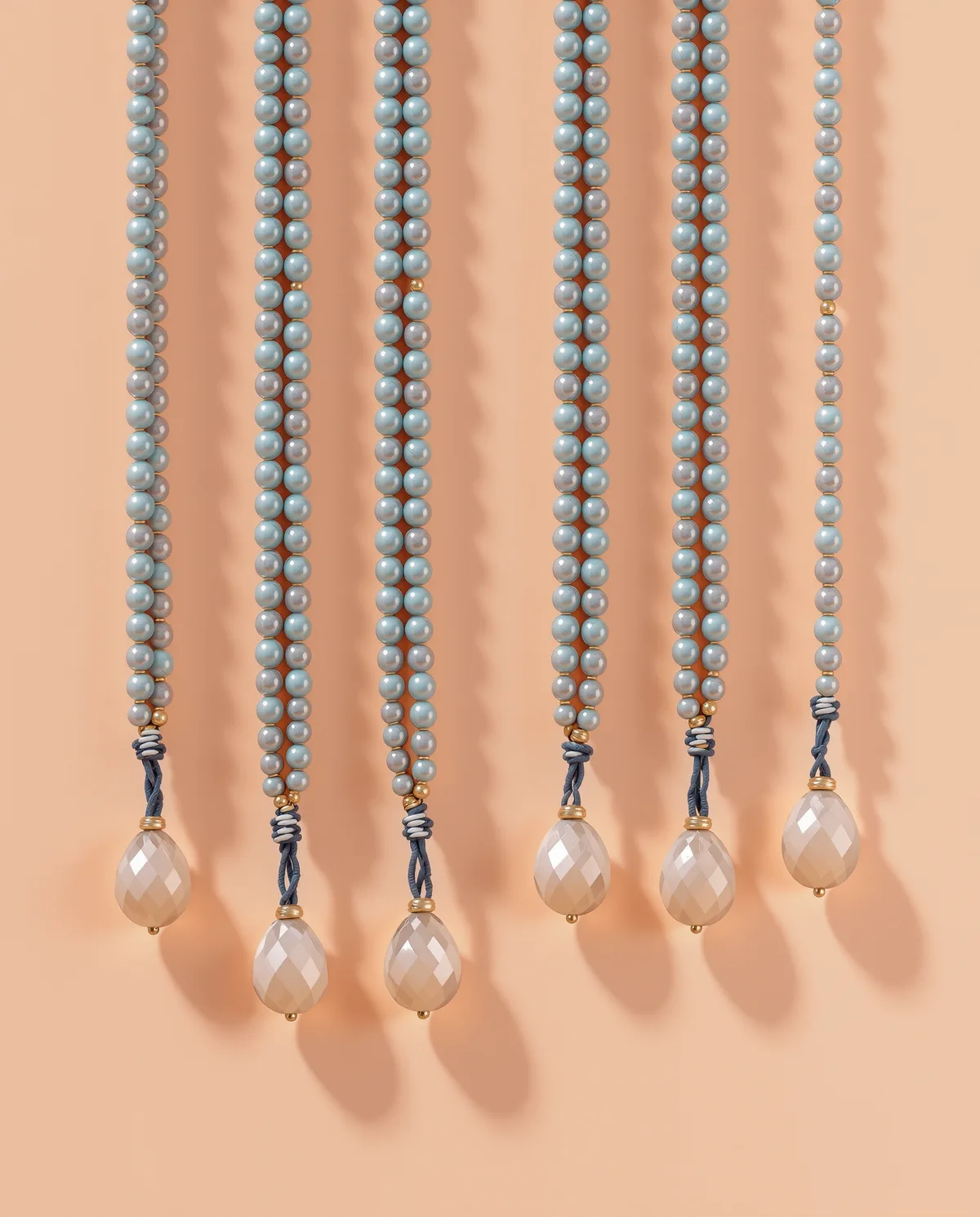
A weighted end bead. A deliberately heavier final bead pulls the strand down, which both straightens it and damps its swing.
This is routine rather than remedial. On our frosted sea-glass valance, larger plastic drop beads sat at the strand ends. On light materials generally — acrylic, wood, bamboo — a heavier end bead or wood and glass spacers down the strand are the standard answer to a drifting panel, and they are specified at the sample stage rather than added later.
The same bead also finishes the hem, so it is doing two jobs for one decision.

A great deal, and it is the lever people are least willing to pull because it costs coverage.
Pitch is centre-to-centre spacing across the header. The shipped construction is 30 strands on a 90 cm panel, a 3 cm pitch; the design library draws 40 strands on 90 cm at roughly 2.25 cm and 60 on 120 cm at roughly 2 cm. Going tighter buys you concealment and light control, and it also means a drifting strand meets its neighbour immediately.
For a panel in a doorway in constant use — the location that produces the most disturbance — open the pitch rather than tighten it, and accept the slightly more see-through result.
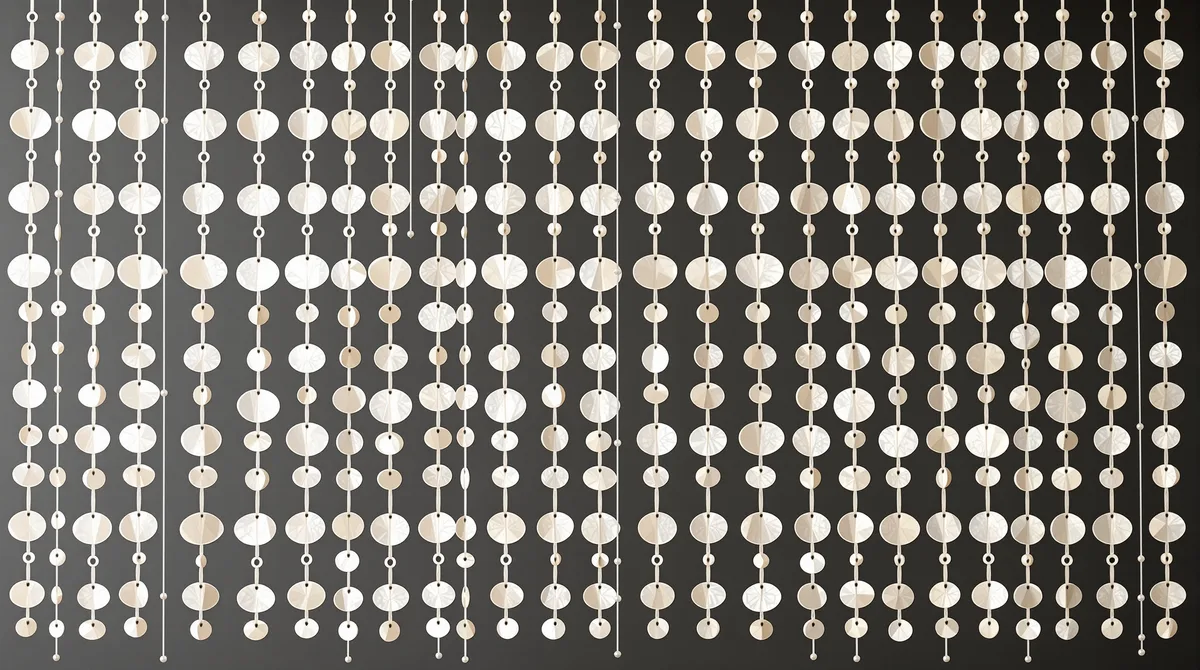
A special case, and the one place where the material itself is the risk. Very thin discs can tangle badly: they are broad, light and flat, so they catch air like sails and they overlap one another by design.
The fix is the same in principle and different in execution: disc weight and size are chosen for it, and beads are mixed into the column where it needs steadying. A locking spacer bead at the centre of each disc — as on our Cherry Blossom blossoms — also stops discs sliding and bunching, which is a related failure.
A well-specified linked-disc column is actually less prone to tangling than a light strung strand, because the discs hold each other in a plane.
Three habits, and they are easy.
Lift it by the rod, never by a handful of hem. Grabbing the hem pulls strands past each other, which is literally the tangling action.
Settle it after hanging. Run a hand down the strands from header to hem once, which sorts out any crossings from the install.
Part it rather than pushing through it when you can be bothered — not always realistic in a doorway, but it halves the disturbance.
Lift it off the rod by the dowel, let the strands hang together as one mass, and tie them into loose bundles at intervals down the length. Three or four ties on a door-length panel.
Never fold it. A fold puts a hard crease on every cord at the same height, and that line is where strands part later — so a fold creates a worse problem than the tangle it prevents.
Done properly, a bundled bead panel is one of the more robust things to move, which matters if it is going into a car twice a year.
Almost always, and the method matters. Separate the strands at the header first and work downwards.
Untangling from the hem drives the knots upward into the header, where thirty strands are gathered close together and nothing can reach them — the same reason dusting is done downwards rather than upwards. And do not pull: the cord is the component that fails, and a knot pulled tight against a drill hole is where it will part.
If a strand does part, it is a repair rather than a write-off: re-strung onto new cord in bead-map order and re-knotted at the header. Spare beads specified with the order are what make that a half-hour job.
Materially. A beaded panel is heavy and awkward and must arrive with its strands in order and unknocked, which means inner packing and a carton specified for the job rather than whatever fits.
On any programme being sold through a shop, a panel that arrives tangled is a returns problem before it is a quality one, and the cost of getting the packing right is far lower than the cost of getting it wrong. That is why packing sits in the cost levers alongside the dowel, and not as an afterthought.
Choosing a bead size is the page where the weighted end bead gets decided, and that is the single most effective fix. A capiz curtain covers the disc construction, which is the one material with a tangling problem of its own. Glass bead curtains is the least tangle-prone build in the category and bamboo door beads the most. Routine care sets out the handling habits in full, and panel headers covers the suspension loops that let a panel be lifted properly. For retail packing, reordering a bead design treats it as part of the specification.
Good to know
Almost always because the strands are too light for the pitch they are strung at. A light strand drifts sideways in any air movement, and if neighbouring strands are close together it will wrap around them. A heavier end bead and a slightly wider pitch fix it, and both are design decisions rather than handling ones.
Always lift it by the rod, settle it after hanging, and store it in loosely tied bundles. Those three habits remove most day-to-day tangling on a well-designed panel. On a badly designed one — very light strands at a tight pitch — handling will only reduce the problem, not solve it.
The lightest. Bamboo is worst, acrylic next, then wood. Glass is the least prone to tangling in the whole category, because it is heavy enough to hang straight and settle fast. Very thin faux-capiz discs are a special case: they can tangle badly unless disc weight and size are chosen for it.
Yes. Pitch is the centre-to-centre spacing across the header, and it determines whether a drifting strand has room to move or immediately meets its neighbour. The standard figures are roughly 2.25 cm at 40 strands on a 90 cm panel. Going tighter buys coverage and costs you tangling.
Lift it off the rod by the dowel, let the strands hang together as one mass, and tie them into loose bundles down the length. Never fold a strung panel: a fold puts a hard crease on every cord at the same height, and that line is where strands part later.
Usually, with patience and from the top down. Separate the strands at the header first and work downwards, because untangling from the hem drives knots upward into the header, which is the hardest part of the panel to reach. Do not pull: the cord is the component that fails.
It has to be. A beaded panel is heavy and awkward and must arrive with its strands in order and unknocked, which means inner packing and a carton specified for the job. On a retail programme, packing is part of the design rather than an afterthought — a panel that arrives tangled is a returns problem.
Keep exploring
Pillar
Door curtains, portals, café lengths and valances: the standard sizes, the strand counts and the one question each format answers.
Compare the optionsGuide
Air moves through, insects are discouraged rather than excluded, and strand pitch is the only lever that changes either.
Compare the optionsGuide
Opaque beads at a tight pitch screen movement and never detail — and nothing in this category works from close up.
How it is madeGuide
Flat translucent discs in linked columns: a different construction, a different sound, and an engineered imitation of shell rather than shell.
Read the guideGuide
Work with the panel hanging, separate in small groups, never pull against a knot, and support the weight as each strand comes free.
See the detailSpecification
Strand order, inner packing, header protection and labels — how a panel arrives untangled and sells from the box.
Specs and sizes
Start a conversation
Send a reference, a colour chip or a sketch. Minimums are set per design and confirmed per quote; sampling is quoted separately and usually runs 16 to 20 days from an agreed brief.