Guide
Settling, and why it matters
What settling is, how long it takes, how to help it along, and why nothing should be cut until it is finished.
Read the guide
Guide · Install
The hem is two metres from the header, which makes a bead panel a very long spirit level. It will find an error in your doorway that nothing else in the room reveals.
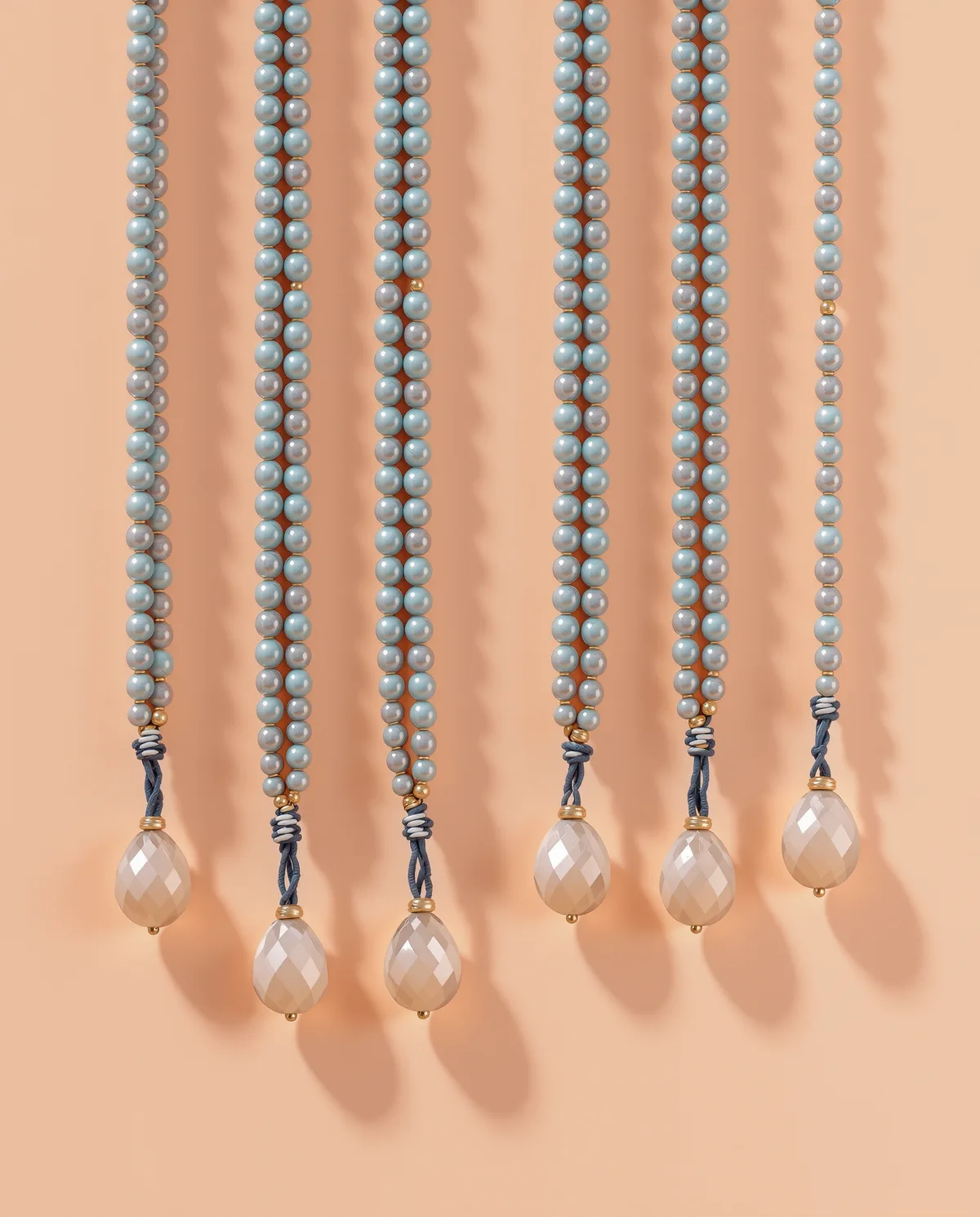
End suspension loops knotted at the top of each bead strand so a panel can be hung level from a dowel or a rod.
Three causes, in order of likelihood: the header is not level, the dowel has rolled or shifted in its seats, or the strands have not settled yet. Check with a spirit level on the header rather than by eye on the hem, re-seat the dowel so it cannot turn, and give a new panel a day before judging it. Uneven strand lengths are the rarest cause.

Moving the header, or waiting. Almost never touching the panel.
A bead panel has no internal structure to adjust. Each strand hangs under its own weight, straight down, from one point on the header. If the hem is not level, either the header is not level, the header has moved, or the strands are not yet hanging freely. Those are the three cases, and two of them are solved at the wall.
A spirit level. A tape. And the date the panel was hung, because if that date is within the last few days the correct answer is probably to do nothing.
Also worth having: a photograph of the panel taken straight on. A slope you can see standing in front of a panel is often not a slope at all — rooms are rarely square, and the eye levels against the door frame rather than against gravity.
Note when the panel was hung. If it is less than a day or two, stop and come back.
Put a spirit level on the dowel or header rail. Record what it says.
If the header is out of level, adjust the fixing at the high end rather than the low one — lowering is easier than raising.
If the header is level and the hem is not, try to turn the dowel by hand. If it moves, it has been rolling.
Seat the dowel so it cannot turn, or pin it.
If the header is level and the dowel is fixed, sight along the header line for a strand hanging lower than the rest. That is a slipped knot, and it is a repair rather than a levelling job.
Only then consider strand lengths, which is the rarest cause by a long way.
Because the panel is a lever two metres long. A header out by two millimetres across a 90 cm span puts the hem out by about four and a half millimetres at the far side — and the eye reads a hem against the floor, which is a long straight reference line, so it catches an error that would be invisible anywhere else in the room.
This is the reason to measure at the header. The hem tells you an error exists and tells you nothing about where it is, because every cause produces the same symptom down there.
A dowel sitting loose in two open cup hooks can rotate. Every time the panel is walked through, it turns a fraction and does not turn back. Over weeks the whole panel twists: strands wind against their neighbours, the hem goes out of plane, and the panel starts to look as if it has been badly made.
The tell is that it was fine when it was hung and got worse gradually. A manufacturing error is present on day one; a rolling dowel appears over a month. Fix it by seating the dowel so it cannot turn — closed hooks, a pin, a notch, or a header rail rather than a round dowel.
New strands hold the shape of the carton they travelled in, and they come out of it over the first day or two as their own weight does the work. During that window a hem can look ragged, slightly short at one end, or wavy.
That is not crookedness and it needs no intervention. It is also the single most common reason somebody reaches for scissors on day one and ends up with a panel that is genuinely too short by day three.
Levelling against the door frame. Old frames are not square and new ones are not always level, and a panel levelled to a frame will be visibly off against the floor and the ceiling.
Second: adjusting at the low end. Raising a fixing means a new hole; lowering the high end means using the hole you already have. Third: correcting a twist by untwisting the strands rather than by fixing the dowel, which works for a fortnight.
Never shorten strands to level a hem. The error is at the top and cutting at the bottom makes it permanent — and if the real cause was settling, you now have a short panel as well as a crooked one.
Never tension individual strands. Never weight a strand to pull it straight. And never adjust anything on the day of installation.
Only in timing. Glass is heavy, so it settles within hours and hangs truer thereafter; acrylic, wood and bamboo are light and take longer, and a very light strand can be deflected by a draught rather than by any fault.
Light panels are also where a heavier end bead earns its place: a deliberately weightier last bead steadies a light strand so it falls straight instead of drifting. That is a design decision taken at the brief rather than a correction made at the wall.
Ten minutes for the common case. The time goes into diagnosis rather than correction, which is why the order on this page matters — people spend an hour on the strands and then discover the header was out by a millimetre and a half.
We build the levelling adjustment into the panel. End suspension loops, knotted at the top of each strand, were developed so a portal could be hung level on a door or a wall rather than depending on the frame being square — you hang on two hooks and level by eye, and the loops take up the difference.
The alternative construction is a stained wooden header rail, which is rigid and beautiful and assumes the opening is true. Both are real builds; the loops are the forgiving one, and in an old house they are what to ask for.
When the header is level, the dowel is fixed, the panel has settled, and the hem is still out — and then the cause is strand length, which means the panel was built to inconsistent lengths. That is rare, because strand length is held to the bead-by-bead sheet in production rather than measured strand against strand, and it is checked at first-article and lot inspection before export packing.
The one case that is not correctable at all: a shaped hem that is off-centre because strands were removed unevenly during an alteration. That is an alteration error rather than a build error, and the only fix is to remove strands from the other side to match.
That the mount is where levelling lives. The documented mounting options are a stained wooden header rail, a single turned wooden dowel, end suspension loops for a level door or wall mount, and a stitched cotton header band with a three-inch rod pocket. Three of those four give you some adjustment; the rail gives none.
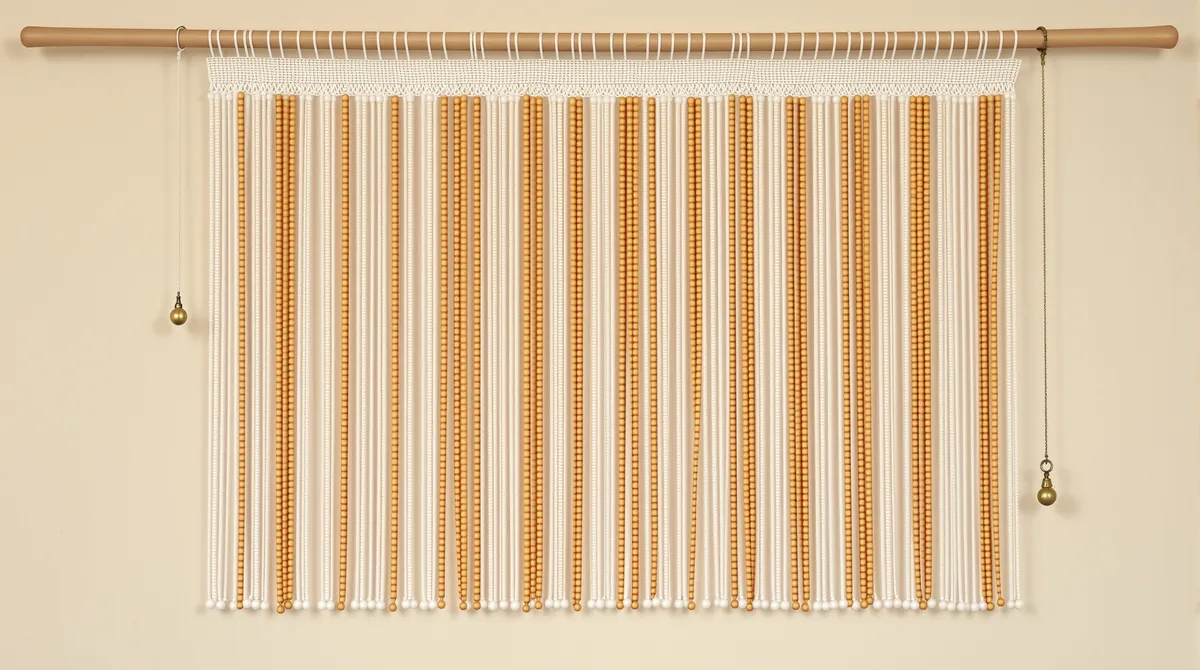
Strand counts in our live portal builds run at 30 hand-strung strands on a single wooden dowel at around 90 × 200 cm, and 2027 render figures put the full-length range at 40 to 60 strands. At those counts a single slipped knot is one strand in thirty, which is why sighting along the header finds it faster than staring at the hem.
Extractable data
| Symptom | Likely cause | Check | Fix |
|---|---|---|---|
| Hem slopes evenly one way | Header not level | Spirit level on the dowel | Re-fix one end |
| Whole panel twisted | Dowel rolling in its seat | Try to turn the dowel by hand | Seat or pin the dowel |
| Hem ragged, no clear slope | Not yet settled | Note the date it was hung | Wait a day |
| One strand low | Header knot slipped | Look along the header line | Re-tie that strand |
| Hem dips in the middle | Dowel bowing | Straight edge along the dowel | Support or replace the dowel |
| Shaped hem off-centre | Strands removed asymmetrically | Count strands either side of centre | Not correctable by levelling |
Good to know
Repair that first and separately, because a parted strand hangs short and will mislead every measurement you take afterwards. It is re-strung in its original bead order and re-knotted at the header, which puts it back to the same length as its neighbours before you start levelling.
Ten minutes if it is the header, which it usually is. Twenty if the dowel needs re-seating. A day if the answer is that the panel has not settled, which is the most common correct diagnosis for a panel hung in the last week.
Levelling never alters the panel, so yes — everything on this page happens at the fixing rather than at the strands. That is the reason to exhaust the fixing causes before touching a single strand: nothing here is irreversible until somebody starts cutting.
A spirit level, ideally a long one, and whatever drives your fixing. A phone level app is better than nothing and worse than a real level on a short header. A straight edge is useful if you suspect the dowel is bowed rather than tilted.
Not if you work at the fixing. The cord is harmed by water, by abrasion against a drill hole under load, and by being pulled against a knot. Re-fixing a bracket or re-seating a dowel involves none of those, which is why it is the right place to start.
The diagnosis is identical, and glass actually makes it easier: heavy strands settle faster and hang truer, so a glass panel reaches its final state in hours rather than days. It also loads the fixing harder, so a glass panel that is drifting out of level is more likely to be a fixing that is moving.
Keep exploring
Guide
What settling is, how long it takes, how to help it along, and why nothing should be cut until it is finished.
Read the guideGuides
One guide per question that arrives often enough to be worth answering properly.
See the detailGuide
Down by the header, bundled loosely in sections, never folded, carried flat or hanging — the method the original packing already used.
Compare the optionsGuide
Find the load, pick the fixing, mount the header level, load the strands dry, then let them settle before judging it.
Compare the optionsGuide
Each no-drill method with the weight it holds, heaviest first, and the one material choice that makes all of them work.
Compare the optionsGuide
Brushing the floor looks intentional and wears fast; a clear gap of a few centimetres lasts and still reads finished.
Specs and sizes
Start a conversation
Send a reference, a colour chip or a sketch. Minimums are set per design and confirmed per quote; sampling is quoted separately and usually runs 16 to 20 days from an agreed brief.