Guide
Storing beadwork properly
Loosely tied bundles in strand order, flat or hanging, never folded, somewhere dry — and label which opening it came off.
Compare the options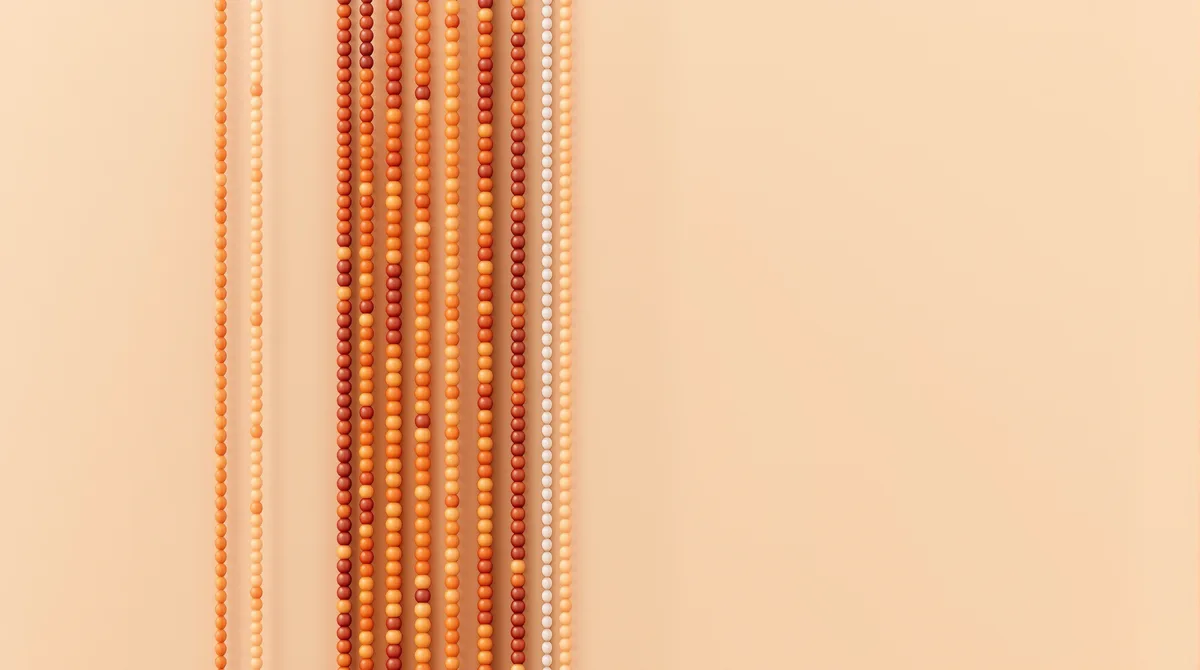
Guide · Install
A panel survives a house move the way it survived the factory to your door: with the strands held in their order and nothing folded.
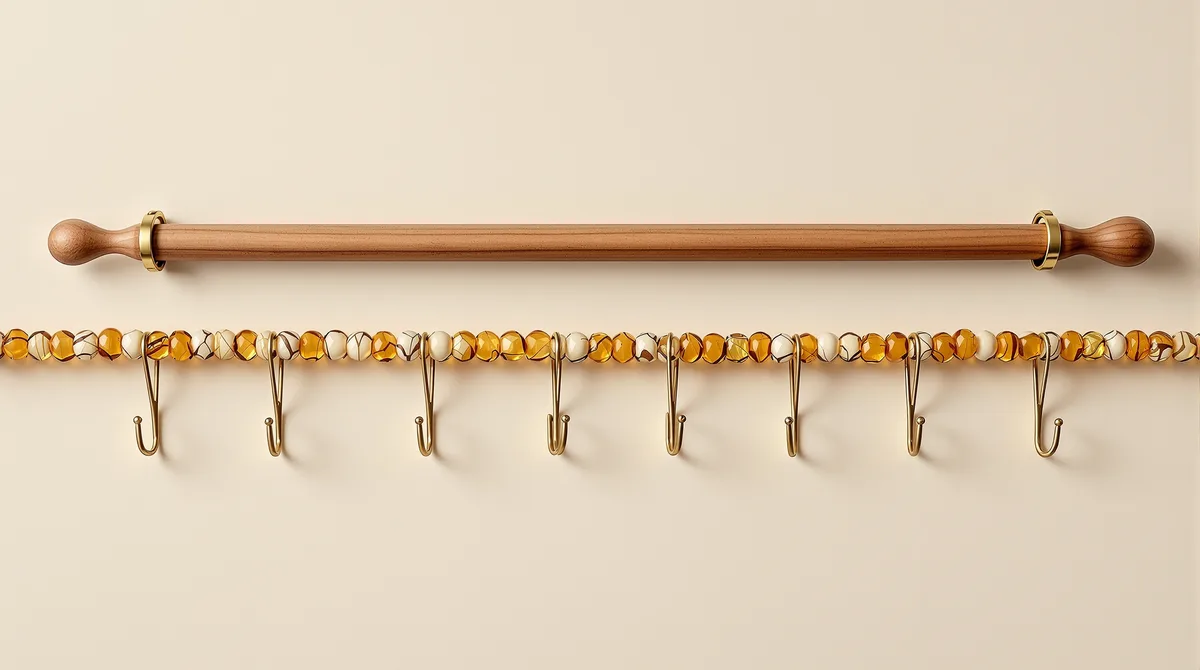
Close hand-strung strands of rust, burnt orange and amber glass beads filling one side of the frame against clear ground.
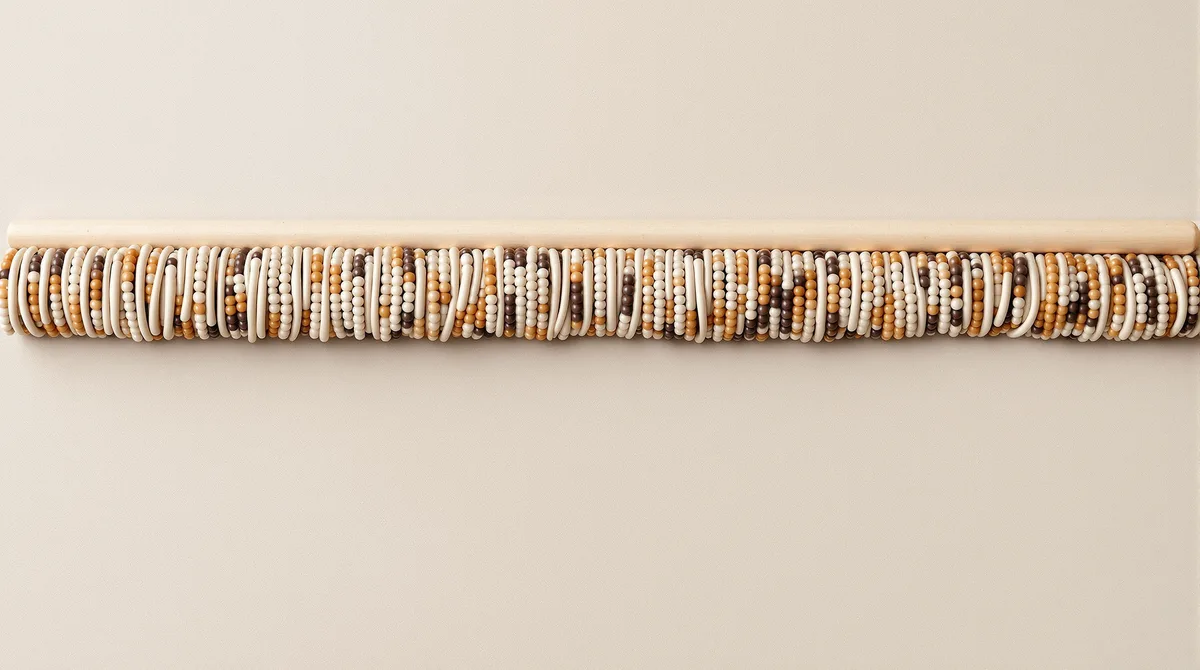
Take the panel down by its dowel with the strands hanging, then gather them into three to five loose bundles in hanging order and tie each softly at two or three points. Carry it flat, rolled around a tube, or hanging in a van — never folded, never in a bag with other objects. Re-hang before untying anything.

Reproducing, by hand, the packing method the panel arrived in. That is genuinely all of it.
A finished panel leaves our quality control and packaging house at Greater Noida packed so that the strands cannot move relative to each other, which is why it arrives as a panel rather than as a tangle. A house move is the same problem in a less controlled environment, and the same solution works.
Soft ties — ribbon, wide tape, strips of cotton. A long carton or a cardboard tube. A luggage tag and a pen. And the original packing if you kept it, which is the correct answer and the one most people cannot use.
Also: somewhere to lay the panel down flat while you bundle it. Doing this standing up with the panel in one hand is how strands end up in the wrong order.
Because a strung panel has a sequence. Strands are fixed to the dowel at a set pitch in a set order, and on a patterned panel each strand's bead sequence is specific to its position. Shuffle them and a mapped pattern no longer reads, even though every strand is intact.
Bundling contiguous groups preserves that sequence automatically. Grabbing handfuls from wherever is convenient does not, and the damage is invisible until the panel is hanging again.
Never fold it. On a move that is the one irreversible mistake available: everything else about a badly packed panel can be undone by hanging it for a week, and a crease cannot.
Never gather the strands in your arms to lift it. Never put it in a bag with other objects — beads chip against anything hard, and glass beads chip against each other. Never tie with string, elastic or cable ties, which bite into cord under the bundle's own weight and leave a mark at the contact point.
And never untie the bundles before the panel is hanging.
At the far end, not at the near end. People bundle carefully, transport carefully, and then open the box on the floor of the new house and lift the panel out by its strands — which is precisely the move that creates the tangle the bundling prevented.
The second failure is pressure. A bundled panel at the bottom of a stack of boxes is under load for the length of the move, and that load goes through whatever the ties are made of into the cord underneath them.
Fifteen minutes down and bundled; ten minutes to re-hang; a day to settle. Against that, an hour or more untangling a panel that was moved badly, with a real risk of a parted strand.
Add time for a glass panel, because the weight means supporting the dowel properly on the way down rather than letting it swing.
Packs it as a rigid unit. Strands are held in order, the dowel is protected, and the carton is specified so that the panel cannot shift inside it — we pack to a carton, label and packaging specification and ship to the port or warehouse a buyer names, which means the packing is a drawing rather than an improvisation.
For a wall hanging, one of our builds specifies a master carton of 85 × 32 × 25 cm for ten pieces, which gives a sense of how tightly a flat beaded piece can be packed when the order is held. The home version of that is the bundle: the same principle, fewer resources.
When a strand is already parted, or a header knot has slipped, or the dowel is split. All three are easier to fix with the panel hanging and its neighbours available as a reference, and all three get worse in a carton.
A split dowel in particular is worth changing before the move rather than after, because a dowel that fails in transit lets the whole bundle shift.
The same four lines that cover unpacking, because moving is unpacking in reverse. Take it down by the rod. Bundle in sections. Do not fold it. Hang it before you untie it.
If the panel is being delivered rather than collected, that information belongs in the box. A care card that only covers cleaning misses the moment the panel is most likely to be damaged.
The original carton, if it exists, which is the best container the panel will ever have. The transit ties it came with. The spare beads. And a note of the fixing used in the old opening, because the new one may need something different.
Hang it, settle it a day, then look along the header line for a strand sitting low — that is a slipped knot, the commonest transit casualty and a five-minute fix. Then look at the hem from a few paces back for the two things a move can do: a fold line across the panel, and a gap where beads have left a strand.
Nothing about domestic moves, and a great deal about transit. The published position is that strands are kept in order and protected against knocking in transit, then packed to the buyer's carton specification. That is the whole engineering content of this page.
It also implies a planning point. A panel travels packed, with its strands held in order, and that is the whole of the method. Beaded décor runs 40 to 60 days after sample approval and every door curtain is made to order, so a panel damaged beyond repair in a move is remade rather than replaced from stock.
Extractable data
| Method | Risk of tangle | Risk to beads | Suits | Note |
|---|---|---|---|---|
| Rolled around a tube, laid flat | Low | Low | Any long panel | Supports the whole strand length |
| Bundled flat in a long carton | Low | Low | Door panels and portals | The original carton if you kept it |
| Hanging in a van on a rail | Very low | Moderate | Short moves, glass panels | Beads knock in transit |
| Folded into a box | High | High | Nothing | Leaves a permanent set in the cord |
| Loose in a bag with other items | Very high | High | Nothing | Beads chip and strands lock together |
| Transit test result | — | — | Per programme | Arranged to the buyer's protocol where required |
Good to know
Yes, and the same method applies at a larger scale — the reason a new panel arrives untangled is that it was packed with the strands held in their order. A shop moving several display panels should bundle and label each one rather than trusting that they will be recognisable later.
Collect the loose beads before anything else, bag them, and label the bag with the strand position. The repair itself is straightforward — the strand is re-strung in its original bead order and re-knotted at the header — but it is only possible if the beads survived the move.
Fifteen minutes to take down and bundle a single door panel, done properly. Rushing it is what costs the hour at the other end, because the time saved comes back as a tangle.
Yes, if nothing was folded and the bundles stayed in order. A move displaces strands without changing them. The irreversible damage is a fold, which sets the cord, and a chipped bead, which does not unchip.
Soft ribbon or wide tape for the ties, a long carton or a cardboard tube, a luggage tag, and whatever removes your fixing. Not string, not elastic bands and not cable ties: anything narrow bites into cord under the bundle's own weight.
Only through folding or through pressure from a tight tie. Cord is harmed by water, by abrasion under load, and by being pulled against a knot — a move involves none of those if the panel is handled by its dowel and tied loosely.
Keep exploring
Guide
Loosely tied bundles in strand order, flat or hanging, never folded, somewhere dry — and label which opening it came off.
Compare the optionsGuides
One guide per question that arrives often enough to be worth answering properly.
Compare the optionsGuide
Sizing one for a reveal, what a friction fixing really carries, and the materials it does and does not suit.
How it is madeGuide
Where to position hooks, what size to use, and the anti-roll detail that stops a dowel walking off them.
Specs and sizesGuide
How to reach structure, how to establish the load first, and when a track beats a pair of hooks.
Specs and sizesGuide
Work with the panel hanging, separate in small groups, never pull against a knot, and support the weight as each strand comes free.
Compare the options
Start a conversation
Send a reference, a colour chip or a sketch. Minimums are set per design and confirmed per quote; sampling is quoted separately and usually runs 16 to 20 days from an agreed brief.