Specification
Panel weight and hardware load
What a beaded panel weighs by material and density, and which fixings suit light acrylic against heavy glass.
View the range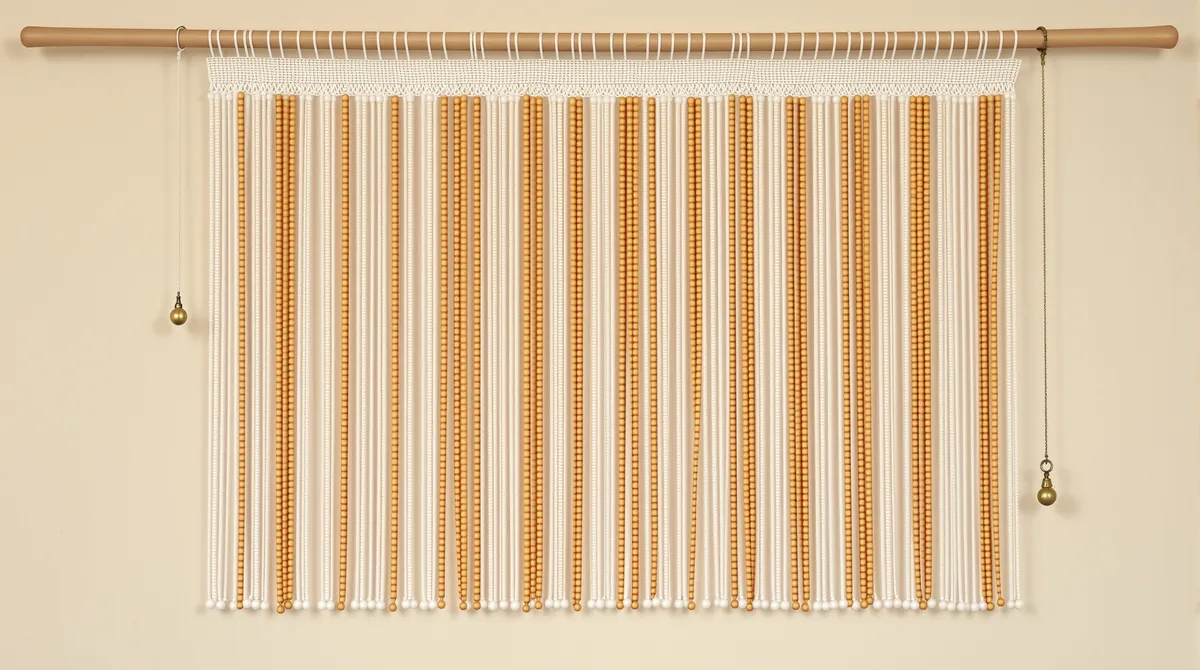
Guide · Install
It starts with weighing the thing. Almost every bad bead-curtain installation is a fixing chosen before anybody worked out what it had to carry.
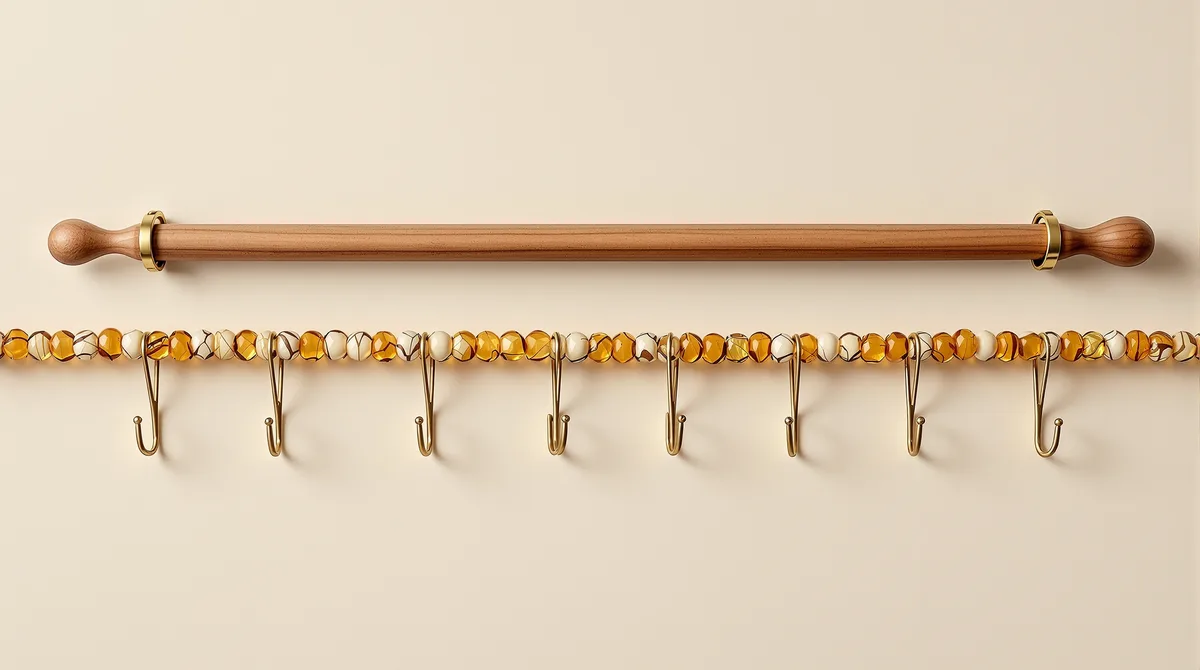
A beaded panel hung from a turned dowel with every honey and amber strand hanging dead plumb, a fine plumb line and small brass bob hanging exactly parallel beside the first cord.
Hang a bead panel in this order: work out what it weighs, choose a fixing rated above that, mount the header dead level, load the strands with the panel already hanging rather than on a table, and then leave it a day to settle before adjusting anything. The fixing follows from the weight, never from the opening.

Four things in a fixed order: getting the weight on a fixing that will hold it, getting the header level, getting the strands down without tangling them, and then leaving them alone.
What it does not involve is tensioning, adjusting or arranging. A strung panel has no shape to set. Every strand hangs under its own weight, so the installation's whole job is to present a level line at the top and get out of the way.
The drop you want, measured from where the header will sit to where the hem should finish — not from the top of the frame, and not to the floor. A fixing chosen for the weight. A tape, a pencil, a spirit level.
And a decision you have to make now rather than later: inside the reveal, or on the wall above the frame. Inside is neat; above makes the opening read taller and gives the strands room to swing. The two produce different finished drops from the same panel, so the choice comes before the measurement.
Lay the package flat and open it fully before lifting anything out.
Lift the panel by the dowel or rod, never by the strands, and let the strands fall straight.
Mark the fixing positions, check them with the level, and fix.
Seat the dowel, rod or end suspension loops. Check the level again with the weight on it, because a hook can settle.
If the strands were bundled or tied for transit, remove the ties one at a time, from the top down, with the panel already hanging.
Run your hands gently down the panel in sections to separate any strands that have crossed.
Leave it a day.
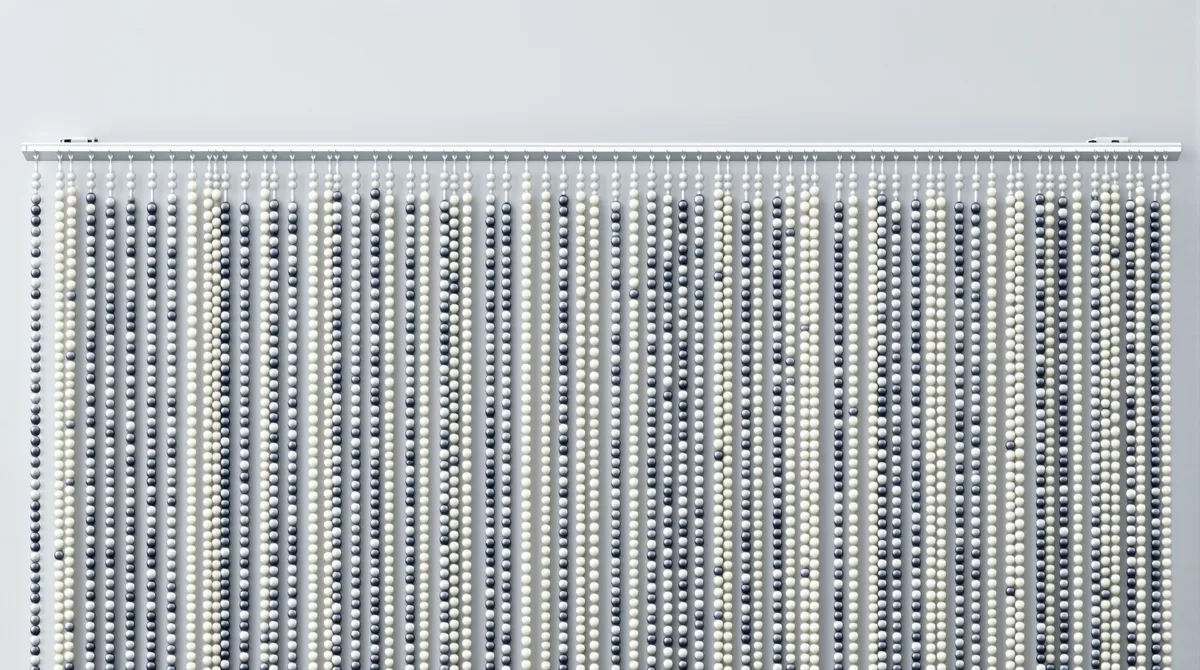
Because weight is the one variable the opening tells you nothing about. Two 90 × 200 cm panels of identical dimensions can differ several times over in weight depending on whether the beads are glass or acrylic, and on how many of them there are — a densely patterned panel at that size can hold about 11,800 beads.
So the sequence is: what is it made of, roughly how many beads, therefore which fixing. A tension rod that holds an acrylic panel will slip under glass, and nothing in the panel's appearance warns you. The panel is weighed on the approved sample, and the method that works is to over-specify the fixing against that weight rather than to calculate finely.
Three failures, in order of frequency. A header that is not level, which shows at the hem because the hem is two metres away from the error. A fixing into plasterboard with nothing behind it, which holds for a week. And strands lifted by hand out of the carton, which produces a tangle before the panel is anywhere near the wall.
The fourth, less common and more annoying: a dowel that can roll in an open hook, so the panel slowly rotates and the strands twist against each other over a fortnight.
Never lift it by the strands. Never shake it out. Never put a vacuum nozzle near it. Never tension a strand to straighten it — they straighten themselves. And never cut anything on the day it goes up, because a new panel is not yet the length it will be.
That last one is the expensive mistake. Strands come out of the carton holding the shape of the packing, and they lengthen and hang true over the first day or two. Trim to the length a panel shows on day one and you have a short panel on day three.
Twenty to thirty minutes for a single doorway, two thirds of it marking and levelling. Add time for a ceiling fixing, because finding a joist is the job.
A pair of panels side by side takes much longer than twice one panel, because they have to agree with each other as well as with the wall. Set a single datum line across both openings first and work to it.
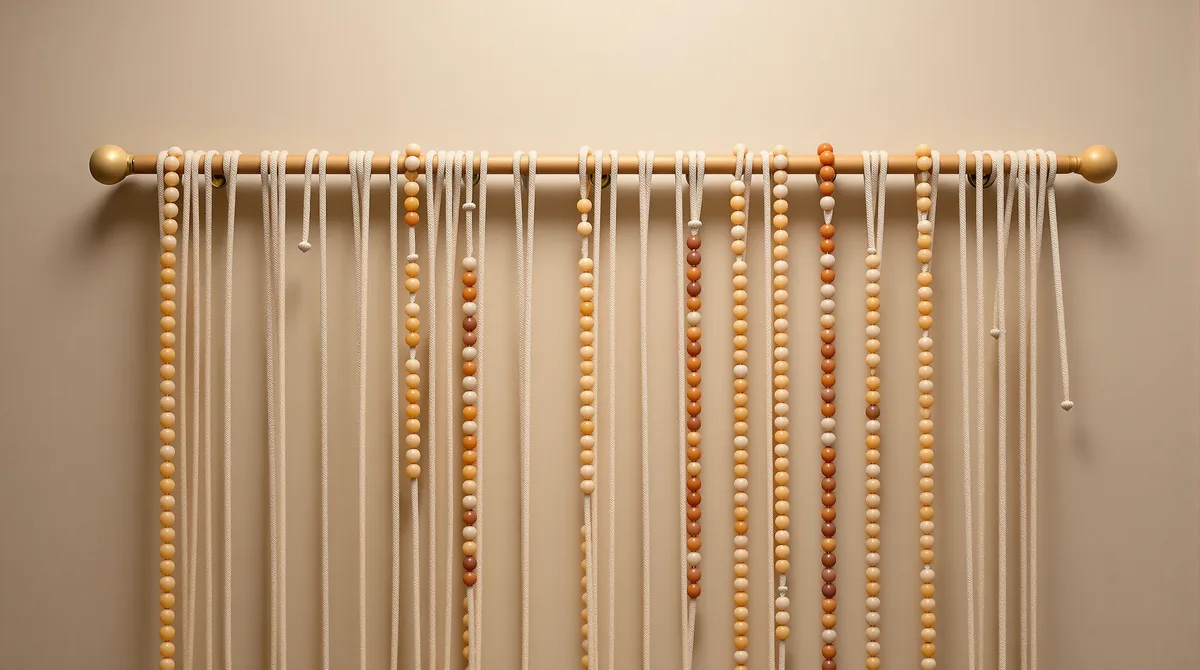
We build the mount into the panel rather than leaving it to the installation. The construction options we actually make are a stained wooden header rail or a single turned dowel, end suspension loops knotted at the top of each strand so a panel can be levelled on hooks, and a stitched cotton header band with a rod pocket — three inches is the pocket depth used on the café-curtain builds.
End loops are the detail worth asking for. They let a panel be hung on two hooks and levelled by eye, which is far more forgiving in an old doorway than a rigid rail that assumes the frame is square.
Nearly always. A panel hanging crooked is a header problem, not a panel problem. A strand that twists is usually caught on its neighbour near the top. A panel that has slipped is a fixing failure.
The genuine repairs are a parted strand, which is re-strung, and a split dowel, which is changed. Neither is a reason to replace a panel carrying several thousand hand-placed beads.
Four lines, and they prevent most returns. Lift it by the rod. Hang it before you untie anything. Check the header is level. Give it a day before you decide it is wrong.
Everything else — fixing choice, drop, floor gap — belongs on the listing rather than in the box, because it has to be read before the purchase rather than after it.
The spare beads, if the order specified them, because they are the only practical way to repair the panel later. The transit ties, which are the right thing to use if the panel is ever taken down. The packing, if it held the strands in order, because that is how it should go back.
And a note of the fixing you used. In three years, when the panel moves to another doorway, the one thing nobody remembers is what was holding it up.
Look along the header from one end, at eye level: the line should be straight and the dowel should not be able to roll. Look at the hem from a few steps back: on a straight hem the bottom edge should be a clean horizontal, and on a shaped hem the shape should be symmetrical about the panel's centre.
Then come back the next day. If the hem has dropped slightly and evenly, that is settling and it is finished. If one area has dropped and the rest has not, one strand is caught at the header.
The published format is a panel hung from a wooden dowel or rod at about 90 × 200 cm, roughly 35 × 79 in, and our live builds put 30 hand-strung strands on a single wooden dowel across several of the portal designs. Portals in the design library run 76 × 140 cm, and there is a 90 × 67 cm format that hangs either as a short portal or as a wall hanging.
The mounting detail that came out of real production is the end suspension loop, developed so a portal could be hung level on a door or a wall rather than depending on a square frame. Beaded décor runs 40 to 60 days after sample approval, with sampling usually 16 to 20 days from an agreed brief — so the fixing is worth deciding at the brief, not at the wall.
Extractable data
| Fixing | Drilling | Best for | Where it fails |
|---|---|---|---|
| Tension rod in the reveal | None | Light acrylic, wood and bamboo panels; rented rooms | Friction only — slips under glass or a wide span |
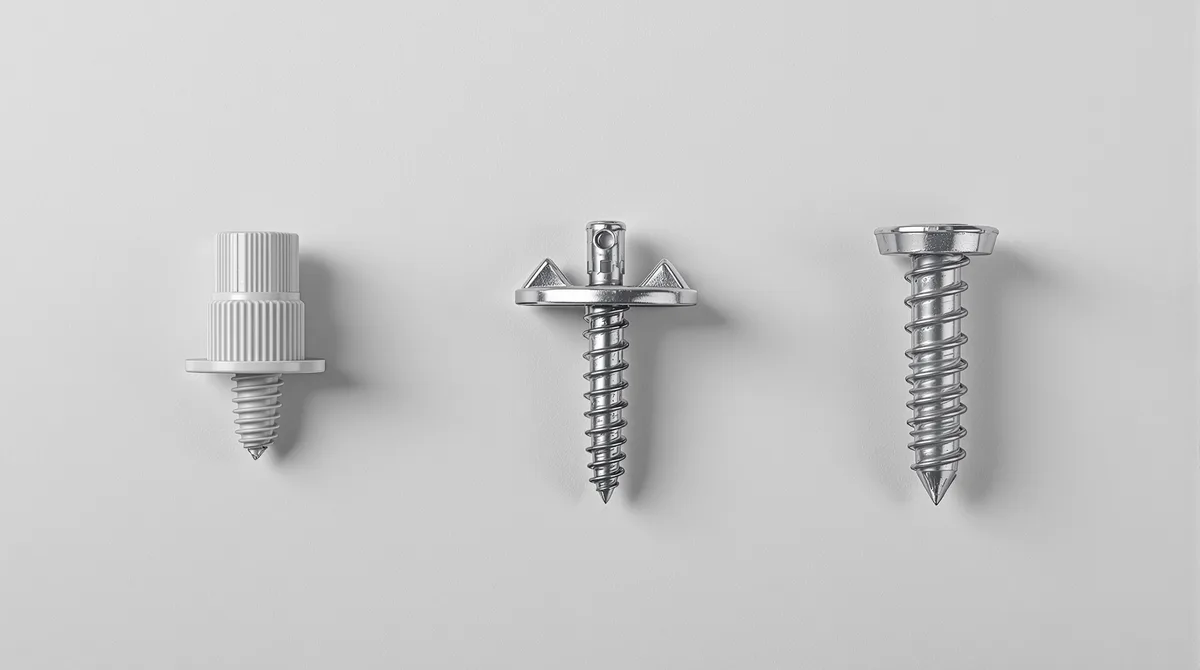
| Cup or screw hooks | Two small holes | Most panels on a dowel or end loops | Pulls out of plasterboard with no fixing behind it |
| Rod on brackets | Bracket fixings | Glass panels, wide openings, heavy drops | Brackets rated below the load |
| Ceiling hooks or track | Into a joist | A panel hung away from a wall | Fixed into board instead of structure |
| Rod pocket on a rod | Depends on the rod | Panels built with a stitched cotton header | Rod too thin for the pocket, so the header sags |
| Panel weight rating | — | Weighed on the approved sample | Hardware is specified to the weighed panel |
Good to know
Yes. A tension rod inside the door frame works well for light acrylic, wood and bamboo curtains, and it is the usual answer in a rented room. It is a friction fixing, so it is not the right choice for a glass panel or for a span much wider than a single interior door.
On a rod with brackets fixed into the frame or the wall, rated for the curtain's weight. Glass is the heaviest option in the category by a wide margin, and the failure is never gradual — a friction fixing holds until it does not. Fix into timber or into a proper wall anchor, not into plasterboard alone.
Always lift it by the rod, settle it after hanging, and store it in loosely tied bundles. The tangles that matter nearly all happen in the first five minutes, because somebody lifted the panel by its strands or shook it out of the carton.
Inside the reveal looks neat and keeps the panel tight to the opening. Above the frame makes the doorway read taller and gives the strands clearance to swing. Either is correct; decide before you measure the drop, because the two give different finished lengths.
Twenty minutes to half an hour for a single door panel, most of it in marking and levelling. The strands themselves take almost no time. If it is taking an hour, something is being lifted by the strands, which is the point at which it starts taking two.
A tape, a pencil, a spirit level and whatever drives the fixing you chose. The spirit level is the one people skip and the one that matters: a header out by a couple of millimetres across a 90 cm span shows clearly at the hem, because the hem is 200 cm away from it.
Hang the panel anyway, then re-string that one strand. A broken strand is a repair rather than a write-off — it is re-strung in its original bead order and re-knotted at the header, which is why spare beads are worth specifying with the order. Photograph it before you touch it.
Keep exploring
Specification
What a beaded panel weighs by material and density, and which fixings suit light acrylic against heavy glass.
View the rangeGuides
One guide per question that arrives often enough to be worth answering properly.
See the detailGuide
Where to position hooks, what size to use, and the anti-roll detail that stops a dowel walking off them.
See the detailGuide
How to reach structure, how to establish the load first, and when a track beats a pair of hooks.
See the detailGuide
Which part of a frame is solid, where to position the fixing relative to the door swing, and the screws that hold.
Read the guideGuide
Three failure causes in order: a fixing into board with nothing behind it, hardware rated below the load, and a dowel that can leave its seat.
Specs and sizesGuide
What settling is, how long it takes, how to help it along, and why nothing should be cut until it is finished.
Specs and sizesGuide
Open the carton flat, find the header first, lift by the rod, hang it, then release transit ties one at a time from the top down.
Compare the options
Start a conversation
Send a reference, a colour chip or a sketch. Minimums are set per design and confirmed per quote; sampling is quoted separately and usually runs 16 to 20 days from an agreed brief.