Guide
Hanging a beaded curtain
Find the load, pick the fixing, mount the header level, load the strands dry, then let them settle before judging it.
See the detail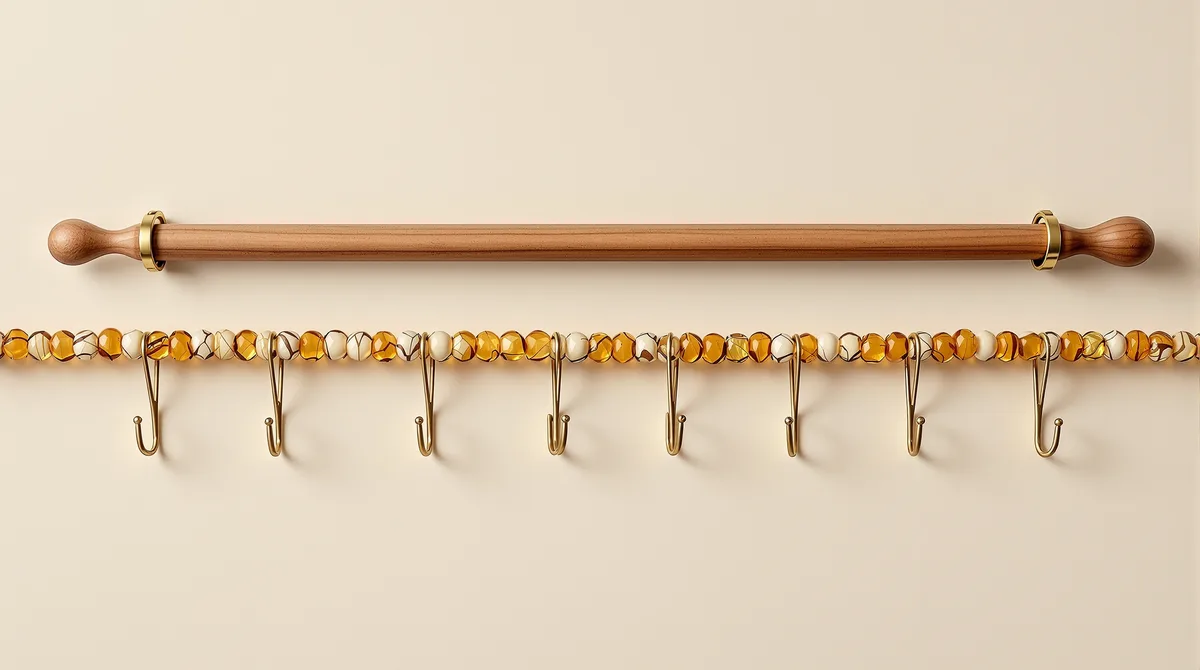
Guide · Install
Two hooks into solid timber is the cheapest fixing in this subject and one of the best. Three details decide whether it works.
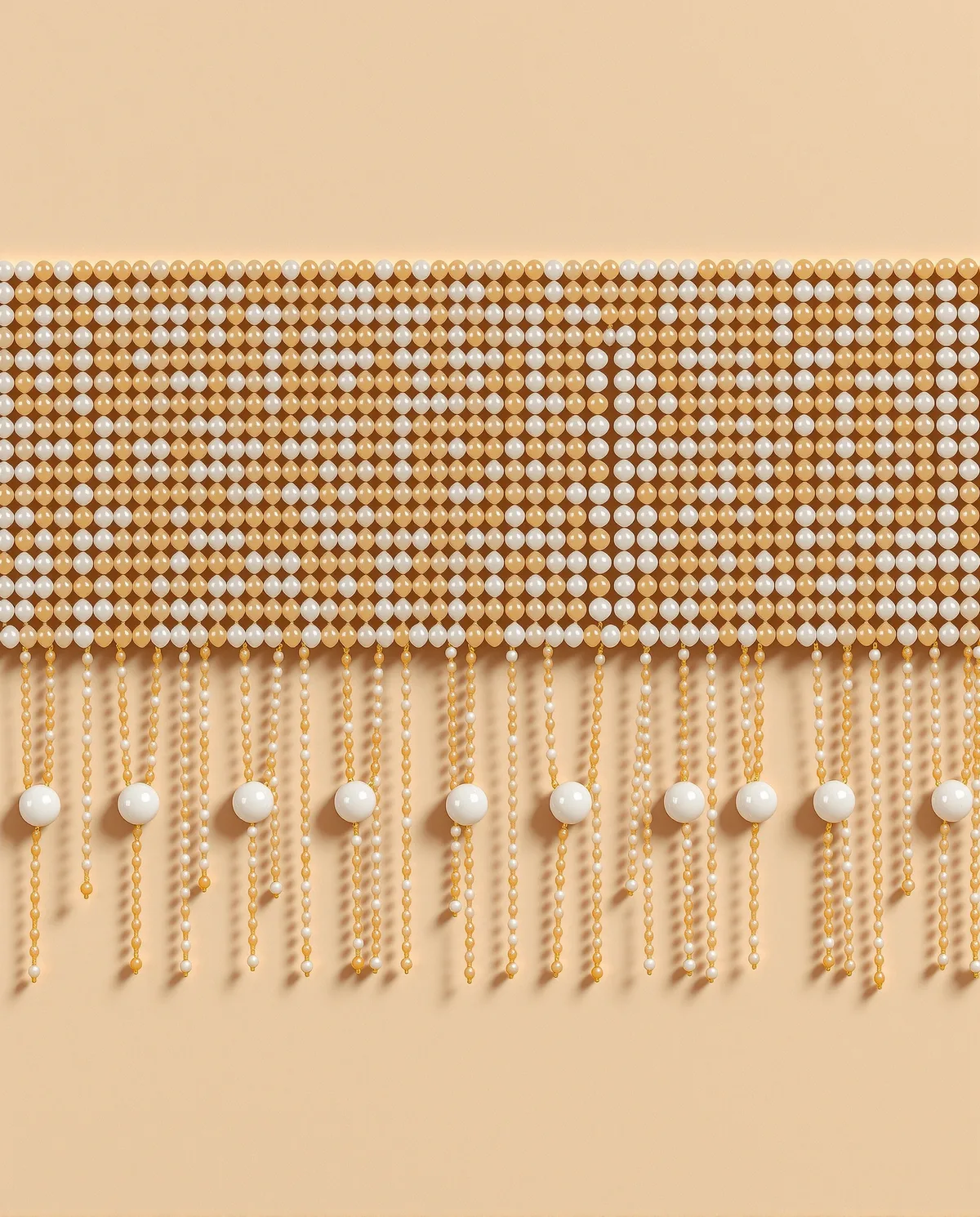
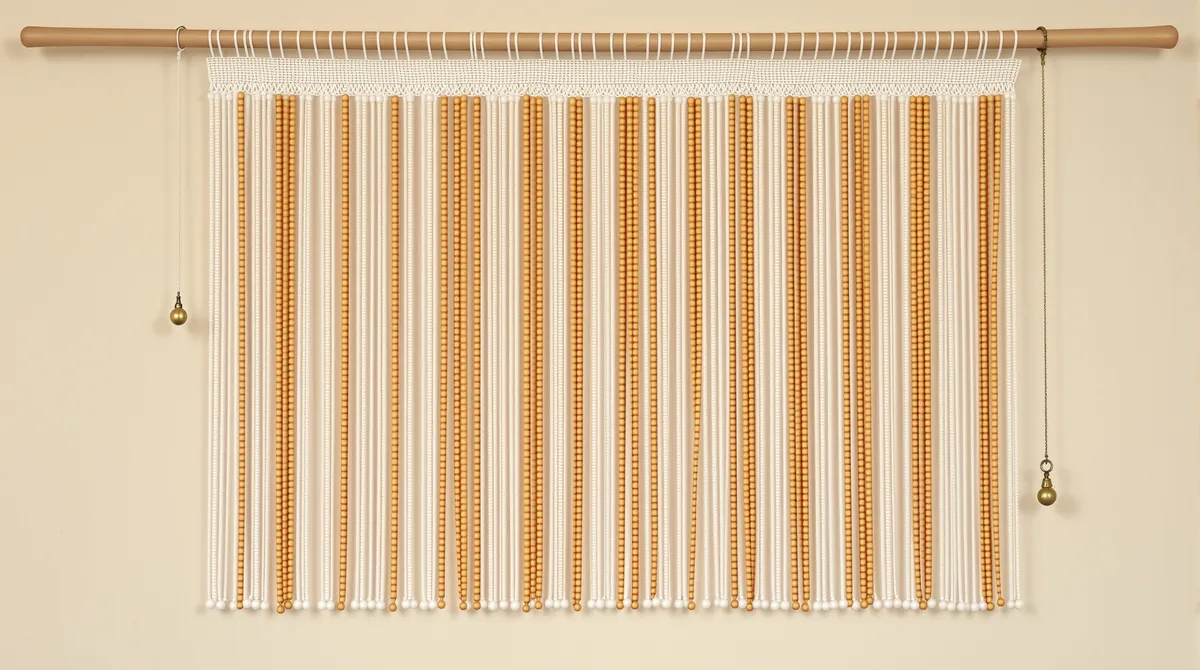
Brass cup hooks and steel screw hooks laid out in a row, a turned wooden dowel resting in two of them with the first knotted row of a cream and amber beaded panel below.
Screw two cup hooks into the solid timber of the door lining, set in from each end by about a tenth of the panel's width, with the openings facing upwards and slightly inwards so the dowel cannot roll out. Use hooks whose thread reaches well into the timber, and add a stop at each end if the dowel is round and smooth.
Two hooks, in the right timber, at the right spacing, facing the right way. That is all of it, and each of those four has a wrong version.
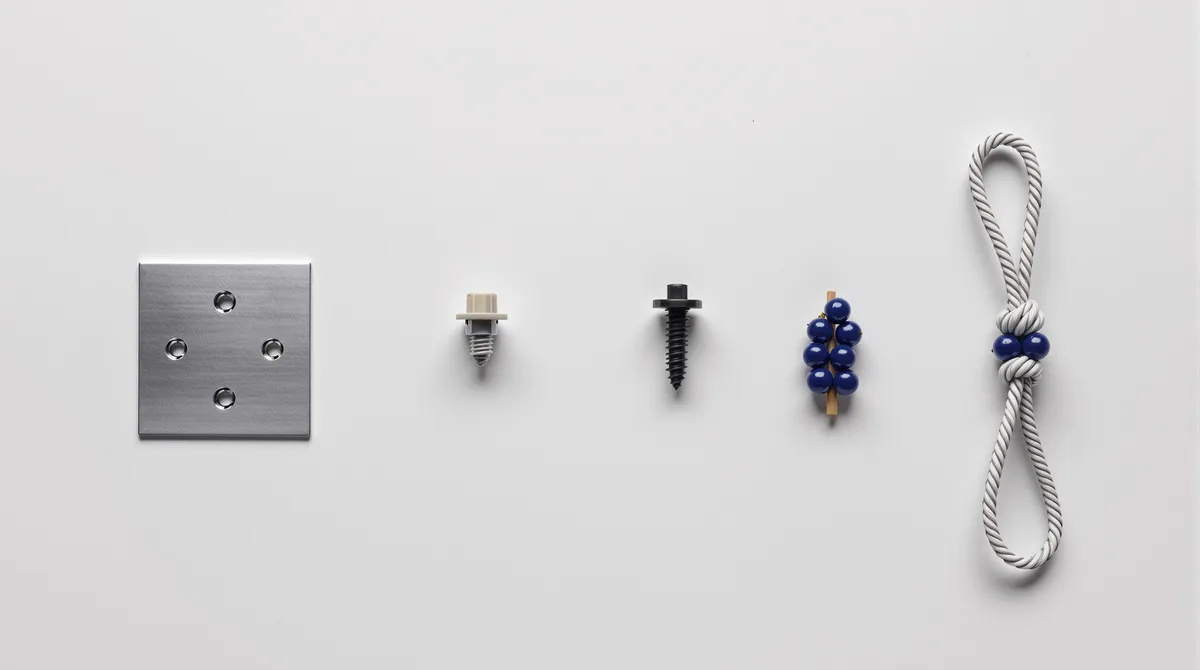
Cup hooks or screw hooks whose thread is long enough to get 20 mm or more into solid timber once it has passed through paint and any filler. For anything other than timber, the wall fixings question is a substrate question first. A bradawl or a 2 mm drill bit. A tape, a pencil, and a level if you want to be sure.
And the panel's width, because the hook spacing comes from it: set in from each end by about a tenth of the width, so a 90 cm panel gets hooks about 9 cm in from each end.
Find the lining. Tap along the architrave: over the lining it sounds solid, beyond it hollow. The lining is the timber the door itself hangs from and it is typically 25 to 38 mm thick.
Mark two points on the head of the lining, inside the architrave, at your calculated spacing. Check they are level with each other.
Drill pilot holes at about two thirds of the thread diameter — on a painted lining a pilot hole is the difference between a clean fixing and a split. Turn the hooks in by hand, using a screwdriver shaft through the eye for the last turns, until the thread is fully buried.
Set the openings facing upwards and canted very slightly inwards, towards each other. Then hang the panel by its dowel.
Designs the header so a hook has something to hold.
A hook carries the dowel, not the beadwork, which is the whole reason this fixing works at all. The load arrives at two points, so the hooks have to be in the frame rather than in the architrave and set in from each end rather than at the corners.
The detail that matters most to a hook fixing is the suspension loop. Some constructions carry end suspension loops knotted at the top of each strand, specifically so the panel can be hung level from a door or a wall without a rail. Where a panel has those, two hooks and nothing else will hang it perfectly level, and the wooden dowel is held rather than balanced. The panel headers reference covers which constructions carry them.
When a hook has opened or pulled, which is the usual failure and a slow one.
A cup hook under a load it was not chosen for does not snap. It straightens, a fraction at a time, over months, until the dowel slides out of the opening — which is why the panel weight is worth establishing before the hook is bought. Replacing the hook with a larger one — or with a bracket and rod if the panel is glass — fixes it, and the panel is untouched.
A hook pulled clean out of its hole almost always means it went into the architrave rather than the lining. Re-site it, do not re-use the hole.
Four short sentences. Fix into the door frame, not into the architrave. Two hooks, set in from each end. Openings facing up and slightly inwards. Lift the panel by the dowel, never by the strands.
One spare hook, the spare beads, and the original stopper beads.
The spare hook matters more than it sounds. Hooks come in a range of thread lengths and gauges, and a replacement bought two years later is almost never the same — which means re-drilling, which means a new hole in the lining.
Hang on each hook with your hand before the panel goes near it. A hook that is going to open will flex under a firm pull, and finding that out with an empty hand costs nothing.
Then look along the hem a week later. A panel sitting low at one end means that hook is opening, and it is much easier to deal with at a two-millimetre droop than at twenty.
It says hooks are one of the two standard domestic fixings and the one chosen for simplicity and strength.
Our own fixing guidance divides by panel weight. A tension rod with no drilling suits light panels — acrylic, bamboo and wood — and renters. Cup hooks or screw hooks are the simple and strong option, holding the rod or the dowel loops. A curtain rod and brackets is for heavier glass panels and wide openings. A ceiling hook or track is for a panel hung away from a wall, fixed into a joist.
Hooks sit in the middle of that list on purpose: stronger than anything that does not drill, simpler than anything that does more.
For a short panel or a valance, hooks are fine. A valance at roughly 120 × 30 to 40 cm holds a bead count of about 900 to 2,000 on our 2027 design-render basis and is a light object even in glass.
For a full-length glass panel, use a rod on brackets. Glass is roughly twice as dense as acrylic, and a densely patterned 90 × 200 cm panel holds about 11,800 beads on the same render basis against roughly 3,100 for a spaced one. That is the range a hook would have to cover, and the heavy end of it is a bracket job.
No, with one specific exception: do not hook strand loops directly over a cup hook as a substitute for a dowel. The hook's cut edge bears on a single point of the loop, and over a year or two it wears through it.
Hang the dowel. If a panel genuinely has no dowel — a rod-pocket construction, for instance — then it needs a rod, and the rod goes on the hooks.
Acrylic and wood: two hooks, straightforwardly. These are the panels hooks were made for.
Glass: hooks for a valance or a café panel, brackets for anything full length.
Faux capiz disc hangings: light, so hooks are plenty. Handle the columns carefully while hanging, because a laser-cut edge chips against a door frame — a disc finished to imitate capiz shell shows the raw material under the finish the moment it does.
Extractable data
| Decision | Get it right by | Why |
|---|---|---|
| What to screw into | The timber door lining, inside the architrave | The architrave is a thin moulding, often over a gap |
| Hook position, 90 cm panel | Two hooks, in about 9 cm from each end | Keeps the dowel's overhang short so it cannot bow |
| Hook position, 120 cm panel | Three hooks, the middle one centred | A long dowel bows between two supports |
| Hook orientation | Opening up, canted slightly inwards | Captures the dowel instead of balancing it |
| Thread length | Enough to reach 20 mm or more of solid timber | A short thread in paint and filler holds nothing |
| Pilot hole | About two thirds of the thread diameter | Prevents splitting a painted lining |
| Anti-roll detail | A stop, a rubber band, or a strand loop over the hook | A smooth round dowel will walk off an open hook |
| Suits | Acrylic, wood, bamboo panels; valances in any material | Light to moderate loads |
| Does not suit | Full-length glass panels | Use a rod on rated brackets instead |
Good to know
A bradawl or a small drill for pilot holes, a tape, a pencil, and something to turn the hook with once it gets tight — a screwdriver shaft pushed through the hook's eye gives you the leverage. No wall plugs, because you are going into timber, which is the main reason to use hooks at all.
Not if the panel hangs from its dowel. Where cord does get damaged is when a strand loop is hooked directly over a cup hook as a way of fixing a panel without a dowel: the hook's cut edge bears on one point of the loop and will eventually wear through it. Hang the dowel, not the loops.
For a valance or a short panel, no — hooks are fine. For a full-length glass panel, yes: it belongs on a rod carried by brackets rated above its weight. A cup hook under a glass panel opens slowly over years rather than failing suddenly, and the first sign is a panel sitting low at one end.
Yes, and hooks are ideal for a display because they are quick and reversible. For a scheme that changes monthly, screw the hooks into a timber batten rather than into the shop's woodwork, and fix the batten once.
Re-string it before hanging, with the panel flat, in bead-map order from your spare beads if the order specified them, finishing the end with a crimp or the original stopper bead. Hooks make it easy to lift a panel down for a repair, which is a genuine advantage of this fixing over a rod on brackets.
Fifteen minutes. Ten of those are measuring and marking; the hooks themselves go in by hand once the pilot holes are drilled. It is the quickest permanent fixing available in this subject, which is why it is worth doing to the right standard rather than approximately.
Keep exploring
Guide
Find the load, pick the fixing, mount the header level, load the strands dry, then let them settle before judging it.
See the detailGuides
One guide per question that arrives often enough to be worth answering properly.
Specs and sizesGuide
How to establish the real load, which fixing class it demands, and why the substrate decides the job.
Specs and sizesGuide
Open the carton flat, find the header first, lift by the rod, hang it, then release transit ties one at a time from the top down.
See the detailGuide
Down by the header, bundled loosely in sections, never folded, carried flat or hanging — the method the original packing already used.
See the detail
Start a conversation
Send a reference, a colour chip or a sketch. Minimums are set per design and confirmed per quote; sampling is quoted separately and usually runs 16 to 20 days from an agreed brief.