Guide
Transporting beadwork
Down by the header, bundled loosely in sections, never folded, carried flat or hanging — the method the original packing already used.
Read the guide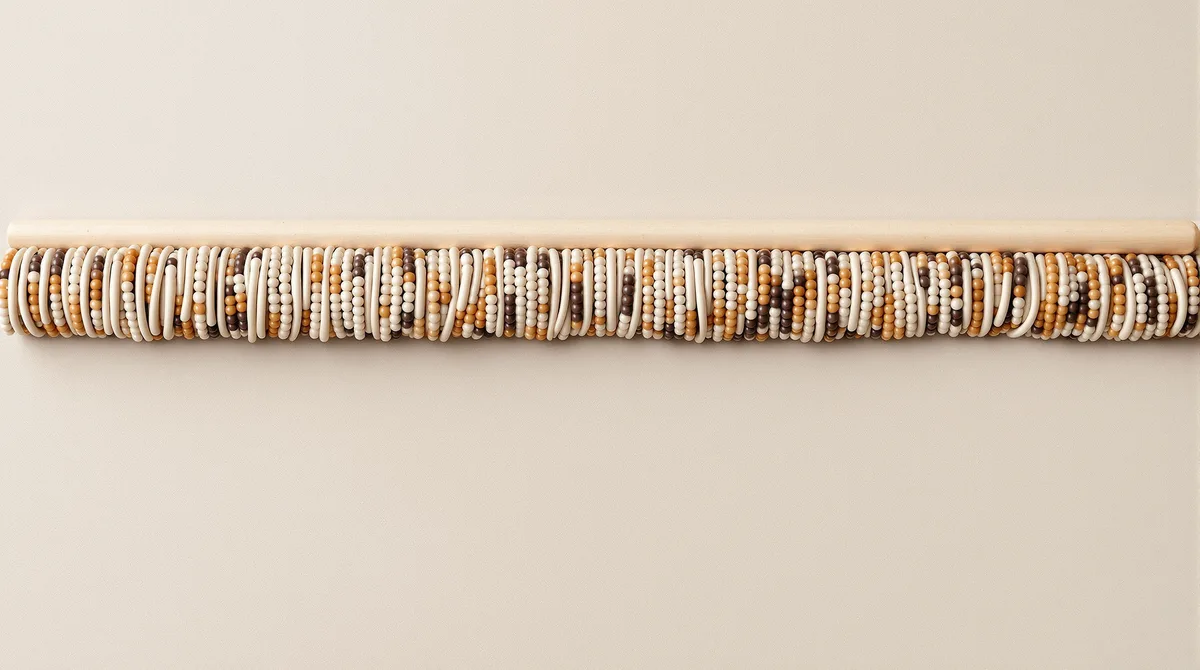
Guide · Care
A panel that goes into a box as a bundle comes out as a panel. A panel that goes in as a panel comes out as a knot.
A beaded panel gathered and bound into one close coil for storage, the strands lying together with no cord crossing another, in oat, chocolate and chalk white.
Take the panel down by its header, gather the strands into a few loose bundles in the order they hang, and tie each bundle softly at two or three points. Lay it flat or roll it around a tube — never fold it — and store it dry, out of direct sun and away from heat. Label it with the opening it came off.

Down, dry, bundle, box, label. In that order, and the dry step is not optional.
Taking a panel down is the moment most storage damage happens, because a panel that has been hanging for two years has settled into a state and handling it badly undoes that in seconds. Lift by the dowel. Never gather the strands in your arms.
Lift by the dowel. Never gather the strands in your arms.
The dry step is not optional. Cotton cord in a damp box slackens, discolours, holds dust and loses the strength it needs to carry several hundred beads per strand, so store at ordinary room conditions inside the heated part of the house.
Into three to five bundles for a 30-strand panel, each one a contiguous group of strands in hanging order. Keep each group together; do not interleave. Tie each bundle at two or three points down its length, loosely enough that the ties slide — soft ribbon, wide tape or a strip of cotton. Not string, not elastic bands, not cable ties.
Store the dowel with the panel, attached. Lay the whole thing flat so the dowel is supported along its length, or roll the panel around a cardboard tube and lay the roll flat. Never fold a strand: a fold puts a set into cord that it never fully loses.
The opening it came off, the strand count, the date, and whether spares were supplied with that panel. Four facts on a luggage tag.
Because everything else in a bead panel is inert and the cord is not. Glass, acrylic and faux capiz sit in a box for a decade and change nothing. Cotton cord in a damp box slackens, discolours, holds dust and loses the strength it needs to carry several hundred beads per strand.
Which makes storage, for a bead panel, almost entirely a humidity question. Cool and damp is worse than warm and dry. The only competing factor is heat, which softens acrylic, so the ideal is ordinary room conditions inside the heated part of the house.
| Component | Dry store | Damp store | Direct sun | Note |
|---|---|---|---|---|
| Glass beads, body colour | Fine | Fine | Fine | The most stable component in storage |
| Surface-dyed beads | Fine | Avoid | Avoid | Dye is a surface property and fades |
| Acrylic beads | Fine | Fine | Avoid | Softens with heat; keep out of a hot loft |
| Wood beads and dowel | Fine | No | Avoid | Swells, marks and can lift a lacquer |
| Bamboo beads | Fine | No | Avoid | Marks in damp and will not recover |
| Faux capiz discs | Fine | Fine | Avoid | Stack flat; thin discs take a set if loaded |
| Cotton cord and header | Fine | No | Avoid | Damp cord slackens, discolours and holds dust |
Keep both out of light. Surface dye carries its colour as a coating and fades, and a panel stored in a sunlit room under a dust sheet is still being bleached through the sheet.
Frosted and sea-glass beads need a different care: do not let them rub. Their matte finish is a surface texture, and strands pressed together under weight for a season will polish each other at the contact points. Loose bundles, not tight ones, and nothing stacked on top.
Store them with the panel, attached. The dowel is the thing holding the strand order, and a stitched cotton header band is the same — unpicking either to save box space costs hours later.
Protect both from damp and from point loads. A dowel resting across two supports with the panel's weight hanging in the middle will bow over months. Lay the whole thing flat so the dowel is supported along its length, or roll the panel around the dowel and lay the roll flat.
Repair it, or bag it. A panel that goes into storage with a parted strand and a handful of loose beads loose in the box comes out with no repair possible, because the beads have mixed with everything else and the order is gone.
If you are repairing, do it before storage while the neighbouring strands are still hanging as a reference. If you are not, bag the loose beads, label the bag with the strand position, and put the bag in the box with the panel rather than in a drawer.
Into three to five bundles for a 30-strand panel, each one a contiguous group of strands in hanging order. Keep each group together; do not interleave.
Tie each bundle at two or three points down its length, loosely enough that the ties slide. Soft ribbon, wide tape or a strip of cotton. Not string, not elastic bands, not cable ties: anything narrow bites into cord under the bundle's own weight and leaves a permanent mark on the cord at that point.
Then lay flat or roll around a cardboard tube. Rolling is better for a long panel because it supports the whole length.
A folded strand. A fold puts a set into cord that it never fully loses, and on a long panel every strand folds at the same height, so the panel comes out with a visible line across it.
Also permanent: a wood or bamboo bead that has been damp, a surface dye that has faded unevenly because half the panel was in light, and a frosted bead polished smooth at a contact point. None of those is recoverable, and all four are storage errors rather than wear.
The opening it came off, the strand count, the date, and whether spares were supplied with that panel. Four facts on a luggage tag.
The opening matters most. In a house with more than one bead panel, or in a shop with several display panels, the single most time-consuming moment is working out which of three bundles fits which doorway — and the answer was obvious the day it came down.
In documentation and in who handles it. A hospitality or retail panel that comes down for a refurbishment will be handled by somebody who has never seen it hanging, so the bundle has to carry its own instructions: lift by the dowel, do not untie until hanging, strand order is preserved.
Our own panels go out packed with the strands held in order from the quality control and packaging house at Greater Noida, which is why a new panel arrives untangled. Storage is just that packing method repeated by someone else, and it fails when the method is not written down.
Inspects it, then packs it so the strands cannot move relative to each other. Inspection runs as first-article and lot checks on an AQL plan — strand length consistency, knot seating, bead alignment, chipping — and only then does the panel get packed for export.
The reason that matters for home storage is that it is the same problem. Transit and storage both do their damage by letting strands move against each other, and both are solved by holding the order.
Leave it hanging. A bead panel in a doorway needs ten minutes of dry dusting a month and nothing else, and hanging is the condition it was designed for — the strands are supported along their whole length by their own weight, which is the least stressful state they can be in.
Seasonal storage is for seasonal pieces. If a panel is coming down because the room has changed, consider whether another opening wants it, because an unstored panel keeps all of its value and a stored one risks some.
Good to know
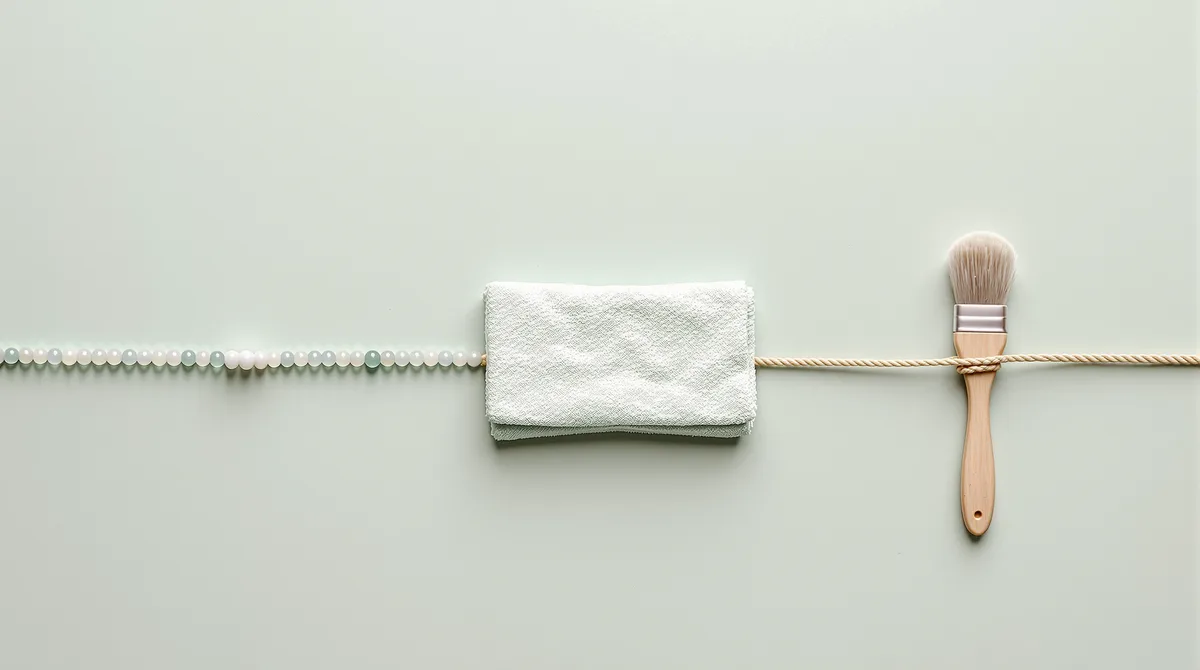
Anything wet. The temptation is to clean a panel before putting it away, and a damp panel in a closed box is the worst thing you can do to it: the cord stays wet, the wood swells and dust turns to film. Dry brush it, then store it.
Yes, and it should be — leave the strands attached to it. The dowel is what keeps the strands in order, and re-tying thirty strands to a dowel is a far bigger job than storing a slightly longer box. Keep the dowel dry and do not rest weight on its middle.
Flat, separated by acid-free tissue, with nothing stacked on top. Embroidered beadwork has a stiffened ground and every bead is couched individually, so pressure deforms the ground and crushes beads against each other. Rolling is for strung panels; flat is for embroidered ones.
No. A parted strand is a repair: re-strung in its original bead order and re-knotted at the header, which is why spare beads are worth specifying with the order. Bag the loose beads from that strand separately and label them, because they are the material for the repair.
Bundled, boxed, labelled, somewhere dry and not hot. A loft is usually the wrong choice because of summer heat on acrylic; a wardrobe or a cupboard inside the heated envelope of the house is right. Check it once in the season rather than once in five years.
No. A strung panel has no textile structure — the cord carries everything — so a drum tangles the strands into one mass and abrades the cord at every drill hole. Immersion of any kind soaks the cord, and the cord is the part that fails.
Keep exploring
Guide
Down by the header, bundled loosely in sections, never folded, carried flat or hanging — the method the original packing already used.
Read the guideGuides
One guide per question that arrives often enough to be worth answering properly.
Open the referenceGuide
Why the cloudiness is mineral film rather than damage, and why how you dry matters more than what you clean with.
Specs and sizesGuide
Which beads can be swapped, why re-dyeing a strung panel does not work, and the replace-or-live-with-it call.
Read the guideGuide
Dry dusting first, spot cleaning the beads, keeping the cord dry, what never to use, and how to handle a broken strand.
Compare the optionsGuide
Cord and wood fail first in humidity, long before glass notices. Which materials and cords survive a persistently damp room.
Read the guide
Start a conversation
Send a reference, a colour chip or a sketch. Minimums are set per design and confirmed per quote; sampling is quoted separately and usually runs 16 to 20 days from an agreed brief.