Specification
Beadwork in a kitchen doorway
Grease, steam and daily traffic: which bead materials survive a kitchen opening, which finishes do not, and how often it needs cleaning.
Open the reference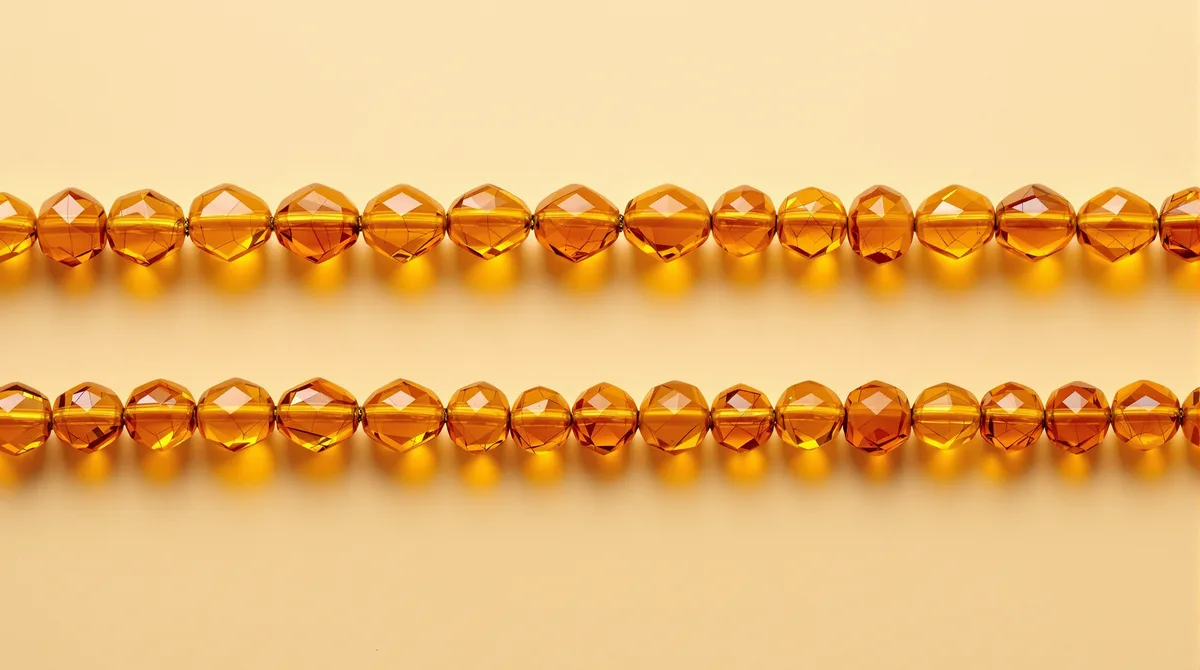
Guide · Care
Film is the only condition on a bead panel that justifies a detergent. It is also the only one that dry brushing cannot touch, which is why it needs its own method.
Two strands of the same amber glass beads side by side: one dulled under an even yellow-brown greasy film, the other clean with a crisp specular highlight on every bead.
Dry brush the whole panel first, then work in sections with a cloth wrung out in lukewarm water and a little mild soap, drying each bead in the same pass with a second cloth. Keep the cord, the dowel and any fabric header out of the water entirely. Never spray, never immerse, and never use a degreaser or a solvent.
Dry brush the whole panel, then damp-work it in sections, drying as you go. Nothing else, ever.
The order is not a nicety. Film and loose dust together make a paste, and a damp cloth on a dusty film smears it along the strand rather than lifting it. Dry first and the film is a thin layer with nothing in it; damp second and it comes off in one pass.
Because it is the only structural component on the panel and the only one that water harms. Wet cotton cord slackens, discolours, holds dust and abrades against the drill hole of every bead it passes through under load — and a parted strand is the result.
That single fact generates every rule on this page. A barely damp cloth is allowed because it puts almost no water into the system. A spray is not, because spray reaches the cord. Immersion is not, because immersion is the cord.
| Component | Mild soap, damp cloth | Degreaser or solvent | Note |
|---|---|---|---|
| Glass beads, body colour | Yes | No | The most tolerant component |
| Frosted or sea-glass beads | Lightly | No | Light pressure; hard rubbing polishes the surface |
| Surface-dyed beads | Lightly | No | Dye lifts on contact with solvent |
| Acrylic beads | Yes | No | Solvents craze acrylic; heat softens it |
| Wood beads and dowel | No | No | Dust and wipe dry only |
| Faux capiz discs | Lightly | No | Abrasives dull the face permanently |
| Cotton cord | No | No | Keep dry; this is the structural component |
| Cotton header or rod pocket | No | No | Marks and shrinks unevenly |
Dry brush the whole panel first, from header to hem, strand by strand. Then take a bowl of lukewarm water with a few drops of mild soap, two cloths, and work in sections of five or six strands.
Wring the first cloth until it is barely moist — if it can leave a drop, it is too wet. Hold the strand steady from behind, wipe down a short length, and dry that length immediately with the second cloth. Work downwards and finish each section before moving on, so you can see what is done.
A 30-strand panel in a kitchen doorway takes about an hour this way, and it is the only hour of wet work a bead panel should ever see.
Because a degreaser is formulated to break down a thin film bonded to a surface, and on a surface-dyed bead the colour is a thin film bonded to a surface. The product cannot tell the difference.
The same reasoning rules out solvents, which lift dye on contact and craze acrylic, and steam, which softens acrylic and drives water into the cord faster than anything else available. Mild soap in lukewarm water is weak on purpose: strong enough to carry a kitchen film away, too weak to touch anything structural.
With less pressure and less patience than you want to use. Surface-dyed beads lose colour to rubbing as well as to solvent, so a dyed bead gets one light pass and whatever comes off, comes off.
Frosted and sea-glass beads need the same restraint for a different reason: their matte look is a surface texture, and rubbing hard polishes them into gloss. A greasy frosted valance buffed clean will be bright and wrong, and it cannot be put back.
Dry only, both. The dowel raises its grain if it gets wet and can lose a lacquer; a stitched cotton header band behaves like any cotton — it marks, shrinks unevenly and wicks water straight to the knots above every strand.
Where a kitchen panel has film on the header itself, accept a partial result. A dry cloth will lift some of it and nothing safe will lift all of it, and a slightly darkened dowel is better than a weakened header.
Stop, collect the loose beads, and bag them before doing anything else. Then finish cleaning the rest of the panel, because it is easier to re-string into a clean panel than a greasy one.
The repair itself is a re-string in the original bead order, re-knotted at the header. The thing worth noticing is why it happened: a strand that parts under the light pressure of a cloth had already lost strength, which usually means earlier damp.
Every few months in a doorway off a working kitchen; more often where anybody smokes; essentially never in a bedroom or a hallway.
The variable is airborne grease rather than time. Dust alone brushes off dry for years. Grease turns each month's dust into a layer that will not brush off, which is why a kitchen panel needs a different schedule rather than a different method.
A dye lifted by a degreaser. A frosted bead polished smooth. A crazed acrylic bead, which is what solvent does to acrylic. A lacquered dowel that has been wet. And a cord that has been soaked, whose loss of strength is invisible until a strand parts.
Everything else is recoverable, and all five are cleaning errors rather than wear.
Position, extraction and bead choice, in that order. A panel in a doorway two metres from a hob loads far faster than one across the room. Working extraction over the hob changes the problem more than any care regime will.
On bead choice: body-coloured glass tolerates this cleaning indefinitely, and surface-dyed beads tolerate it a limited number of times. If a panel is going into a kitchen doorway, that is an argument for specifying body colour at the brief — a decision that costs nothing and saves the panel.
Nothing, because a panel leaves clean — but the relevant discipline is the same. Panels are inspected and packed at our quality control and packaging house at Greater Noida, which runs first-article and lot inspection on an AQL plan, and the finish on each bead is checked against the approved sample.
What that means for a greasy panel at home is that the approved sample is the standard to judge against, not a catalogue photograph. If the panel still looks dull after a careful clean, compare it with the strands behind the door frame, which have had the least exposure. Those are the closest thing you have to the sample.
Good to know
Dry, downwards, strand by strand. Draw a soft brush or dry microfibre cloth from the header to the hem so dust leaves at the bottom. Doing it after the damp work instead means mixing dust into film and spreading it, which is how a panel ends up looking worse than when you started.
Kitchen degreaser, solvent, bleach, abrasive cream, steam and hot water. Degreaser is the specific temptation here and the specific mistake: it is formulated to attack a surface film, and surface dye on a bead is also a surface film.
No. Water raises the grain on a turned dowel and can lift a lacquer or wax finish, and the dowel is where every strand is knotted, so water there reaches the cord. If the dowel has film on it, wipe it with a cloth that is dry enough to leave no mark.
Spot work only, with almost no moisture, and never immersion. Embroidered pieces have a stiffened ground and every bead couched individually, so water swells the ground and slackens the thread. A greasy coaster is a candidate for retirement rather than restoration.
No — it is re-strung in its original bead order and re-knotted at the header, which is the repair spare beads are specified for at order stage. But a strand parting during cleaning is a warning: it means the cord was already weak, probably from earlier damp, and the other strands deserve a look.
It should not be. A film-covered panel in a closed box transfers the film to every surface it touches and the dust sets into it. Clean it, dry it thoroughly, then bundle it loosely in hanging order and store it dry.
No. A strung panel has no textile structure — the cord carries everything — so a drum tangles the strands into one mass and abrades the cord at every drill hole. Immersion of any kind soaks the cord, and the cord is the part that fails.
Keep exploring
Specification
Grease, steam and daily traffic: which bead materials survive a kitchen opening, which finishes do not, and how often it needs cleaning.
Open the referenceGuide
Dry dusting first, spot cleaning the beads, keeping the cord dry, what never to use, and how to handle a broken strand.
How it is madeGuides
One guide per question that arrives often enough to be worth answering properly.
Compare the optionsGuide
Why water raises grain and lifts lacquer, the dry method that works, and the damp limit that is worth respecting.
Specs and sizesGuide
The washing method with its temperature and soap limits, the solvent warning, and why static makes acrylic dustier.
Specs and sizesGuide
Solvents, bleach, abrasive cream, steam and hot water — what each does to dye, to frosted surfaces, to acrylic and to the cord.
Compare the options
Start a conversation
Send a reference, a colour chip or a sketch. Minimums are set per design and confirmed per quote; sampling is quoted separately and usually runs 16 to 20 days from an agreed brief.