Material
Wood, in detail
Turned and drilled in our own wood factory: grain variation you approve rather than eliminate, the finishes that hold colour, and the dowel from the same plant.
How it is made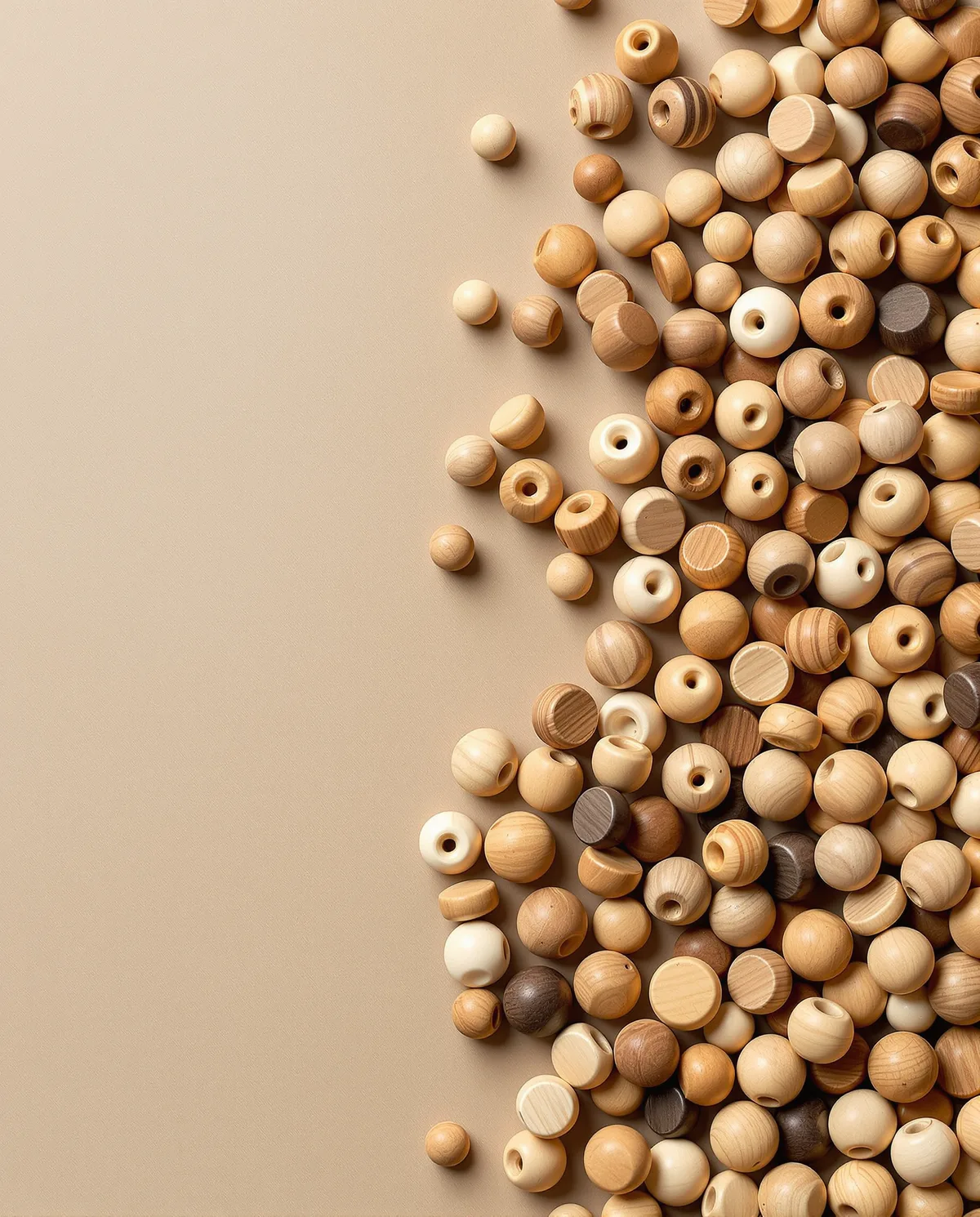
Guide · Care
Wood is the only bead in the category that is actively damaged by the thing most people reach for. Keep it dry and the bead outlasts the cord, which is the service item on any strung panel.
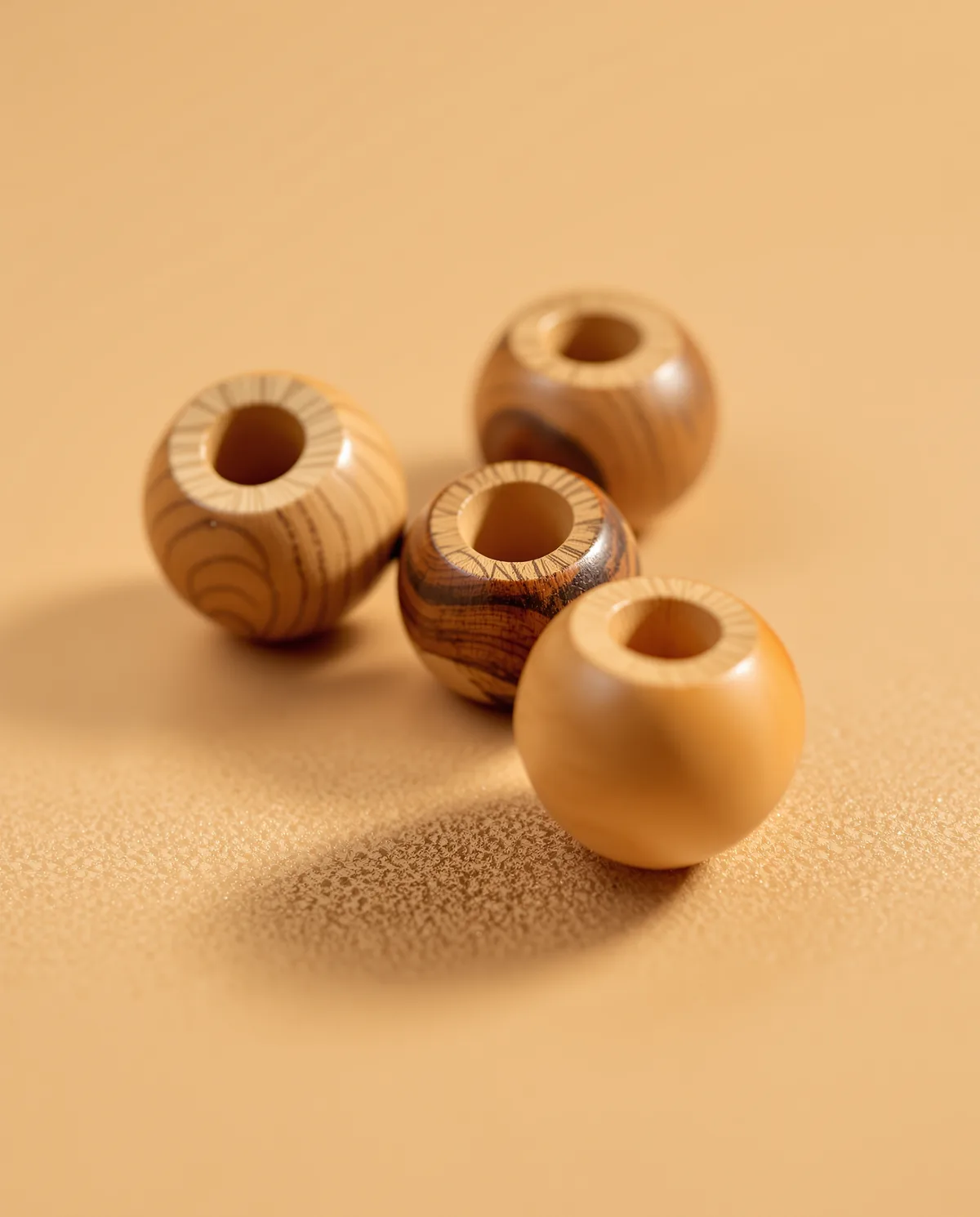
Turned wood beads in natural and stained finishes, rounds from ten to twenty millimetres and flat discs, the end grain open around each drilled hole.
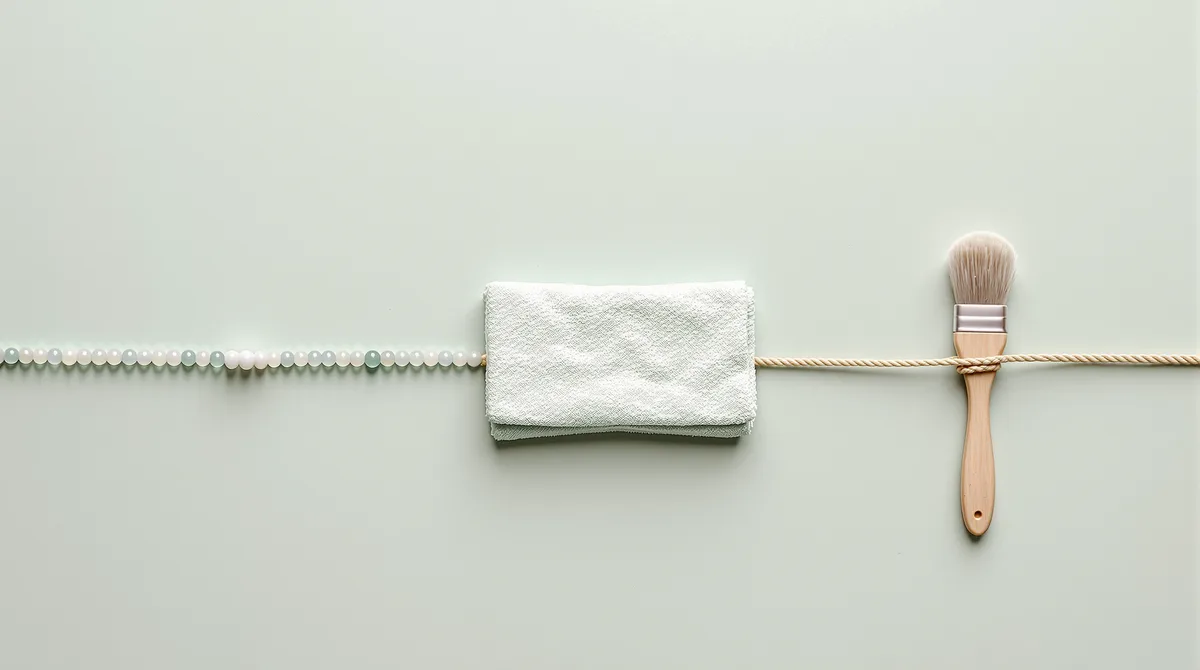
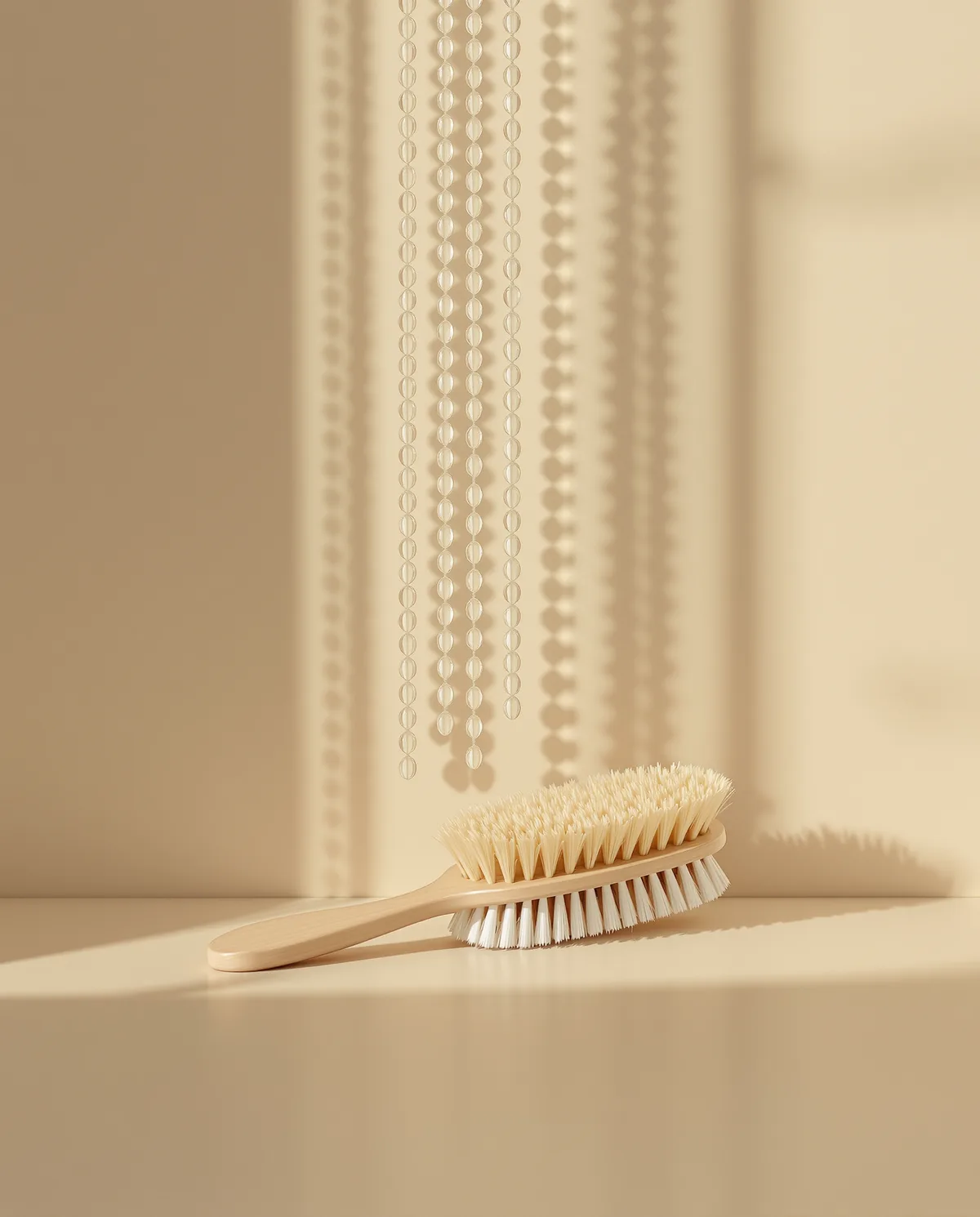
Clean wooden bead strands dry: a soft brush or a dry cloth drawn down each strand from the header to the hem. At most use a barely damp cloth, dried in the same pass. Never soak wooden beads and never let them stand in steam — water raises the grain, can lift a lacquer or wax finish, and swells the bead around its drill hole.
Dry, and then stop.
A soft brush or a dry cloth drawn down each strand from the header to the hem handles almost everything a wooden panel accumulates. If something has actually marked the wood, a barely damp cloth followed immediately by a dry one is the limit. There is no third step: wooden beads are never washed.
On a wooden panel the cord has an extra enemy, and it is the bead.
Cotton cord passes through the drill hole of every bead on its strand, and the stringing medium is specified against that hole. When a wooden bead takes up moisture it swells, and it swells inwards as well as outwards — the hole tightens around the cord. A tight hole grips, and a gripped cord abrades every time the strand moves.
That is the mechanism behind a fact that looks superstitious: wooden panels that have been through a damp winter drop strands the following summer. The cord did not fail from the water directly. It failed because the beads closed on it.
| Component | Dry clean | Damp cloth | Immersion | Notes |
|---|---|---|---|---|
| Turned wood beads, waxed | Yes | Barely damp | No | Wax is a surface; damp work dulls it over time |
| Turned wood beads, lacquered | Yes | Barely damp | No | Water can lift a lacquer at the drill hole first |
| Stained wood beads | Yes | Barely damp | No | Stain can bloom if it stays wet |
| Unfinished wood beads | Yes | No | No | Raises grain immediately; dry work only |
| Bamboo beads | Yes | Barely damp | No | As wood; keep out of rain and constant damp |
| Wood-tone accent beads in glass or acrylic | Yes | Yes | No | Tolerant, but the strand is only as tolerant as its wood |
| Cotton cord | Yes | Avoid | No | A swollen bead grips and abrades the cord at the hole |
| Wooden dowel | Yes | Barely damp | No | Same material, same rules as the beads |
| Steam exposure | — | — | Avoid | The one position to design out: a bathroom or kitchen hob doorway |
Three things, and all of them are finish damage rather than structural.
Raised grain. Once water has swollen the surface fibres of a turned bead, the smoothness is gone and the only remedy is to sand and refinish the bead, which is not practical on a strand of three hundred.
A lifted lacquer. Lacquer fails at the drill hole first, because that is where the end grain is exposed and where water sits. A lifted edge then catches the cord.
A bloomed stain. A stained bead that stays wet can go cloudy or patchy, and the patch is in the wood rather than on it.
Against those, a dulled wax finish is recoverable: a wax made for finished timber, applied sparingly and buffed, brings it back.
Position, mostly. A wooden panel in the wrong doorway will need attention constantly and a wooden panel in the right one will need almost none.
The positions to avoid are the ones with water in the air: a bathroom doorway, a doorway directly in an extract path from a hob, a utility room, a conservatory that condenses. Wood is hygroscopic and it will track the humidity of the room it hangs in.
The position to prefer is an interior doorway in a heated, ventilated space. There, dry dusting monthly is the whole maintenance programme, and a wooden panel will outlive the decorating scheme around it several times over.
Checks tone against the approved sample, dry, bead by bead on a sample strand.
Natural grain varies, which means a run of wooden beads is never uniform the way a run of moulded acrylic is. That is a question of realistic tolerances rather than of quality: a tone range is approved on the sample and production is held to it, rather than pretending the variation does not exist. Wood beads are specified per design and confirmed when we quote.
Dowels for our curtains are turned in our own Saharanpur wood factory, and that factory's disciplines — wood turning and carving, joinery, staining, waxing and lacquering — are the same ones that decide how a wooden bead behaves in a damp room. First article inspection happens dry at our quality-control and packaging house in Greater Noida, against the approved sample.
Monthly dry dusting in a normal interior. Fortnightly if the panel hangs anywhere near a kitchen.
Damp work: only in response to a specific mark, not on a schedule. A wooden panel that is wiped damp twice a year has been wiped damp twice too often.
A wax refresh, on a waxed panel, every few years if the beads start to look dry. That is a judgement call and it should be made bead by bead on a sample strand before anyone treats the whole piece.
Water in quantity. Steam. Solvent. Abrasive cream. Bleach.
And one that is specific to wood: silicone-based furniture polish. It builds a film that attracts dust, goes patchy at the drill holes where it pools, and makes a later wax treatment impossible without stripping. Spray polish is the most common well-intentioned mistake on a wooden panel.
On a mixed panel — wood with glass seed beads or acrylic accents, which is the most common boho construction — the strand is only as tolerant as its least tolerant bead, and on a wooden strand that is always the wood. The bead materials reference divides the families.
So treat the whole strand as wooden. Do not wipe the glass accents firmly and the wood lightly, because the cloth carries water along the cord between them. One pass, light, dried immediately.
Surface-dyed glass or acrylic accents on a wooden strand are the worst combination for a confident cleaner: dye lifts under pressure, wood raises under water, and the two mistakes are made with the same cloth.
The dowel is the same material as the beads and follows the same rules: dry cloth, barely damp at the very most, never wet.
It is also the component most likely to be ignored, because it reads as hardware rather than as part of the piece — the panel headers reference treats it as neither. On a wooden panel it is neither — it is the largest single piece of timber in the object and it is doing all the structural work. A dowel that has raised its grain at the hook points is a dowel that will eventually split there.
A cotton header band is not a wood problem but it is a water problem: it wicks moisture into the knots above the first bead on every strand. Keep it dry.
Re-string on new cord in bead-map order, re-knot at the header, finish with a crimp or the original stopper bead.
The wood-specific complication is matching. Grain and tone vary naturally, so a replacement bead from a different run may be visibly different even when it is the same specification. Use the spares from the original order first, if the order specified them. If they are gone, send a photograph of the strand and the header: the construction is on record, and the position is that we can match the specification exactly and the tone approximately.
Indoors, dry, and loosely bundled — and the "indoors" is the part that matters on wood.
Take the panel down by the dowel, gather the strands into loose bundles tied at two or three points with soft ribbon, and lay it flat or roll it around a cardboard tube. Then put it somewhere heated. A garage, a loft or an outbuilding will cycle through months of high humidity, and the beads will take it up, swell around their holes and grip the cord.
Four lines. Dust dry with a soft brush, from the header to the hem. Wipe only with a barely damp cloth, and dry at once. Do not soak, machine wash or steam. Keep away from constant damp and out of the rain.
A care card in the pack is worth more on wood than on any other material, because the instinct it corrects — reaching for water — is strongest exactly where it does most harm.
Good to know
Spot-clean only, and that is even more true where wooden beads are involved — a coiled wooden mat on a backing will not tolerate immersion from either side. Lift debris with a soft dry brush, wipe lightly with a barely damp cloth, dry at once.
No. Re-string on new cord in bead-map order and re-knot at the header, finishing with a crimp or the original stopper bead. Matching a replacement wood bead takes a little more care than matching glass, because natural grain and tone vary — work from the spares from the original order if you still have them.
Dry, loosely bundled, and nowhere humid. Wood is hygroscopic: a panel stored in a damp garage or an unheated outbuilding for a winter will take up moisture, swell around the drill holes and may bloom its finish. A dry cupboard indoors is the right place.
Never, and with wood it is the most destructive version of that mistake. The beads swell, the finish lifts, the cord soaks, and the drum tangles the strands. A wooden panel that has been through a machine is not repairable in any satisfying way.
Dry, downwards, strand by strand, from the header towards the hem. On wood, a soft natural-bristle brush works better than microfibre: the bead surface is slightly textured even when finished, and bristles reach into it where a flat cloth skims across.
On wood specifically: water in quantity, steam, solvent, abrasive cream and silicone-based furniture polish. Polish builds a film that attracts dust and goes patchy at the drill holes. If a waxed bead looks dry, the right remedy is a wax formulated for finished timber, applied sparingly and buffed, not a spray.
No, and on a wooden panel the dowel and the beads are the same problem. Both are finished timber, both raise their grain when wet, and both can lift a lacquer. Dust the dowel dry with the rest of the panel and never wipe it damp unless something has actually been spilled on it.
Keep exploring
Material
Turned and drilled in our own wood factory: grain variation you approve rather than eliminate, the finishes that hold colour, and the dowel from the same plant.
How it is madeGuide
Dry dusting first, spot cleaning the beads, keeping the cord dry, what never to use, and how to handle a broken strand.
See the detailGuides
One guide per question that arrives often enough to be worth answering properly.
Read moreGuide
Which beads can be swapped, why re-dyeing a strung panel does not work, and the replace-or-live-with-it call.
See the detailGuide
A soft brush drawn downwards, strand by strand, so dust leaves at the hem instead of compacting in the header.
Read the guide
Start a conversation
Send a reference, a colour chip or a sketch. Minimums are set per design and confirmed per quote; sampling is quoted separately and usually runs 16 to 20 days from an agreed brief.