Guide
Cleaning a beaded curtain
Dry dusting first, spot cleaning the beads, keeping the cord dry, what never to use, and how to handle a broken strand.
View the range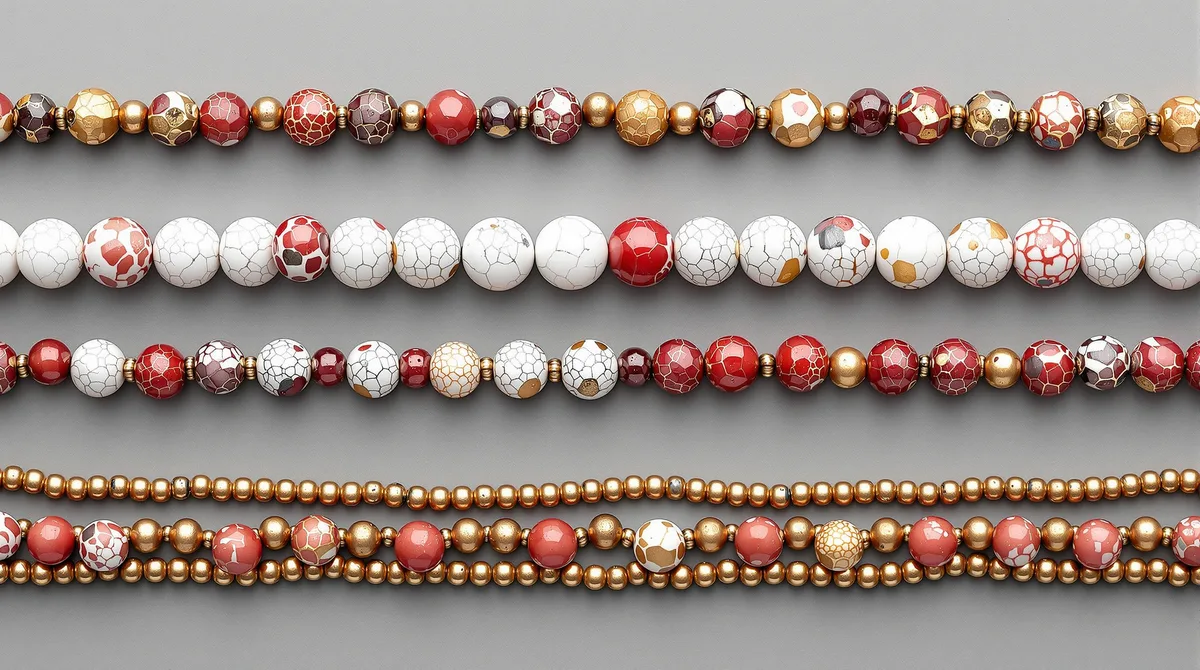
Guide · Care
Five products, five distinct failures. None of them is reversible, and every one of them looks like reasonable cleaning at the moment it is applied.
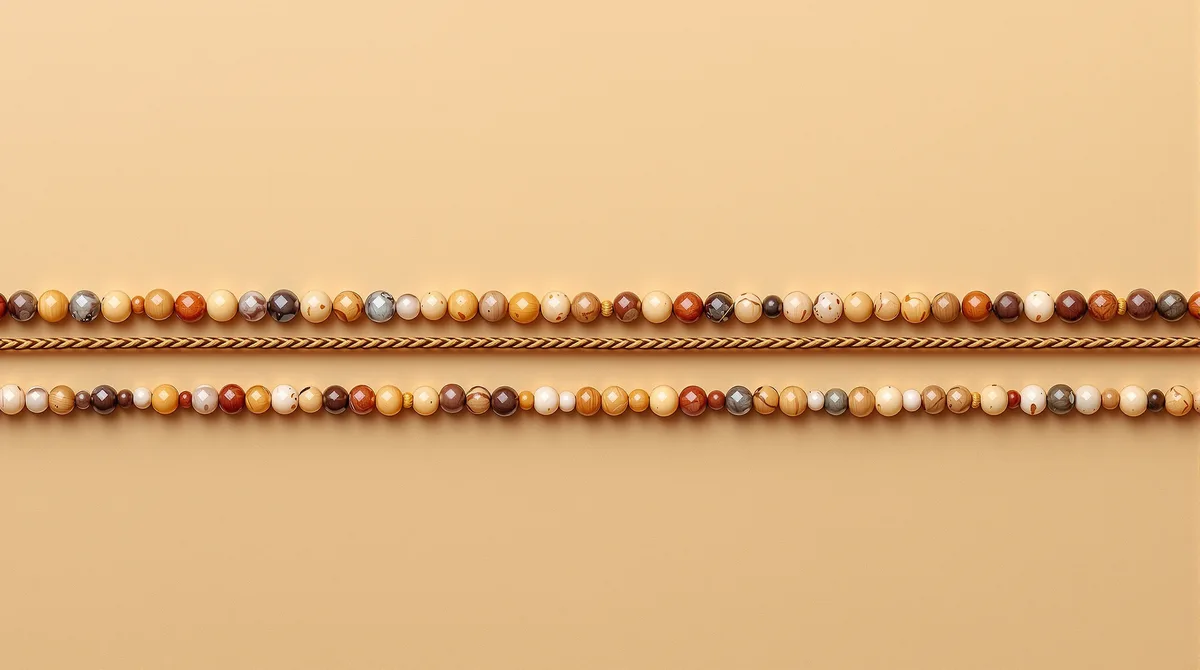
Four strands of the same round bead shape laid parallel, each one carrying a different surface — crazed, mottled, speckled and plated.
Never use a solvent, bleach, abrasive cream, steam or hot water on beadwork, and never use a vacuum nozzle on a hanging panel. Solvent lifts surface dye; bleach attacks dye and cord together; abrasive cream scratches acrylic and dulls faux capiz; steam and hot water soften acrylic and soak the cord; suction pulls strands against their knots.
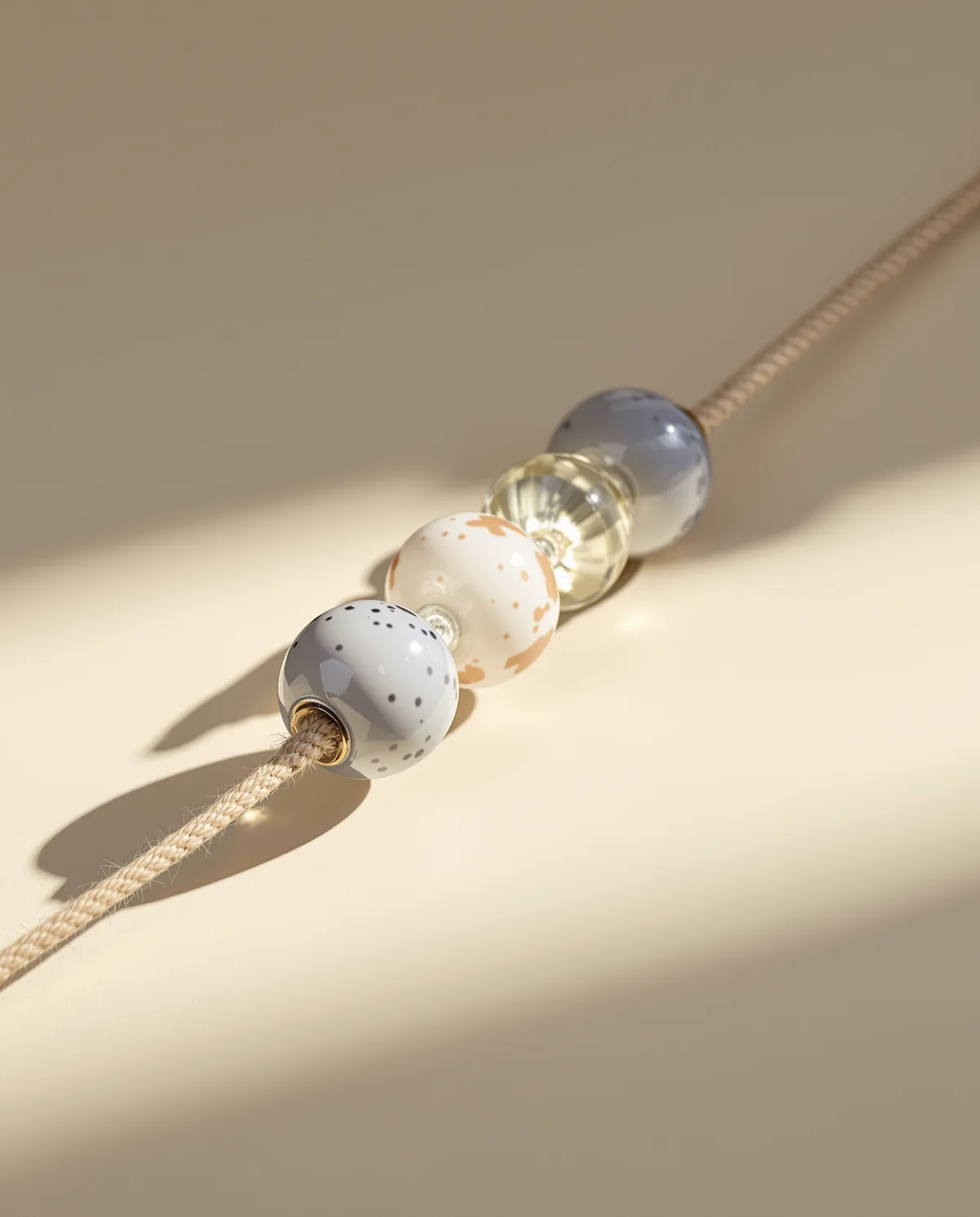
Dry, then barely damp, then stop. Mild soap on a barely damp cloth is the only chemical that is ever justified, and only on a greasy film that dry brushing has already failed on.
Everything on the prohibited list below is something people try because it works on other surfaces. The reason it fails here is that a bead panel is three incompatible materials — glass or polymer, cotton cord, and often wood — assembled so that whatever reaches one reaches the others.
Because it is the only structural component and the one most of these products attack. A densely patterned 90 × 200 cm panel holds about 11,800 beads, carried entirely by cord. Wet cotton cord slackens, discolours, holds dust and abrades against the drill hole of every bead it passes through under load.
Bleach weakens it chemically. Steam and hot water soak it. Immersion soaks it thoroughly. Each of those produces a panel that looks improved and has a shorter life, which is the most frustrating category of damage because the cause and the effect are months apart.
| Product or method | What it attacks | Result | Reversible |
|---|---|---|---|
| Solvent | Surface dye, acrylic | Colour lifts; acrylic crazes | No |
| Bleach | Surface dye, cotton cord | Colour loss; cord weakens | No |
| Abrasive cream | Acrylic, faux capiz, frosted glass | Scratches; dulls; polishes matte to gloss | No |
| Steam | Acrylic, cord, wood | Softens; soaks; raises grain | No |
| Hot water | Acrylic, cord | Softens; soaks | No |
| Vacuum nozzle | Header knots | Strand pulled against its knot | Sometimes, as a repair |
| Machine washing | Cord, strand order | Abrasion at every drill hole; one tangled mass | No |
| Polish or wax | Frosted and pearlised surfaces | Gloss where there should be none | No |
| What is permitted | — | Dry brush; barely damp cloth; mild soap on a film | — |
Because surface dye and a surface film are the same kind of thing, and a solvent is formulated to remove a surface film.
Surface-dyed beads are extremely common — dyeing a fine base strand to match a large accent bead is the normal way a ground is tied to its accent, so the dyed component is often most of the colour you can see. A solvent takes it off on contact, in the exact area you wiped, which leaves a pale patch with a hard edge.
The related case is kitchen degreaser, which is a solvent sold for a purpose that makes it look reasonable on a greasy panel. It is the single most likely product to be used and the single worst choice.
Mechanically, not chemically. The strand is released at the header, laid out so the bead order is recorded, rebuilt onto fresh medium, and re-knotted at the same pitch and length as its neighbours.
Nothing in that process involves a cleaning product, and that is the point: beadwork repairs are assembly work. Spare beads are specified with the order because a parted strand is an anticipated failure with a known fix.
Dry, loosely bundled in hanging order, never folded, out of light. The same three materials that dislike solvent and steam also dislike damp and sun, so storage and cleaning share one rule set.
The specific storage version of an irreversible error is the fold: a fold sets cord permanently, and because every strand folds at the same height the panel comes out with a line across it.
Four prohibitions, not nine. Never immerse. Never spray. No solvent or abrasive. No vacuum.
A card has about forty words of attention, and a list of nine prohibited products will not be read. Those four cover every mechanism: water into the cord, chemical attack, mechanical abrasion, and suction on a header knot.
Only in who needs telling. A hotel or restaurant panel is cleaned by whoever cleans the rest of the room, with the products they use on everything else — which are exactly the products on this list.
Three lines are enough for a cleaning schedule: dry brush downwards, nothing wet, nothing sprayed. Put them in the project's own maintenance documentation rather than relying on a card in a drawer. Where a specification needs a soiling or cleanability rating, it is tested against the specified build and quoted with the project.
A surface dye lifted by solvent or bleach. A frosted or sea-glass bead polished to gloss. A crazed acrylic bead. A lacquered dowel that has been wet and dried with the grain raised. A cord that has been soaked. And a header knot pulled loose by suction, which turns a cleaning session into a re-string.
Six irreversible outcomes, all from products that are perfectly sensible somewhere else in the house.
Dust monthly, dry, and the question rarely arises. The products on this list get used when a panel has been left long enough that dry brushing no longer works, which in a normal room takes years and in a kitchen doorway takes months.
The design-side answer is bead choice: body-coloured glass tolerates cleaning indefinitely where surface dye does not, and smaller beads strung close hold less dust than large beads because there is less upward-facing surface. Both are decisions taken at the brief rather than at the cupboard.
Dry methods, and a check rather than a clean. Panels are inspected at first-article and lot level on an AQL plan at our quality control and packaging house at Greater Noida, and then packed with the strands held in their order.
The relevant point for a householder is what inspection is looking for: bead chipping, strand drift, knot slip and colour variance. Three of those four are exactly the things the prohibited products on this page produce — which is a useful way to think about it. If a cleaning method could create a defect our own inspection would reject, it is not a cleaning method.
Good to know
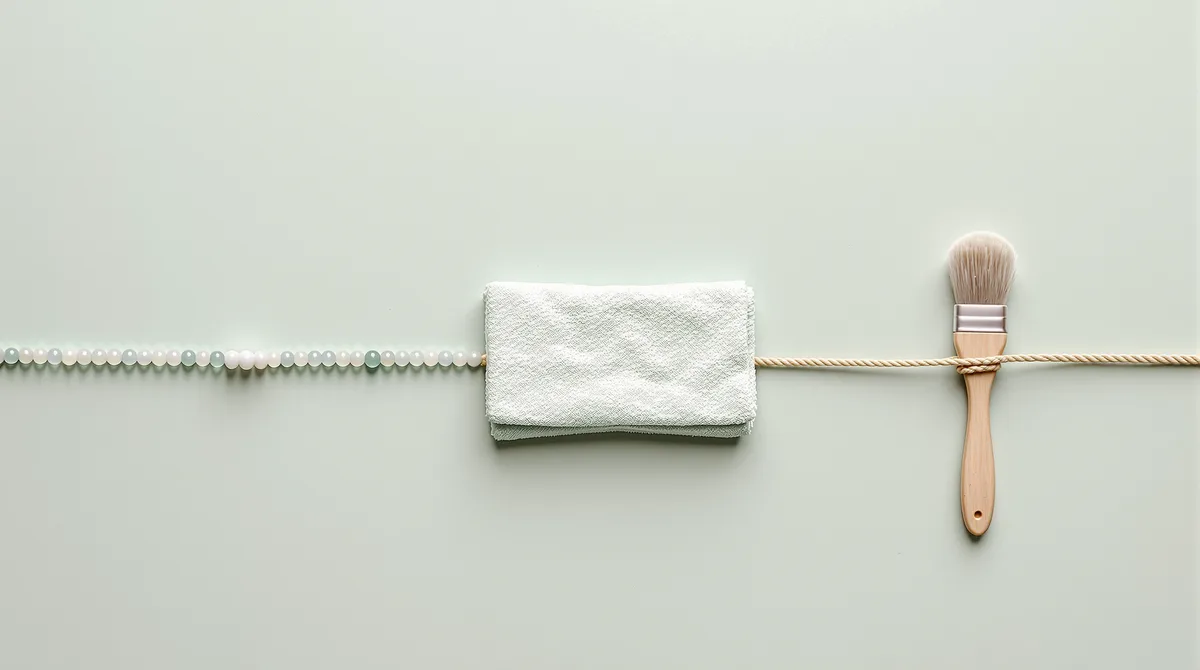
Dry lifting and spot work. A soft dry brush with almost no pressure, or low-tack tape to lift dust, and a barely damp cloth on the beads only. Never immerse: the ground is stiffened and every bead is couched individually, so water swells the ground and slackens the thread.
No, it is a repair. The strand is re-strung in its original bead order and re-knotted at the header, which is why spare beads are worth specifying with the order. If it parted during cleaning, the cord had already lost strength, which usually means earlier damp or a vacuum.
Dry, bundled loosely in hanging order, never folded, out of direct light. The storage mistakes are a mirror of the cleaning ones: the components that water and sun attack are the same components, and a closed box with a damp panel in it is the worst combination available.
No, and this is the one absolute on the page. A strung panel has no textile structure — the cord carries everything — so a drum tangles the strands into one mass and abrades the cord at every drill hole it passes through. Even hand immersion soaks the cord.
Dry, downwards, strand by strand. A soft brush or dry microfibre cloth drawn from the header to the hem so dust leaves at the bottom. Upwards drives dust into the header, where thirty strands sit close together and nothing can reach it.
Solvent, bleach, abrasive cream, steam, hot water, a vacuum nozzle, a washing machine and furniture polish. A dry brush and a barely damp cloth do everything a bead panel ever legitimately needs.
Keep exploring
Guide
Dry dusting first, spot cleaning the beads, keeping the cord dry, what never to use, and how to handle a broken strand.
View the rangeGuides
One guide per question that arrives often enough to be worth answering properly.
Read the guideGuide
A soft brush drawn downwards, strand by strand, so dust leaves at the hem instead of compacting in the header.
Open the referenceGuide
The one material that tolerates water, the method that works, and why immersing a complete panel ends it.
Compare the optionsGuide
Why water raises grain and lifts lacquer, the dry method that works, and the damp limit that is worth respecting.
Read the guideGuide
The four dos, the four nevers, the material note and the one line about the cord that prevents most returns.
How it is madeGuide
The one case for a mild detergent: how to lift kitchen or smoke film without soaking the cord, and why dry dusting comes first.
Compare the options
Start a conversation
Send a reference, a colour chip or a sketch. Minimums are set per design and confirmed per quote; sampling is quoted separately and usually runs 16 to 20 days from an agreed brief.