Guide
Shortening a panel
Mark one strand, work to that mark on every strand, and re-secure each end — the method depends on cord, wire or monofilament.
Compare the options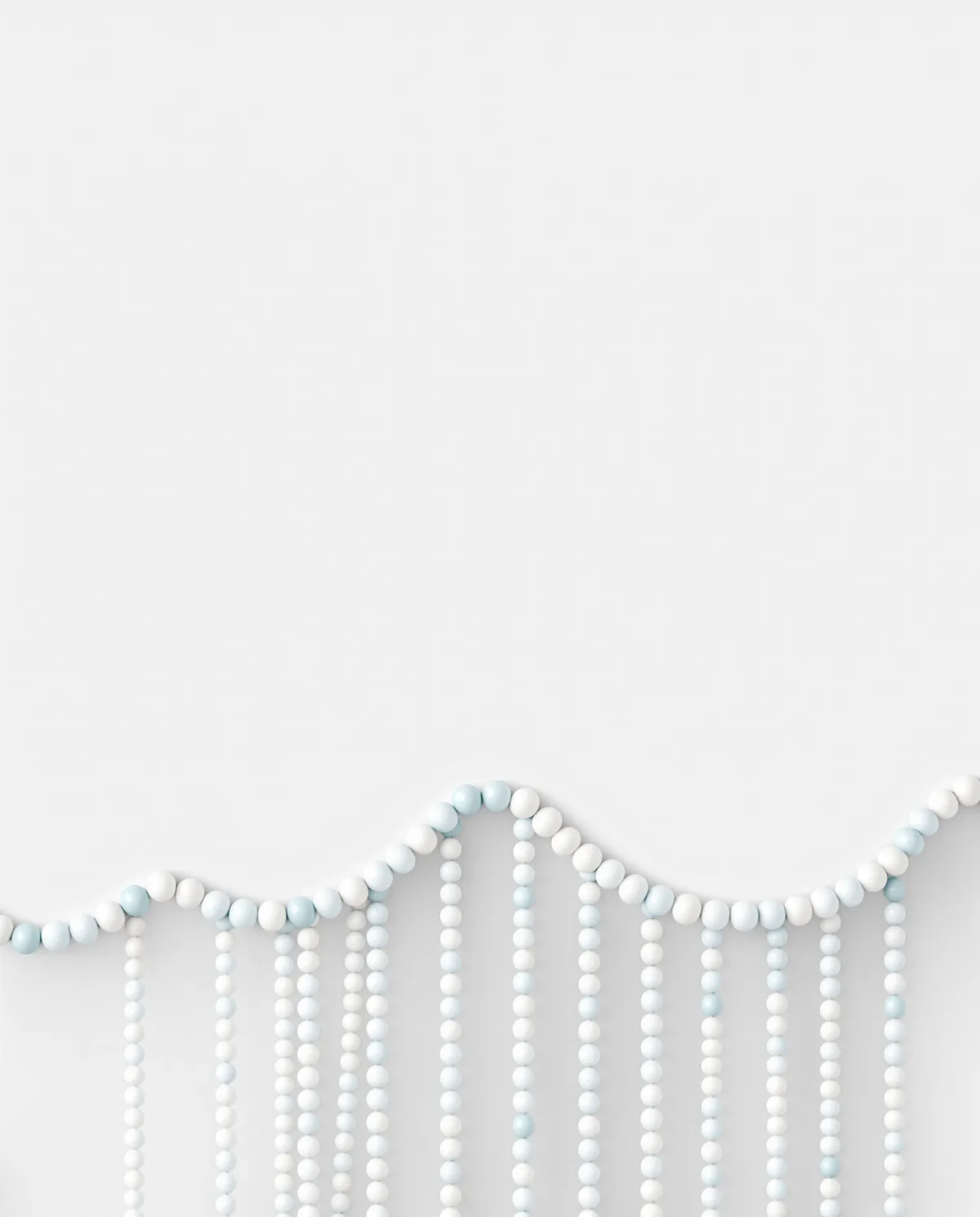
Guide · Altering
A hem shape is nothing but a list of strand lengths. That makes reshaping arithmetically simple, physically irreversible, and the one alteration where marking is the entire job.
Twenty bead strands cut to stepped lengths so the hem sweeps up into a scalloped arch, longest at the sides and shortest at the centre.
Yes, in one direction only: a hem can be cut into a shape, never out of one. Work out the finished length for every strand first, mark all of them, check the marked line by eye from across the room, and only then start removing beads and re-securing ends. The shape is a list of lengths, and the list has to exist before any cutting.

Deciding a finished length for every single strand, marking all of them, and then removing beads to those marks.
The decision is the job. A hem shape is not a cut — there is nothing continuous to cut across — it is a sequence of strand lengths that the eye reads as a curve. Get the sequence right and a modest panel looks designed. Get one strand wrong in the middle of an arc and the whole curve reads as a mistake.
A settled panel: fresh strands lengthen over the first day or two, so a hem cut on day one is a hem that moves.
Then masking tape, a tape, and a way to strike the shape. For a V-point, two straight edges. For a scallop or an arch, a length of string pinned at a centre point above the panel, used as a compass. And a notebook with a list: strand number, finished length.
For a V-point, linearly. Decide the centre length and the edge length, divide the difference by the number of strands from centre to edge, and step each strand by that amount. On a 30-strand panel with a 20 cm difference, that is about 1.3 cm per strand each side of centre.
For an arc, geometrically: strike the arc with a string compass rather than calculating it, because a circular arc is not a linear taper and an eye reads the difference instantly.
Then round every length to a whole number of beads. A strand can only be an integer number of beads long, and on a large-bead panel the rounding is coarse enough to visibly quantise a smooth curve — which is a reason to choose a shape with steps in it rather than a shallow curve.
Because the panel is what people look at. A shaped hem centred on the opening but not on the panel looks wrong even when the measurement is correct, and the error is unfixable because you cannot add beads back.
Count strands, do not measure distance. If the panel has 30 strands, the centre is between strand 15 and strand 16, and every pair either side of that line should match. On an odd count there is a true centre strand and it is the longest or shortest point.
Cutting as you mark. Somebody marks three strands, cuts them, marks three more — and the shape is never seen as a whole until it is finished and wrong.
Second: not settling first. Third: measuring from the floor rather than from the header, so an unlevel floor becomes a crooked hem. Fourth: a shallow curve on a large-bead panel, where the bead pitch is coarser than the curve.
Never cut without re-securing in the same pass. Never cut a strand you have not marked. Never attempt a shape on a panel that is also crooked, because the crookedness will be baked into the shape.
And never reshape a mapped pattern without checking what the shape removes. A motif that runs to the hem will be cut through, and the cut will go through it at a different height on every strand.
Bead size decides the achievable resolution. Small beads give a fine curve because each strand's length can be adjusted in small increments; large beads quantise it. Seed-bead panels can carry a genuinely smooth arc; a panel of 13 by 22 mm dotted ovals cannot, and should be given a stepped shape instead.
Material also decides the end finish. Cord takes a knot, coated wire takes a crimp, monofilament takes a knot plus a stopper. Each re-secured end on a shaped hem is visible at a different height, so the finish quality matters more here than on a straight hem where everything lines up.
Two to three hours for a V-point on a 30-strand panel. A day for a scallop. The cutting is quick; the marking and the standing-back are not, and compressing them is exactly how the job fails.
Draws the shape on the sheet. A hem shape in production is a list of strand lengths on the bead-by-bead plan, which is how a scallop repeats identically across a run and how both halves of a curve agree.
The real builds show what that buys. One frosted sea-glass valance carries a scalloped arch hem across 30 hand-strung strands, fullest at the sides, with the longest strand at 24 in and the shortest at 10 in — a 14 in sweep planned before a bead was threaded. A café-curtain build uses a scalloped chevron hem below moulded daisy connectors. An arched-cut drop removes the centre entirely to frame a walk-through. None of those is achievable by trimming afterwards.
If the deepest point of the new shape is within about a fifth of the existing drop, it is an alteration. Beyond that you are removing a large fraction of the bead count, and the panel's proportions change rather than its edge.
The line: a shaped hem costs planning rather than material at the brief, and costs the whole bead count at home. If the shape matters, specify it — production runs 40 to 60 days after sample approval, with sampling usually 16 to 20 days from an agreed brief.
That a straight hem can be shaped at home and a shaped hem cannot be straightened. That it is a measuring job rather than a cutting job. And that the removed beads become the spares.
If they want a shape, point them at a specified panel. A hem is one of the cheapest things to ask for at the brief and one of the most expensive to attempt afterwards.
Extractable data
| Hem shape | How the lengths run | Difficulty | Note |
|---|---|---|---|
| Straight | All equal | Baseline | The default on most builds |
| V-point | Longest at the centre, even taper | Low | Easy to mark, easy to get wrong by one bead |
| Inverted-V | Shortest at the centre | Low | Reads more graphic than a V-point |
| Scalloped | Repeating arcs across the width | High | Each scallop needs its own arithmetic |
| Scalloped arch | Sweeps up at the centre, fullest at the sides | High | One build runs 24 in longest, 10 in shortest |
| Scalloped chevron | Stepped down into points | High | Used on a café-curtain build |
| Arched cut | Centre removed entirely | Moderate | Turns a curtain into a portal |
| Staggered or uneven | Deliberately irregular | Low | The forgiving shape to attempt |
Good to know
Two to three hours for a V-point on a 30-strand panel, and most of that is marking and checking. A scallop is longer because each strand's length comes from its own position in an arc rather than from a single taper, and an arithmetic error shows as a dent in the curve.
No. Every strand that has been shortened would have to be rebuilt at the bottom, bead by bead, and the original profile is gone. This is the least reversible alteration on a bead panel, which is the reason the whole method is about marking rather than cutting.
Masking tape, a tape measure, a long straight edge or a piece of string pinned at a centre point to strike an arc, fine cutters, and whatever re-secures the ends. A camera is genuinely useful: photograph the marked panel and look at the photograph rather than at the panel.
Only at the end you are working on. The risk is a re-tied knot smaller than the drill hole of the last bead, which lets the bead ride over it and empties the strand weeks later. Check each knot against the last bead before moving on.
Handling and arithmetic both. Glass beads are larger per unit of length in many builds, so a strand's length changes in bigger steps and the achievable curve is coarser. Support each strand as you work and let removed beads into a tray rather than onto a hard floor.
For a display piece, yes, and a staggered or uneven hem is the safe choice because it tolerates error. For stock, no — a reshaped panel is no longer a stock item, and a shaped hem is specifiable at order, where it costs planning rather than material.
Repair it to full length first. A parted strand is short, and if it is left in place it will either be marked wrong or will set the line for everything else. It is re-strung in its original bead order and re-knotted at the header before any reshaping starts.
Keep exploring
Guide
Mark one strand, work to that mark on every strand, and re-secure each end — the method depends on cord, wire or monofilament.
Compare the optionsGuides
One guide per question that arrives often enough to be worth answering properly.
Open the referenceGuide
Adding strands between existing ones, or removing alternates — and what each does to a mapped pattern.
Compare the optionsGuide
Narrowing a panel removes whole strands rather than cutting across them, and which strands go decides whether the pattern still reads.
Compare the optionsGuide
Why acrylic forgives cutting, which tool to use, and how to finish an end so it holds for years.
Read the guideGuide
Cut a full-length panel to valance drop, finish every end, and keep the removed beads — they are the spares and the second piece.
Read the guide
Start a conversation
Send a reference, a colour chip or a sketch. Minimums are set per design and confirmed per quote; sampling is quoted separately and usually runs 16 to 20 days from an agreed brief.