Specification
Strand count and pitch in beadwork
Width divided by pitch gives the strand count — the value that sets density, weight, view-through and cost together.
Read the guide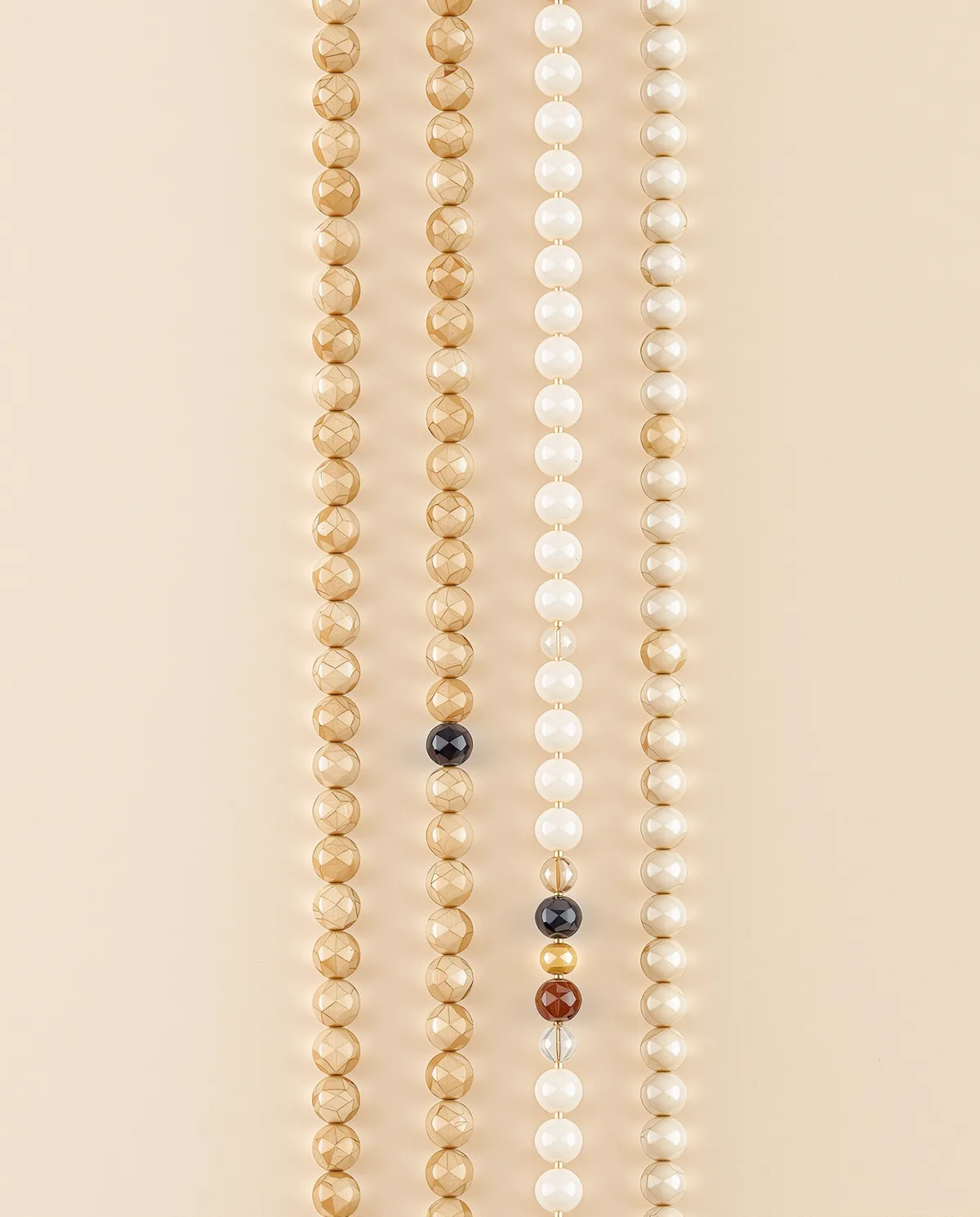
Guide · Altering
Density is the one property of a bead panel that is adjustable after the fact, and the arithmetic is brutal: halving the pitch doubles the bead count.
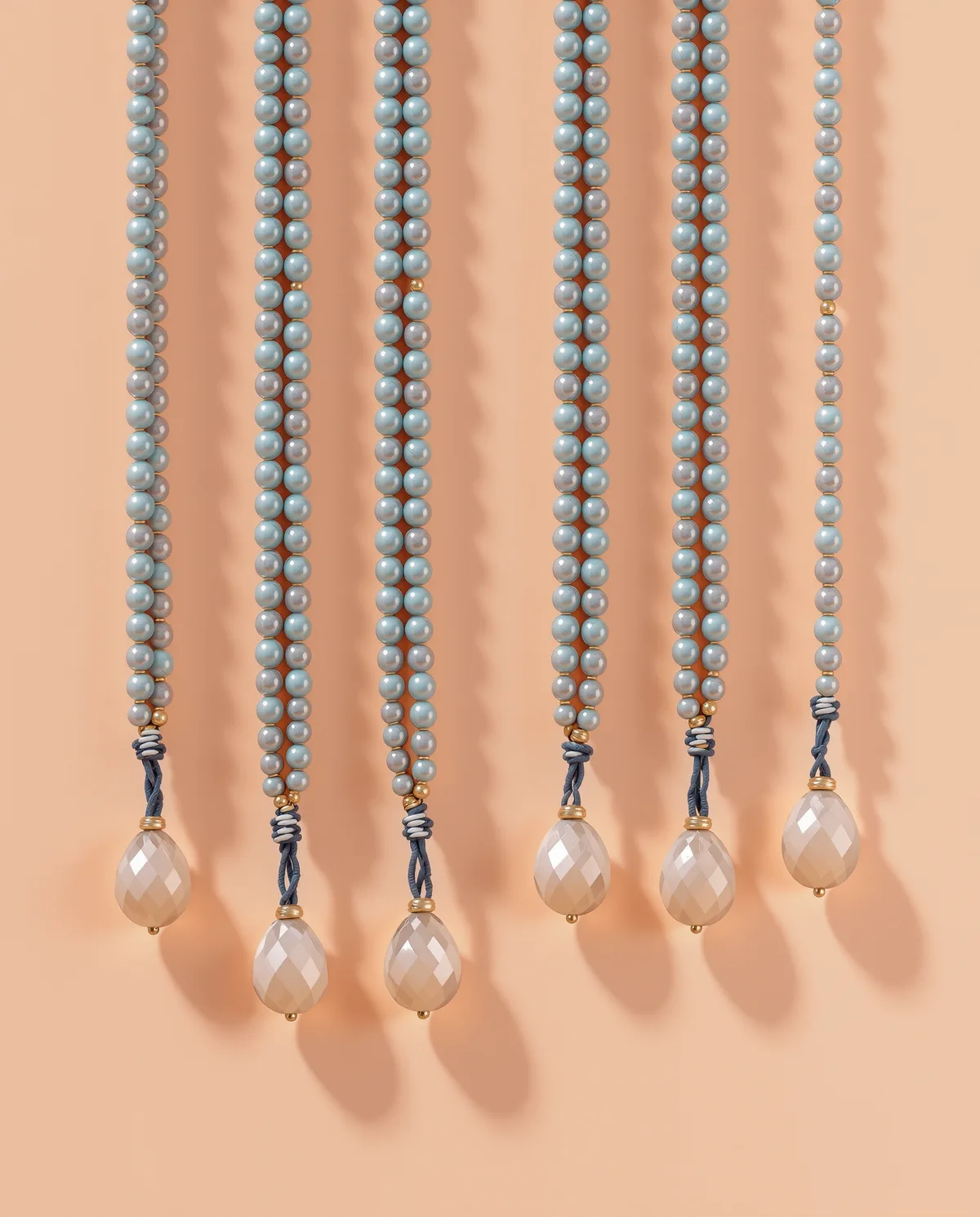
Six bead strands shown side by side, three strung close-packed and three strung with gaps of bare cord, so the difference in density reads directly.
Both are possible on a finished panel. Removing alternate strands doubles the pitch and halves the bead count, which opens a panel up. Adding strands between existing ones halves the pitch and doubles the count, which needs as many new strands as the panel already has. Either destroys a mapped pattern and neither touches a scattered one.
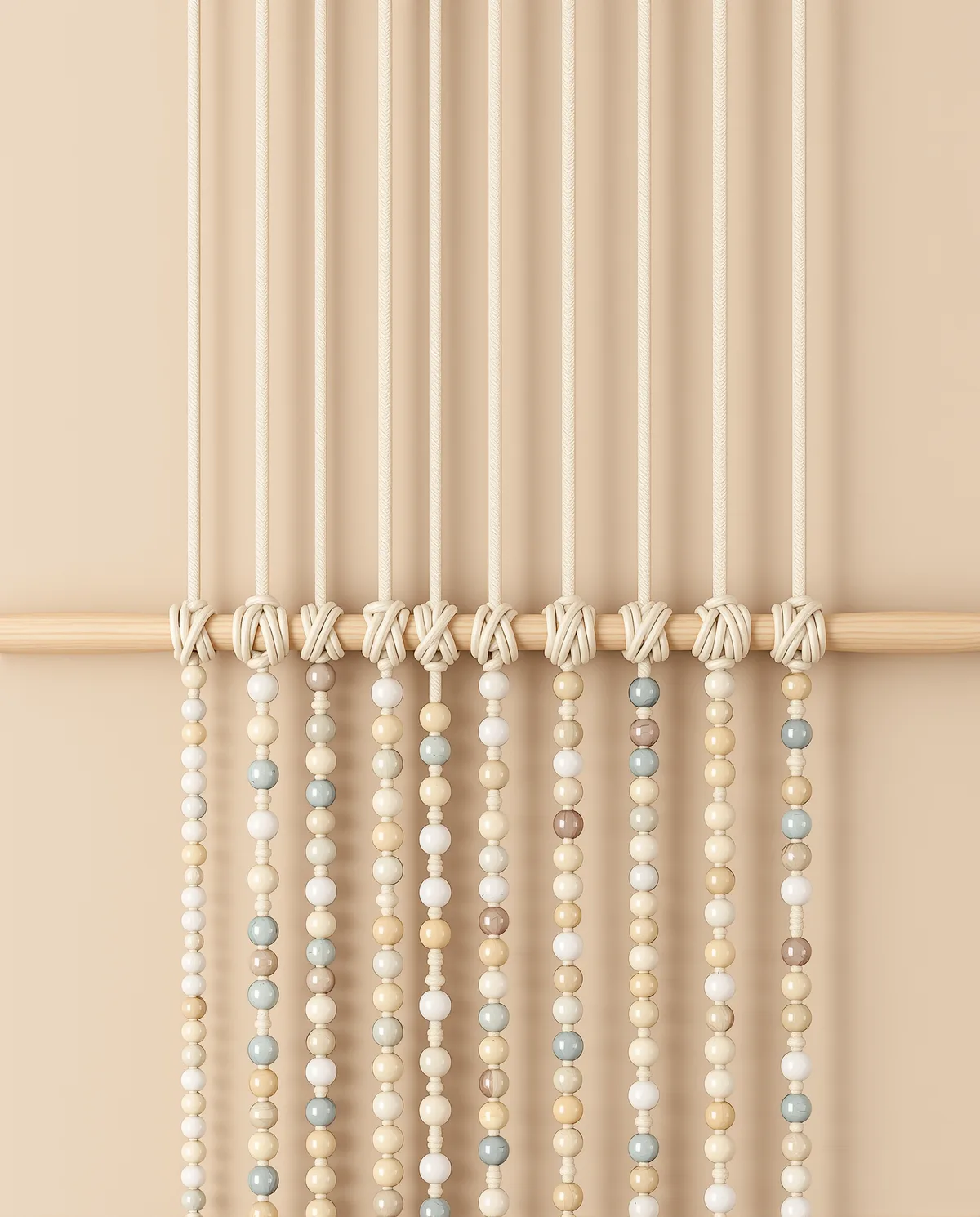
Re-tying the header. Density is strand pitch, pitch is set by where each strand is knotted to the dowel, and nothing else about the panel changes.
That makes it mechanically the simplest alteration available and, in one direction, the most expensive. Taking strands out is an afternoon. Putting strands in is manufacturing, because every new strand is a full strand: the same bead order, the same length, the same finish at both ends.
The existing pitch, measured across ten strands and divided by nine. The existing strand count, counted. A photograph of the panel hanging, straight on, which is the only record of where a pattern's repeats fall.
If you are adding, you also need the bead order and enough beads — which in the halve-the-pitch case means as many beads again as the panel already contains.
Because it is multiplicative and people treat it as additive. Halving the pitch does not add a bit of density; it doubles the number of strands and therefore roughly doubles the bead count and the weight.
For calibration: a 90 cm panel runs 40 strands at roughly 2.25 cm pitch, a sparser build at that size holds about 3,100 beads, and a densely patterned panel at the same size holds about 11,800. The spread between those two is what density does to a panel.
If the pattern is mapped — a motif, a letter, a figure, a graphic repeat — it does not survive either change. The map assigns a bead sequence to each strand position, so removing alternate strands deletes half the image and adding strands inserts columns with no information in them.
If the pattern is a scattered accent, both changes are fine. Where large beads are thrown three or four to a strand at random and deliberately never aligned in a row — the dotted and mushroom portal builds work this way — there is no column structure to break. A plain panel is equally indifferent.
Removing. It is quick, reversible, reduces weight, and often improves a panel that was specified denser than the opening needed.
Adding is rarely worth it at home. Building thirty strands by hand to an existing bead order and an existing length, with every bottom end finished to match, is most of the work of making a panel — and the result is a panel of doubled weight on a fixing chosen for the old one.
Reusing the old header marks. If the pitch has changed, every mark has changed, and re-tying to the old positions produces a panel that is denser at one end.
Second: adding strands whose finished length is slightly off. New medium takes up a little under load, so a new strand built to exactly the neighbours' length settles slightly longer. Build a bead short rather than a bead long when adding.
Third: not checking the fixing afterwards. A panel that has gained weight has gained it on hardware that was chosen for the original.
Never cut strands off to open a panel up — untie them, so they can go back. Never add a strand by knotting it into the cord of an existing one. Never space strands by eye on the dowel; mark the pitch.
And never change density to fix a crooked panel. A panel hanging unevenly is a header that is not level, and re-tying every strand at a new pitch will not help.
Removing alternate strands from a 30-strand panel: thirty to forty minutes, plus re-marking the dowel. Adding to halve the pitch on the same panel: multiple evenings, and the limiting factor is bead count rather than skill.
That asymmetry is worth stating before anybody starts, because the two jobs sound symmetrical and are not.
Sets the pitch on the sheet, before any bead is strung, and treats it as a cost lever rather than as a finish. Cost on a beaded panel moves in a known order — bead size and material, then construction, then strand spacing, then the mount, then height — and spacing is the third of those.
The production version of opening a panel up is called de-densifying, and it is one of the first levers we reach for when a design has to hit a target: a tighter outline with a more open fill reads almost identically at arm's length and removes a large fraction of the beads. The same logic works in reverse, which is why a density change belongs at the brief rather than at the wall.
When strands have been lost. A panel that has had three strands fail and be removed is now at an inconsistent pitch, and the fix is either to rebuild those strands or to remove enough others that the pitch is even again.
The second option is legitimate and under-used: an evenly open panel reads as designed, and an evenly dense panel with three gaps reads as broken.
That density is set at order and is the main thing that distinguishes two panels of the same size. That a panel can be opened up at home by removing alternate strands, which also halves its weight. And that it cannot practically be made denser afterwards.
If the listing states the strand count, most of this conversation is pre-empted — which is the single most useful number a bead panel listing can carry.
That strand counts are specified per order and are the panel's defining figure. Live portal builds run 30 hand-strung strands on a single wooden dowel at around 90 × 200 cm. The library runs full-length panels at 40 to 60 strands, valances at 56 to 60 across 120 cm, and linked faux-capiz hangings at 12 to 16 columns rather than strands.
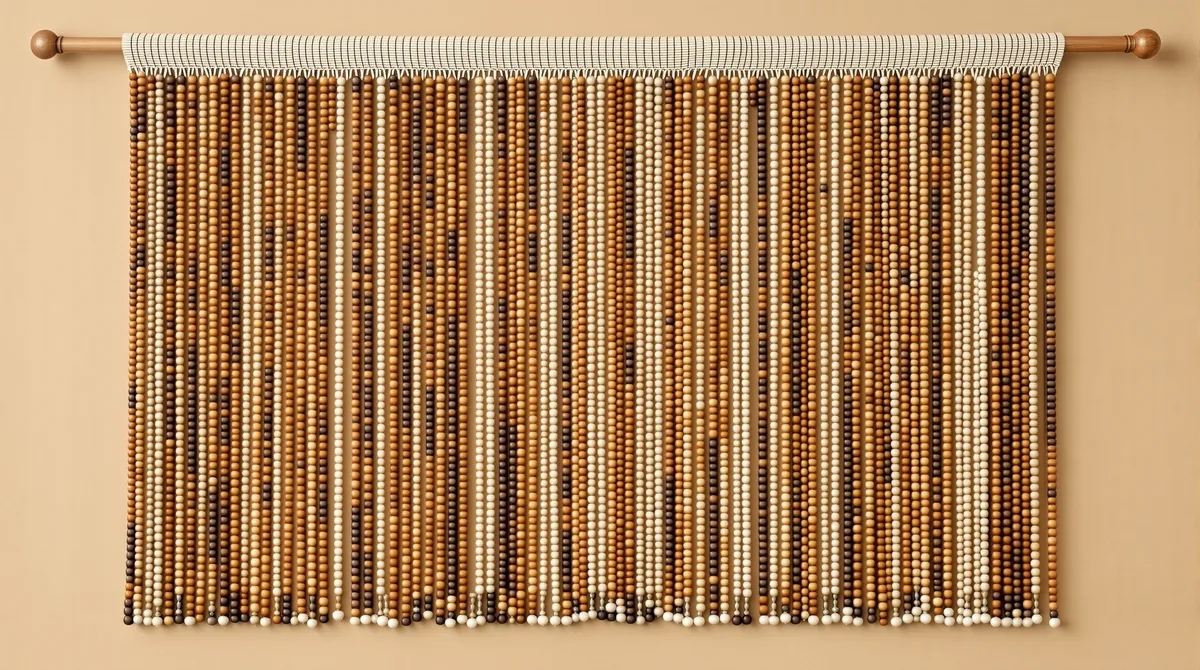
The published figure that frames all of it: a densely patterned 90 × 200 cm curtain can hold about 11,800 beads, every one placed by hand. Density is not a finish on a bead panel. It is most of the product.
Extractable data
| Change | Pitch | Bead count | New strands needed | Pattern survives |
|---|---|---|---|---|
| Remove every other strand | Doubles | Halves | None | No, unless scattered |
| Remove every third strand | Up by half | Down a third | None | Rarely |
| Add one between each pair | Halves | Doubles | As many as exist | No, unless scattered |
| Add at one edge only | Unchanged | Up | A few | Yes |
| 90 cm panel as built | about 2.25 cm | about 3,100 spaced | 40 strands | — |
| 120 cm panel as built | about 2.0 cm | — | 60 strands | — |
Good to know
Removing does not, provided you untie at the header rather than pull. Adding does not either, because the new strands are new. The only risk is to the header itself: re-tying knots into the same positions repeatedly works the dowel, and on a soft wood a hole can start to enlarge.
Removing strands from a glass panel has a bonus: the weight drops substantially, which can move the panel from needing brackets to being fine on hooks. Adding strands has the opposite effect, and a glass panel at doubled density is a serious load that the original fixing was not chosen for.
Opening a panel up by removing alternate strands is a reasonable display move, and the removed strands are then spares. Adding strands is not a shop job, because it means building strands and a shop does not hold the beads or the bead order.
If you are opening the panel up, remove the broken strand as one of the ones that goes — it is the obvious candidate. If you are adding strands, repair it first, because a parted strand is a reference length you have lost and the new strands have to match the existing ones.
Half an hour to remove alternate strands from a 30-strand panel. Days to add strands, because each new strand has to be built bead by bead to the existing bead order and the existing length — a full-length strand can carry a few hundred beads.
If you remove strands and keep them intact and in order, yes — untie rather than cut, label the positions, and the panel is reversible. Adding is also reversible, in that added strands can be removed again. What is not reversible is cutting strands off.
Keep exploring
Specification
Width divided by pitch gives the strand count — the value that sets density, weight, view-through and cost together.
Read the guideGuides
One guide per question that arrives often enough to be worth answering properly.
Read the guideGuide
Why acrylic forgives cutting, which tool to use, and how to finish an end so it holds for years.
Specs and sizesGuide
Matching the bead, extending the stringing medium, hiding the join — and why raising the header usually beats splicing strands.
Specs and sizesGuide
The per-strand arithmetic for a V-point or a scallop, and why marking the whole shape before cutting anything is the job.
Compare the optionsGuide
Narrowing a panel removes whole strands rather than cutting across them, and which strands go decides whether the pattern still reads.
Read the guide
Start a conversation
Send a reference, a colour chip or a sketch. Minimums are set per design and confirmed per quote; sampling is quoted separately and usually runs 16 to 20 days from an agreed brief.