Specification
Strand count and pitch in beadwork
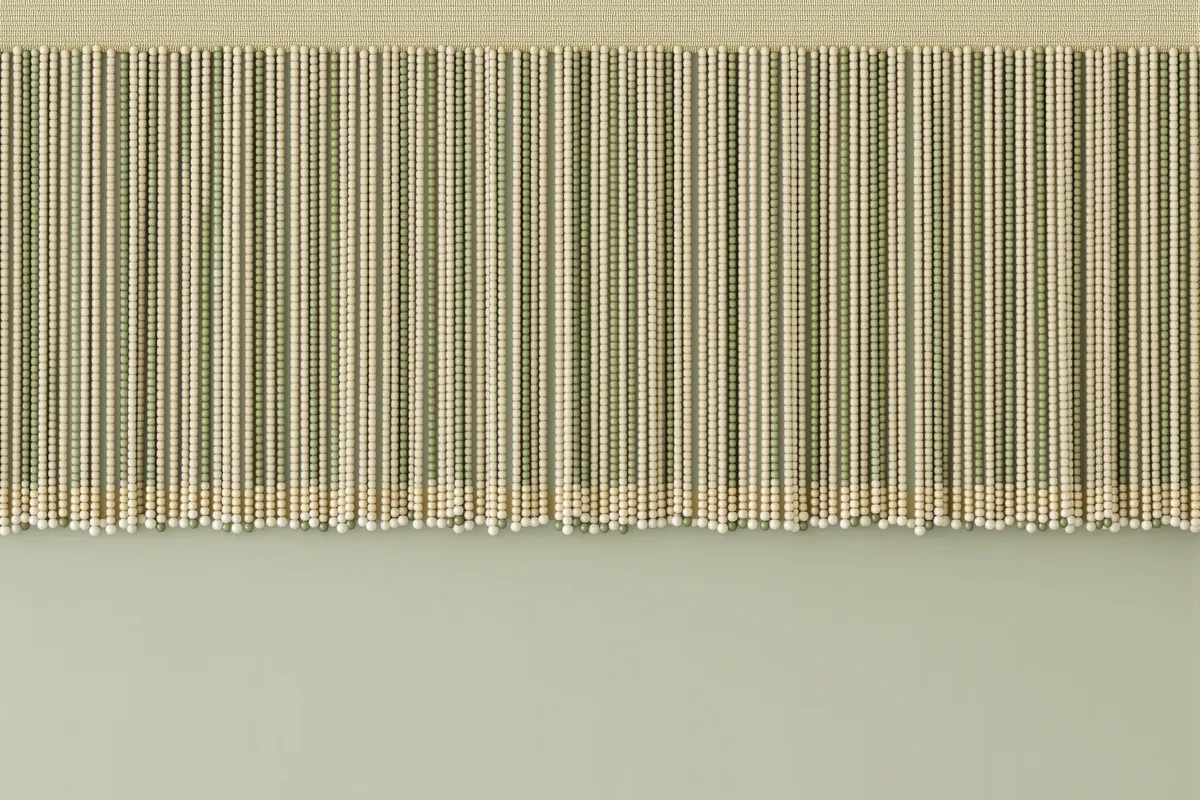
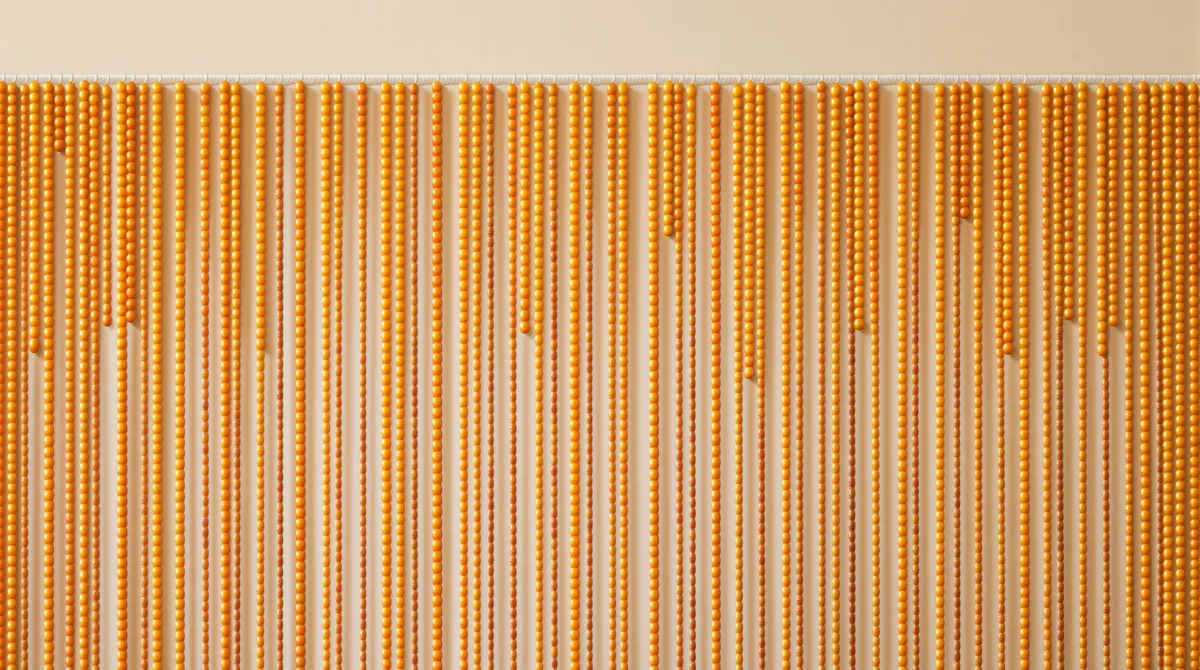
Width divided by pitch gives the strand count — the value that sets density, weight, view-through and cost together.
Specs and sizes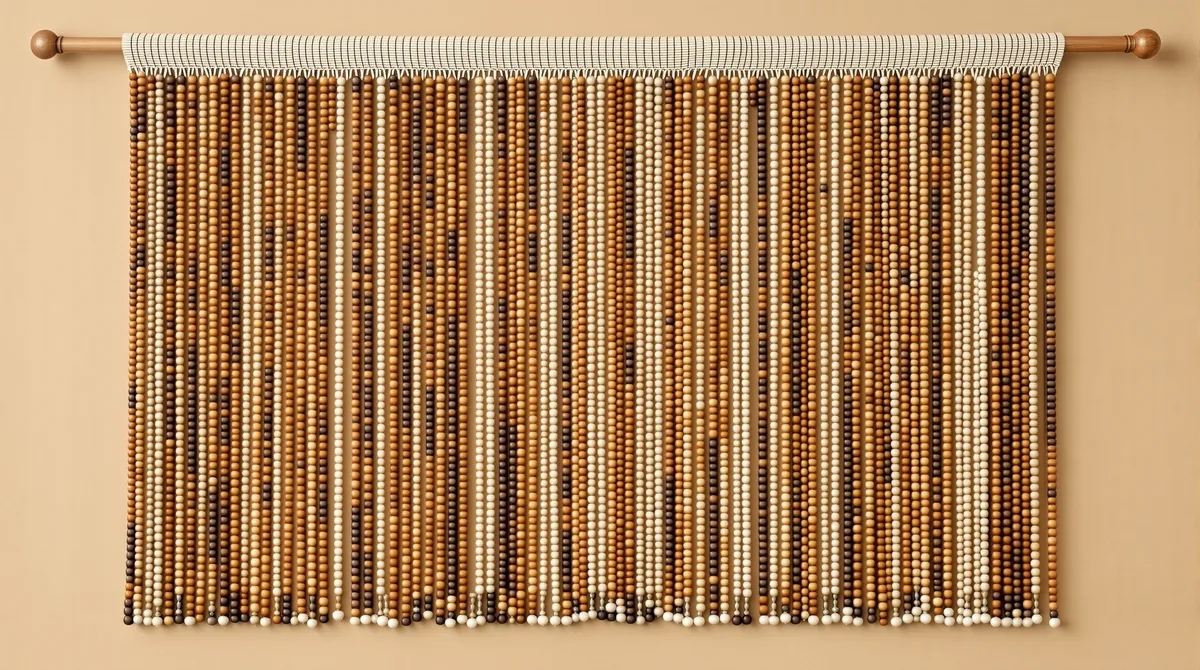
Guide · Altering
There is nothing to cut. A bead panel has no fabric across it, so narrowing one is a subtraction of whole strands — and which strands you subtract decides whether the pattern survives.
A beaded panel head-on with the three end cords removed from its dowel, leaving a short bare length of dowel while the remaining caramel and chocolate strands keep their original…
Narrow a bead panel by removing whole strands at the header, never by cutting across it. Work out how many strands the new width needs, take them out symmetrically from both ends, and on a patterned panel remove repeats rather than arbitrary strands. Re-knot or re-seat every strand you disturbed, then let the panel settle before judging it.

Removing strands and re-closing the header. That is the whole job.
A beaded panel is a row of independent strands hung from a dowel or a stitched header. There is no weft, no backing and nothing structural running across the width, so the width is simply the number of strands multiplied by the pitch between them. Change the width and you are changing the count, not the cloth.
This is why narrowing is the easiest alteration on a bead panel and reshaping a hem is the hardest: one subtracts units, the other re-measures every unit.
The new width, measured at the opening rather than taken from a door's nominal size. The existing strand count, which you count rather than assume. The pitch, which you get by measuring across ten strands and dividing by nine.
Then the thing most people skip: a photograph of the panel hanging, straight on, before anything comes off. On a patterned panel that photograph is the only record of where the repeats fall, and you will want it twice.
Measure the new width and divide it by the existing pitch. That gives the new strand count; round down, because a slightly narrow panel looks intentional and a slightly wide one fouls the frame.
Subtract from the old count to get the number of strands to remove, and halve it. You are taking that many off each end.
On a patterned panel, check the photograph before marking. Adjust so you remove whole repeats, even if that means losing one strand more than the arithmetic asked for.
Mark the strands to go with masking tape at the header.
Release each marked strand at the header — untie it, or unhook it if it hangs on an end suspension loop — supporting its weight as it comes free.
Re-knot or re-seat the two new edge strands so they sit as firmly as the rest.
Hang it and leave it a day before judging anything.
By removing repeats rather than strands. Almost every patterned panel we build is mapped bead by bead onto a grid, and a motif occupies a known number of adjacent strands. Take out half a motif and the eye finds the damage immediately, because it reads the interruption rather than the pattern.
Scattered-accent constructions are far more forgiving. Where large beads are thrown three or four to a strand at random and deliberately never aligned in a row — the dotted and mushroom portal builds work this way — there is no repeat to break, so any strand can go. If you have a choice of panel for an awkward opening, choose a scattered one.
We never narrow a finished panel. We re-issue the bead map at the new strand count, which is a different job and a better result.
That means the pattern is re-centred and re-proportioned to the new width rather than cropped to it, the edge strands are built as edge strands, and the header is made to the final length instead of being shortened. On a mapped design we also re-check that the motif still reads at the smaller width — a pattern that works across 60 strands can become unreadable across 28.
Nothing is held in stock, so a width is specified rather than selected, and the re-map costs planning rather than material.
Removing up to about a fifth of the strands is an alteration: the panel keeps its proportions and nobody can tell. Beyond roughly a third, it is a different object — the pitch is unchanged but the panel is now narrow and tall, and a design drawn for a doorway starts to read as a wall hanging.
The line: if the opening needs more than a third of the strands gone, specify a panel for that opening instead. The strands you would remove are most of the bead count, which is most of the value.
Three things. That the panel is narrowed by removing strands, so the look stays the same and the coverage reduces. That whole strands come off both ends, so the pattern stays centred. And that the removed beads come back in the box as spares, because that is the single most useful thing a customer can be handed.
A short note on the care card to that effect prevents the call that starts "can I cut it".
All of it. The removed strands intact if you can, because an intact strand is a replacement strand. The loose beads otherwise, sorted by colour, because a chipped bead mid-panel is replaceable only if you have its twin.
Keep the cord offcuts too if the panel is built on cord rather than coated wire. Matching stringing medium later is harder than matching a bead.
Hang it, settle it, then look along the header from one end at eye level. The two new edge strands should sit at the same pitch as every other strand and hang in the same plane. A new edge strand that stands slightly proud means its knot has not seated and will slip.
Then check the hem: the bottom edge should be continuous. If the removed strands were not symmetrical, a shaped hem will now be visibly lopsided, and that is the one error this job can produce that cannot be undone by re-hanging.
Our live door formats are 90 × 200 cm and 120 × 200 cm, and the portals in the design library run 76 × 140 cm, with a 90 × 67 cm format that serves as either a short portal or a wall hanging. Across those, the full-length range runs 40 to 60 strands.
For context on what is being removed: a densely patterned 90 × 200 cm curtain can hold about 11,800 beads. On a 40-strand panel that is roughly 295 beads per strand, so four strands off each end is nearly 2,400 beads — which is why the removed beads are worth bagging rather than binning.
The arithmetic is the same and the handling is not. A glass strand is the heaviest thing in the category and the beads are colour-dependent in strength, so large feature beads in some colours chip where they strike beads of another colour. Support released strands, do not let them swing, and lay them flat.
Narrowing a glass panel also reduces its weight substantially, which can change the fixing in your favour — a panel that needed brackets may now sit happily on hooks.
There is nothing to void: the panel is not a warranted mechanism. What is true is that an altered panel is no longer the piece that was approved on the sample, so if it then fails at the header it is very hard to say whether the alteration or the original knot was at fault.
The cord itself takes no harm from untying. It takes harm from water, from abrasion against a drill hole under load, and from being pulled against a knot. None of those is part of this job if you work at the header rather than at the hem.
Extractable data
| Panel width | Strands in the renders | Approximate pitch | Strands removed per 10 cm |
|---|---|---|---|
| 90 cm door curtain | 40 | about 2.25 cm | about 4 |
| 120 cm door curtain | 60 | about 2.0 cm | about 5 |
| 76 cm portal | 27 to 40 | 2.0 to 2.8 cm | about 4 |
| 120 cm valance | 56 to 60 | about 2.0 cm | about 5 |
| Linked faux-capiz hanging | 12 to 16 columns | column-based, not strand-based | one whole column |
Good to know
Allow an hour for a plain panel and considerably longer for a mapped one, because the work is in deciding rather than in doing. Releasing and re-seating a strand at the header takes a minute or two; working out which strands can go without wrecking a repeat is the part that needs care and good light.
Only if you keep the strands whole. Release them at the header rather than cutting them, label the order they came out in, and the panel is reversible. Cut them off and it is not — a re-strung strand has to be rebuilt bead by bead from the original sequence.
A pair of fine scissors or flush cutters for the header knots, a crimping plier if the panel is built on coated wire rather than cord, masking tape to mark the strands you are removing, and a labelled bag for what comes off. Nothing specialised.
Not if you work at the header. The cord is the service item on any strung panel, and the damage comes from pulling against a knot or from putting water into it, not from untying one. Untie rather than yank, and the strands you keep are untouched.
The method is identical, the handling is not. Glass strands are heavy and the beads chip where they knock together hard, so support the weight of a released strand instead of letting it swing against its neighbours. Lay removed glass strands flat rather than coiling them in a bag.
Yes, and it is a sensible thing to be able to offer. The practical caution is that it stops being a stock item once altered, so do it to order rather than speculatively. Every beaded door curtain is made to order in the first place, so a width change is better specified than retro-fitted.
Keep exploring
Specification
Width divided by pitch gives the strand count — the value that sets density, weight, view-through and cost together.
Specs and sizesGuides
One guide per question that arrives often enough to be worth answering properly.
View the rangeGuide
Cut a full-length panel to valance drop, finish every end, and keep the removed beads — they are the spares and the second piece.
See the detailGuide
Adding strands between existing ones, or removing alternates — and what each does to a mapped pattern.
Specs and sizesGuide
Mark one strand, work to that mark on every strand, and re-secure each end — the method depends on cord, wire or monofilament.
Specs and sizesGuide
The per-strand arithmetic for a V-point or a scallop, and why marking the whole shape before cutting anything is the job.
See the detail
Start a conversation
Send a reference, a colour chip or a sketch. Minimums are set per design and confirmed per quote; sampling is quoted separately and usually runs 16 to 20 days from an agreed brief.