Manufacturing
Beaded pelmets
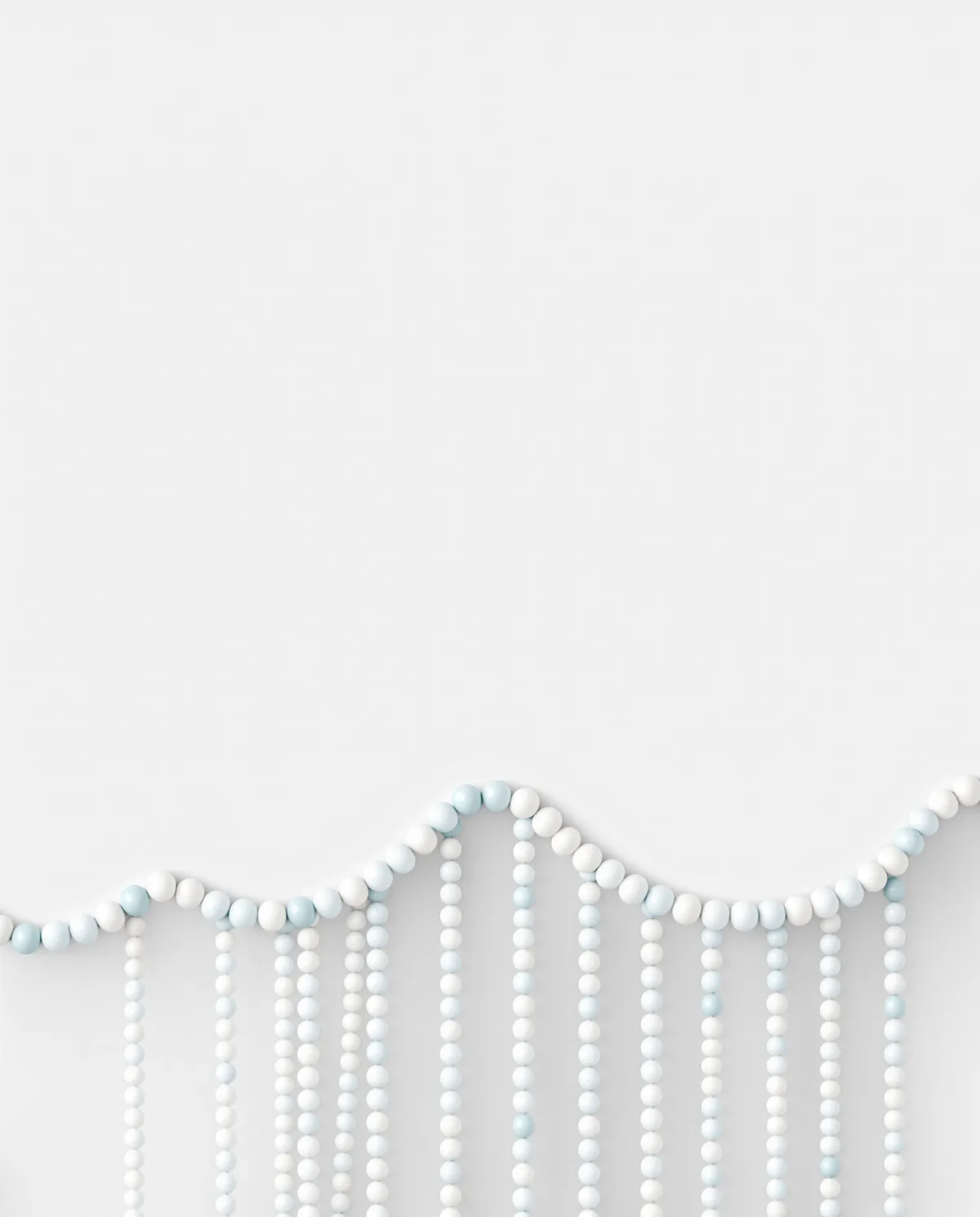
Short strung panels at 120 × 35 cm and other formats, 56 to 60 strands, with scalloped, fan-arch, V-point and straight hems — and why height is the cost lever.
Compare the options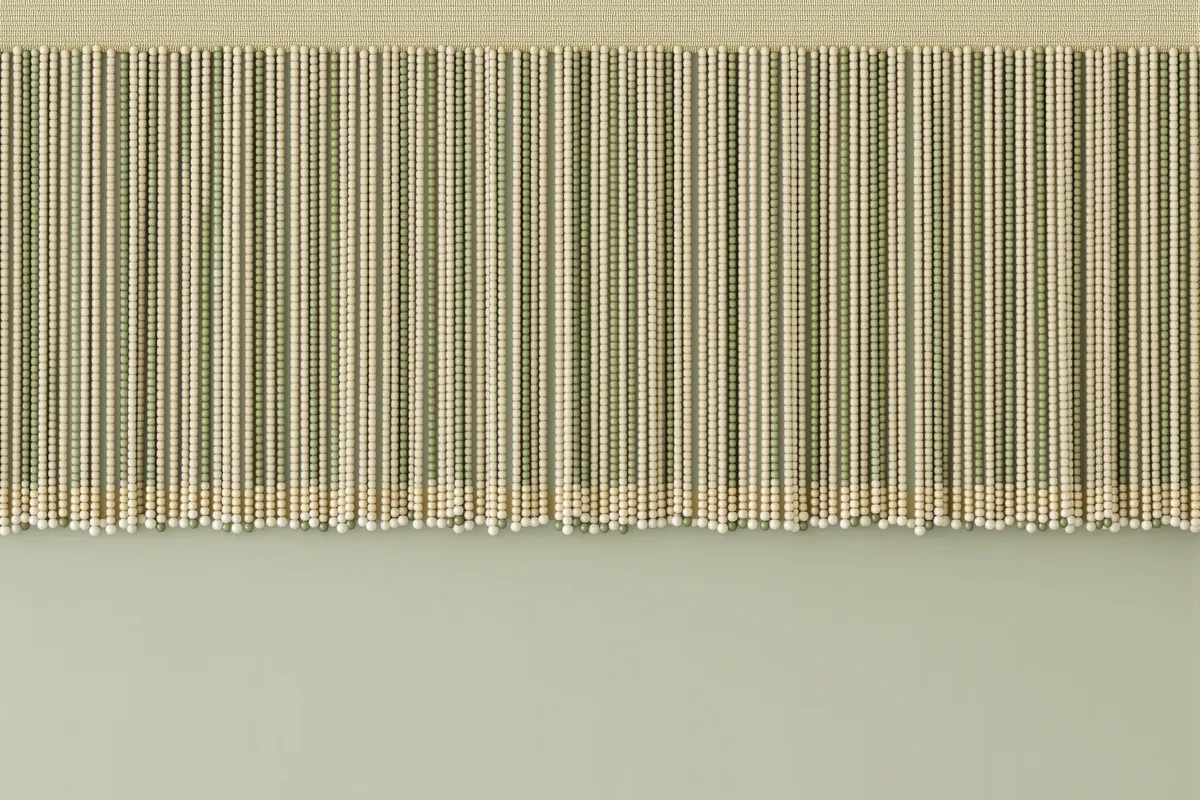
Guide · Altering
This is the alteration with the best outcome and the worst arithmetic. You keep a tenth of the beads and throw away nine tenths of the value — unless you keep them.
A short beaded valance only thirty centimetres deep, close strands of olive, moss and oatmeal beads below a plain header rail, the hem stepped into a repeating fan arch.
Yes, and it is the most reliable alteration available on a bead panel: the strand count and the header are unchanged, so only the drop reduces. Decide the valance depth, mark a level line across every strand, remove the beads below it, and re-secure every end. Keep the removed beads — they are both the spares and the material for a second piece.
Setting one level line across every strand, removing everything below it, and re-closing every end. The header, the strand count and the pitch are all untouched.
That is why it works so reliably. Most alterations to a bead panel change something structural — the number of strands, the pitch, the hem geometry. This one changes a single number, the drop, and leaves the panel's identity intact.
The valance depth you want. For calibration, our own valance format runs 30 to 40 cm deep across a 120 cm width, and one real build sits at 30 × 24 in. The Seventies Sunroom valance in the design library is 120 × 35 cm.
Then a settled panel, tape, a level, cutters, whatever re-secures the ends, and far more tray space than you expect — a 40-strand full-length panel holds thousands of beads and you are removing most of them.
Because it attacks the one dimension that is purely a quantity. Height on a bead panel is beads per strand, and nothing about the panel's design depends on how many beads are on each strand — unless the design is a pattern, which is the one caveat below.
It also fixes two common problems at once. A panel that is too long for its opening becomes a valance that fits. A panel whose bottom beads are chipped from brushing the floor loses the damaged section entirely.
It is cropped to its top band, and whether that reads depends on what the pattern was. A repeating field crops cleanly and looks intentional. A motif that ran down the drop is cut through and loses its subject. A gradient keeps only its lightest end.
The exception worth knowing: a beaded top band — a solid band of close horizontal rows at the head of a panel — crops perfectly, because it is already a valance-shaped design element sitting at the top of a longer piece. If your panel has one, this conversion was almost designed for it.
Considerably. A scalloped, V-point or arched hem is a list of strand lengths, and raising the whole list by the same amount does not reproduce the shape at the new depth — it compresses it into something that reads as a dent.
The shape has to be re-drawn proportionally: if the original sweep was 14 in across a 24 in drop, a 10 in valance cannot carry it. Either re-proportion the shape to the new depth, or convert to a straight hem, which on a valance often looks better anyway.
Weight drops by roughly the proportion you remove, which with glass is the difference between a panel that needed brackets and a valance that will sit on hooks. That is a real gain.
Bead size decides how fine a line you can achieve: large beads quantise the depth in coarse steps, so a 30 cm valance in 13 by 22 mm dotted ovals has far fewer length options than the same depth in seed beads. And faux capiz columns are a different case entirely — a linked-disc column is cut by removing whole discs, so the depth comes in disc-diameter increments.
Cutting before marking the whole panel. Measuring from the hem rather than from the header, which accumulates the original hem's irregularity into the new line. And binning the removed beads, which is the single most expensive mistake available here.
The fourth: mounting the finished valance at the same header height as the curtain. A valance usually belongs above the opening rather than inside it, and moving it up is the difference between a deliberate dressing and a panel that was obviously cut down.
Never cut a strand without re-securing it in the same pass. Never cut all the strands first. Never discard the removed beads. And never do this to a panel you may want back — this conversion is one-way in practice.
Two to three hours for a 30- or 40-strand panel, most of it removing and trays. It is not difficult work and there is a great deal of it, because you are handling most of the panel's beads.
Builds the valance as a valance, which is a denser object than the top of a curtain. A valance runs 56 to 60 strands across 120 cm — roughly a 2 cm pitch, denser than a full-length panel at the same width — because a short piece needs more strands to read as a solid dressing rather than as a fringe.
That is the real difference in outcome. A converted curtain is a valance at curtain density; a specified valance is a valance at valance density. Height is a major cost lever, so a specified valance is also far cheaper than a curtain, which is the commercial reason to specify rather than convert: production runs 40 to 60 days after sample approval, with sampling usually 16 to 20 days from an agreed brief.
When you already own the curtain and the opening wants a valance. That is the whole of the case, and it is a good one.
The removed beads are the second half of the value. Sorted by colour and kept dry they are the repair stock for the valance, and on a plain panel they are enough material to build a second short piece — a café-width valance, a window dressing, or a set of strands for a lamp or a mirror surround. On a 40-strand full-length panel you are removing thousands of beads, and a design the library describes as densely patterned at 90 × 200 cm can hold about 11,800 in total. Those beads cost real stringing hours to make and they do not stop being beads when they come off a strand.
Extractable data
| Format | Size | Strands | Beads |
|---|---|---|---|
| Full-length door curtain | 90 × 200 cm to 120 × 210 cm | 40 to 60 | about 3,100 to 5,600 |
| Densely patterned door curtain | 90 × 200 cm | — | about 11,800 |
| Valance | 120 × 30 to 40 cm | 56 to 60 | about 900 to 2,000 |
| Café curtain | 76 × 76 cm | — | about 1,800 |
| Sea-glass valance build | 30 × 24 in | 30 | longest strand 24 in, shortest 10 in |
| Seventies Sunroom valance | 120 × 35 cm | — | — |
Good to know
Only by rebuilding the bottom of every strand, bead by bead, from the beads you removed — which is possible if you kept them in order and impractical otherwise. Treat this conversion as one-way and keep the removed beads for repairs rather than for reversal.
Masking tape wide enough to span the panel, a level or long straight edge, fine cutters, a crimping plier if the panel is on coated wire, and a tray. Thousands of beads come off, so the tray matters more here than on any other alteration.
No, because you work at the bottom end of each strand and the cord above it is untouched. The one real risk is a re-tied knot smaller than the last bead's drill hole, which lets the bead ride over it and empties the strand later. Check each knot against the bead.
The method is identical and the weight saving is dramatic — a glass valance weighs a small fraction of the glass curtain it came from, which usually means it can go on a lighter fixing. Keep removed glass strands flat rather than coiled, and let beads into a tray not onto a hard floor.
It is a legitimate way to get a valance out of an unsold curtain for a display, and a bad idea for stock. A converted panel is no longer a stock size. Because every beaded door curtain is made to order anyway, a valance is better specified than converted.
This conversion is the best possible outcome for a panel with a broken strand near the bottom, because the break is probably below your new line and simply disappears. Repair any break that falls above the line first, so the strand is at full length when you mark.
Keep exploring
Manufacturing
Short strung panels at 120 × 35 cm and other formats, 56 to 60 strands, with scalloped, fan-arch, V-point and straight hems — and why height is the cost lever.
Compare the optionsGuide
Mark one strand, work to that mark on every strand, and re-secure each end — the method depends on cord, wire or monofilament.
How it is madeGuides
One guide per question that arrives often enough to be worth answering properly.
Open the referenceGuide
Narrowing a panel removes whole strands rather than cutting across them, and which strands go decides whether the pattern still reads.
How it is madeGuide
Why acrylic forgives cutting, which tool to use, and how to finish an end so it holds for years.
Compare the optionsGuide
A valance dresses the top of an opening; a short curtain covers part of it. The line sits near a third of the height.
Compare the options
Start a conversation
Send a reference, a colour chip or a sketch. Minimums are set per design and confirmed per quote; sampling is quoted separately and usually runs 16 to 20 days from an agreed brief.