Guide
How to shorten a beaded curtain
Mark one strand, work to that mark on every strand, and re-secure each end — the method depends on cord, wire or monofilament.
See the detail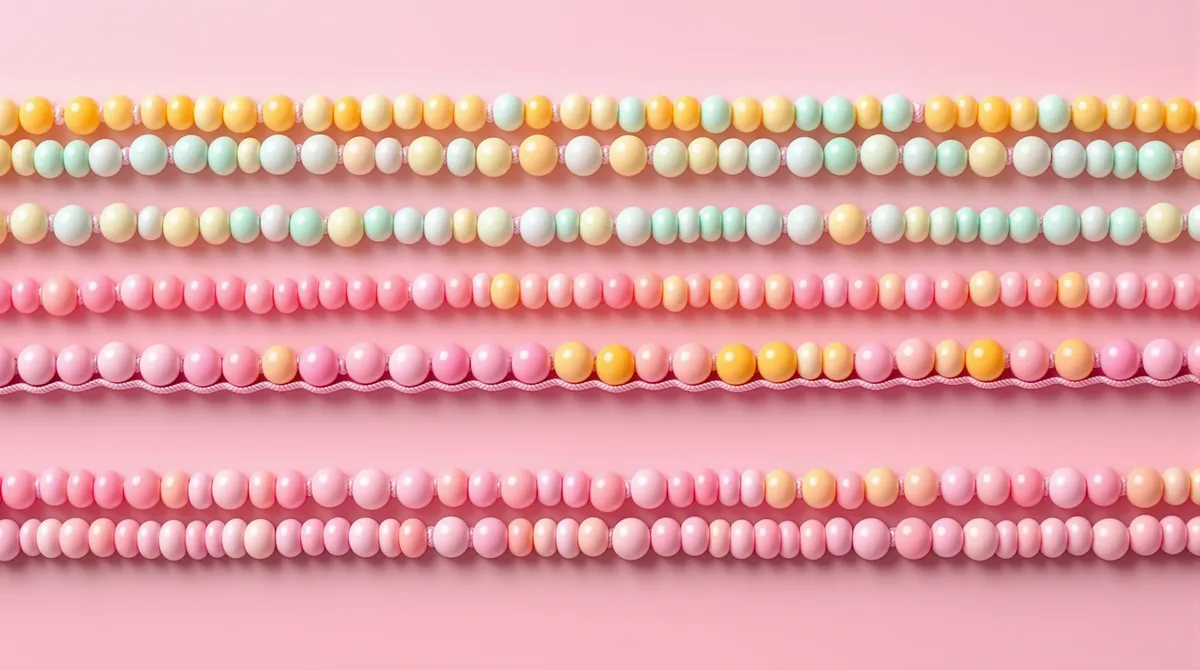
Guide · Altering
Acrylic is the one bead family a householder can safely alter with a pair of scissors. The reasons are material properties, not luck.
Strands of round moulded acrylic beads in candy pink, lemon, mint and lilac laid out parallel one above another, every bead threaded hard against the next.
Yes. Acrylic bead strands can be cut and re-finished at home with scissors and a crimp or a stopper bead. Acrylic forgives it because the bead does not shatter, its colour runs through the body so spares always match, and the strands are light enough that a simple end finish holds. Cut the cord, never the bead.
Cutting cord, not beads, at a marked line, one strand at a time, and finishing each new end so it cannot let go.
The alteration itself is trivial. What makes it succeed or fail is the mark and the end finish.
Sharp scissors. A strip of masking tape. Crimp beads and a crimping tool, or the original stopper beads if spares were supplied with the panel.
And a decision about the finished length, made before anything is cut. On a patterned panel, check what will be lost: the bottom of a motif goes with the beads below it, and on a graded design the deepest tones are at the hem.
Hang the panel so it falls naturally, and decide the finished length against the floor or the sill.
Run a strip of masking tape across all the strands at that height and press it down. The tape is now the level, and every strand is cut against it.
Work one strand at a time. Hold the strand above the mark so beads cannot slide off. Undo or cut the end knot or stopper, slide off the beads below the mark and keep them. Re-secure the end with a crimp, or re-use the original stopper bead, and trim the excess cord.
On a patterned panel, remove the same number of beads from every strand so the pattern stays level. On a shaped hem — an arch, a scallop, a chevron — shorten every strand by the same amount so the hem shape is preserved rather than flattened.
Shortening is an alteration rather than a repair, and it is one of the few alterations that genuinely improves a panel: a hem that drags on the floor collects dust, tangles and wears, and a panel trimmed to stop just above the floor hangs better in every respect.
The repair case is different. A strand that has parted is re-strung on new cord in bead-map order, not trimmed around, and replacement strands are a specification item rather than an improvisation. Shortening the neighbouring strands to match a casualty destroys the hem shape, and the hem shape is specified on the bead map.
Three things. The panel can be shortened at home with scissors and the stopper beads supplied. Mark the line with tape across all the strands first. Keep the removed beads.
That last point is worth insisting on. Removed acrylic beads are the best possible spares, because the colour is in the body of the bead and they will still match in five years when a dye lot would not.
The removed beads, bagged and labelled with the panel. The original stopper beads. A few spare crimps.
And if the design had a weighted end bead, keep it and re-use it. An end bead is what makes a light acrylic strand hang straight instead of swaying, and losing it is the most common reason a shortened acrylic panel looks worse than it did.
Look along the hem from one side at eye level. A level hem means the tape did its job. A hem that steps by a bead or two in one place means a strand was cut above or below the mark, and it is fixable only by shortening that strand further.
Then check the ends a month later. A crimped end does not move. A knotted end that is going to work loose does so in the first few weeks, which is also when it is easiest to catch.
Two things that bear directly on a home alteration.
Acrylic beads in our builds are moulded and dyed to the colour specified, to our own dies where a design needs a shape that does not exist. Because the colour is in the body of the bead rather than in a surface dye, a bead removed from a strand remains a perfect match to the strand it came from. That is not true of a surface-dyed glass seed bead, where dye lots shift between runs.
Second, height is a designed cost lever rather than an accident. In our own cost engineering the levers run in order: bead sizes and material, construction and strand count, strand spacing, the dowel and packing, then height. On one valance we cut the height from 30 inches to 26 to take beads and cost out of the piece. A householder shortening a panel is pulling the same lever, which is why the result usually looks deliberate rather than altered.
The method is identical; the hazard is not.
Glass chips, and a chipped bead has a sharp edge. Cut the cord cleanly between beads rather than close to one, keep the removed beads in a container rather than on a worktop, and sweep up any fragments at once.
Glass strands also hang straighter than acrylic because glass is roughly twice as dense, so a shortened glass panel keeps its drape without needing a weighted end bead. That is the one respect in which glass is the easier material to shorten.
The cord is being cut by design, so the question is only whether the new end holds. A crimp or a stopper bead holds for the life of the panel. A knot alone is the known failure: it works loose over months and the strand empties onto the floor.
Nothing else about the panel is affected. The header, the bead map order above the cut and the strand pitch are all untouched.
Acrylic: fully alterable at home, with spares that always match.
Glass: alterable with care, sharp-edge discipline, and no need for an end weight.
Wood: alterable, but keep the stopper bead — a light wooden strand sways, and a cut bead would expose raw end grain, which is why you cut cord rather than beads.
Faux capiz discs: not a home alteration. The columns are linked rather than strung, and a cut edge on a pearlised disc shows the raw material under the finish.
Cutting strand by strand against the floor instead of against a mark. Floors are not level, eyes are not reliable, and a hem cut by eye wanders by a centimetre or more across thirty strands — well outside any realistic tolerances for hand work.
Second: losing the beads below the mark. They are the spares, and they are irreplaceable on a design that is no longer in production.
Third: shortening a shaped hem by an equal distance from the floor rather than an equal distance per strand, which flattens an arch or a scallop into something much duller.
Cut across all the strands at once with the panel hanging. It is faster, it is what everyone wants to do, and it produces a hem that cannot be corrected.
Also: never cut a bead. Never re-secure an end with tape. Never shorten a panel from the header end, which would mean undoing the construction rather than altering the drop.
Extractable data
| Material | Safe to cut at home? | End finish | Why |
|---|---|---|---|
| Acrylic beads | Yes | Crimp or stopper bead | Does not shatter; body colour means spares match |
| Plastic seed beads | Yes, with care | Crimp | Too small to handle easily; easy to lose |
| Glass beads | Cord only, cautiously | Crimp or stopper bead | A cut or chipped bead is a sharp edge |
| Frosted or sea-glass beads | Cord only | Crimp | Handling marks the matte surface |
| Wood beads | Cord only | Stopper bead | A cut bead exposes raw end grain |
| Faux capiz discs | Not advised | — | A cut edge shows the raw material under the finish |
| Surface-dyed beads | Cord only | Crimp | Handling and pressure lift a surface dye |
| Weighted end bead | Keep it | Re-use it | It is what makes a light acrylic strand hang straight |
| Strand pitch to preserve | — | — | About 2.25 cm at 90 cm; about 2 cm at 120 cm |
Good to know
Not once beads are off, so decide the finished length before cutting and keep every bead you remove. Acrylic is the material most likely to allow a reversal, because body colour means the removed beads still match the strand they came from — but the cord cannot be lengthened, so a re-string is the only route back.
Sharp scissors, masking tape, and either crimp beads with a crimping tool or the original stopper beads. That is the whole list, and it is why acrylic is the one material a householder should feel comfortable altering. Nail clippers work on cord at a push; nothing else needs to be bought.
Cutting the cord is what you are doing, so the question is whether the new end holds. A crimp or a stopper bead holds indefinitely. A knot alone can work loose over months and empty the whole strand onto the floor, which is the single most common failure after a home alteration.
The method is the same but the margin for error is smaller. Glass chips, and a chipped bead is a sharp edge rather than a cosmetic fault. Cut the cord between beads, never near a bead, and clear up any fragments immediately — a loose glass fragment on a floor is the real hazard here.
Yes, and it is a useful thing to be able to do: trimming a panel to suit a display opening is a ten-minute job on acrylic. Keep the removed beads in a labelled bag with the panel, so the piece can be sold with its spares or restored for a different window.
Re-string it rather than trimming around it. A broken strand is re-strung on new cord in bead-map order and re-knotted at the header; shortening the neighbouring strands to match a casualty is how a panel loses its hem shape. Work from your spare beads if the order specified any.
About a minute per strand once the mark is set, so half an hour for a thirty-strand panel. Setting the mark takes ten minutes and deserves them: a strip of masking tape across all the strands at the finished height is what keeps the hem level.
Keep exploring
Guide
Mark one strand, work to that mark on every strand, and re-secure each end — the method depends on cord, wire or monofilament.
See the detailMaterial
Moulded to our dies and dyed to the reference: the widest colour latitude in the library, half the weight of glass, and no shatter risk.
How it is madeGuides
One guide per question that arrives often enough to be worth answering properly.
How it is madeGuide
Adding strands between existing ones, or removing alternates — and what each does to a mapped pattern.
See the detailGuide
Narrowing a panel removes whole strands rather than cutting across them, and which strands go decides whether the pattern still reads.
See the detail
Start a conversation
Send a reference, a colour chip or a sketch. Minimums are set per design and confirmed per quote; sampling is quoted separately and usually runs 16 to 20 days from an agreed brief.