Specification
Cord, thread or wire for strung beadwork
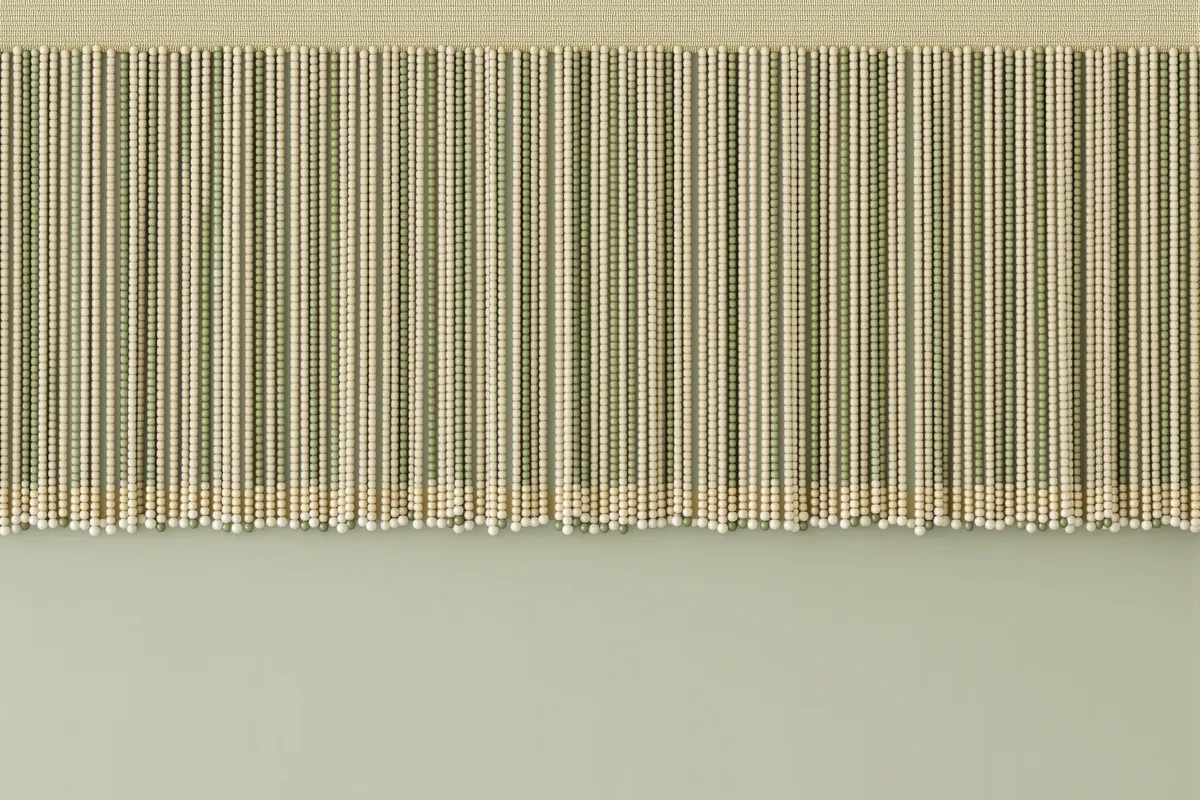
Cotton cord, nylon thread and coated steel wire compared on drape, repair and how each one eventually fails.
Specs and sizes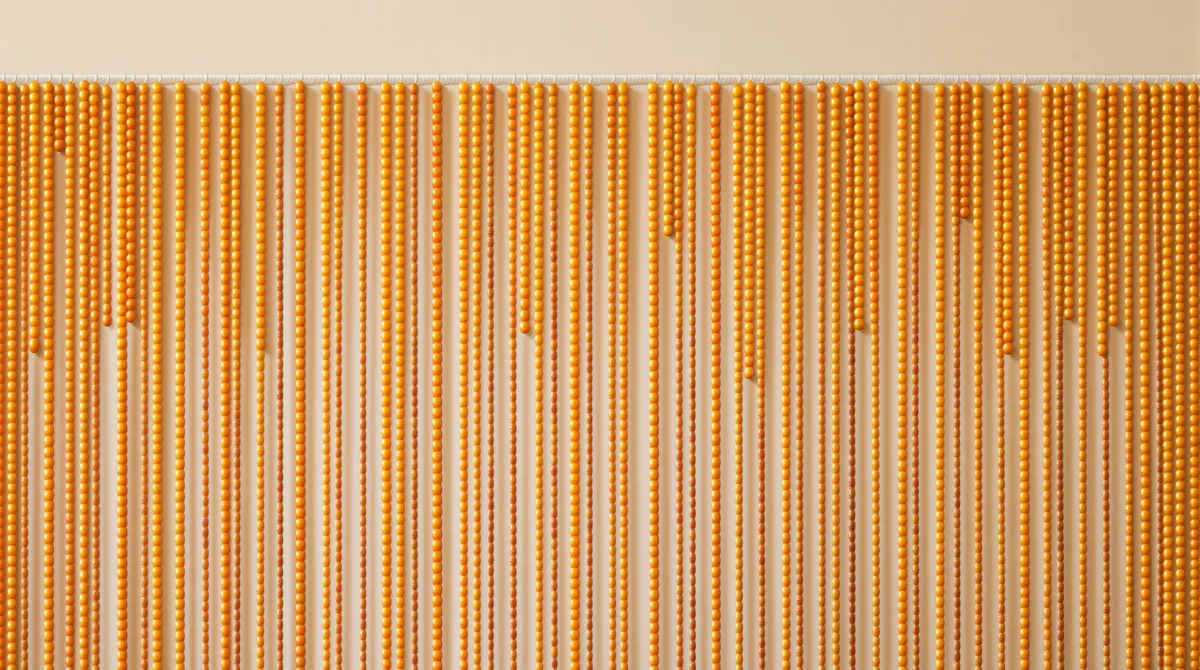
Guide · Altering
The beads come off easily. The end does not go back on easily, and how it goes back on depends entirely on what the strand is strung on.
A beaded curtain head-on with a new hem cut dead level across the glossy orange, canary and chocolate strands, three cords at the edge still hanging at their original longer…
Hang the panel, let it settle, then mask a level line across all the strands at the finished length. Work one strand at a time: hold it above the mark, release the end, remove the beads below the line, and re-secure the end with a knot, a crimp or the original stopper bead. The re-securing method follows the stringing medium.
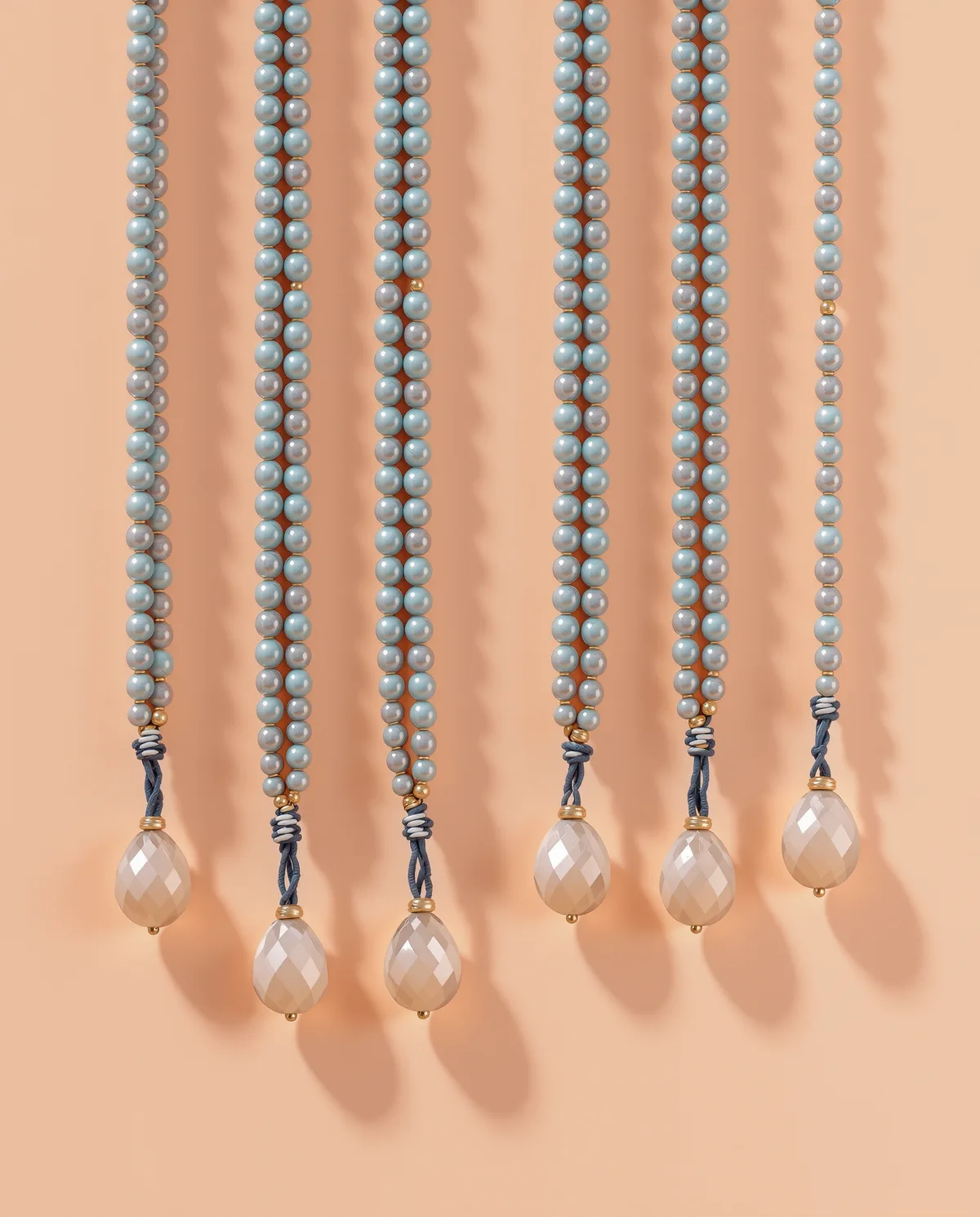
Setting one level line across every strand, then removing beads below it and re-closing each end. The second half is the work; the first half is the result.
Shortening is a different job from reshaping a hem, even though both end with strands at new lengths. Shortening keeps the hem's existing profile and moves it up; reshaping changes the profile. If the panel's hem is already a scallop or an arch, every strand needs the same reduction, not the same finished length.
A settled panel. A new one is still holding the shape of its packing and will lengthen over the first day or two, so trimming on day one leaves it short by the weekend.
Then masking tape wide enough to span the panel, a level or a long straight edge, cutters, whatever the ends need re-securing with, and a tray. Work with the panel hanging. Shortening a bead panel on a table is how you discover the strands are not all the same length and never were.
Hang the panel and leave it at least a day.
Decide the finished drop, including the gap at the floor.
Run masking tape across all the strands at that height, checked level. On a shaped hem, instead mark the reduction on one strand and transfer that reduction to each strand individually.
Take one strand. Hold it above the tape so no beads can slide.
Release the end — untie the knot, cut above the crimp, or remove the stopper bead and keep it.
Slide off the beads below the line. Keep a few extra.
Re-secure the end: double knot for cord, a fresh crimp for coated wire, or refit the stopper.
Move to the next strand. Do not re-measure; the tape is the measure.
Because measuring each strand individually accumulates error, and the error lands at the hem where it is most visible. Thirty measurements of 185 cm produce a hem that wanders by several millimetres; one tape line produces a hem that is straight by construction.
This is the same principle we use in production, where strand lengths are held to the bead-by-bead sheet rather than compared to each other. The sheet, not the neighbour, is the reference.
| Stringing medium | How to tell | Re-secure with | Difficulty | Watch for |
|---|---|---|---|---|
| Waxed cotton cord | Matte, slightly fuzzy, takes a knot | A tight double knot, trimmed close | Easy | Knot too small to stop the last bead |
| Nylon-coated steel wire | Springy, shiny, will not hold a knot | A crimp bead, flattened | Moderate | Crimping pliers needed; a knot will slip |
| Monofilament | Clear, stiff, nearly invisible | A double knot plus a stopper bead | Moderate | Knots creep under load |
| Stopper-bead finish | A deliberately larger last bead | Refit the same stopper | Easy | Keep the stopper — it is the finish |
| Breaking strain | — | Confirmed per build | — | Established against the specified medium |
The bottom of it is lost, and you should look at what that means before you cut. A motif that runs to the hem will be cropped mid-shape. A repeating field crops cleanly. A graded design — colour or bead size running down the drop — loses its deepest tones, which on a size-graded ombre means losing the largest beads, which also changes how the strand hangs.
Scattered-accent designs are the forgiving case. Where large beads are thrown three or four to a strand at random, deliberately never aligned in a row, there is nothing to crop.
Never cut a strand without securing the end in the same pass. Never let go of a strand above the cut before the end is closed. Never cut all thirty strands first and then start re-securing them — that is how a floor ends up with several thousand beads on it.
And never shorten a panel to fix a crookedness problem. A panel hanging unevenly is a header that is not level, and cutting the strands bakes the error into the panel permanently.
An hour for a plain 30-strand panel on cord. Two for the same panel on coated wire, because setting a crimp properly is slower than tying a knot and a badly set crimp fails.
Add time for a shaped hem, where every strand has its own finished length and the tape line method does not apply. That is closer to reshaping a hem than to shortening one, and it is worth reading it as that job instead.
We do not shorten panels. The drop is a specified dimension, so a shorter panel is a shorter build: fewer beads per strand, the same strand count, the hem profile re-drawn to the new proportion.
That matters because height is one of the main cost levers on a beaded panel. On one frosted sea-glass valance the drop was reduced from 30 in to 26 in specifically to take bead count out of the build, which is the production version of exactly this job — done on the sheet, before any bead was strung.
When the hem has been damaged. A panel whose bottom beads have been chipped by a hard floor, or whose end stoppers have worn, is genuinely better shortened by a few centimetres than repaired bead by bead — you remove the damage and re-close every end in one pass.
That is also the one case where shortening improves the panel rather than adapting it, because the new ends are fresh and the floor gap increases.
That a panel can be shortened at home, that every end has to be re-secured, and that the removed beads are the spares for any future repair. Then the one line that prevents the most disappointment: let it hang for a day first.
If the listing states the drop and the floor gap it was designed for, most of this conversation never happens.
Published door formats run 90 × 200 cm and 120 × 200 cm, with portals at 76 × 140 cm in the design library and a 90 × 67 cm dual wall-hanging and portal format. Our 2027 design library puts full-length panels at 40 to 60 strands, with the exact count confirmed on the approved sample.
Against those formats, the practical note is that standard drops are generous on purpose. A 200 cm panel in a 195 cm opening is a shortening job; a 200 cm panel specified for a 203 cm opening is not. The published lead time for beaded décor is 40 to 60 days after sample approval, which is the comparison for anybody weighing an alteration against a panel built to the right drop.
Good to know
Repair it first, then shorten. A parted strand is re-strung in its original bead order and re-knotted at the header, and you want it back at full length before you set a line across the panel — otherwise the broken strand sets the line and the rest come out long.
About an hour for a 30-strand panel on cord, longer on coated wire because each crimp has to be set properly. The marking takes ten minutes and is the part that decides the result; the strand work is repetitive rather than difficult.
Not easily, and this is the one alteration that is effectively one-way. Keep every removed bead in order if you want any chance of it, because putting length back means rebuilding the bottom of each strand bead by bead. The reversible alternative is to raise the header instead of cutting.
Masking tape, a spirit level or a long straight edge, fine scissors or flush cutters, and a crimping plier if the panel is on coated wire. A tray under the panel catches the beads you release, which otherwise end up under the furniture.
Only at the end you are working on, and only if you cut above the knot by mistake. The cord higher up the strand is untouched. The real risk is a re-tied knot that is smaller than the drill hole of the last bead, which lets the bead ride over it and empties the strand later.
Handling, not method. Glass strands are heavy and the beads chip where they strike each other, so support the strand you are working on and let the removed beads into a tray rather than onto a hard floor. The weight also drops noticeably, which can mean the panel is now fine on a lighter fixing.
For display, yes — it is a reasonable way to fit a panel into a shop fixture. For stock, no: a shortened panel is no longer a stock size, and because every beaded door curtain is made to order in the first place, a customer wanting a shorter drop is better served by specifying it.
Keep exploring
Specification
Cotton cord, nylon thread and coated steel wire compared on drape, repair and how each one eventually fails.
Specs and sizesGuides
One guide per question that arrives often enough to be worth answering properly.
How it is madeGuide
The per-strand arithmetic for a V-point or a scallop, and why marking the whole shape before cutting anything is the job.
Read the guideGuide
Cut a full-length panel to valance drop, finish every end, and keep the removed beads — they are the spares and the second piece.
Specs and sizesGuide
Adding strands between existing ones, or removing alternates — and what each does to a mapped pattern.
Read the guideGuide
Matching the bead, extending the stringing medium, hiding the join — and why raising the header usually beats splicing strands.
See the detail
Start a conversation
Send a reference, a colour chip or a sketch. Minimums are set per design and confirmed per quote; sampling is quoted separately and usually runs 16 to 20 days from an agreed brief.