Guide
Double doorway beadwork
One panel or a pair, where the join falls, and why the walk-through gap should be designed rather than left to chance.
Open the reference
Guide · Install
The join is the whole problem. Get the pitch and the level right across it and nobody sees two panels; get either wrong and nobody sees anything else.
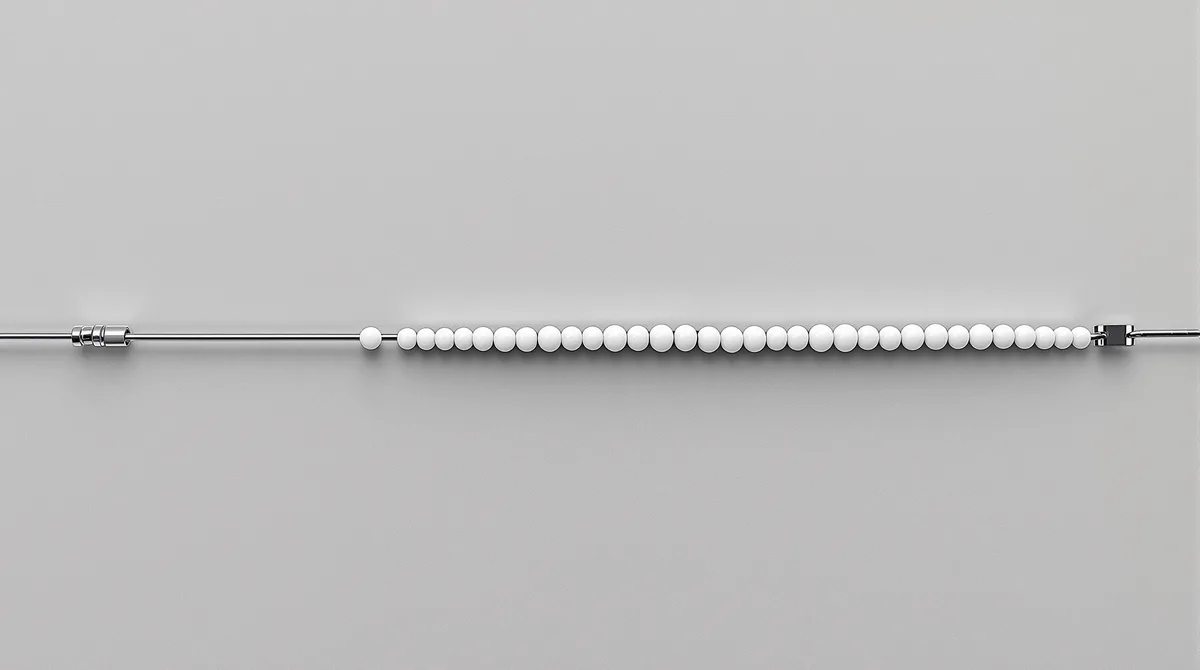
Six bead strands shown side by side, three strung close-packed and three strung with gaps of bare cord, so the difference in density reads directly.
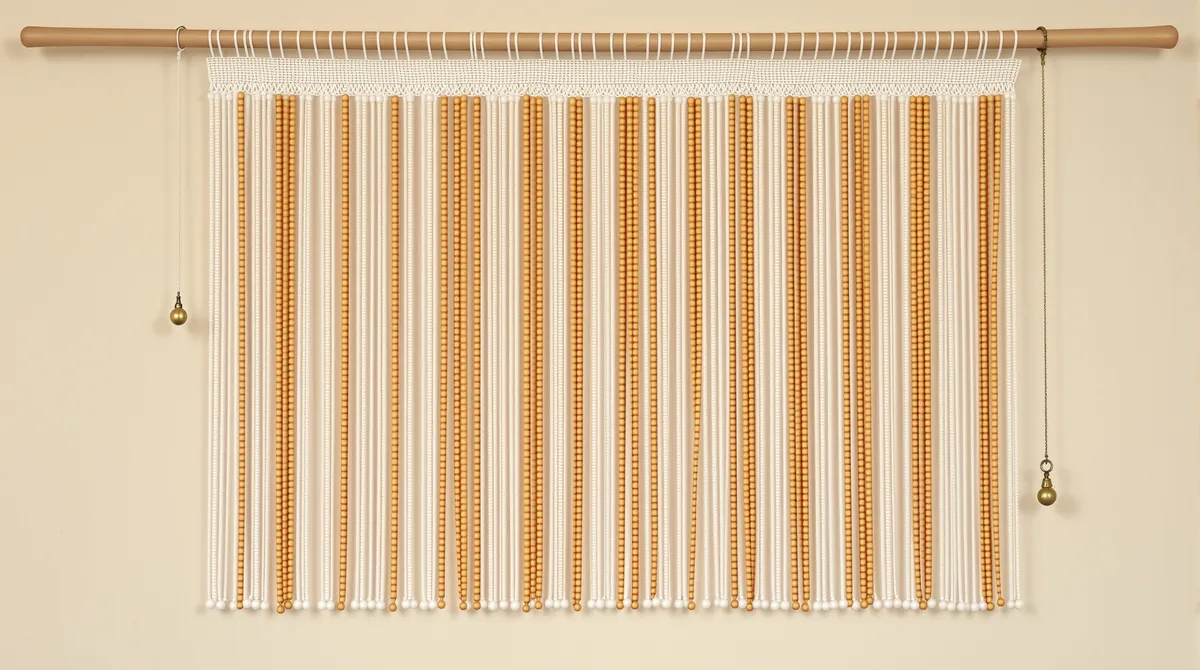
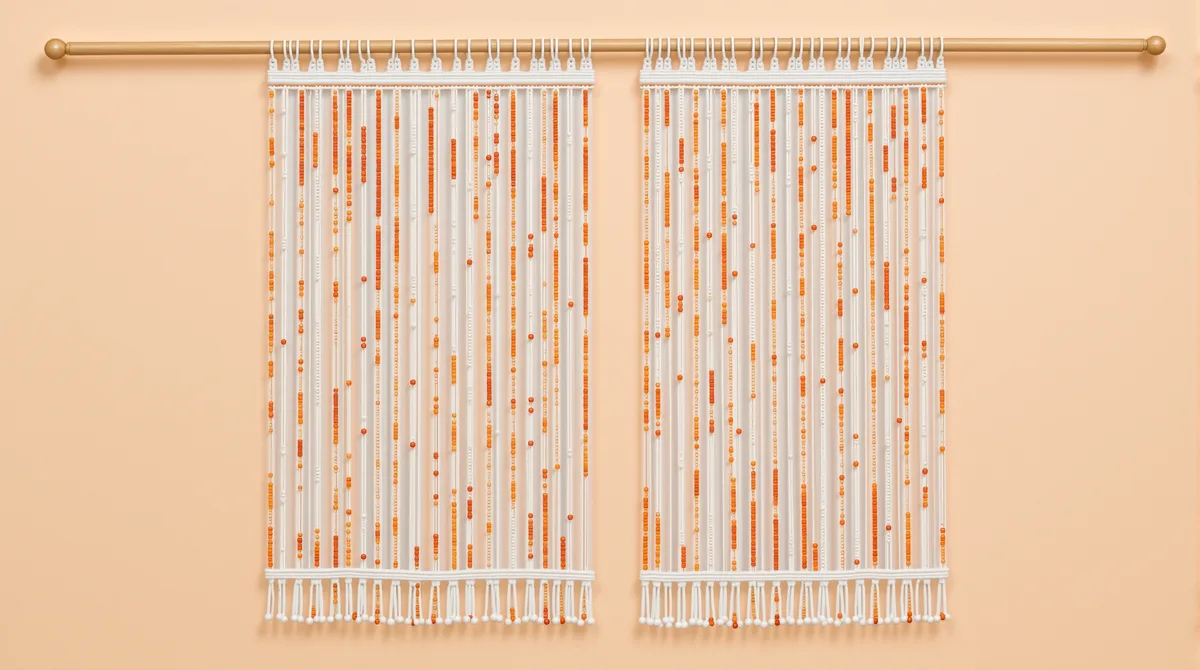
Hang two panels on one continuous rod or batten so both headers are automatically level, and overlap them by one strand pitch at the join so no gap shows. The pitch must match across the join: two panels strung at different strand counts for the same width will read as two panels however carefully they are hung.
Hanging two headers at exactly the same height, at exactly the same pitch, with a join that does not read as a seam.
The first of those is solved by hardware — one rail, rated for the panel weight of both halves. The second and third are solved before the panels are made, which is why this page is as much a specification page as an installation one.
The opening width, and a decision about where the join falls.
Then a rod or batten long enough to span the whole opening in one piece. That single component is what makes the job easy: two panels on one continuous member are level with each other by definition, and no amount of careful measuring will achieve the same thing with two separate fixings.
And, critically, the knowledge that both panels came out of one production run on one bead map. If they did not, no installation technique will hide it.
Fix the rod or batten first, across the full opening, into solid structure — a timber lining, two joists, or masonry with the correct plug. Level it carefully, because every error in the rod appears twice.
Hang the first panel. Hang the second so its outermost strand sits about one strand pitch inside the first panel's outermost strand — overlapping, not butted. At 90 cm and forty strands that centre-to-centre spacing is about 2.25 cm; at 120 cm and sixty strands, about 2 cm. The strand count reference carries the full table.
Settle both panels together: run your hands down the pair in sections to free crossed strands, especially at the join, and leave it a day.
Change the span's hardware, not the join.
Two full-length glass panels on one rod is a substantial load. Use three or four brackets across the span into solid structure, and expect the rod to be the limiting component rather than the brackets: a long round dowel will bow under glass, which puts the two panels at slightly different heights in the middle and undoes the whole point of using one member.
For a wide glass pair, specify a rail rather than a dowel. On our own constructions the choice among the panel headers is a design decision — a round dowel on most, a rectangular beam profile where the span and the load call for it, and a stained wooden header rail where it is part of the look.
Hanging as a pair does nothing to either panel, with one exception worth managing: at the join, strands from the two panels sit against each other and rub whenever someone passes.
Two mitigations, both free. Overlap by one pitch rather than butting the panels tight, so the strands interleave loosely rather than press. And put the join away from the line people actually walk through, which on a doorway means off-centre.
Glass: heavier, hangs straighter, and the join is easier to keep tidy because the strands settle fast after being disturbed. The hardware is the constraint.
Acrylic and wood: lighter, and the join is harder to keep tidy because light strands sway and tangle against each other. Specify a weighted end bead on both panels, which steadies the drops and keeps the join still.
Faux capiz disc columns: these are the hardest pair to join well, because a disc column is visually distinct and a gap between two columns reads immediately. Specify the pair as one piece on one header if the format allows.
Two separate fixings. It is the obvious way to hang two panels and it is the reason most pairs look wrong: two brackets set by eye will differ by a few millimetres, the hems will step, and the eye goes straight to it.
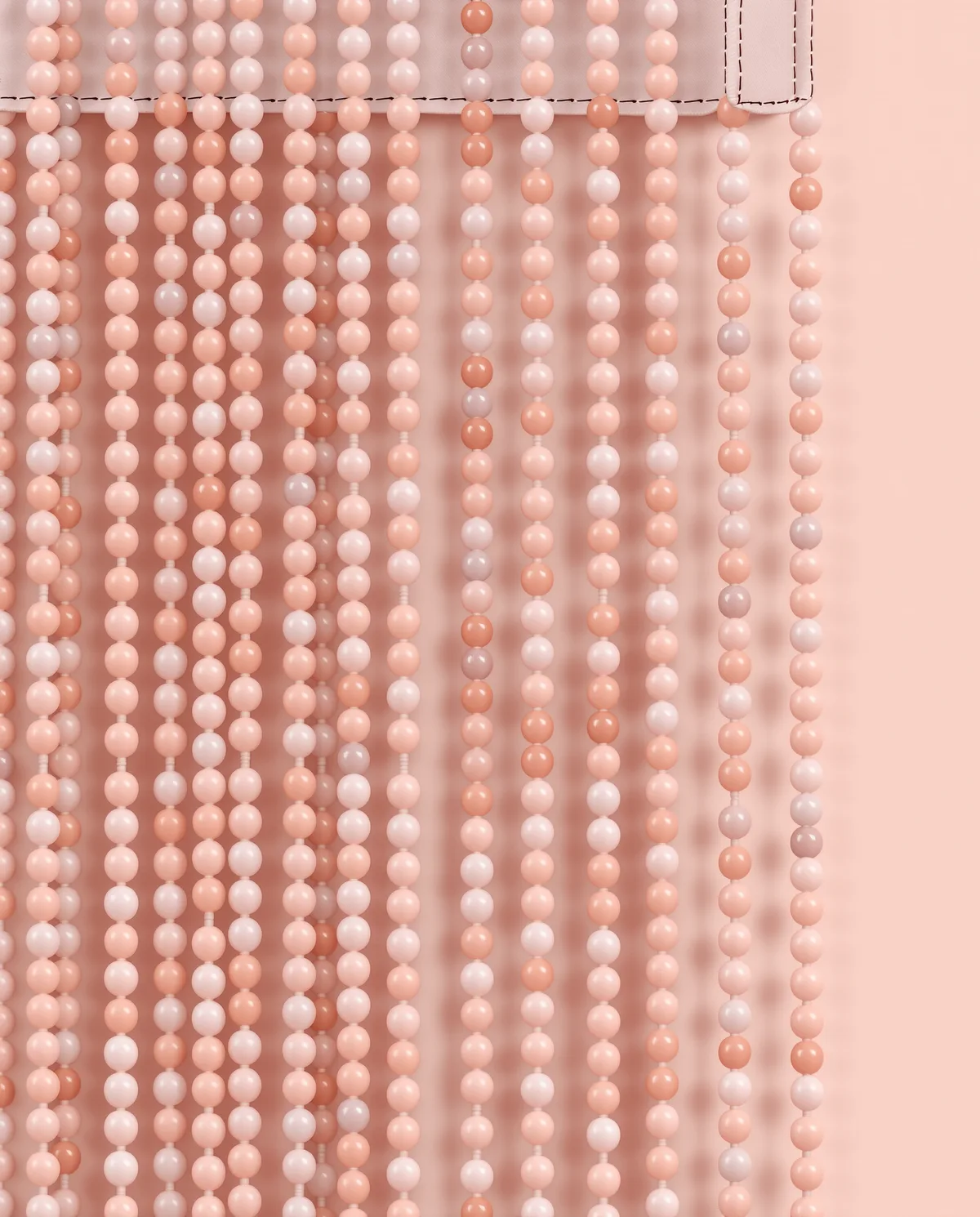
Second: panels ordered at different times. Surface-dyed seed beads shift slightly between dye lots, so two panels from two runs can be a tone apart — invisible on their own and obvious side by side. Order both in one run.
Third: a single large motif planned across the join. The join moves slightly in use and a motif that crosses it will never quite line up. Use a repeat.
Butt two panels tight and tie them together at the hem to stop them parting. That loads the end strands of both panels sideways and will part a cord.
Also: never trim strands at the join to make two panels fit an opening. The hem shape is cut into the finished drop of each strand on the bead map, and trimming at the edge leaves a notch that reads as damage.
Two hours for a pair, properly, against an hour for a single panel. The extra time is in levelling the span and in dressing the join, and both reward being done slowly.
Then a full day of settling before judging it. A new join always looks worse on the first evening than it does on the third.
Writes both panels onto one plan.
A pair should come off one colour-count sheet: the document that names every bead position on every strand, which is what makes a pattern repeat exactly across a production run and keeps strand lengths identical. It sits inside the tech pack for the design. Two panels on one map share a pitch, a drop, a hem shape and a bead lot, and that is the whole of the problem solved at source.
Where a pair is genuinely a single wide piece in two halves, we would also match the end strands deliberately: the outermost strand of one panel and the innermost strand of the other are specified to interleave, so the join is a designed overlap rather than an accident of hanging.
When a pair has gone out of level or a join has opened, which is almost always a fixing fault rather than a panel fault.
Re-hang both panels from one continuous member and the symptom usually disappears. Replacing a panel because its hem does not match its neighbour's is the wrong call unless the two were genuinely made in different runs, in which case the answer is that they were never a pair.
Three things. Hang both panels from one rod. Order a pair together on a single order, so the bead lots match. Put the join off-centre.
For a wide opening, add the alternative: a single 120 cm panel at sixty strands covers most openings up to about 47 inches, and one panel has no join to get right.
Extractable data
| Variable | Get it right by | Symptom if wrong |
|---|---|---|
| Header level | One continuous rod or batten for both panels | One panel hangs high; the hems step |
| Strand pitch | Specifying the same pitch on both panels | A dense panel beside an open one |
| Join overlap | Overlapping by one strand pitch | A vertical line of light at the seam |
| Join position | Off-centre, away from the walk-through | Strands pulled apart at the seam daily |
| Bead lot | Ordering both panels in one production run | A visible tonal step at the join on dyed beads |
| Strand drop | One bead map for both panels | Hems at different heights |
| Pattern across the join | A repeat rather than a single large motif | A motif cut in half at the seam |
| Pitch at 90 cm width | 40 strands, about 2.25 cm | — |
| Pitch at 120 cm width | 60 strands, about 2 cm | — |
Good to know
Both panels are unaffected by being hung as a pair, and either can later be hung alone. What does not transfer is the pattern: two panels designed as a pair with a repeat running across the join will each look slightly incomplete on their own, which is worth knowing before committing to a pair.
A tape, a level, a drill, anchors for the substrate, and a rod or batten long enough to carry both panels in one span. The long span is the tool that matters: a single continuous member is what makes two headers level without any measuring at all.
Not in itself. The risk is at the join, where strands from the two panels sit against each other and rub every time someone walks through. Overlapping by one pitch rather than butting the panels tight reduces that contact; putting the join away from the walk-through removes it.
The join does not change; the fixing does. Two full-length glass panels on one rod is a serious load, so use three or four brackets across the span into solid structure, and expect the rod itself to be the limiting component — a long dowel will bow under glass before a bracket fails.
Yes, and a pair is often the better display: two narrower panels are easier to handle, to pack and to re-hang than one wide one. Hang them from a batten so the pair can be repositioned for each scheme, and keep the join off the sight line from the door.
Re-string it before hanging, with the panel flat, in bead-map order from the spares. On a pair, note which panel it belonged to: if the two were made in one run their bead lots match, and mixing spares between panels later is how a tonal step appears at the join.
Keep exploring
Guide
One panel or a pair, where the join falls, and why the walk-through gap should be designed rather than left to chance.
Open the referenceGuides
One guide per question that arrives often enough to be worth answering properly.
Read the guideGuide
Find the load, pick the fixing, mount the header level, load the strands dry, then let them settle before judging it.
Read the guideGuide
Each no-drill method with the weight it holds, heaviest first, and the one material choice that makes all of them work.
Read the guideGuide
Sizing one for a reveal, what a friction fixing really carries, and the materials it does and does not suit.
Specs and sizes
Start a conversation
Send a reference, a colour chip or a sketch. Minimums are set per design and confirmed per quote; sampling is quoted separately and usually runs 16 to 20 days from an agreed brief.