Manufacturing
Valance beadwork
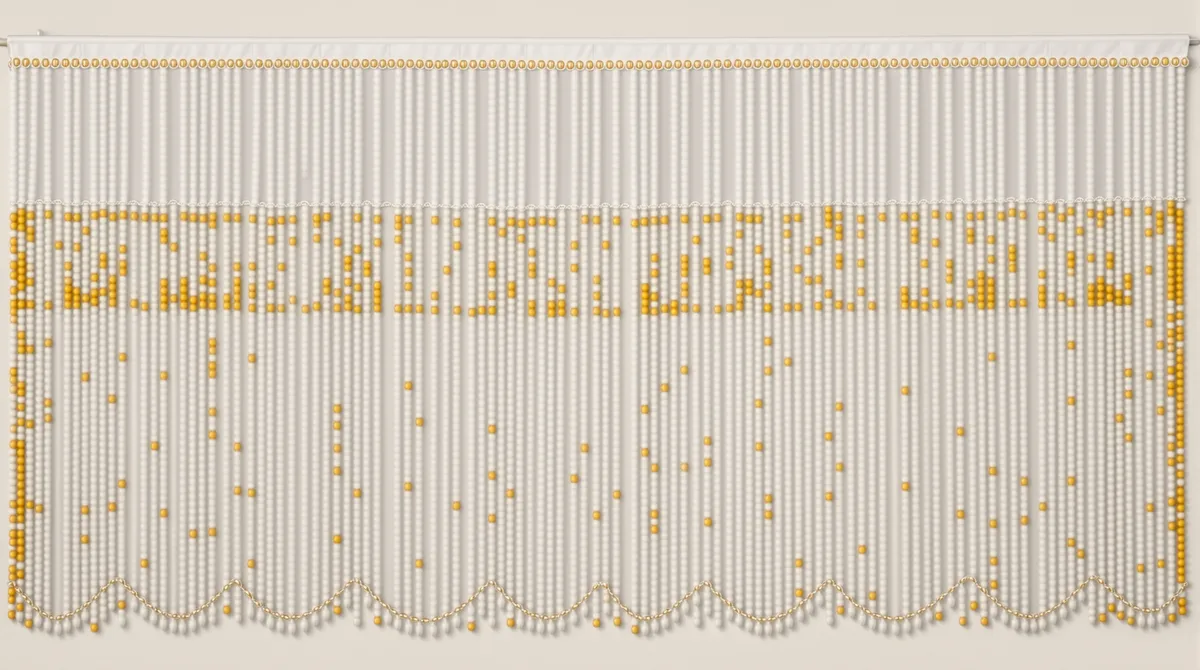
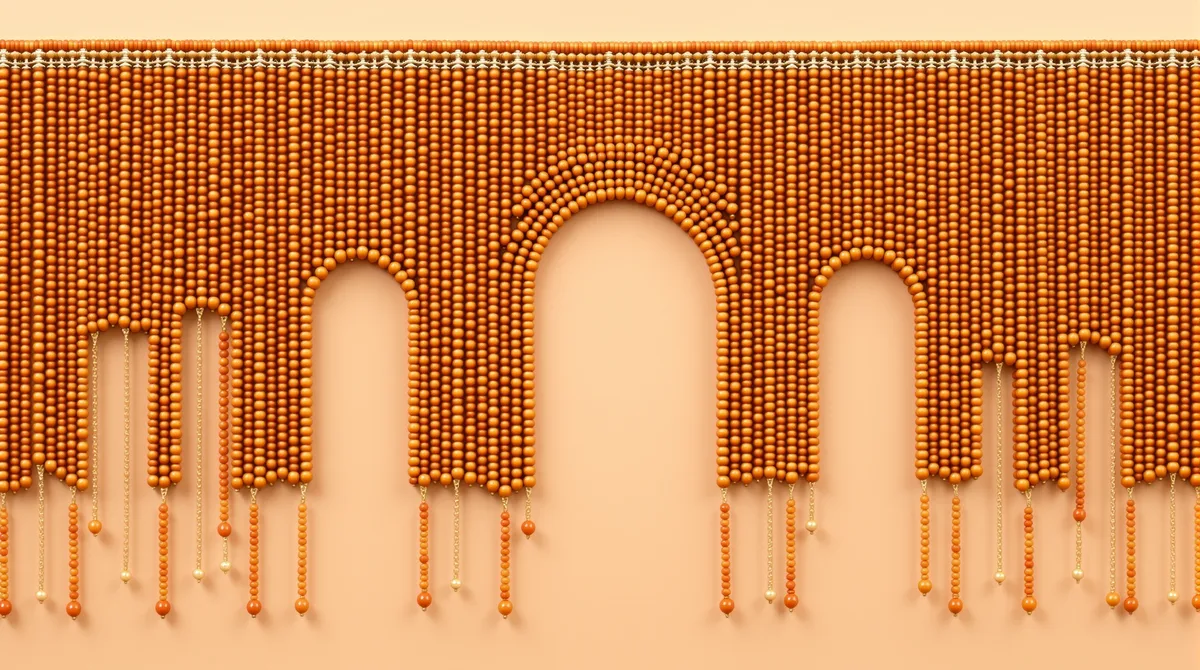
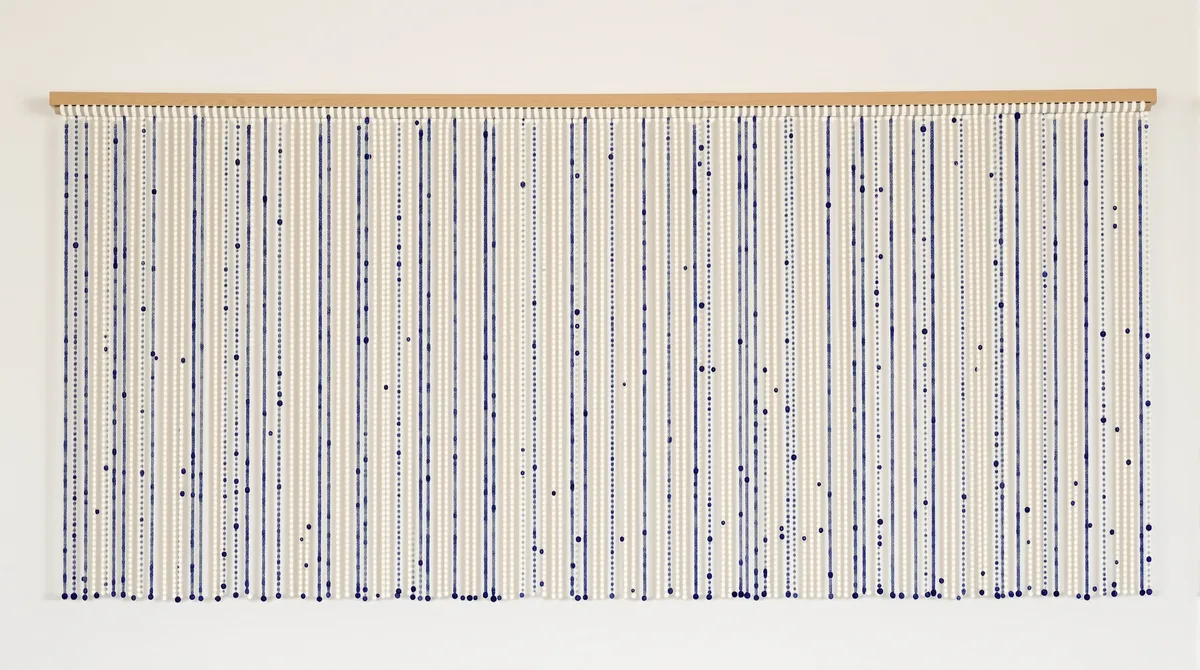
Short strung panels at 120 × 35 cm and other formats, 56 to 60 strands, with scalloped, fan-arch, V-point and straight hems — and why height is the cost lever.
How it is made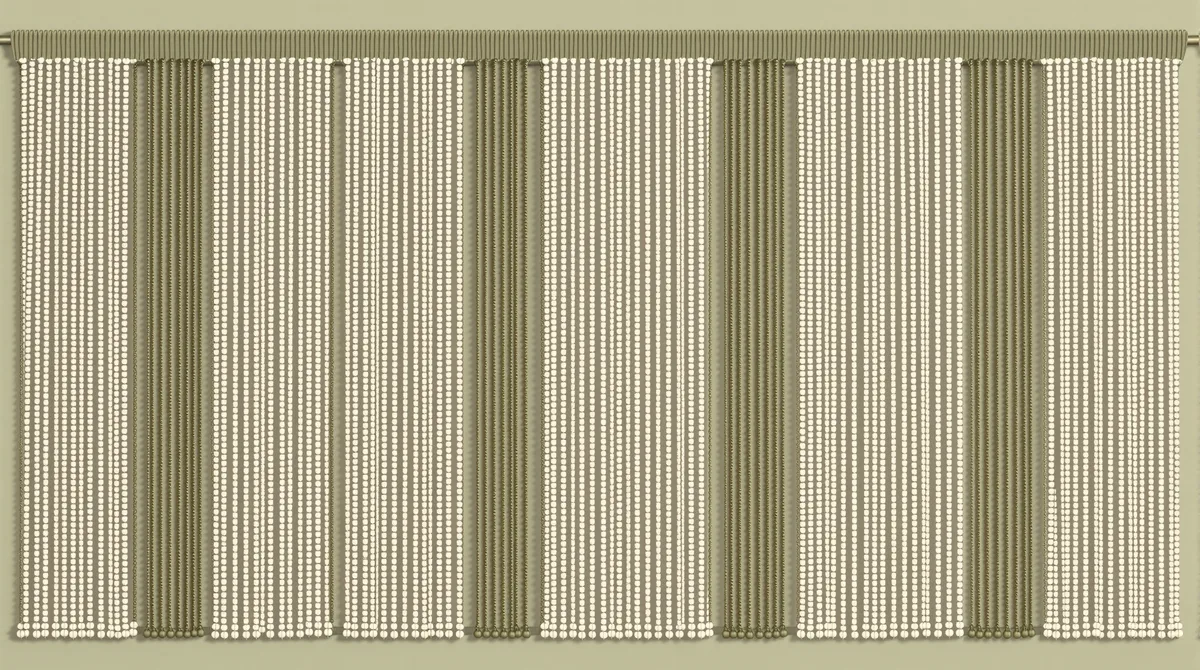
Guide · Comparison
Both are shorter than a door curtain and they are not the same object. One decorates a header; the other screens a part of an opening, which is a different job entirely.
Six narrow panels in olive, moss and oatmeal below one header rail, alternating between a shallow valance with a fan-arch hem and a drop three times as deep finishing straight.
A valance dresses the top of an opening and screens nothing: in our own formats it runs 30 to 40 cm deep. A short curtain covers part of the opening and starts to screen, conventionally anything from a valance depth up to about half the height. The practical line sits near a third: below that it reads as a header, above it as a curtain.
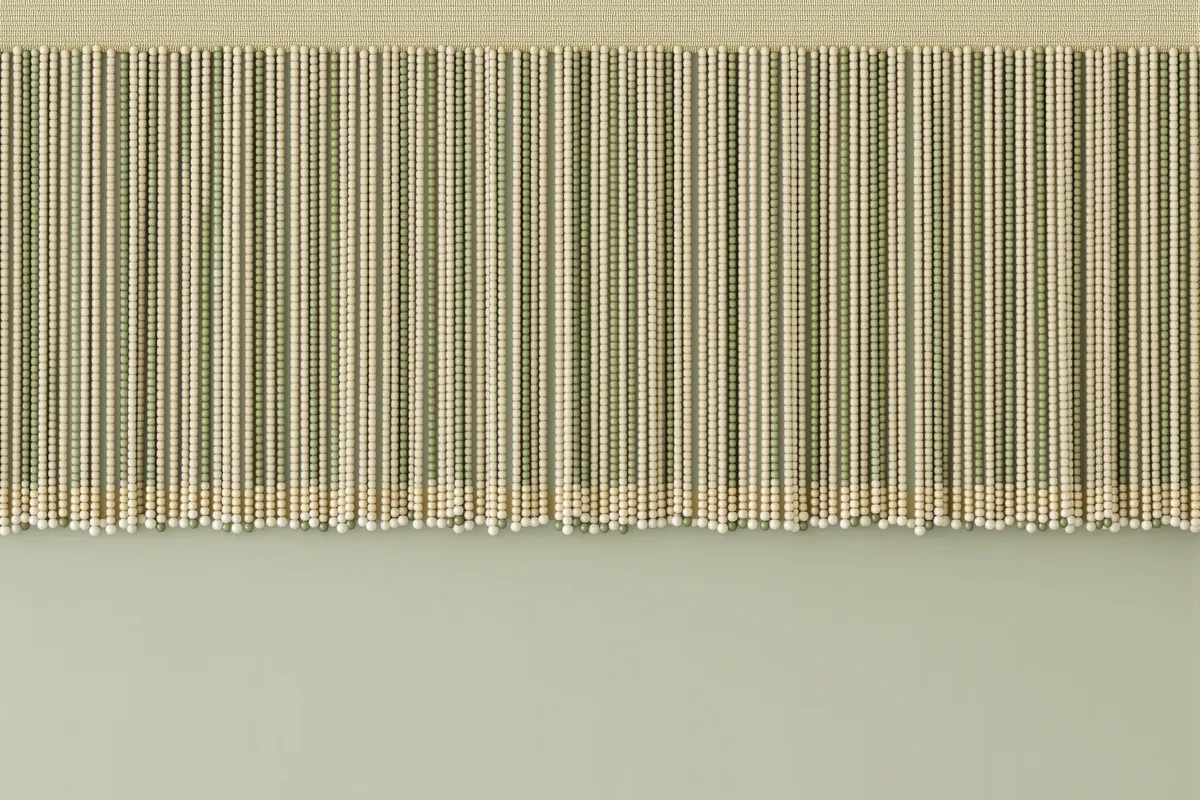
A valance dresses a header. A short curtain screens part of an opening. The line between them is roughly a third of the opening's height, and the useful test is behavioural rather than dimensional: if you could walk under it without touching it, it is a valance.
A beaded valance is a short band of beadwork hung at the head of a window or doorway. In our own formats it runs 30 to 40 cm deep across a 120 cm width, and one design-library piece sits at 120 × 35 cm. It is dense, because a short piece has to read as a band rather than as a fringe, and it is usually shaped at the hem for the same reason.
A short beaded curtain is a curtain that stops early. Conventionally that is anything from valance depth up to about half the height of the opening, and the café format — 76 × 76 cm in our own set — is the archetype: it covers a window's lower half and leaves the top clear.
| Specification | Beaded valance | Short beaded curtain |
|---|---|---|
| Job | Dresses the top of an opening | Screens part of an opening |
| Depth in our formats | 30 to 40 cm | Up to about half the opening |
| Example format | 120 × 30 to 40 cm | 76 × 76 cm café format |
| Strands in the renders | 56 to 60 across 120 cm | Depends on width |
| Bead count in the renders | about 900 to 2,000 | about 1,800 at café size |
| Density | Higher — it must read as a band | Moderate |
| Within a child's reach | No, if mounted above a door head | Usually yes |
| Hem shapes used | Scalloped, scalloped arch, V-point, straight | Straight, scalloped chevron |
| Cost against a full curtain | Much lower | Lower |
Because density is what makes a short piece read as a deliberate band. A valance runs 56 to 60 strands across 120 cm, which is roughly a 2 cm pitch, against 40 strands at around 2.25 cm on a 90 cm full-length panel.
The reason is proportional. A sparse full-length panel still reads as a curtain because its height carries it; a sparse 30 cm band reads as a few beads hanging off a rail. The shorter the piece, the more the eye needs the strands close together.
The short curtain, in any comparable width, simply because it has more beads per strand. Both are light compared with a full-length panel, which usually means a tension rod or two hooks is enough for either.
The real weight consequence is at the other end of the comparison. Height is one of the main cost and weight levers on a beaded panel, and a valance removes almost all of it, which is why a 120 cm valance in glass can be a lighter object than a 90 cm acrylic door curtain.
The short curtain, because cost follows bead count. The order the levers move in is bead size and material, then construction, then strand spacing, then the mount, then height — and this comparison is almost entirely the height lever.
Render figures give the shape of it: a valance at about 900 to 2,000 beads, a café curtain near 1,800, against about 3,100 to 5,600 for a full-length panel and about 11,800 for a densely patterned one at 90 × 200 cm. The valance is a different order of magnitude, and that is before stringing hours are counted.
Both pack flat with the strands held in their order and protected against knocking, to the buyer's carton and label specification. The valance ships cheaper on weight.
Neither is held in stock: there is no retail stock programme behind these formats, and every piece is made to order, so a valance and a short curtain are both specified items with a production lead time of 40 to 60 days after sample approval.
The short curtain, and for a mundane reason: it is within reach. A piece across the lower half of a window is brushed past, leaned on and pulled aside, which loads header knots laterally and works cord against drill holes.
A valance above a door head is handled by nobody. Its only service item is dust, and dusting a valance is a two-minute job rather than a ten-minute one. For a commercial interior where nothing will be maintained, that is a serious argument.
Valances suit a brief that wants beadwork as a finish: a shop window header, a restaurant doorway, a bedroom window where a full panel would be too much. They also suit rooms with small children, because a valance mounted above a door head is physically out of reach.
Short curtains suit partial screening: a kitchen window overlooked from a path, a café front, a lower pane that needs privacy while the upper one keeps the light. They are also the right answer where the sill or a radiator makes a full-length panel impossible.
Yes, with a beaded top band. A solid band of close horizontal rows at the head of a piece, with strands continuing below, gives a valance's visual weight and a short curtain's screening in one object — and it is a construction we build rather than a theoretical one.
The other mixed case: a valance and a full-length curtain developed from the same bead-by-bead sheet so they sell as a pair. That is a real option and it costs planning rather than material, because the colour sequence is written once and cut to two lengths.
That valances and café curtains are an established part of the programme rather than an afterthought. Both sit inside the current beaded range alongside portals, curtains and wall hangings, in continuous large-format production, reordered season after season.
The construction detail is where the formats differ most. One frosted sea-glass valance build carries 30 hand-strung strands on a single wooden dowel with a scalloped arch hem, fullest at the sides, longest strand 24 in and shortest 10 in, at a finished 30 × 24 in. A café-curtain build instead uses a stitched cotton header band with a three-inch rod pocket, a beaded top trim, moulded daisy connectors and a scalloped chevron hem at 24 × 30 in. Those are two short pieces built on completely different principles, which is the clearest evidence that the formats are not interchangeable.
Good to know
They answer different briefs. A valance is a finish applied to the top of an opening, and it screens nothing. A short curtain is a partial screen that leaves the lower part of an opening clear. Asking which is better is like asking whether a pelmet is better than a blind.
In the sense that a single piece can be built with a solid beaded top band and strands continuing below it, yes — and that is a good construction. The band reads as a valance, the strands read as a short curtain, and the piece as a whole looks considered rather than cut down.
The valance, by a wide margin, because freight on beadwork follows weight and a valance has a fraction of the beads. Both pack flat with the strands held in order, so the difference is almost entirely in mass rather than in volume.
Neither, as formats — fading follows how the colour is held in the bead, not the piece's proportions. The one indirect difference is exposure: a valance across the top of a window sits in the brightest part of the opening, so a surface-dyed valance fades faster than a surface-dyed short curtain below it.
The short curtain, because it is within reach and gets handled. A valance mounted above a door head is touched by nobody, so its only service item is dust. A short curtain across the lower half of a window is brushed past, leaned on and pulled aside.
Both formats are real. Valances and café curtains sit inside the current beaded programme alongside portals, curtains and wall hangings, in continuous large-format production.
Keep exploring
Manufacturing
Short strung panels at 120 × 35 cm and other formats, 56 to 60 strands, with scalloped, fan-arch, V-point and straight hems — and why height is the cost lever.
How it is madeGuide
Valance, café length and half drop: three short formats, what each one does, and how bead count falls with height.
See the detailGuides
One guide per question that arrives often enough to be worth answering properly.
Specs and sizesGuide
A portal frames the opening and leaves it clear; a full curtain covers it. Wear, bead count and how the room reads all follow.
Compare the optionsGuide
What a noren actually is, how it differs from strung beadwork, and which of the two a threshold brief needs.
Read the guideGuide
Cut a full-length panel to valance drop, finish every end, and keep the removed beads — they are the spares and the second piece.
Compare the options
Start a conversation
Send a reference, a colour chip or a sketch. Minimums are set per design and confirmed per quote; sampling is quoted separately and usually runs 16 to 20 days from an agreed brief.