Specification
Packing and tangle prevention
Strand order, inner packing, header protection and labels — how a panel arrives untangled and sells from the box.
Compare the options
Guide · Buying
Three things come as part of the goods and one has to be asked for at order stage. Each absence tells you something specific about how the panel was made.
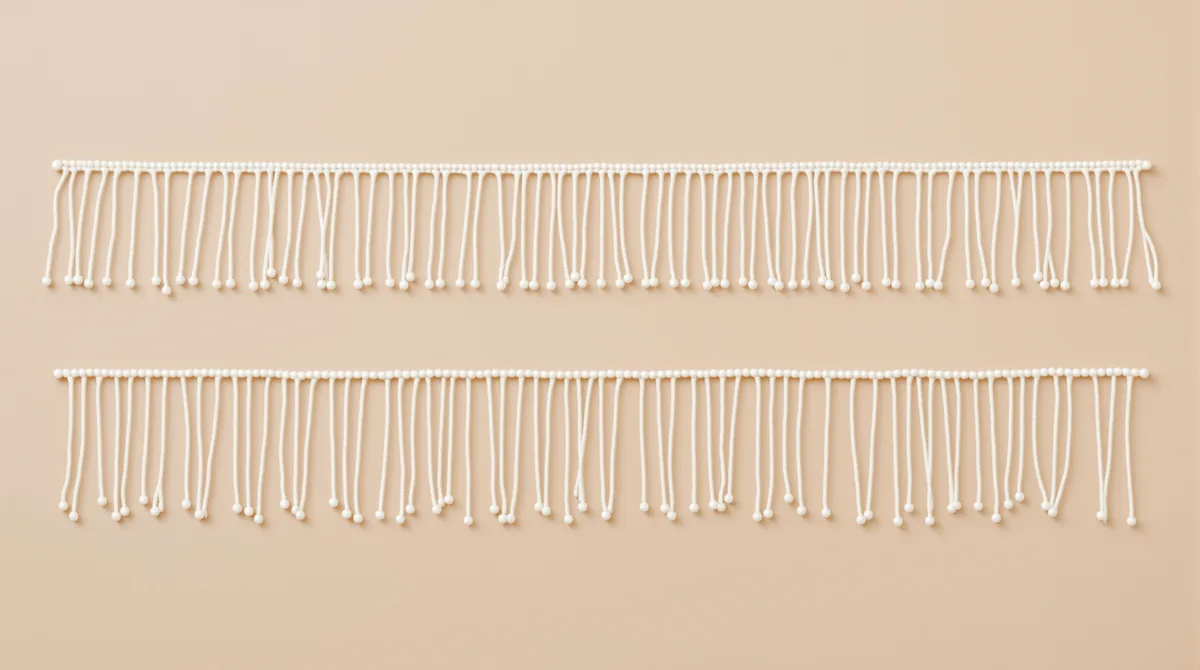
Bead strands hanging from a narrow stitched cotton header band, its top edge folded and stitched into a rod pocket.
Three things come with the goods: the panel on its own header — a dowel, a rail, end loops or a stitched rod pocket — a care card naming the materials, and packing that held the strands in order. Spare beads are the fourth item, not automatic: a packing-specification item agreed per order, so ask for them by colour. A rod is often not included and should be stated.

The panel on its header, a care card, and packing that did its job — plus spare beads, where the order asked for them. Four items, and three of them are often missing from panels bought at the cheap end of the market.
The reason to care is not completeness for its own sake. Each of the four maps onto something about how the panel was made: the header onto whether the mount was designed, the spares onto whether repairs were anticipated, the care card onto whether anybody has thought about the cord, and the packing onto whether the maker understands what damages a strung panel.
Because the strands are attached to it, and how they are attached is a construction decision taken at the brief.
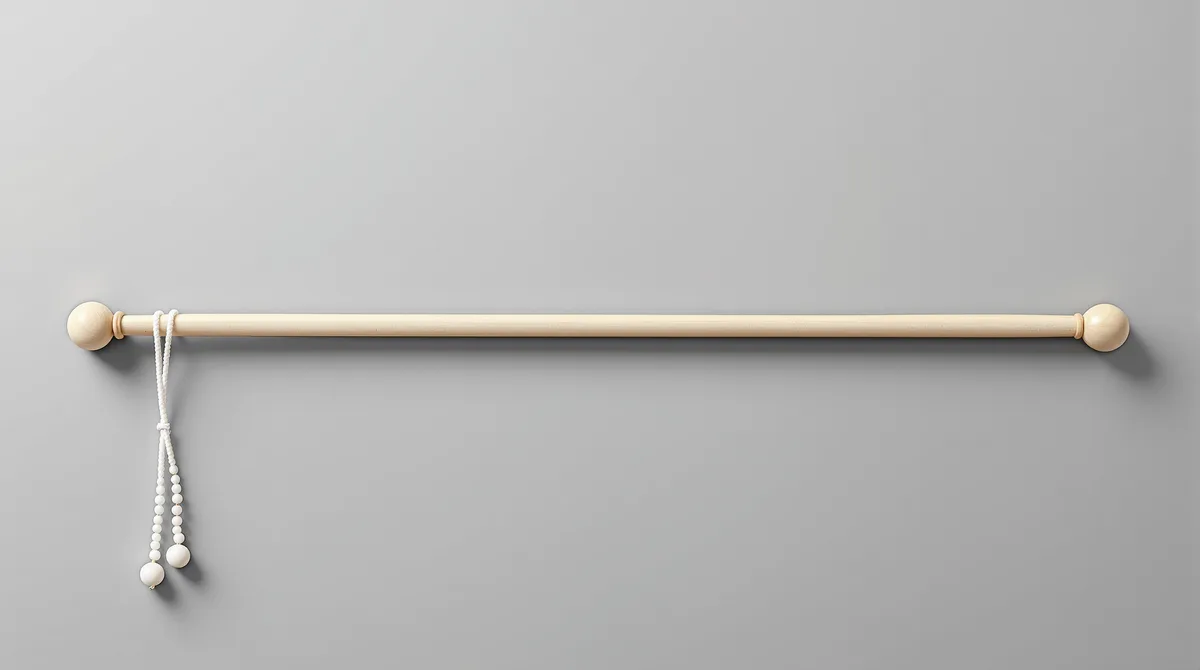
The four builds we actually make are a stained wooden header rail, a single turned wooden dowel, end suspension loops knotted at the top of each strand, and a stitched cotton header band with a rod pocket — three inches deep on the café-curtain builds. Those are not interchangeable: a rail assumes a square opening, loops forgive one, a dowel can hang from hooks or rest on a rod, and a pocket needs a rod you supply.
A panel that arrives with no header, or with strands tied to a length of generic dowelling, has had the most consequential part of its installation left to chance.
They are the repair kit for a known failure mode. A parted strand is a repair rather than a write-off: it is re-strung in its original bead order and re-knotted at the header, and that is only possible if the beads exist.
They are also the one item on this list that does not arrive by itself. Spares are a packing-specification item, agreed per order: ask for spare beads by colour on the packing specification, and a replacement strand and spare beads can be built into the production run and packed with the goods. Ordered that way they come from the same beads as the panel itself, which makes them a better match than any later purchase could be — dye lots shift between runs, so a bead of the same catalogue colour from a later batch will be close rather than identical.
Which makes the spares line a statement about expectation on both sides. A buyer who asks for them expects the panel to be repaired; one who leaves the line blank has decided, usually without noticing, that it will be replaced.
Four instructions and four prohibitions, plus the materials. Dust dry and downwards, lift by the rod, spot-clean with a barely damp cloth, store in loose bundles. Never immerse, never spray, no solvent or abrasive, no vacuum.
And one line that matters more than the rest: the cord is the part that fails, so keep it dry. A densely patterned 90 × 200 cm panel holds about 11,800 beads, carried entirely by cord, and the glass is close to indestructible in domestic use. Customers who do not know that wash, spray and vacuum, and the panel fails months later for reasons nobody connects.
Holding the strand order. That is the whole function, and it is why a new panel arrives untangled.
Panels are packed with the strands kept in order and protected against knocking in transit, to the buyer's carton, label and packaging specification, at our quality control and packaging house at Greater Noida. One wall-hanging build uses a master carton of 85 × 32 × 25 cm for ten pieces, which only works if the strand retention is genuine.
The customer-side consequence: keep the carton and any transit ties. They are the correct container for a move or for seasonal storage, and nothing you improvise will be as good.
The rod, and the fixings. Both for the same reason: they belong to the building rather than to the panel.
A rod for a stitched header has to be sized to the pocket, which is why the pocket depth should be on the listing. Hooks and brackets have to be rated for the load and suited to the substrate — plasterboard with nothing behind it is the commonest reason a panel ends up on the floor — and the panel is weighed on the approved sample, so the instruction is to over-specify the hardware against that weight rather than to supply it.
| Item | Usually included | What it is for | If it is missing |
|---|---|---|---|
| Panel on its header | Yes | The product | It is not a finished panel |
| Turned dowel or header rail | Yes, where the build uses one | The mount | Check whether the build uses loops instead |
| End suspension loops | Where specified | Levelling on an imperfect opening | The header is rigid; the opening must be square |
| Rod for a rod pocket | No | Threading a stitched header | Buy one sized to the pocket depth |
| Spare beads | Only where specified | Repairing a parted strand | No repair stock exists for that design |
| Care card | Yes | Dusting and cord guidance | Nobody has told the customer about the cord |
| Inner packing | Yes | Holding strand order in transit | Expect a tangle |
| Transit ties | Where used | Holding strand order | Keep them if present |
| Fixings or hooks | No | — | Hardware is chosen for the wall, not the panel |
Everything above, in one short block. What the header is. Whether a rod is included. Whether spare beads were specified for that order. What the care card covers. And, if the header is a rod pocket, the pocket depth.
That list is six lines and it pre-empts most of the questions a customer sends after delivery. It is also a competitive statement: a listing that can say "spare beads supplied" is making a claim about repairability that most of the category cannot make — and it can only say it where somebody put the spares on the packing specification.
Almost all of the damage a panel ever suffers. Tangles mostly happen in the first five minutes, when somebody lifts the panel by its strands or shakes it out of the box. Spares get thrown out with the packaging. The care card gets read after the first cleaning rather than before it.
The method that prevents all three: open the carton flat, lift by the header, hang the panel, then remove any ties one at a time from the top down — and put the spares somewhere labelled before the packaging goes out.
Their own packing, labels and care text. We pack to a buyer's carton, label and packaging specification and ship to the port or warehouse named, and a buyer's own care text can be included in the pack alongside their labels.
For a programme, the three contents decisions worth making deliberately are the spares policy — how many beads of which colours, per piece — the care card wording, and the inner packing that holds the strand order. All three are quoted as part of the packing rather than as extras, and all three show up in returns data rather than in a sample review.
The spares, labelled with the panel rather than the colour, kept dry and sealed. The transit ties. The carton, if there is room. The care card. And a note of the fixing you used.
That set is the difference between a panel that can be moved, stored and repaired in five years and one that can only be replaced — and nothing is held in stock, every beaded door curtain being made to order, with production running 40 to 60 days after sample approval.
Good to know
It will work and it is harder to maintain. A doorway panel is parted by hand several times a day, so it is the format most likely to need a strand re-strung eventually. Without spares, that repair depends on matching a bead years later, which with surface-dyed or specialty glass is sometimes not possible. For a doorway, the spares line is the one on the packing specification worth not skipping.
It would be useful and almost nobody does, including us — no weight is published per design, because it follows from bead material, bead size and bead count rather than from the format. The material is the practical proxy: glass is the heaviest family by a wide margin.
Yes. Width, drop and strand count are set per order and nothing is held in stock, so a non-standard panel is an ordinary order rather than a special case — spares specified on that order are cut from the same beads as the panel, which makes them a better match than catalogue spares would be.
It is the reason a new panel arrives as a panel. Strands are kept in their order and protected against knocking in transit, and panels are packed to the buyer's carton, label and packaging specification. Tangles overwhelmingly happen after the carton is opened, not inside it.
Fixings are not usually included, and there is a good reason: hardware has to be rated for the load and suited to the wall, and neither is knowable from our side. The panel brings its own header — dowel, rail, loops or rod pocket — and the hook, bracket or rod is chosen for the building.
They are loose small objects, so store them as you would any small components: a sealed labelled bag, out of reach. That is a storage instruction rather than a product claim; the age grade is assigned by the buyer for its own market.
Keep exploring
Specification
Strand order, inner packing, header protection and labels — how a panel arrives untangled and sells from the box.
Compare the optionsGuides
One guide per question that arrives often enough to be worth answering properly.
How it is madeGuide
Where it hangs, which material, how dense, how long, which hem, how it fixes — and why colour is the last decision, not the first.
How it is madeGuide
Knot finish, strand length consistency, bead alignment, drill quality, header fixing, dye evenness, spares and packing.
View the rangeGuide
Width at three heights, the floor gap, the header depth — and the two decisions that come before any of them.
Open the referenceGuide
Open the carton flat, find the header first, lift by the rod, hang it, then release transit ties one at a time from the top down.
View the range
Start a conversation
Send a reference, a colour chip or a sketch. Minimums are set per design and confirmed per quote; sampling is quoted separately and usually runs 16 to 20 days from an agreed brief.